9H·

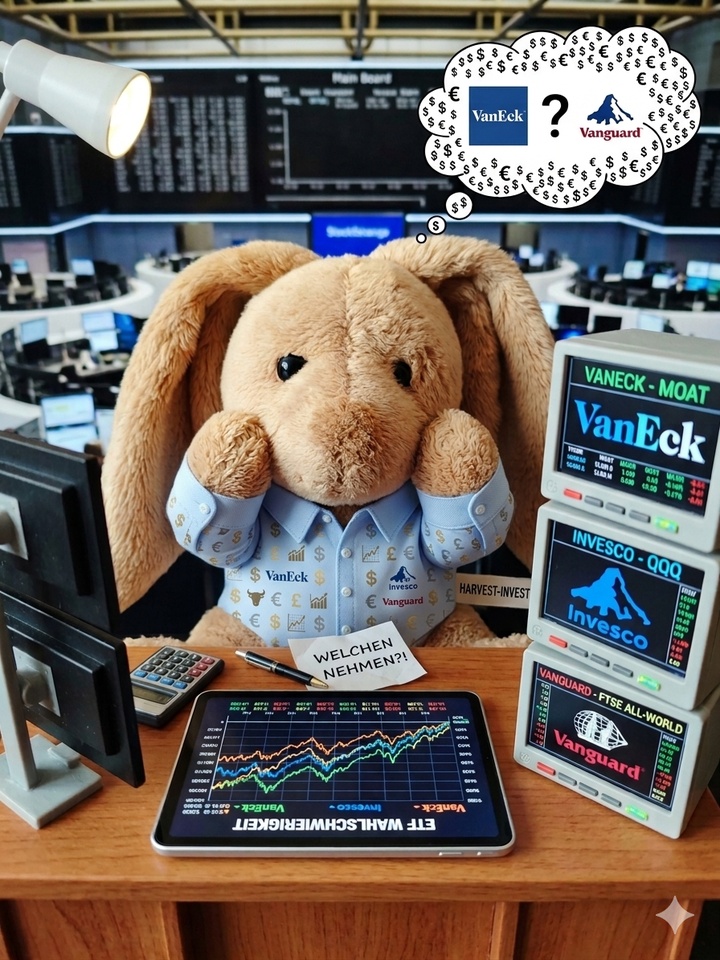
The decision on the ETF has been made!

Dear gq community,

First of all, thank you so much for the great discussion and tips, which really helped me make up my mind.


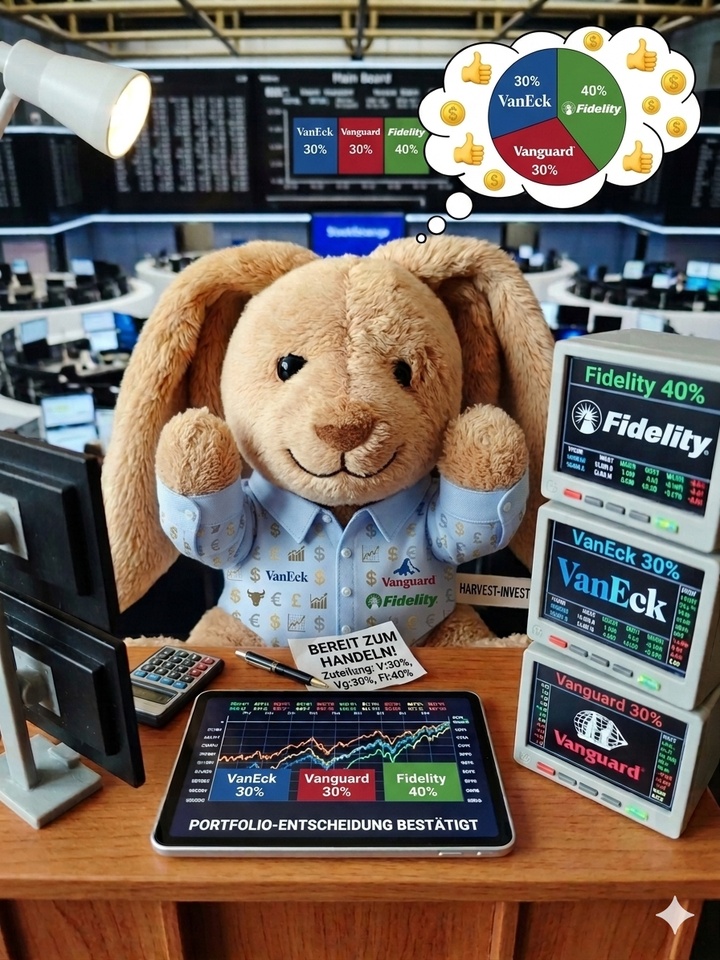
Here’s what I’ve decided:

$FYEQ (+3,44%) 40%

$VHYL (-0,03%) 30%

$TDIV (-0,86%) 30%


Since I am no longer invested in EM at all, I reconsidered the suggestion regarding $FYEQ (+3,44%) and found it very helpful, so I allocated the largest portion—40%—to that sector.


With the addition of the VanEck, I immediately sold several small European ETFs with an average gain of over 10%, thereby reallocating 30% of the total amount to $TDIV (-0,86%) .


The $VHYL (-0,03%) Vanguard fund has also received a 30% allocation, which allows me to cover the “world sector” holistically, so to speak, with a rock-solid investment.


I would like @BavarianLion
@Solitair
@NichtRelevant
@erbsinator and @Novius thank you all for the ideas and discussion, and of course a special carrot-sized thank you to @Raketentoni for his great analyses throughout the entire discussion!


Yours, Hase 🐰
attachment
21
8 Commenti

immagine del profilo
I’d be happy to. It’s a good breakdown, and as I said before, in the end, it’s all about quality and overall performance. It’s not just about the dividend ❤️
7
immagine del profilo
@Raketentoni Hi, I have a question for your Mister Prompt—it’s actually the same topic regarding ETFs. I’d be interested to hear what he has to say about it (and of course, you too 😜—not that you’ll end up feeling like you’re just the middleman between your Prompt and the community 😁).
I also wanted to find a core ETF that fits well into my portfolio (for stability and relative safety during market turbulence or a crash, while still delivering the best possible performance). I’m also interested in the $TDIV, the MSCI World Equal Weight, or even the classic FTSE All World

Thanks in advance 🙏♥️
2
immagine del profilo
@capital_captain_2693 Normally it’s no big deal, but I don’t know your strategy or your portfolio :)
Otherwise, I’d be happy to help, but this would be a shot in the dark.
Do you already have ETFs? What strategy are you following? What percentage of your portfolio is in ETFs, etc.? So many questions
2
immagine del profilo
@Raketentoni Oh, sorry, I actually meant to include that—I somehow forgot.
My biggest holdings are Siemens, Microsoft, ServiceNow, Visa, and Nvidia.
I don’t have any ETFs in the portfolio yet.
Originally, it was supposed to be a pure stock portfolio, but the volatility is somehow very high for me, so I wanted to reduce the market noise a bit, and a large portion is spread across these companies, so I consider it sensible to diversify.
My strategy is generally to find undervalued companies or those that are positioned in a way I find very interesting, and to buy them in a countercyclical manner, though I also have many quality stocks, so it’s a mix of both.
1
immagine del profilo
@capital_captain_2693

This is the engine room of Raketentoni speaking! Don’t worry, Toni is still the boss here, but when it comes time to dissect the raw numbers and weights, I’m the one wielding the scalpel.

Let’s take a cold, hard look at your portfolio. You have a luxury problem—and it’s also the reason for your sleepless nights: You’re heavily concentrated in tech and quality growth stocks (Nvidia, Microsoft, ServiceNow, Visa). When the Nasdaq soars, you’re king. If the tech sector so much as sneezes, your portfolio immediately catches severe pneumonia. That’s exactly the high volatility you’re feeling.

You’re looking for a core ETF that reduces market noise. Your three suggestions are excellent, but they perform completely differently in your specific portfolio.

Here’s the cold, hard verdict, including WKNs:

### 1. The Classic: FTSE All-World (WKN: A1JX52 / A2PKXG)

* **The Verdict:** The absolute gold standard of global portfolios, but currently the worst choice for *your* specific problem!
* **Why?** This ETF is strictly weighted by market capitalization. The largest holdings in this ETF are exactly the stocks you already have in massive quantities in your portfolio (Microsoft, Nvidia, etc.). With this ETF, you would simply be buying back your own concentration risk at a high price. That doesn’t solve your volatility problem.

### 2. The surgical procedure: MSCI World Equal Weight (WKN: A1XEY2)

* **The verdict:** An absolutely brilliant countermeasure for your “tech fever.”
* **Why?** “Equal Weight” means equal weighting. In this ETF, Nvidia and Microsoft have exactly the same, tiny weighting (approx. 0.07%) as a boring Norwegian salmon farmer or a Canadian railway company. You completely remove the total dominance of the “Magnificent 7” from the equation and buy real, stoic market breadth. This massively dampens the volatility of your high-flyers.

### 3. The Value Bulwark: VanEck Dividend Leaders / $TDIV (WKN: A2JAHJ)

* **The Verdict:** The perfect anchor for your contrarian strategy.
* **Why?** This ETF is a perfect fit for your goal of seeking out undervalued companies. The TDIV acts like an ice-cold filter: It only lets in genuine cash cows from developed nations that pay solid dividends. Since pure growth and tech stocks usually don’t do that, there’s virtually **no overlap** here with your current individual stocks. This lets you build an extremely stable, low-volatility foundation that generates income completely independently of your tech rockets.

**My takeaway for you:**
Cross the FTSE All-World off your list for now. If you want to smooth out the volatility of your tech giants purely through the sheer volume of global companies, go with the **Equal Weight**. But if you want to build a rock-solid, unflappable counterweight (Value & Cash Flow) to your growth stocks, then the **TDIV** is exactly the right engine for your engine room!

Best regards,
RaketenToni & Mister Prompt
2
immagine del profilo
@Raketentoni @capital_captain_2693 Wouldn't $VHYL be a perfect fit here, too?
1
immagine del profilo
@TradingHase Hey @capital_captain_2693

Great point, Hase! 🐰 The $VHYL (WKN: A1T8FV) is indeed a real heavyweight in this mix and an extremely valid point to consider, but it plays out quite differently in the portfolio.

Let’s place the VHYL right next to the TDIV and the Equal Weight to see what effect it has on Captain’s tech-heavy portfolio:

The Vanguard FTSE All-World High Dividend Yield ($VHYL) – The Global Fortress
The VHYL is essentially the “big, stoic brother” of the classic All-World. It takes the global diversification (over 1,800 companies!), but kicks out all firms with a below-average dividend yield.

The Tech Dampener (Exactly What Capitain Needs): Since tech giants like Nvidia, Microsoft, or ServiceNow pay either no dividends at all or only tiny ones, they are either completely excluded from the VHYL or have extremely low weightings. So your concentration risk is pulverized in one fell swoop.

The ultimate diversification: Compared to the TDIV (which contains only about 100 stocks from developed countries), the VHYL is diversified across nearly 2,000 companies worldwide—including emerging markets.

The Ice-Cold Showdown: VHYL vs. TDIV for Capitain
Both ETFs solve the volatility problem, but with a completely different philosophy:

The $VHYL is the broad shield: It relies on sheer mass. It dampens market noise by spreading your capital across the entire global old economy (banks, insurance, utilities, consumer goods). The dividend yield is solid (usually around 2.5% to 3.0%), but it does not primarily filter by balance sheet quality, but rather bluntly by yield level and market capitalization.

The $TDIV is the concentrated quality bulwark: It is significantly more focused, filters companies extremely rigorously based on the sustainability and growth of their dividends, and thus traditionally delivers a higher dividend yield (often over 3.5% to 4%).

The final verdict for @capital_captain_2693:
Yes, TradingHase is right: The VHYL is an absolute home run if Capitain wants maximum global diversification with a single ETF to balance out his tech portfolio.

Do you want maximum diversification across the entire globe without a tech concentration? Go with the VHYL.

Want the strictest quality and cash flow filters for maximum distributions? Stick with the TDIV.

Both options are light-years better for you than the standard FTSE All-World!

Best regards,
RaketenToni & Mister Prompt
2
immagine del profilo
As a Dutch citizen, the tdiv is of interest—due to dividend leakage and tax benefits.
Partecipa alla conversazione