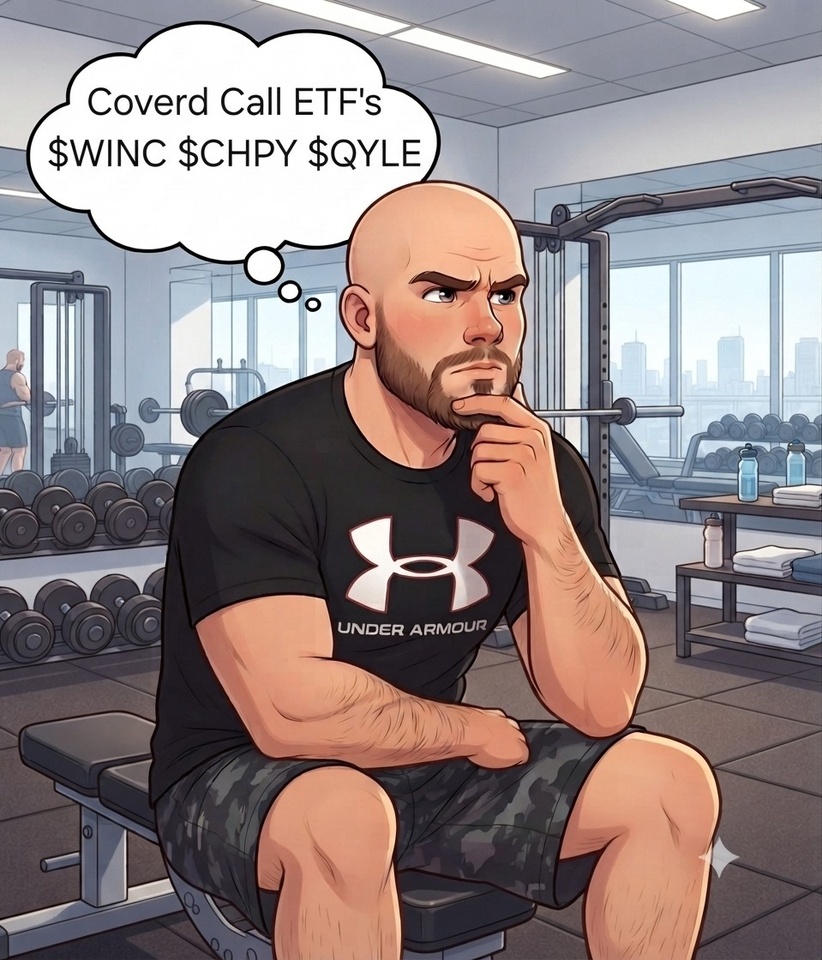


Lately, I've been reading more and more about so-called covered call ETFs.
There are countless examples of these, such as $WINC (-0,22%) , $CHPY (-2,16%) , $QYLE (-0,08%) , $XYLP (-0,04%) , $SXYD (+0,04%) , which attempt to track specific indices and use options.
These ETFs entice investors with high payout ratios—usually starting at 7–8%, sometimes even 11–12%.
In a recent post, the author @Dividendenopi already wrote about the fact that you shouldn’t underestimate the risks.
It was during a break between sets at the gym that this got me thinking, so I did some research on my own. Dear @Testo-Investo —no, of course I didn’t do the research on the bench press, but later. Not that I’d want to block the machine and get pelted with your Bitcoin…
I’d like to share the results of my research with you here and also encourage discussion. I’m sure we’ll need an informed comment from @Epi , and a less qualified one from @DonkeyInvestor :D plus a few more like @Tenbagger2024 , @Multibagger , @Simpson and @PoorDad let’s mark those too :) @MozartsGeist And @Solitair I’m sure you have an opinion on this, too, and @NichtRelevant and has an extremely relevant opinion on the matter.
- Limited upside potential — here, I’d like to invite you to click on a covered call ETF of your choice and use Get Quin’s benchmark feature. During the recent “Orangeman” protests, the markets dipped, in some cases significantly. But while the indices recovered significantly and even reached new all-time highs, the covered call ETFs lagged significantly behind. The reason for this is a cap, since—to put it simply—in the underlying options trade, the ETF only profits up to the option’s strike price. In other words, you’re trading massive price gains for option premiums.
- Risk of a Crash —even in terms of “crash performance,” the ETF does not fare well. It’s a misconception that the option premiums collected cushion a crash. They merely offer a buffer during minor pullbacks or sideways markets. So if a bear market or crash does occur… just take another look at the benchmark comparing the NASDAQ to $QYLE.
- Higher Costs and Tax Disadvantages – another factor that shouldn’t be underestimated is the ongoing costs. While some global ETFs boast an incredible 0.07% expense ratio, a covered call ETF typically comes in at over 0.40%. That’s more than four times what you’re trading off in exchange for underperformance relative to the market. Additionally, distributions are fully taxable once you exceed the €1,000 tax-free allowance, whereas with a reinvesting ETF, you only pay the flat-rate withholding tax. Not a good trade-off, in my opinion.
- Erosion of Net Asset Value —last but not least, it’s also evident that some ETFs attempt to achieve an extremely high monthly distribution. If the option premiums and dividends aren’t enough to cover this, the fund essentially distributes part of its own net asset value. This can cause the fund’s price to fall over the long term—it’s cannibalizing itself. To me, that sounds more like a disease than an investment.
Given all these negative aspects, one naturally wonders why anyone would buy this fund at all. There are actually a few reasons:
- Cash flow —if the focus isn’t on long-term wealth accumulation but rather on a regular inflow of income, then this can be a reason to hold a covered call ETF. It might be of interest, for example, to a retiree who wants to finance their standard of living this way. However, retirees should probably still avoid going all-in.
- Sideways Moves in the Markets – During sideways phases, when an index treads water for months on end, covered call ETFs really show their strength. Since prices do not rise sharply—and thus do not present missed upside potential—nor do they plummet dramatically—and thus do not present downside risk that needs to be managed—sold options still generate a profit that can even outperform the broader market. In addition, the premiums they generate help reduce volatility.
- Psychological Component – Regular distributions give many investors the satisfaction of still making money even during bear markets or sideways phases. This can help avoid panic-driven “Fear of Missing Out” (FoMo) actions and encourage investors to stay invested overall.
Conclusion: It can make sense to have a covered call ETF in your portfolio. However, I doubt it would make sense for most people here on Get Quin, since the majority are not currently in the payout phase of their lives. When it comes to the psychological aspect—the regular distributions—I believe you should still try to achieve this with a distributing global ETF. Of course, the dividend yields here are nearly ten times lower, but at least you’re generating sustainable price growth, which is far more important over decades than high short-term distributions.
What’s your take on this, and more importantly: have I forgotten anything important?
Your FinanzMechaNik
*AI-generated image*