

Hello, GQ Community,
I'm popping in again after a long hiatus! ✌️ After quite some time, I'm back today with another company spotlight.
While it feels like half the community is $SOFI (-0,84%) or $NU (+3,11%) the quintessential FinTech company, today I’d like to draw your attention to another absolute heavyweight in the industry. This time, though, we’re traveling to the Land of the Rising Sun! Today, we’re heading to Japan! 🇯🇵
Because what many people don’t even realize is this: While the U.S. and Latin America are celebrating the FinTech hype, a massive capital market revolution is currently underway in Japan—and right at the center of it all is a digital champion that dominates the entire ecosystem.
🏛️ SBI Holdings, Inc. $8473 (-0,7%) : The Japanese financial and FinTech empire of the NISA revolution
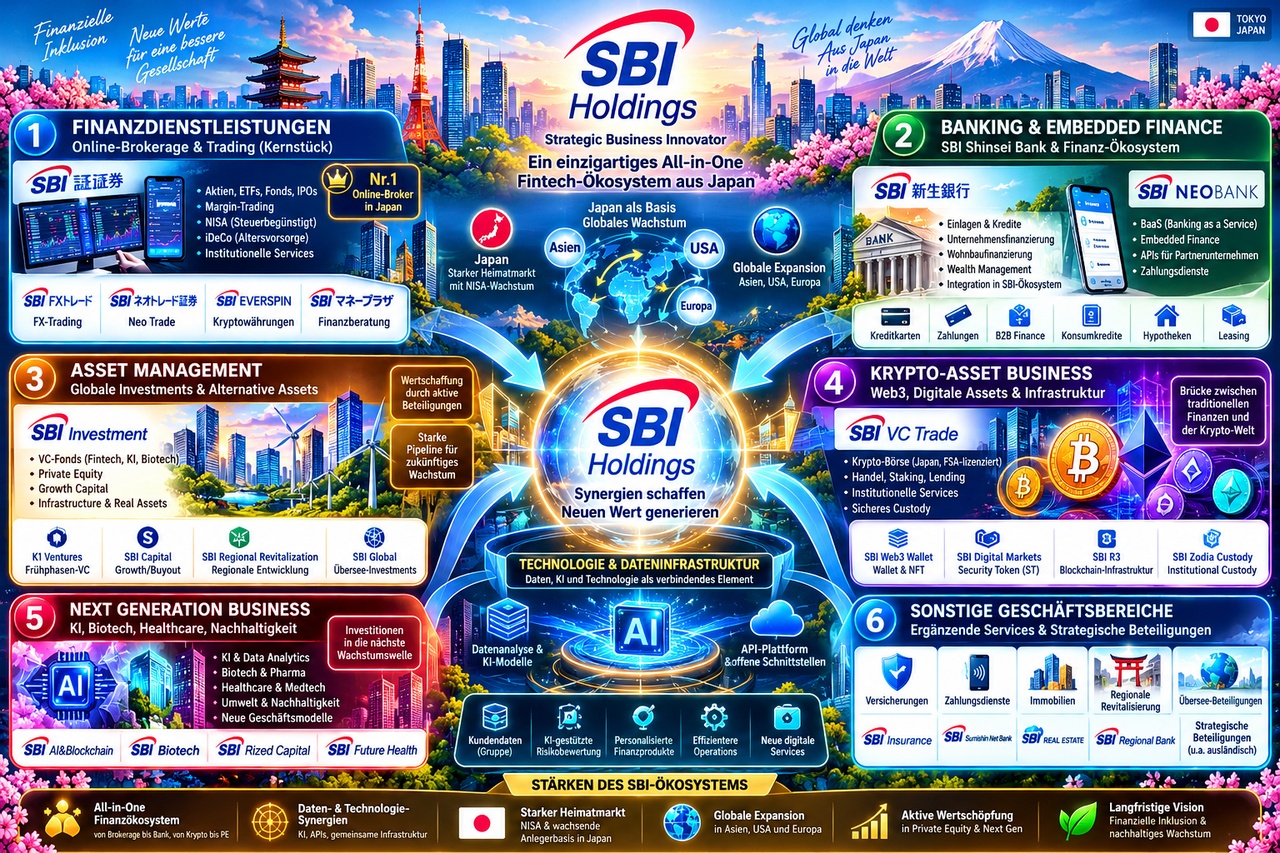
While traditional Japanese megabanks (such as MUFG $8306 (-2,75%) or Sumitomo Mitsui $8053 (-0,53%) ) are weighed down by heavy operational baggage from the branch-based era, founder Yoshitaka Kitao has created Japan’s leading digital financial mega-conglomerate with SBI Holdings $8473 (-0,7%) , Inc., has created Japan’s leading digital financial mega-conglomerate. SBI occupies the most attractive future-oriented sectors of the Japanese capital market: online brokerage (No. 1 in Japan), commercial and digital banks (including SBI Shinsei Bank and SumiShin Net Bank), asset management, venture capital/private equity, as well as crypto-assets and blockchain infrastructure.
With the launch of the new, government-subsidized, tax-free NISA investment system (Nippon Individual Savings Account), Japan is experiencing a historic shift from savings accounts to stocks and ETFs. SBI is the primary beneficiary and infrastructure leader of this movement. On the Tokyo Stock Exchange (TSE), the stock is trading at around 2,925 JPY in October 2026.
1. The Business Model: Japan’s All-in-One FinTech Flywheel ⚙️🇯🇵💳
SBI $8473 (-0,7%) operates a diversified, highly scalable ecosystem with strong synergies between banking, trading, and investment:
① Online Brokerage & Trading Market Leadership: SBI Securities is by far Japan’s largest online broker. To completely dominate the competition, SBI pioneered the zero-commission model for domestic stocks (“Zero Option”). SBI offsets this through margin trading, foreign exchange transactions, mutual fund management, and integration with its own banking division.
② Banking Powerhouse (SBI Shinsei Bank & SumiShin): Through the full acquisition of Shinsei Bank and strategic partnerships (including the sale of SumiShin shares to NTT DOCOMO to tap into millions of mobile phone customers), SBI combines $8473 (-0,7%) extremely low-cost retail customer deposits with high-margin corporate and consumer lending business.
③ Asset Management, Private Equity & Crypto: SBI $8473 (-0,7%) manages massive VC funds in the global fintech, AI, and tech sectors. In addition, the group operates its own crypto exchanges (SBI VC Trade) and maintains a closely intertwined, long-standing partnership with Ripple (XRP) for cross-border payment networks.
2. The Technology: AI Transformation, Zero-Fee APIs & Web3 Pioneer 🧪📊
SBI’s unique technological selling point is based on maximum customer traffic and technological scalability:
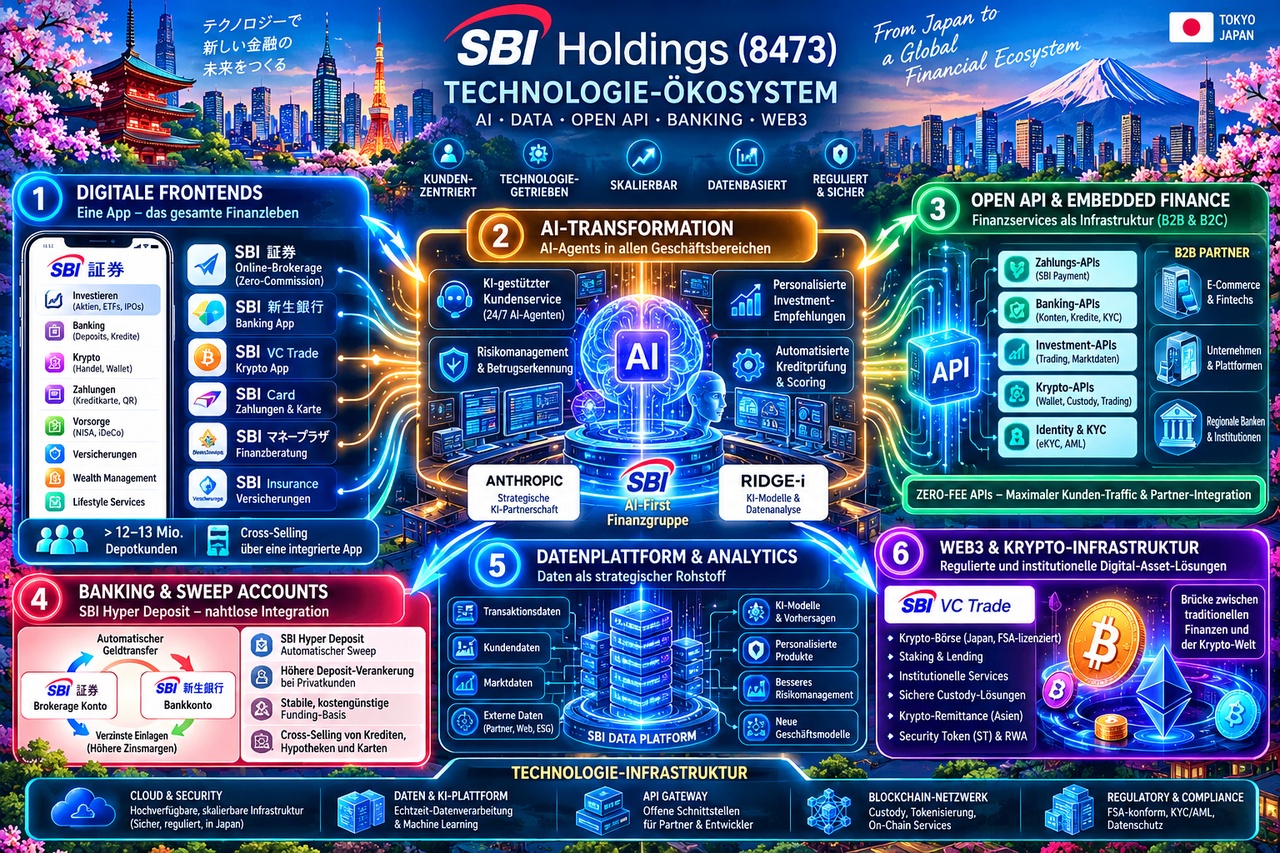
AI-First Financial Group: SBI is the first Japanese financial conglomerate to undertake a comprehensive AI transformation in partnership with Anthropic and Ridge-i to roll out automated financial AI agents in customer service and risk management.
Embedded Banking & Sweep Accounts: Through innovations such as SBI Hyper Deposit, SBI seamlessly links brokerage accounts to the bank’s balance sheet. Funds flow back and forth fully automatically and earn interest, which significantly strengthens deposit retention among retail customers.
Web3 & Crypto Infrastructure: While European TradFi banks are shying away from digital assets, SBI is expanding regulated custody, trading, and remittance solutions for institutional and retail customers in the Asian region.
3. Key Figures 📊
Stock Exchange Listing: Listed on the Tokyo Stock Exchange (Prime Market) under the ticker $8473 (-0,7%)
Current price: ~2,925 JPY.
Market capitalization: ~1.93 trillion JPY (~12.5 billion USD / EUR).
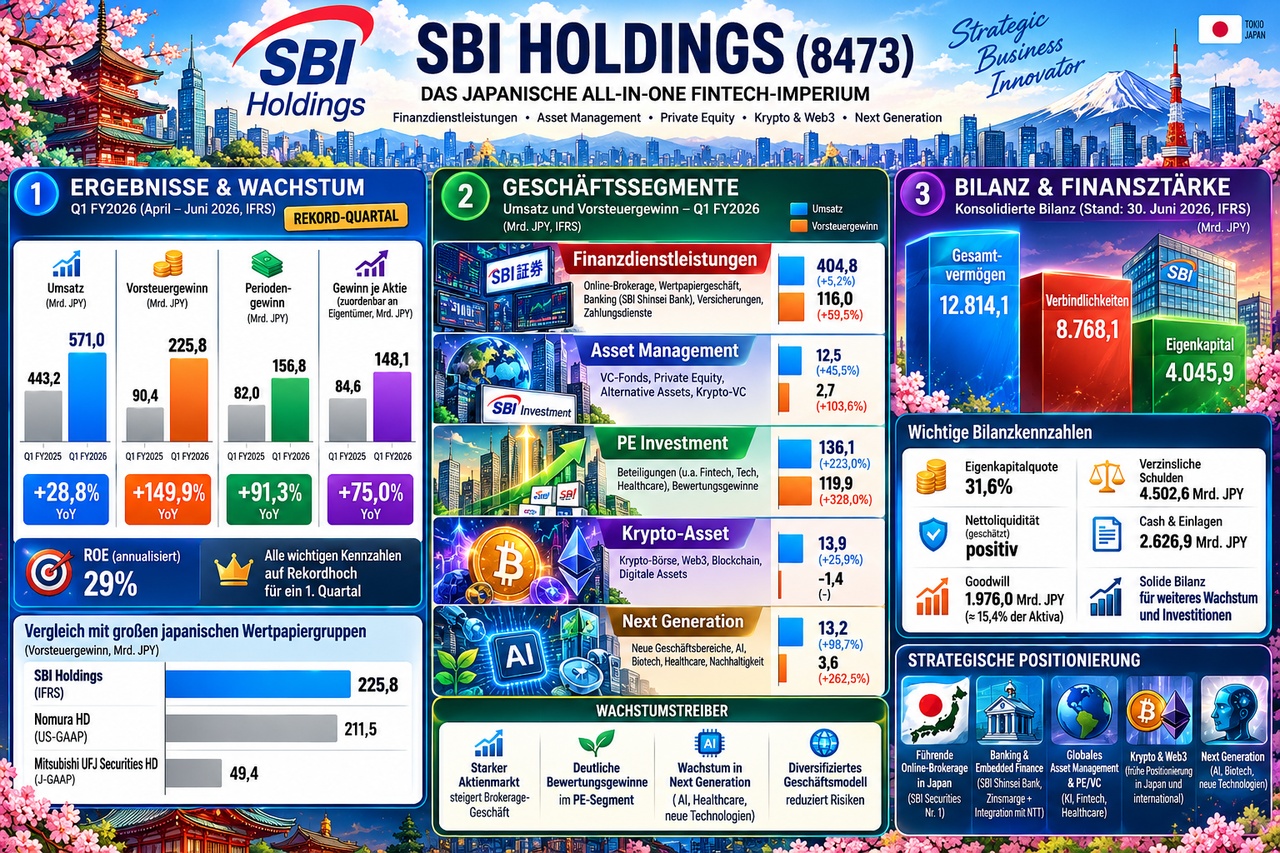
Earnings Surge (Q1 FY26): SBI posted record results in the first quarter of FY2026: Pre-tax profit rose by +149.9% year-over-year to 225.8 billion JPY. Net income climbed by +75.0% YoY to 148.1 billion JPY.
Profitability (ROE): The annualized ROE in this record quarter was >24–29% (the bank’s medium-term target is >15%).
Dividend: Solid dividend policy. Expected dividend yield of ~3.2% to 3.5% (target for FY2026 is ≥ 95–170 JPY per share; interim dividend raised).
Appears extremely undervalued: Trailing P/E ratio ranging from an extremely low ~3.95x to 4.2x. The price-to-book (P/B) ratio is at a favorable ~0.85x to 0.9x (substantial conglomerate discount).
4. Why is this stock particularly exciting right now? 🚀
1. The NISA megatrend in Japan
Through the reformed NISA program, the Japanese government is effectively forcing savers to move their money—which is sitting idle in checking accounts—into the stock market. SBI is securing the lion’s share of these new accounts and AUM.
2. Profit surges driven by one-time gains & consolidation
Sales of SumiShin shares to NTT DOCOMO (approx. 142.4 billion JPY in extraordinary gains over the course of the year), as well as deconsolidation and restructuring gains in the banking sector, are bolstering the balance sheets and generating capital for share buybacks.
3. Bank of Japan (BoJ) Interest Rate Shift
After decades of negative interest rates, SBI Shinsei Bank’s massive deposit business is benefiting significantly from rising net interest margins on corporate loans and mortgages.
5. Competition & Moat ♟️
The Environment:
Traditional brokers (Nomura Holdings $8604 (+0,22%) , Daiwa): They have high branch costs and are lagging behind in modern, commission-free online trading. SBI $8473 (-0,7%) has already surpassed Nomura $8604 (+0,22%) in quarterly pre-tax profit.
Online rivals (Rakuten Securities, Monex): Rakuten $5838 (-1,48%) is a strong competitor but suffers from the financial problems of its parent company, Rakuten $4755 (+0,07%) (mobile communications division).
SBI’s competitive moats at a glance:
Network & Economies of Scale (Scale Moat): Over 12–13 million brokerage account holders generate economies of scale that allow SBI to set commissions to zero and erode competitors’ margins.
Financial Ecosystem (Cross-Selling): The integration of brokerage, bank accounts, credit cards, and a crypto exchange under one roof ensures extremely low customer acquisition costs (CAC).
6. Additional Insider Facts💡
Japanese Governance Reform: The Tokyo Stock Exchange is putting pressure on companies trading below their book value (P/B < 1.0x). SBI is responding with more aggressive payouts, dividend increases, and strategies to reduce the holding discount.
The Mynavi & Kyobo Asset: Through strategic investments (such as in the Korean insurer Kyobo Life or Mynavi), SBI is systematically building recurring equity-method income in the triple-digit millions.
7. Risks ⚠️
Equity Gain Volatility (Fair Value Accounting): As a holding company, SBI accounts for its massive private equity and VC portfolio at fair value under IFRS. A weak tech or IPO market immediately has a negative impact on net income for the period. ❗️
Cyclical Dependence on Trading Volumes: In bear markets, trading fees and margin loans plummet. ❗️
Crypto & Regulatory Exposure: Activities in the crypto sector (Ripple/XRP) carry a higher regulatory risk and risk of negative media coverage compared to traditional banks. ❗️
8. Conclusion
SBI Holdings is a highly dynamic FinTech and banking empire that appears to be valued at a bargain and is leading the digital transformation of Japan’s financial sector. Despite highly volatile VC results, the company offers substantial rebound and re-rating potential driven by the NISA boom and rising interest rates in Japan.
Should the global tech sector collapse and SBI’s VC investments lose massive value, while at the same time the Japanese stock market stagnates following the NISA hype, the P/E ratio of ~4x could remain a value trap. The market often punishes complex holding structures with crypto exposure for a long time during crises.
@Get_Rich_or_Die_Tryin
@Tenbagger-Capital
@Dividendenopi
@Raketentoni
@schlimmschlimm
@PikaPika0105
@Multibagger
@Stocktective And, of course, everyone else ✌️