Dear Community,
In my recent posts, we’ve tried to uncover the layers of modern energy infrastructure:
- The Nuclear Renaissance: We’ve seen how the decommissioning of old reactors and the disposal of radioactive waste have become a lucrative business for specialists, while at the same time new reactors are making a comeback as CO2-free power plants.
- Industrial Heat: Next, we delved deeper into the factory floors. Heat is the “currency” of industry. Those who efficiently utilize waste heat or decarbonize process heat secure their competitiveness for the future.
- Power Highways: We also analyzed the hardware behind the AI boom. Without high-performance grids and high-voltage cables, even the cleanest electricity remains stuck where it’s produced—far away from the power-hungry data centers.
But what if the solution to all these problems were right under our feet? What if we could combine the drilling expertise of waste management specialists, process heat for industry, and a constant energy supply for AI networks all in one place?
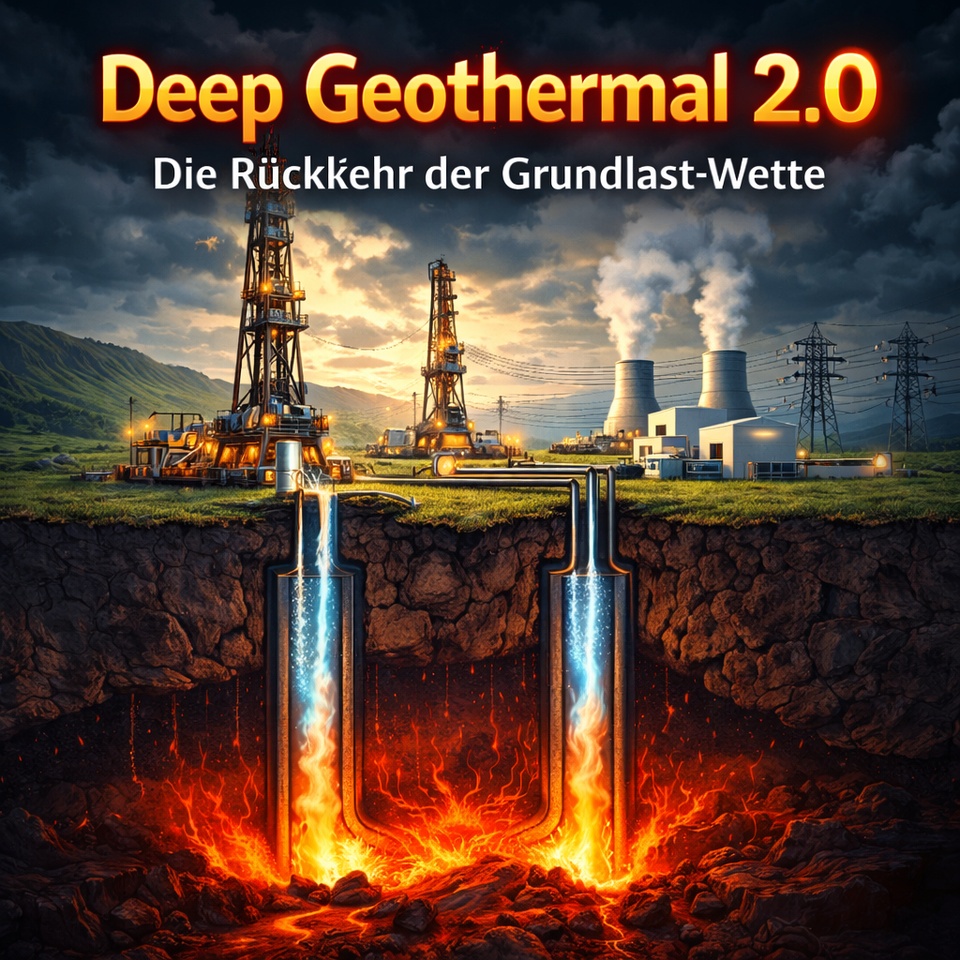
Welcome to the next chapter: Deep Geothermal 2.0. While we’ve only scratched the surface so far, by 2026 this technology will allow us to harness the earth’s crust’s enormous heat on a much broader scale. It’s the perfect symbiosis of the oil industry’s precision and the promise of an eternal, baseload-capable energy source.
1. The “Pure Play” Operators & Developers
Ormat Technologies ($ORA (-2,74%))
- Profile: The only vertically integrated geothermal company listed on the U.S. stock exchange. Ormat designs, builds, and operates power plants worldwide.
- Core Business: A vertically integrated provider of clean energy—the company designs, manufactures, builds, sells, owns, and operates primarily geothermal and recovered-energy power plants based on its proprietary Ormat Energy Converter.
- Revenue Model: Revenue comes from plant construction and sales, the sale of OEM equipment, long-term power purchase agreements (PPAs), operation and maintenance, and the ownership of generation facilities; in addition, Ormat is expanding its business model to include energy storage and solar-hybrid solutions.
- Strategy: Ormat operates a global portfolio and focuses on organic growth, targeted acquisitions, and technical optimization to expand scalable, reliable baseload and storage solutions in the growing renewable energy market.
- Growth Factor: Ormat is benefiting significantly from the rising demand for “clean firm power” from tech giants and has the most stable cash flows in the sector.
- Opportunities: Recurring revenue, technological advantages, and diversification. Recent project closures and acquisitions, as well as streamlined permitting processes, can accelerate growth and strengthen the company’s market position.
- Risks: Geothermal and storage projects are capital- and development-intensive and are subject to drilling, resource, and permitting risks. Expiring or unfavorable PPAs, competitive and technological uncertainties, and dependence on project financing and supply chains could weigh on earnings.
Constellation Energy ($CEG (-2,81%))
- Profile: Primarily a nuclear giant, but following the $26.6 billion acquisition of Calpine (completed in January 2026), it now has additional exposure to geothermal energy capable of providing baseload power in the U.S.
- Core Business (Generation & Marketing): Constellation operates a diversified generation portfolio focused on a large, reliable nuclear fleet, supplemented by renewable and thermal plants. The company produces and sells predictable, low-emission energy to wholesale markets and utilities.
- Customer Solutions: Through its retail and service units, Constellation provides electricity and natural gas contracts, as well as energy management, demand response, and sustainability solutions for commercial, public sector, and residential customers.
- Growth & Strategy: Growth is driven by the expansion of clean capacity (a combination of nuclear and geothermal power for data centers), technological innovations (decarbonization applications), and strategic acquisitions to strengthen market presence in key regions.
- Growth Factor: They offer data centers a comprehensive, CO2-free package (“24/7 Clean Power”).
- Opportunities: Benefits from a large, low-carbon portfolio and steady revenues from nuclear power operations; the expansion into additional gas and geothermal assets enhances diversification and supports growth driven by rising electricity demand (AI).
- Risks: Regulatory reviews and approval risks associated with major acquisitions, operational risks and power plant downtime, as well as market and fuel price volatility; furthermore, integration costs and debt can create pressure.
2. The “Shovel Sellers” (Drilling & Sensor Technology)
Baker Hughes ($BKR (-0,56%))
- Profile: One of the world’s largest oilfield service providers. Baker Hughes supplies technologies, equipment, and field services for the exploration, drilling, production, and processing of crude oil and natural gas, as well as gas turbines and compressors—supplemented by a global service network.
- Business Model: Sales and rental of equipment, long-term service and maintenance contracts, spare parts, and after-sales services are combined with project-based engineering and installation services.
- Differentiation: Market leader in high-temperature drill bits and the AutoTrak system (rotary steerable, https://www.youtube.com/watch?v=bVTROMVLjOU). digital monitoring, performance contracts, and integrated solutions combine hardware with software to reduce operational efficiency and lifecycle costs.
- Growth Factor: Since EGS drilling is technically more challenging than oil drilling, Baker Hughes can command higher margins in this area.
- Future Focus: Expansion of solutions for decarbonization, hydrogen, CO₂ management, and renewable energy integration complements the traditional portfolio.
- Opportunities: Benefits from a broadly diversified product base, strong aftermarket revenues, technological innovation, and a global presence.
- Risks: High dependence on economic conditions and raw materials; regulatory pressure, intense competition, and geopolitical exposure.
Helmerich & Payne ($HP (+2,31%))
- PProfile: A leading global provider of drilling rigs (approx. 25–30% market share in the U.S.). Expanded massively on a global scale through the acquisition of KCA Deutag (2025).
- Technology: H&P uses its AutoSlide software (https://www.youtube.com/watch?v=WyBDMAYijdM&t=83s),to automate directional drilling on its state-of-the-art FlexRigs. This ensures precise, smooth boreholes—critical for installing kilometers of geothermal pipes.
- Growth Factor: Strategic investments in geothermal startups (such as Google partner Fervo Energy). The “FlexRigs” are specially adapted for the precise horizontal drilling that is crucial for EGS systems.
- Strategy: Transition from a pure equipment rental company to a software and automation group for green baseload power; the goal is to become an indispensable hardware supplier for the geothermal revolution.
- Opportunities: Market leadership in state-of-the-art AC rigs; high margin potential through the transition to the Software-as-a-Service model (AutoSlide); strong global presence following the acquisition of KCA Deutag.
- Risks: Dependence on U.S. shale oil activity (Permian Basin); high capital requirements for maintaining the massive fleet; competition from integrated service giants such as Halliburton.
Weatherford International ($WFRD (+1,43%))
- Profile: A specialist in well construction and management. Weatherford offers niche technological solutions in extreme environments.
- Technology: They have developed solutions that withstand temperatures of over 400 °C+ (Supercritical Geothermal). Their packers and seals use metal-to-metal connections that remain stable under extreme heat.
- Growth Factor: A trusted partner for “extreme” deep-well projects set to become commercial in 2026/27. Also benefits from “well intervention” (maintenance) to resolve scaling issues in geothermal wells during ongoing operations.
- Digitalization: With the ForeSite® platform, they optimize flow and heat extraction with minimal pumping effort.
- Opportunities: Unique technological position in the “supercritical geothermal” sector (400 °C+); strong pricing power for specialized sealing systems; recurring revenue from maintenance and scale management.
- Risks: Historically volatile financial performance (despite a successful turnaround); heavy reliance on extreme-depth projects that could fail due to technological challenges; geopolitical risks in emerging markets.
3. Infrastructure & Specialty Materials
Vallourec ($VK (-0,81%))
- Profile: French specialist in seamless steel pipes and premium connection solutions (OCTG), focusing on the high-end segment.
- Technology: Geothermal drilling requires significantly higher-quality pipes than traditional gas drilling to prevent corrosion caused by aggressive deep-well water. Vallourec supplies Thermosoc™ (vacuum-insulated pipes) to prevent heat loss during ascent.
- Differentiation: The patented VAM® threaded connections remain gas-tight even when the metal expands or contracts extremely due to massive temperature fluctuations.
- SStrategy: Transformation into an enabler for deep geothermal energy; benefits from ESG requirements through low-carbon production (electric arc furnaces).
- Opportunities: Global market leader in premium connections (VAM®); high barriers to entry due to specialized materials technology; rising demand for vacuum-insulated pipes (Thermosoc™).
- Risks: Fluctuating steel prices and energy costs in production; competition from cheaper but lower-quality Asian suppliers; currency risks (euro/dollar).
Expro Group Holdings ($XPRO)
- Profile: Provider of well services and energy solutions for the entire life cycle of a well.
- Core Business: Focus on well flow management. They measure pressure, temperature, and brine composition in real time and monitor the integrity of the equipment.
- Innovation: Wireless data transmission via sound waves through the steel casing, since conventional cables would melt in the heat.
- Growth Factor: A profitable growth proxy (“reservoir caretaker”) that benefits directly from increased investment in the maintenance of deep reservoirs. Asset-light model with high margins driven by recurring maintenance contracts.
- Opportunities: The asset-light model ensures high cash flow margins; technological leadership in wireless data transmission; long-term service contracts secure revenue for decades.
- Risks: Lower growth volume compared to pure plant builders; dependence on the willingness of major power plant operators to invest; shortage of specialized engineers.
4. The Hybrid Specialist (Lithium-Geothermal)
Vulcan Energy Resources ($VUL (-3,4%))
- Profile: A company that builds geothermal power plants in the Upper Rhine Graben to simultaneously extract emission-free lithium for electric vehicle batteries.
- Technology & Operations: Utilization of Direct Lithium Extraction (DLE) from hot brine flows, coupled with geothermal power and heat generation. Activities range from exploration to commercial operation (Phase 2026: scaling).
- Revenue Model: Revenue comes from the sale of low-carbon lithium products (offtake agreements with VW, Renault, and Stellantis), electricity supplies, and district heating for municipalities.
- Opportunities: ESG appeal due to “zero-carbon lithium”; local European supply chain. First-mover advantage and strong political tailwind from the EU Critical Raw Materials Act.
- Risks: Scaling up DLE extraction to an industrial scale is challenging; project expansion could be delayed or become more expensive. Permitting, financing, and local acceptance risks, as well as price risks in the lithium market (risk of dilution).
Strategic Conclusion: The Dawn of “24/7 Clean Firm Power”
The energy market of 2026 could mark the end of the era in which renewable energy was considered weather-dependent. Deep Geothermal 2.0 bridges the critical gap between the massive energy demand of AI infrastructure and the global imperative for decarbonization.
We see a rare convergence here:
Technology Transfer: The expertise of the oil industry (H&P, Baker Hughes, Vallourec) is becoming an enabler for green baseload power.
Sector Coupling: Vulcan Energy demonstrates that energy generation and raw material extraction (lithium) can function symbiotically.
Consolidation: Constellation Energy’s $26 billion acquisition of Calpine demonstrates that the “big players” now view geothermal energy as a systemically important core component of their portfolio.
The investment narrative: While the first wave of the energy transition was often volatile, this sector could now combine the predictability of traditional baseload power with a significantly better ESG profile over the long term. Those who invest today in the “turbine manufacturers” and operators of this infrastructure are betting on the foundation upon which the digital economy of the next decade will be built.
My personal growth conclusion: Where is the greatest potential?
As a growth investor in 2026, I’m looking for companies that not only deliver stable cash flow but also have the potential for massive scaling and above-average margin expansion thanks to unique technological advantages. In this landscape, two favorites stand out to me:
1. The technological enabler: Helmerich & Payne ($HP (+2,31%))
H&P is the classic “pick-and-shovel” bet, but with a crucial software edge. Thanks to its AutoSlide software (“autopilot for directional drilling”), the company is transforming itself from a capital-intensive rig lessor into a true technology partner. By controlling the specialized FlexRigs (“flagship drilling rig” + the gold standard for modern automated onshore drilling), which are indispensable for modern EGS (Enhanced Geothermal Systems) operations, they earn revenue from every meter drilled for tech giants like Google.
2. The High-Risk/High-Reward Hybrid: Vulcan Energy Resources ($VUL (-3,4%))
Here, investors are betting on the convergence of two megatrends: renewable baseload power and securing local raw material supplies. Vulcan is on the cusp of industrial-scale expansion in 2026. With binding off-take agreements from giants like VW, Stellantis, and Renault, growth is no longer a matter of sales but purely one of operational execution. Those speculating on a potential “tenbagger” and willing to tolerate volatility will find the most exciting hybrid model on the market here.
Strategic Assessment: While H&P, as a hardware supplier, provides the “safety net” for geothermal investors, Vulcan Energy represents a bold bet on an entirely new industrial model combining energy and lithium mining.
Is Deep Geothermal 2.0 the long-awaited “nuclear killer”? While we’ve been debating nuclear power for decades—and investing billions in new plants—geothermal energy seems to be solving the baseload issue almost silently and decentralized. Are you already betting on “shovel sellers” like H&P and Baker Hughes in your portfolio, or are we still overestimating the scaling potential of deep geothermal energy?
Best regards,
Anderlé ✌🏼