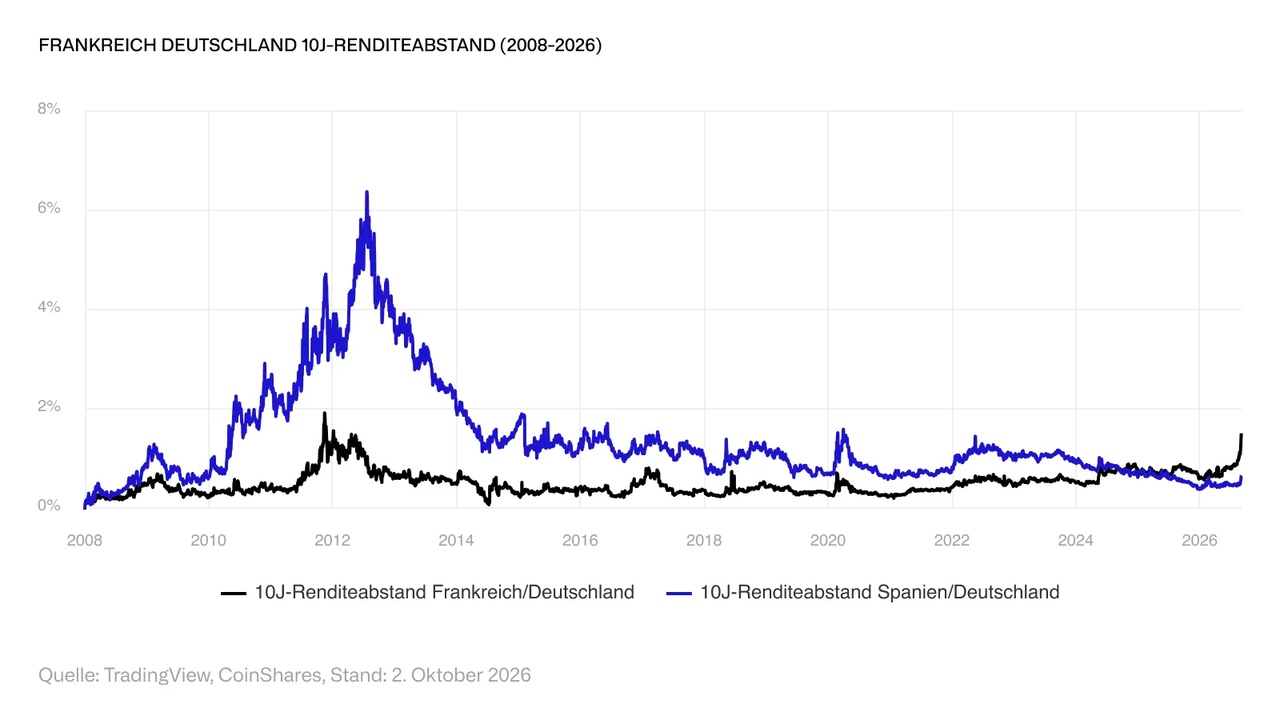
The Maastricht Treaty requires eurozone countries to maintain an annual budget deficit below 3 percent and public debt below 60 percent of GDP. At the height of the euro crisis in 2012, France and Germany were still on par at around 90 percent. Since then, Germany has moved closer to meeting the Maastricht criteria, with its debt now at about 64 percent, while France’s debt has risen to about 117 percent—and this during a period of historically low interest rates. That is why rising long-term interest rates are so problematic for Paris: if existing debt is refinanced at higher rates, the interest burden will skyrocket.
Politicians are underestimating the problem: Some candidates are bringing up the possibility of a debt haircut, as was done in Greece before the bailout package and the IMF intervention. The yield spread between French and German government bonds is already widening significantly, while former crisis-hit countries like Spain are not under pressure to the same extent. This is a warning sign for the eurozone; after all, France is one of its largest economies. We can expect downward pressure on the euro’s value and, consequently, additional inflation. This could affect non-government stores of value such as $GOLD and $BTC (-1,74 %) could benefit from this.
You can invest in Bitcoin through the following platform: $BITC (-2,16 %)