What happens to an industry where demand is skyrocketing but which suddenly can’t get any more money?
This question has been on everyone’s mind since yesterday. Elon Musk wrote on X that the credit markets had AI data center operators. Just a few days earlier, the Nebius CEO himself had admitted that key sources of capital had temporarily dried up.
1. The Statements
- Elon Musk: In recent weeks, the credit markets have cut off all companies without significant revenue outside of AI data centers had almost completely cut off access to funding. $SPCX (+0,41 %) I’ve taken on $40 billion in debt for GPUs, but only thanks to investment-grade (= high creditworthiness according to rating agencies) and revenue from Starlink and rocket launches. He predicts a mass extinction and consolidation . He rules out the possibility of SpaceX acquiring any Neoclouds.
- Chamath Palihapitiya: Neoclouds are disorganized and poorly capitalized. By 2027, there will be a lot of partially unused computing capacity, and that year will weed out many bad investments.
- Arkady Volozh, CEO of $NBIS (+2,54 %): Asset-backed financing and debt markets have temporarily dried up. Nebius is working with customer prepayments and other instruments that should be sufficient to build at least the one gigawatt planned for this year.
- Gartner: As early as mid-October, the research firm predicted that by 2030, over 80% of neoclouds would no longer be independent.
Context: Musk is a direct competitor to traditional Neoclouds, as he rents out GPU capacity himself—SpaceX could benefit from negative headlines.
2. Why a lack of capital affects the valuation:
Neoclouds build and buy first, but the money doesn’t come back for years.
This results in a simple chain:
1. Growth requires capital.
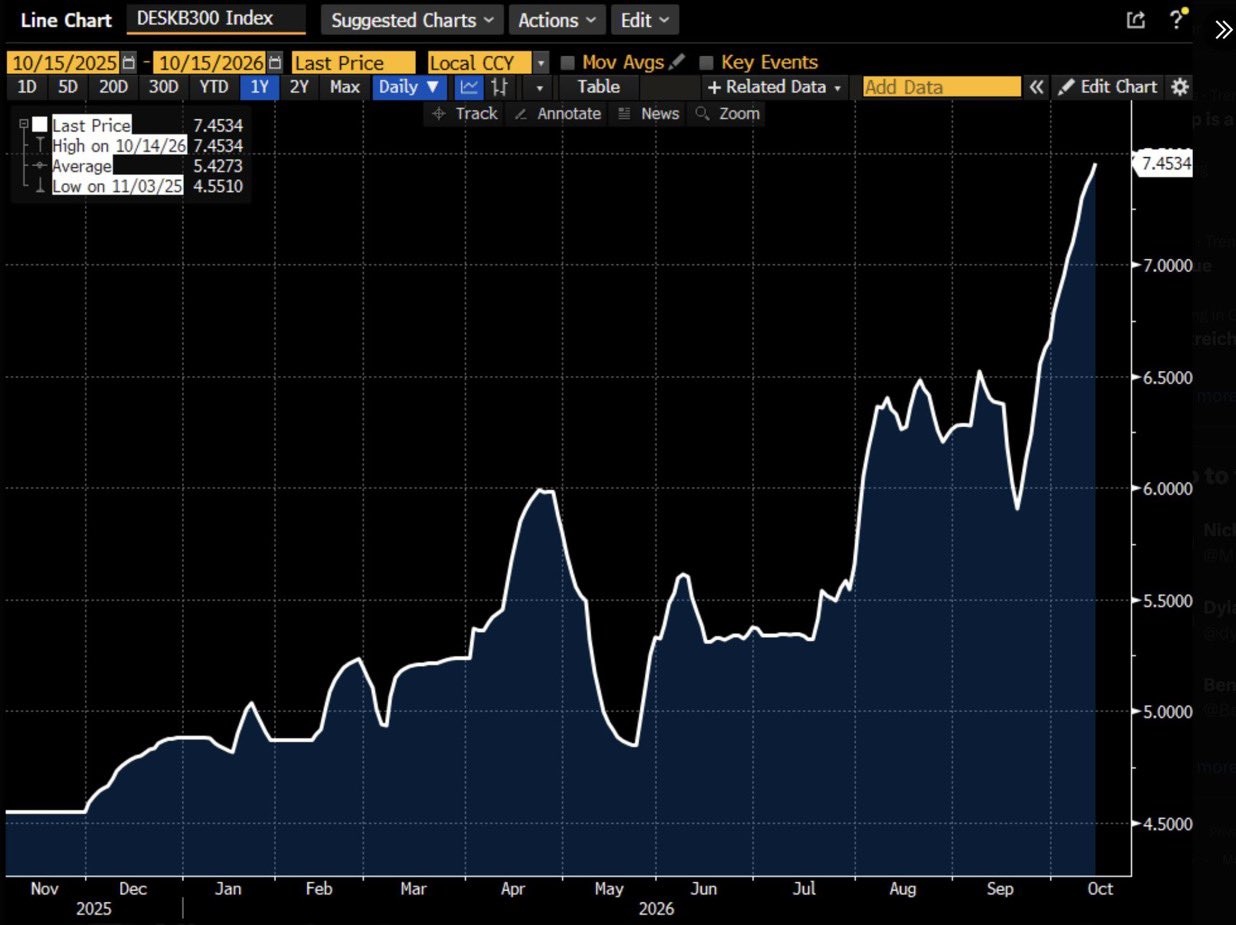
2. Capital becomes expensive or is no longer provided at all: CoreWeave bonds $CRWV (-0,63 %) maturing in 2031 yielded at times nearly 16%. At this price, projects are barely profitable, so this funding channel is largely closed.
3. Valuations factor in high growth: The market has priced in years of capacity expansion.
4. This growth cannot be delivered without capital: What isn’t financed won’t be built. Lower growth → lower stock prices. On top of that, companies are raising capital by issuing new shares at low prices, which dilutes the holdings of existing shareholders dilutes and creates further downward pressure.
5. Valuations are coming under pressure: Growth expectations are falling, while at the same time the interest rate used to discount future earnings is rising.
4. How are different types of financing affected?
Closed channels:
- Unsecured high-yield bonds
- GPU loans without high-credit-quality customers
- Asset-backed financing for Neoclouds
Open, but tighter and more expensive:
- Secured loans with investment-grade borrowers: Nebius received on October 22 $3.5 billion from $C (+1,51 %), though with a term of only one year
- Stock sales that dilute shares more significantly when prices are low
Outstanding:
- Customer prepayments
- Bonds for hyperscalers and corporations with other sources of revenue
5. Why isn’t a booming business getting funding?
Investors aren’t short on money. $GOOGL (+0,27 %), $AMZN (+0,62 %), $META (-0,5 %) and $ORCL (+1,5 %) have invested over $228 billion in bonds.
The reason lies in the lender’s logic:
- No share in the boom: If GPU rental rates double, the shareholder benefits. The lender receives only the interest, but bears the loss in the event of a crisis.
- Uncertain collateral: Financiers estimate that a GPU’s value after three years will be 10 to 60 percent of the original price. This is a huge range when billions are invested in GPUs.
- Macro: Due to the Fed’s interest rate hike in September and an oil price above $100 caused by the war in Iran, new issuances in the high-yield market plummeted in October.
Has this ever happened before?
- Data Centers in 2001: Exodus Communications, then one of the largest data center operators, went bankrupt, and its facilities were sold off cheaply. Equinix $EQIX (+1,46 %) barely survived, $DLR (+1,02 %) and was later formed from acquired real estate. Data centers became a huge business—but only for the next owners.
- Fiber Optics 2000–2002: The demand for the Internet was real, but funding dried up. Global Crossing and WorldCom went bankrupt.
- Shale Gas 2015/16: The high-yield energy market dried up; many producers went bankrupt, and the most cost-effective ones took over the rest.
- Crypto Miners 2022: Core Scientific filed for bankruptcy and is now an AI rental provider itself.
The pattern is always the same: When the capital market closes for a capital-intensive industry, the balance sheet, not demand. In these examples, macro-driven freezes lasted weeks to months, while freezes affecting an entire industry lasted about one to three years.
6. Which Neoclouds are affected
The key factor is the business model:
- Landlords with tenants of high creditworthiness:
$CIFR (+2,2 %) with Amazon as the direct tenant, $WULF (+1,33 %) backed by Google. In the case of $HUT (+1,25 %), $CLSK (+0,86 %) and $RIOT (+1,51 %) investment-grade credit protection is still pending. Banks are primarily reviewing the tenant in these cases, which is why financing continues. They benefit very little from the rise in GPU prices because their rents are locked in for 10–20 years. - Landlords with a large CoreWeave stake: Galaxy $GLXY (+4,92 %) and Core Scientific, and to some extent also $APLD (+2,17 %), where a hyperscaler now accounts for the majority of tenants. Their risk hinges on the industry’s weak link.
- GPU clouds: $IREN (+0,08 %) , $NBIS (+2,54 %) , $CRWV (-0,63 %) , $USCTF (+2,24 %) and $BTDR (+1,51 %) . This is exactly the channel Musk is referring to. Nebius relies on contracts with $MSFT (+0,4 %) and Meta, while IREN relies on Microsoft; on top of that, there are substantial upfront payments: At Nebius, they cover about 50–60%, and at IREN, about 45% of the respective investments. CoreWeave, on the other hand, contributes about $50 billion in debt and lease obligations.
- Without a signed AI contract:
$MARA (+1,47 %) and $KEEL (+2,85 %). They need customers and financing in the midst of the lockdown.
7. Conclusion
Overall, Musk’s statement is exaggerated, but essentially correct: For companies that only sell GPU rentals and don’t have customers with high credit ratings, the credit market is currently closed.
However, there’s a contradiction in this situation: What isn’t financed won’t be built, and that further reduces supply further, while Musk himself speaks of exploding demand .
Companies that can finance their capacity are likely to benefit from this.
Customers who urgently need computing power will become more aware of this problem, which could potentially increase prepayments for contracts. In addition, customers could use their own creditworthiness as collateral for their AI computing power providers or become lenders themselves.
In my view, therefore, one question above all else will determine the future of the industry:
Who can secure financing to sustain these growth rates?
The quarterly results in November will provide answers; particular attention should be paid to the financing structure and prepayments.
Sources:
https://x.com/elonmusk/status/2114434646914068862
https://x.com/chamath/status/2114389987563381004
https://www.youtube.com/watch?v=ElxZFG9lfmQ
https://www.sec.gov/Archives/edgar/data/0001513845/000110465926117978/tm2628078d1_ex99-1.htm
https://www.cnbc.com/2026/10/14/coreweave-stock-bond-yields-ai-debt.html
https://www.advisorperspectives.com/articles/2026/10/21/surging-yields-biggest-debt-sale-delay