1Sem.·

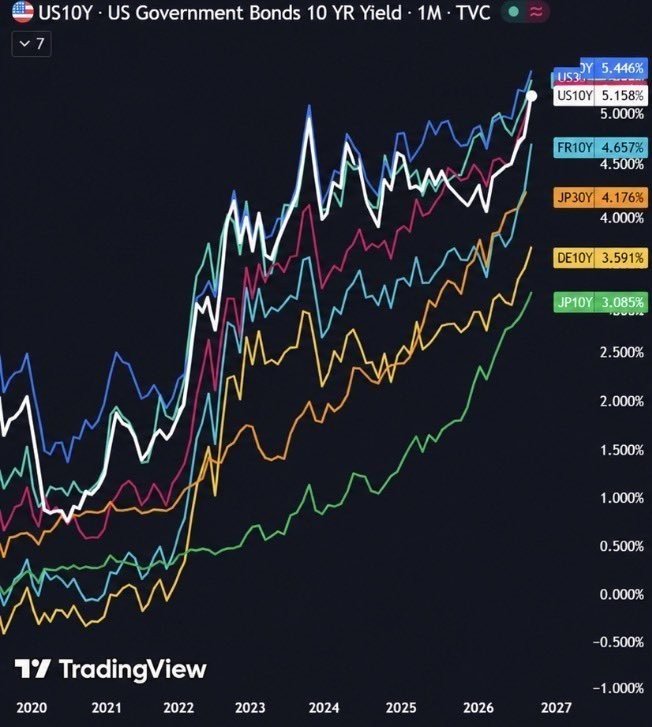
The time has come: The sovereign debt crisis begins

attachment

🇺🇸 U.S. 10-Year 5.167%, 19-year high.

🇺🇸 U.S. 30-Year 5.45%, 22-year high

🇯🇵 Japan 5Y 2.40%, 31-year high.

🇯🇵 Japan 10Y 3.09%, 30-year high.

🇩🇪 Germany 10Y 3.62%, 17-year high.

🇫🇷 France 10Y 4.73%, 18-year high.

🇫🇷 France 30-year 5.25%, 24-year high.

🇦🇺 Australia 10-year 5.44%, 15-year high.


Historically, such interest rate hikes have always been followed by a recession and a stock market crash.


My prediction: In 10 years, the stock market will be right where it is today.


Take care!

55
122 Commentaires

image de profil
I'm predicting a 15-year period and a 70% crash 💥 Date: November 4, 2026, at 8:54 a.m. CET. This is not investment advice!!
•
25
•
image de profil
1Sem.
@Crash-Propheteus Sure, you're the "Crash Prophet," after all. 😅
•
2
•
image de profil
••
image de profil
@emppsb Yes, at least
•
1
•
image de profil
@Crash-Propheteus What should I do? Sell everything??
••
image de profil
@fund_manager_2787 Yes, save your investment 💣
••
image de profil
@fund_manager_2787 Yeah, save your investment 💣
••
image de profil
1Sem.
@fund_manager_2787 Sell everything—and then what? Then the money sits in your bank as a bond? I wonder if that's better...
•
1
•
image de profil
@Epi Time in the market… we all know the rest 😉
•
1
•
image de profil
1Sem.
@BavarianLion There are certainly strategies that can help avoid such downturns. For laypeople, of course, a rigid “buy and hold” strategy is the best approach. However, history shows that very few people have the nerves of steel to weather a long, deep bear market. Germans, in particular, are known for making poor decisions.
•
1
•
image de profil
@Epi I certainly wouldn’t call myself an expert, but I wouldn’t say I’m a complete novice either! I think that if you’re really thinking long-term, then B&H isn’t a bad strategy! For example, I’ve also bought McDonald’s stock recently, even though the company is currently in a crisis! In the long run, though, I see McDonald’s as a fundamentally strong company!
••
Voir toutes les 6 autres réponses
image de profil
The only thing I can say with certainty is that things happen. And that probably causes other things to happen. Maybe a third thing will happen as a result of the second thing. But we'll just have to wait and see. I think we can use things like that as indicators.
•
16
•
image de profil
1Sem.
@SchlaubiSchlumpf Words of wisdom from a mathematician: 100% correct, 100% useless. 😅👍
•
4
•
image de profil
@Epi Not for philosophers 😁

No, but seriously. A lot of people have already written about a crash. Do I think it’s very possible? Definitely. If I had to, I’d bet in favor of one happening in the next few years rather than against it. Still, I’m staying out of the fray. I already expected back in 2021 that NVIDIA wouldn’t keep rising 😂
•
3
•
@SchlaubiSchlumpf Which event is supposed to serve as an indicator here? The one that has already happened, or the one that is just now being pointed out as a reaction?
•
1
•
image de profil
@DEW_7240 Always look at the big picture. One thing alone will rarely change the world—even if it sometimes seems that way.
•
1
•
image de profil
@SchlaubiSchlumpf And after all, good things take time.😂
•
1
•
image de profil
The creeping correction in the stock market has actually been underway at the grassroots level for weeks and months now. Don’t be blinded by the S&P 500 Index—after all, the rally is being kept alive by just a handful of companies. If you take a closer look, the picture is quite different: About 75% of stocks are stuck below their 50-day moving average, and more than half are languishing below the 200-day line. Historically speaking, this is an extremely shaky foundation, which is why the market has been in trouble for quite some time now. We’re just waiting for the black swan. I could imagine it being public opposition to data centers. Or a dispute over electricity prices. Or this, or that, or the other thing...
•
9
•
image de profil
@Olli68 How do you handle this?

Get out of the market? Increase cash reserves? Wait it out?
Considering how long the real estate bubble lasted before it finally burst, I think it’s very difficult to know how to position oneself.

I’d be interested in hearing your take on this.
•
1
•
image de profil
@Sunrise-Mantis That really depends on your investment horizon. Since I’m already 58, limiting losses is naturally more important to me than long-term performance.
Over the past few months, I’ve already sold off all my tech stocks (only Dell remains in my portfolio) and reallocated my holdings to companies that are debt-free and perform well even during market crashes. However, I generally never hold more than 10 stocks in my portfolio, as that makes it easier to manage and track.
Most of my portfolio consists of gold and active funds + ETFs (quality, value, and equally weighted) anyway. I’m not a big fan of passive index ETFs.
I’ll sell my Nasdaq ETF (my third-largest position) as soon as the party ends there.
In recent weeks, I’ve also accumulated about 25% cash through tech sales. I’ve been buying physical gold (coins) since 2003 and have never sold any.
As I said, I’m getting on in years, and this certainly isn’t a strategy younger investors should copy. The important thing is to always expect that the market might go down for a few years at a time.
•
7
•
image de profil
@Olli68 Thank you for the detailed answer 👍🏼
•
2
•
image de profil
1Sem.
@Olli68 I agree with your assessment. Essentially, I had been following a similar strategy to yours until I discovered the world of momentum trading. Before that, my fundamentally bearish mindset cost me too much in returns.
Now I trust these strategies. Currently, they’re allocated about 25% cash, 25% gold, 25% 3xGTAA, and the rest in commodity ETFs.
•
2
•
image de profil
1Sem.
@Sunrise-Mantis It's difficult to give a general yet specific recommendation.
My advice would be to look into trend-following strategies. They'll help answer your question depending on market conditions.
•
1
•
image de profil
@Olli68 Just heard from Markus Koch:

44% of the stocks in the S&P are at least 20% below their 52-week highs

24% of stocks in the S&P are down at least 30%

8% of stocks in the S&P are down at least 40%


Ouch 🤕 I wasn’t aware of that. This is going to be interesting 😬
•
3
•
image de profil
@Olli68 Poor market breadth can also resolve in a bullish manner or through rotation. It does not necessarily have to be a bearish convergence.
••
image de profil
Take care, and thank you for the news. I will ask the blacksmith right away to forge me an iron helmet to protect me against falling stock prices.
•
7
•
image de profil
1Sem.
@Yoshika Don't forget the tailor for the parachute!
•
1
•
image de profil
So, is a 50/50 mix of gold and Bitcoin the ideal portfolio? 🤣
•
6
•
image de profil
1Sem.
@Psychedelic_Sunflower I don't think gold and BTC will remain unaffected by a debt/liquidity crisis.
When money is needed for interest payments, it will be withdrawn from elsewhere.
•
2
•
image de profil
@Psychedelic_Sunflower As bond yields rise, the opportunity cost of holding gold increases. So why invest in gold?
•
2
•
image de profil
@Psychedelic_Sunflower If only we knew what was going to happen ^^
My portfolio consists mainly of $BTC, and right now I’m moving my cash to the stock market to overweight it even further.

Then there’s also the China-Taiwan war scenario, which would plunge the (tech) world into chaos.

Bitcoin for 30k or less? I’d love that 😅
But I’ve got to get out before that happens 😅
•
1
•
image de profil
@Alpalaka However, as bond yields continue to rise, so does the risk that the debt crisis will escalate and that confidence in fiat currencies will ultimately (and rightly so) wane.
••
image de profil
@Artiskon If we knew exactly what was going to happen, we wouldn't have to work anymore 😅 But since, unfortunately, we don't know, we diversify and keep the risk manageable 😄
I’ll increase my Bitcoin allocation even further if the elimination of the holding period starting in 2027 is confirmed and the grandfather clause remains as currently planned. I’m also considering selling my ETFs for that purpose and rebuilding my portfolio starting in 2027 using my regular savings rate, while slowly reducing my Bitcoin overweight.
In the event of a war against Taiwan, however, tech stocks won’t necessarily move in tandem with Bitcoin. There’ll probably be losses across the board, but I’d guess that the tech sector would take a much bigger hit.
••
image de profil
1Sem.
@Psychedelic_Sunflower Real returns are likely to be the decisive factor in the medium term. If they decline despite rising nominal interest rates, real assets are likely to benefit.
•
2
•
image de profil
@Epi Yes, that's true. But if the debt crisis turns into a crisis of confidence in the fiat currency, the world will probably look very different. In favor of tangible assets.
•
2
•
image de profil
Please let me know in advance so I can sell everything before then. You certainly seem to have timed and predicted every bear market perfectly—especially with a statement like “in 10 years, we’ll be right back where we are today,” which is a pretty arrogant claim…
Looking at rolling 10-year periods for the S&P 500 (including dividend reinvestment), the historical probability of being in the black after 10 years has ranged from over 94% to 97%.
Just for the record:
Sharply and rapidly rising interest rates (especially due to central bank hikes aimed at combating inflation) do indeed massively increase the risk of an economic slowdown or recession. The reason for this is that loans become more expensive for businesses and consumers. Nevertheless, there have also been periods in history with interest rate hikes that ended in a so-called “soft landing” (e.g., in the U.S. in the mid-1990s, 1994–1995), without leading to a full-blown recession or a severe market crash.
When looking at statistical warning signs, it is not just the peak in yields that is decisive, but the yield curve (e.g., the spread between 2-year and 10-year U.S. Treasury bonds). When the yield curve inverts (i.e., short-term interest rates are higher than long-term rates), a recession has historically followed within 12 to 24 months in over 80–90% of cases in the U.S. However, the mere fact that long-term interest rates reach a multi-year high does not necessarily lead to an immediate stock market crash.
•
5
•
image de profil
@MrSchnitzel00 Negative 10-year returns occurred almost exclusively when investors entered the market at the absolute peak of a bubble and the 10-year period ended immediately after a severe crisis—for example: 1929–1939 (the Great Depression) or 2000–2010 (the so-called “Lost Decade,” triggered by the bursting of the dot-com bubble in 2000 and the financial crisis of 2008)

Even during the period of extremely high interest rates and inflation in the 1970s and early 1980s (when interest rates in the U.S. reached over 15%), broad market indices rarely fell into negative territory on a nominal basis over a 10-year period. However, real returns (after adjusting for inflation) were negative at times during this period.
•
1
•
image de profil
1Sem.
@MrSchnitzel00 Shall we talk about the current Shiller P/E ratio for the S&P 500 (40)? That's quite a bit above the average (17). The "Lost Decade" forecast isn't based solely on the current rise in interest rates. That merely marks the beginning of this phase.
•
2
•
image de profil
@Epi A high Shiller P/E ratio may point to more moderate expectations for the next 10 years (e.g., 5–7% per year instead of 10%+), but historically, it by no means guarantees a negative return or a level below today’s.
Furthermore, you can’t compare the current situation to 2000 (the dot-com era)—companies are all posting high profits and have strong outlooks. AI is driving this even further.
Risk is definitely elevated, but I find your claim that we’ll be in the same place in 10 years as we are today to be quite exaggerated.
••
image de profil
@MrSchnitzel00 I see it a little differently. It doesn’t matter at all what kind of apparent record profits are on paper, because standard balance sheets and quarterly figures only tell half the story here. All this AI hype has been heavily financed on credit for the past one and a half to two years. The massive investments are eating up almost all of the operating cash flow, while the corporations are flooding the market with bonds. Above all, off-balance-sheet debt—through hidden leasing contracts and partner funds—masks a truly gigantic mountain of debt behind the scenes. Without this extreme and concealed debt financing, this breakneck pace would never be feasible, and in the end, some companies here will suffer massive losses (e.g., Oracle will be the first).
•
2
•
image de profil
@Olli68 So you think the investments won't pay off? And that CEOs don't know what they're doing? And that AI has little future?
••
image de profil
@MrSchnitzel00 Long term or short term? We don't need to debate the long-term success of AI. But in the short term, I see the whole thing as a walk on a razor's edge. And there's going to be a major crash in this sector in a few years. I'm already seeing some major signs of that. But that's just my opinion.
••
image de profil
@Olli68 There are definitely a few risks—I agree with you there—but maybe everything will turn out just as the CEOs and others envision? And no one can predict a crash exactly; it’s going to happen, but the question is when… maybe it’ll keep going for a few more years. A crash usually comes very unexpectedly.
••
image de profil
@MrSchnitzel00 Exactly. That last sentence sums it up perfectly. 👍
I’m afraid there will be major confrontations between the public and data centers in the near future. At some point, the public will realize that local data centers don’t create jobs, that they’re ugly, high-security structures in the countryside, and that local electricity is becoming expensive and unreliable. I really fear that will happen.
We’re already seeing a freeze on new permits.
••
image de profil
@Olli68 Well, I don't entirely agree with you—it has both positive and negative effects. A lot of it also benefits the community because that's where the investment goes… Why don't you check out the penultimate interview—I think it was with Jensen Huang? There are a lot of misunderstandings and misjudgments there…
••
image de profil
@MrSchnitzel00 Sorry, but Jensen Huang says and does a lot just to avoid a crash or a slowdown. It's like asking the finance minister if taxes are a good thing.
But anyway, we'll see...
•
1
•
Voir une réponse de plus
We live in exciting times
•
4
•
image de profil
Do you think Momentum could still perform well?
•
3
•
image de profil
1Sem.
@valentin28 If you look at the backtests for the last interest-rate-driven zero-decades, momentum strategies at least allowed investors to preserve their capital. When everything is falling, the best strategy is to stay in cash and re-enter the market when prices start rising again. Bear market models are virtually impossible due to asymmetric volatility.
•
4
•
image de profil
@Epi Thank you. Do you use indicators to determine whether a prolonged bear market is on the horizon?
••
image de profil
••
image de profil
@Epi So does it make sense to keep a higher percentage of cash? What percentage would you recommend, roughly?
••
image de profil
1Sem.
@FinanzMechaNikk I wouldn't make any blanket recommendations. My cash allocation is 25%. But that doesn't mean anything. At the same time, I have a 3x leveraged position in the Nasdaq 100, which accounts for almost 10% of my portfolio. It always depends on the strategy.
•
2
•
image de profil
@Epi Thanks anyway for the reply. I'm currently having a bit of trouble determining a reasonable cash allocation given the circumstances.
However, in the event of a market crash, I would probably sell off my individual stocks, which account for about 30 percent of my portfolio.
•
1
•
image de profil
@Epi I'm not questioning your knowledge of GTAA—but calling cash the best investment during a bond crisis shows a complete lack of understanding of macroeconomics…
••
So, if you take your own posts seriously, you'll surely sell everything, right?
•
3
•
image de profil
@dividend_dynamo_wtbrk I don't think it's that crazy to put all my eggs in one basket 😅
••
image de profil
1Sem.
@dividend_dynamo_wtbrk Why sell everything? That would be pretty unimaginative and would hardly yield any return.
•
2
•
image de profil
How does 3xGTAA protect my assets from the crisis?
•
3
•
image de profil
1Sem.
@DonkeyInvestor Not at all. That's how I'll overcome the crisis. And if even more investors join in, I'll just trigger the crisis myself. Just for you. Because you didn't want -3xTLT. 🫡
•
2
•
image de profil
I also expect a sideways market in the 30s. The lows could actually be at today’s levels, so you’re not too far off with that statement. Before that happens, though, there are still some big gains to be made. Back in the ’90s, in a similar situation, the S&P continued to rise for another 3–4 years, gaining 60%, while the Nasdaq doubled in value.
•
3
•
image de profil
1Sem.
@Dirty30 You're right, of course. The path forward is pretty unclear. That's why you shouldn't bet against the trend.
•
2
•
image de profil
@Epi Exactly, yeah. But recognizing all that when the trend breaks—I’m not worried about you, though, since you’re a trend hunter 😁
••
image de profil
1Sem.
@Dirty30 I'm not a trend hunter—I'm a trend follower. That's something completely different! 😬
•
1
•
image de profil
Wow, 10 years of sideways movement / a steep decline, and only a slow recovery? That's certainly a bleak outlook.
•
2
•
Voir toutes les 9 autres réponses
image de profil
Hmm. If that's how it turns out, I'll probably rent it out for now. And if I don't spend the money on living expenses, I'll use it to buy some cheap stocks.😉
•
2
•
Voir toutes les 2 autres réponses
image de profil
So, in your opinion, what's a sensible way to hedge? Should small investors use stop-loss orders with ETFs? Should they keep a lot of cash on hand to buy more, or what would you recommend to a small investor?
•
2
•
Voir toutes les 2 autres réponses
Blessed are those who focus on dividends 👋🏻👋🏻👋🏻
•
2
•
Afficher la réponse
image de profil
As interest rates rise, it’s becoming increasingly difficult—and more expensive—to finance the welfare state. I expect further tax increases, cuts to social programs, and further erosion of democracy in Germany. Anything is possible.
•
1
•
Afficher la réponse
Perfect. I'll be happy to snap up your stocks on the cheap for the next 10 years.
•
1
•
Voir toutes les 2 autres réponses
image de profil
1Sem.
A multi-year crash would be the best thing that could happen to me. I'm relatively young; I don't plan on selling for another 20 to 30 years anyway.
•
1
•
Voir toutes les 6 autres réponses
With Scot Bessents' intervention... everything will work out just fine.
•
1
•
image de profil
I also see that something is happening here—it has to.

It’s already happening in some industries; it’s time to identify new markets and sectors and reallocate resources accordingly.

When one party ends, the next one begins somewhere else—it all follows historical cycles.
•
1
•
Afficher la réponse
image de profil
So go ahead, when is the crash going to start? 😶
••
Voir toutes les 2 autres réponses
Just relax. It's no big deal.
••
Afficher la réponse
How do you handle situations like this? I’m not sure—of course, it depends on the person, right? Thanks :)
••
Voir toutes les 2 autres réponses
image de profil
Epi, you should know better by now, after all this time ;)
••
Afficher la réponse
image de profil
Epi knows everything again. Well, everything—just to get clicks and for the Wikifolio side hustle (not bad, that fee-skimming scheme).
••
Voir toutes les 7 autres réponses
Participez à la conversation