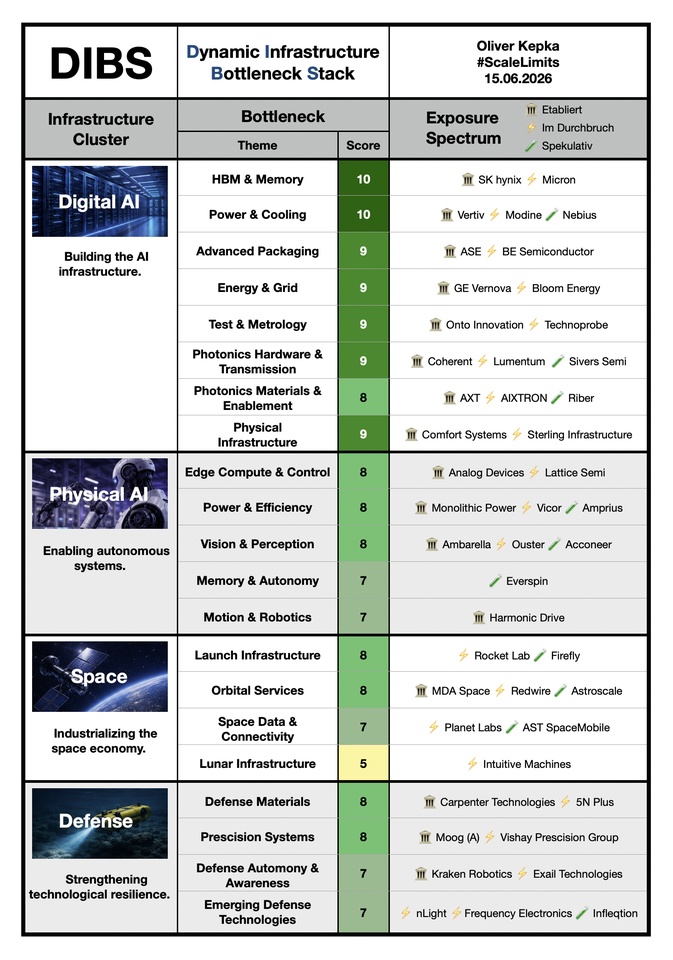
Hello, everyone, a dear friend @RenaTess brought this company to my attention and asked me to take a look at it.
Personally, I find the company very exciting, and I see a lot of potential here thanks to its growth sectors.
I look forward to hearing your thoughts, as well as those of the prompts and agents.
(@Aktienhauptmeister , @Raketentoni )
A key supplier to the renewable energy, aerospace, and high-tech sectors. The company manufactures high-purity specialty semiconductors and performance materials.
5N Plus Inc. was selected by the U.S. Department of Defense to establish domestic production of gallium arsenide components for U.S. defense applications.
The company will collaborate with its first customer, the U.S.-based global defense technology company Lockheed Martin, to complete product qualification before transitioning to a controlled, low production rate, with a potential path toward a follow-on production agreement. The capabilities being developed at the company’s Utah facility could also support the future production of GaAs substrates and other advanced semiconductor materials for additional defense and aerospace applications, including space-based solar cells and high-frequency semiconductor devices. This would expand the addressable market for 5N+ and create significant long-term growth potential.
Gallium arsenide (GaAs) is a strategically important semiconductor material used in advanced sensing systems and other devices for defense applications. Since there is currently no qualified domestic source of GaAs for electro-optical GaAs components, U.S. defense contractors rely on foreign suppliers.
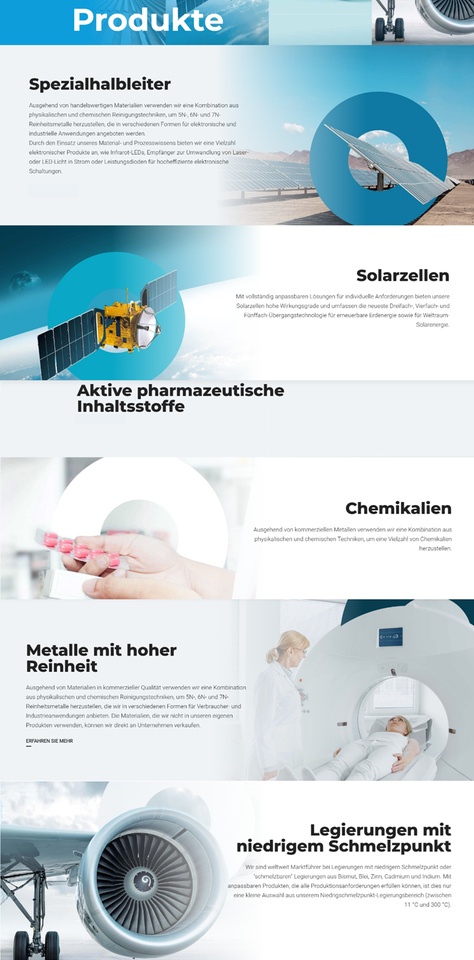
5N Plus Inc. is a global manufacturer of specialty semiconductors and high-performance materials. The company utilizes a range of technologies to develop and manufacture its products. The company’s business segments include “Specialty Semiconductors” and “High-Performance Materials.” The “Specialty Semiconductors” business segment operates in North America and Europe and manufactures and markets products used in various applications, including renewable energy, space satellites, and imaging. Its end markets include photovoltaics (terrestrial and space-based solar energy), medical imaging, infrared imaging, optoelectronics, and high-performance electronics. The High-Performance Materials segment operates in North America, Europe, and Asia and manufactures and sells products used in various pharmaceutical, healthcare, and industrial applications. Its main products are sold as active pharmaceutical ingredients, feed additives, specialty chemicals, commercial-grade metals, alloys, and technical powders.
Number of employees: 849
Locations
- Montreal (Canada)
- Headquarters
- Bridgeport (United States)
- St. George (United States)
- Eisenhüttenstadt (Germany)
- Heilbronn (Germany)
- Lübeck (Germany)
- Shangyu (China)
- Hong Kong (China)
Earnings Call: 5N Plus Beats Estimates for Q2 2026 Thanks to Strong Sales
August 4, 2026
🧾 Summary of the Earnings Call – 5N Plus (Q2 2026)
5N Plus significantly exceeded expectations and reported a strong second quarter of 2026. Revenue and profit were well above analyst estimates, driven by high demand for renewable energy, aerospace propulsion systems, and bismuth products.
🔹 Q2 2026 Financial Results
- Revenue: $122.4 million (+28% YoY)
- Earnings per share: 0.22 USD (Estimate: 0.1619 USD → +35.9% beat)
- Net income: $19.7 million (previous year: $15.2 million)
- Adjusted EBITDA: $26.6 million (+10%)
- Operating cash flow: –1.9 million USD (previous year: +22.3 million)
- Net debt: $23.7 million (end of 2025: $50.3 million)
🔹 Business Performance
- Strong demand in renewables, Space Propulsion and Performance Materials.
- Specialty Semiconductors is fully booked for 2026 and 2027.
- High visibility: Order backlog in the semiconductor segment stands at 365 days (maximum).
- Margins under pressure due to:
- higher metal input costs
- operational inefficiencies
- more expensive chemicals
🔹 Market reaction
- Stock slightly higher: +1.21% to $32.58.
- Year-to-date performance: +161% YoY, +84% YTD.
- InvestingPro rates the stock as overvalued (Fair Value Note).
🔹 Outlook
- EBITDA forecast for 2026 confirmed: $100–105 million.
- Margins are expected to remain roughly at Q2 levels in H2 2026 (~30%).
- Metal costs will not be reflected until a two-quarter lag .
- Net debt is expected to the end of 2026 .
- Capacity for 2026–2027 is sold out; planning for 2028–2030 is underway.
- New CDSC production in Montreal to begin at the end of Q3 2026.
- Germanium refining in the U.S. will begin in 1.5–2 years .
🔹 Management Comments
- CEO Perron: Strong demand, record revenue in the renewable energy sector.
- Aerospace business with record bid levels (AZUR SPACE).
- CFO Fournier: Margin pressure from metal prices, chemicals, and maintenance.
🔹 Risks
- Metal and chemical costs
- Operational disruptions
- Negative cash flow
- Seasonal weakness in the Performance Materials segment
5N+ Solarzellen treiben BepiColombos Reise zum Merkur an
September 4, 2026
Our proprietary AZUR SPACE solar cell technology, manufactured in Heilbronn, Germany, has once again supported one of the most challenging interplanetary journeys of all time.
September 3, 2026 | Montréal, Québec
5N Plus Inc. (TSX:VNP) (“5N+” or “the Company”), a leading global manufacturer of specialty semiconductors and performance materials, announced today that it has been selected by the U.S. Department of Defense to receive a $7.3 million grant to establish domestic production of gallium arsenide components for U.S. defense applications. This follows the successful presentation of the Company’s proposal at the first Defense Industrial Base Accelerator (DIBX) Pitch Competition, which took place August 25–27 in Philadelphia.
5N Plus Inc. wird die Produktionskapazität von Weltraum-Solarzellen weiter erhöhen
February 2, 2026 | Montréal, Québec
5N Plus Inc. (TSX:VNP) (“5N+” or the “Company”), a leading global manufacturer of specialty semiconductors and performance materials, today announced plans by its wholly-owned subsidiary AZUR SPACE Solar Power GmbH (“AZUR”) to expand solar cell production capacity by an additional 25% in 2026. The new capacity, which is expected to come online gradually starting in the second half of the year, will contribute to capacity increases of 30% in 2025 and 35% in 2024.
January 30, 2026 | Montréal, Québec
5N Plus Inc. (TSX:VNP) ("5N+" or "the Company"), a leading global manufacturer of specialty semiconductors and performance materials, announced today that it has been awarded a grant of $18.1 million from the U.S. government to expand capabilities and increase capacity for the recycling and refining of germanium at its facility in St. George, Utah, to supply the supply chains for optical and solar germanium crystals.
Revenue Breakdown by Business Segment:
2025 (USD)
Specialty Semiconductors 285 million
Performance Materials 106 million
Geographic Revenue Breakdown:
2025 (USD)
United States 188 million
Germany 58.46 million
Other Europe 47.57 million
Other Asia 42.87 million
China 16.36 million
Other Americas 13.55 million
Japan 8.78 million
France 6.32 million
Belgium 5.02 million
Other 4.1 million
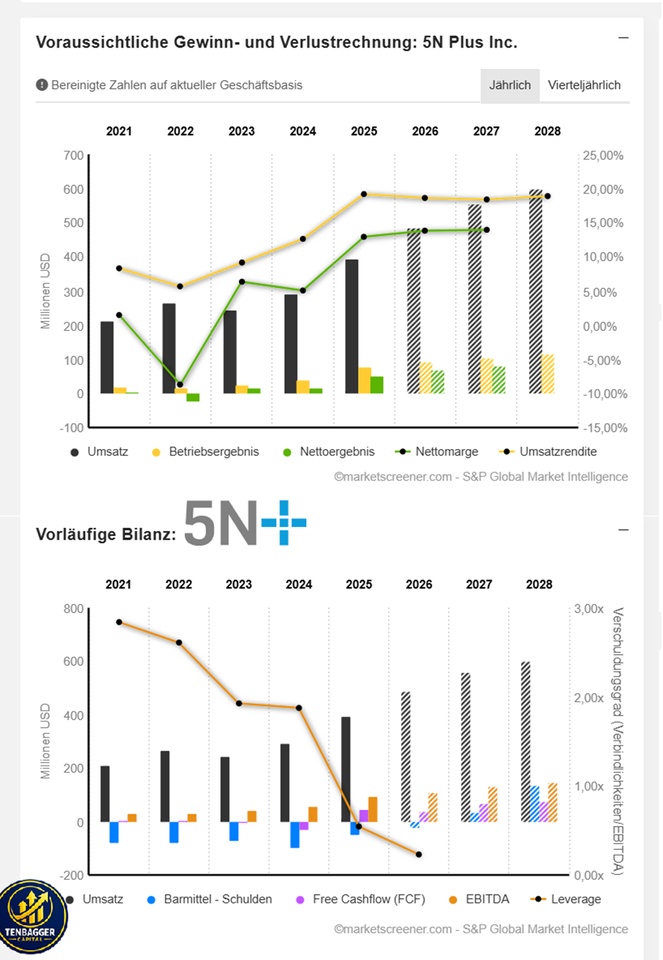
🔎 Performance at a Glance
- Revenue: 391.1 → 598.0 million USD through 2028 — very strong growth, though momentum is slowing.
- EBIT: 75.07 → 113 million USD — operating profitability remains strong.
- EBIT margin: remains stable at 18–19%.
- FCF: Particularly interesting: 43.42 → 75 million USD. Following the decline in 2026, a significant jump in FCF is expected for 2027/28.
- Net debt: $50.3 million in 2025 → −134 million USD in 2028. This points to a very strong net cash position going forward.
- ROE: MarketScreener projects 29.92% ; for 2026–2028, it currently lists no forecast.
- Earnings per share: 0.56 → 0.8667 USD through 2027, with double-digit growth each year following the strong jump in 2025.
My brief summary: The MarketScreener forecast shows a very interesting combination of strong revenue growth, high margins, sharply rising free cash flow, and drastically declining debt. Particularly striking is the expected transition from $50.3 million in net debt in 2025 to $134 million in net cash in 2028.
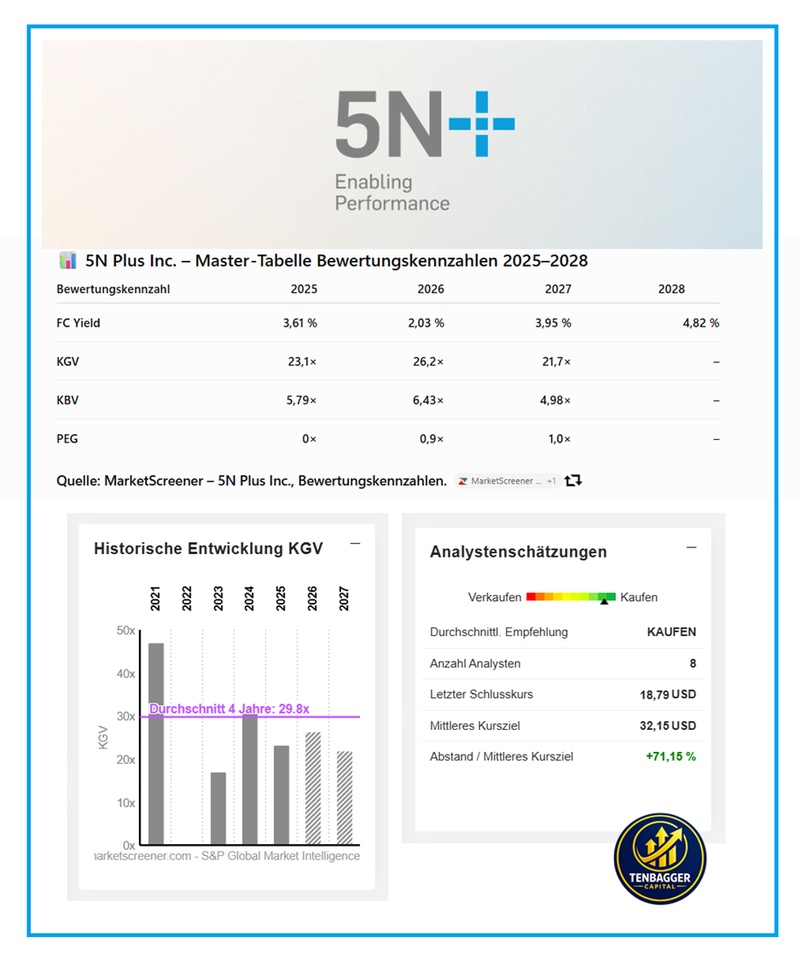
🔎 Valuation at a Glance
- FC Yield: rises from 3.61% → 4.82% through 2028—positive for the cash flow valuation.
- P/E ratio: After rising in 2026 to 26.2× it will fall in 2027 to 21.7×.
- KBV: In 2026, at 6.43× very high, but drops to 4.98×.
- PEG: 0.9× in 2026 and 1.0× in 2027 —this places the valuation roughly in line with expected earnings growth.
- For 2028, MarketScreener currently does not show any values for P/E, P/B, or PEG; for the FC yield, however, 4.82%.
Quick take: The valuation of 5N Plus remains challenging despite the sharp rise in its share price—particularly in terms of KBV. At the same time, the FCF yield and the P/E ratio is expected to decline by 2027, which, combined with the expected earnings growth, results in an attractive valuation profile.
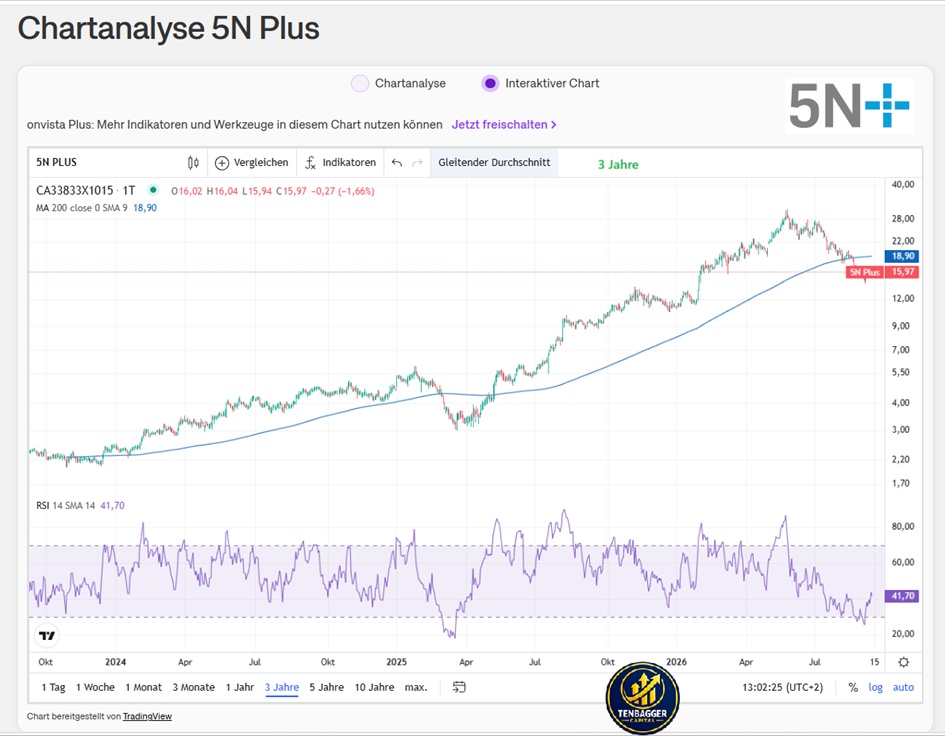
September 11, 2026, 1:25:44 p.m. •
Lang & Schwarz (EUR)
15.97 EUR