3Mon·

Company Profile - Dancing the Argentine Energy Tango 🇦🇷⚡ with Central Puerto S.A.

PSA: Since I don’t really have the time—and, to be honest, the motivation (except for the introduction and some formatting)—here’s the result of my research so far, compiled and summarized with the help of AI. In the slides I created, the debt-to-EBITDA ratio is still listed as 0.3; following the acquisition of Patagonia, it has provisionally risen to approximately 1.06. I hope this analysis is still of interest to those who are interested in companies and markets of this kind. I’m not quite done analyzing the company myself and haven’t invested (yet), but it looks very likely that I’ll open a position. Of course, this isn’t investment advice—there are better ways to burn through your money, like a visit to a beer garden.


Now we’ll finally get to what I recently came across and that will likely make its way into my portfolio sooner or later. The role I’m hoping this will play is that of an EM quality play in the energy sector—the largest private energy producer in its home country, with a (more than) solid balance sheet and a surprising focus and diversification.


I’m talking about none other than Central Puerto S.A. $CEPU (+2.84%) The stock is traded either on its home exchange or via the U.S. ADR, which is linked here. I’ve been digging into it for a few hours now and would like to briefly introduce the company to you. Since I find it very exciting—and given that it’s already more than profitable—I’d say the outlook, management’s approach, and the execution of their plans deserve some due diligence 📈


Executive Summary - Central Puerto S.A. $CEPU (+2.84%)


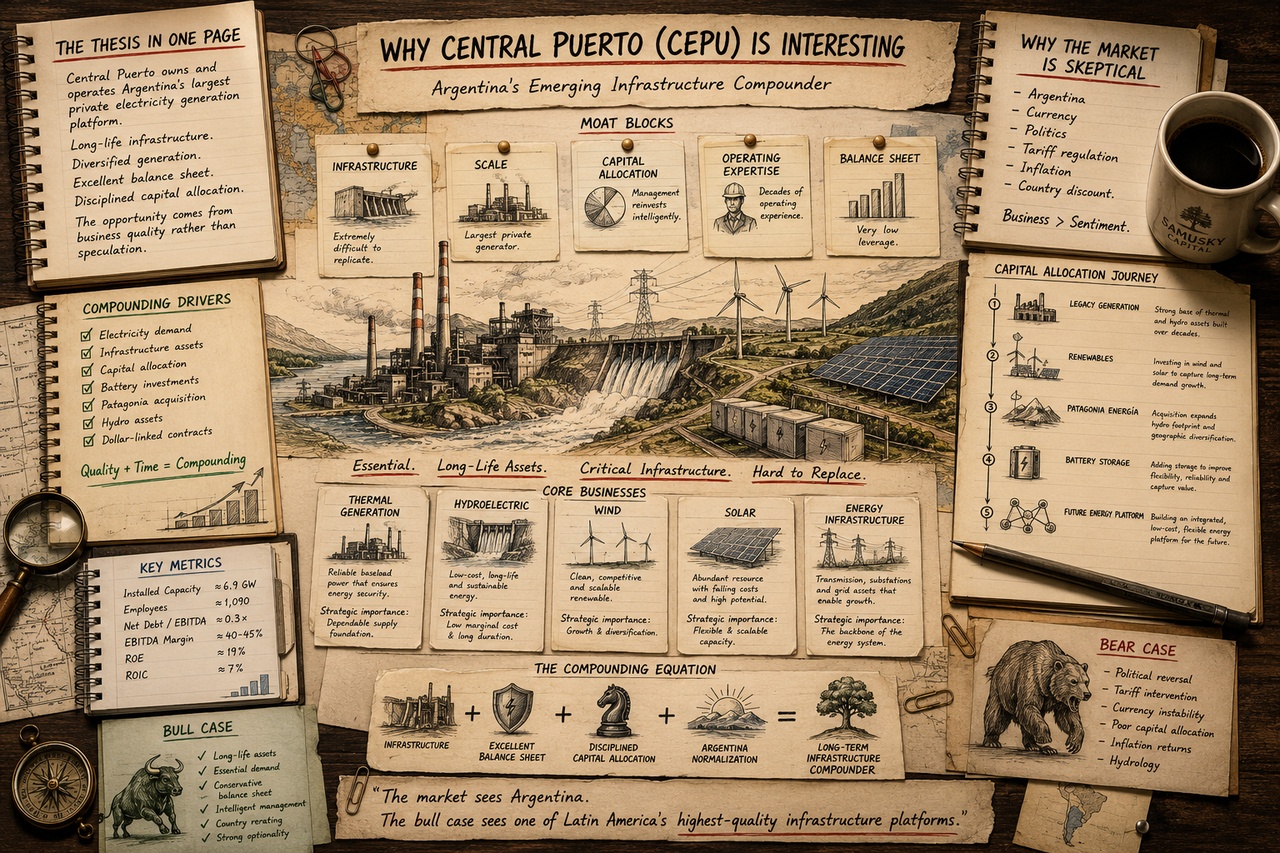
Central Puerto is a high-quality infrastructure company operating in one of the world’s historically least trustworthy investment regions.

The investment opportunity depends does not on Argentina becoming a developed economy.


Instead, it is based on three assumptions:


  • Central Puerto continues to deploy capital intelligently.
  • Argentina continues its gradual macroeconomic normalization.
  • The market is slowly narrowing the country’s structural valuation discount.

attachment

Unlike many investments in emerging markets, the company itself appears fundamentally much stronger than its home country’s reputation.


Business Model -> Argentina’s largest private electricity generator


Sector -> Independent Power Producer (IPP)


Generation mix -> Thermal • Hydroelectric • Wind • Solar


Growth platforms -> Battery storage • Natural gas • Forestry • Energy infrastructure


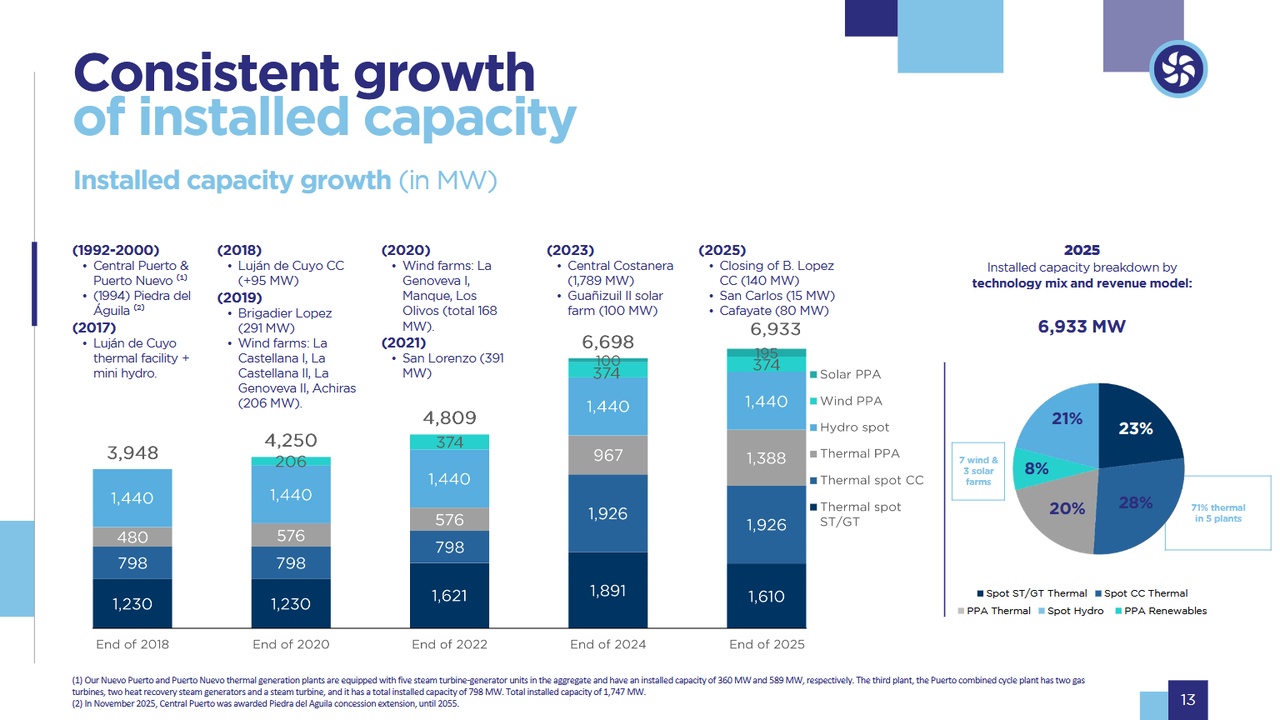
Installed capacity -> approx. 6.9 GW


Employees -> approx. 1,090


Market Capitalization -> approx. 2–2.5 billion U.S. dollars


Investment Thesis:


The market currently views $CEPU (+2.84%) the company primarily as an Argentine utility.

We increasingly view the company as:


A disciplined infrastructure capital allocator operating in Argentina.


It is precisely this distinction that forms the core of the investment thesis.

Long-term shareholder returns could come from three independent sources:


Organic earnings growth.

Smart reinvestment of generated cash flows.

A gradual decline in the Argentine country risk premium.

Why do we like this company?


Infrastructure

Demand for electricity remains essential regardless of the economic cycle.


Long-Lived Assets

Power plants generate stable cash flows over decades. Replacement costs are extremely high.


Diversified Power Generation

The company is not dependent on a single technology.


  • Thermal Power Plants
  • Hydropower
  • Wind power
  • Solar energy
  • Battery storage


Conservative Balance Sheet

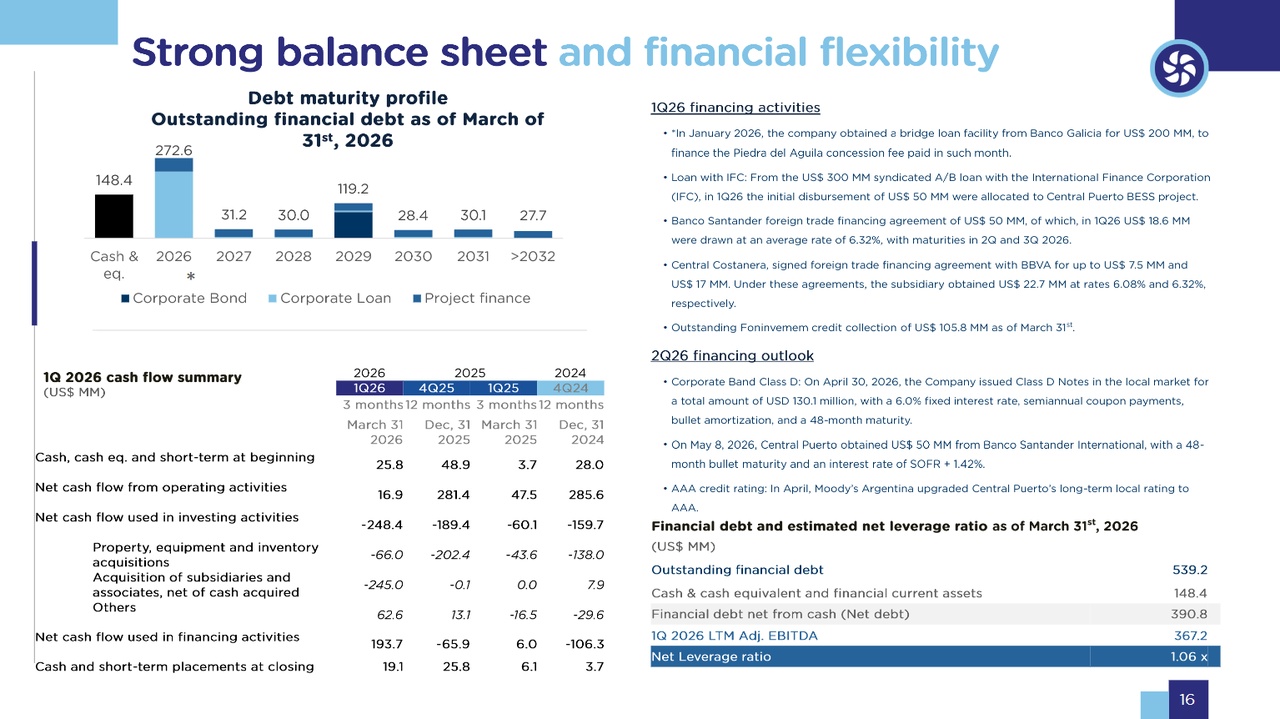
Even after the acquisition of Patagonia Energía, the ratio of net financial debt to EBITDA is estimated to be only 1.0–1.1× and thus remains conservative for a capital-intensive infrastructure company.


Management

Management consistently prioritizes reinvesting capital over maximizing short-term distributions.

This approach appears rational as long as these reinvestments generate attractive returns over the long term.


  • Financial Overview


  • EBITDA margin -> approx. 40–45%
  • Operating margin -> over 30%
  • Return on Equity (ROE) -> approx. 19%
  • Return on Invested Capital (ROIC) -> approx. 7% (normalized estimate)
  • Net financial debt / EBITDA -> approx. 1.1×
  • Cash Flow Generation & Liquidity -> Strong
  • Financial risk -> Rather low


attachment


Important Note

ROIC currently appears relatively moderate, as significant funds have been invested in acquisitions and growth projects in recent years.

The key question is therefore:

Will these investments generate attractive returns in the long term?


Capital Allocation

This area is increasingly becoming one of the strongest components of the investment thesis.


Recent investments include:


  • Acquisition of Patagonia Energía
  • Battery Energy Storage Systems
  • Efficiency improvements at existing thermal power plants
  • Energy infrastructure
  • Development of a forestry platform


Rather than maximizing dividends in the short term, management appears to be focusing on building the company’s future earnings potential.
attachment

Facts vs. Assumptions


✅ Facts

  • Argentina’s largest private electricity generator.
  • Diversified power generation portfolio.
  • High operating margins.
  • Conservative debt levels despite the recent acquisition.
  • Management actively reinvests capital.
  • Acquisition of Patagonia completed.
  • Battery storage projects are under development.
  • Infrastructure assets with a long economic useful life.


🪧 Assumptions

  • Argentina continues its economic normalization.
  • The country risk discount will decline over time.
  • The Patagonia acquisition will generate attractive long-term returns.
  • The battery storage investments will achieve a satisfactory ROIC.
  • Dividends will resume as soon as attractive reinvestment opportunities diminish.
  • The regulatory environment remains largely stable.


This distinction is crucial.

The facts support the company as it stands today.

The assumptions determine future returns.


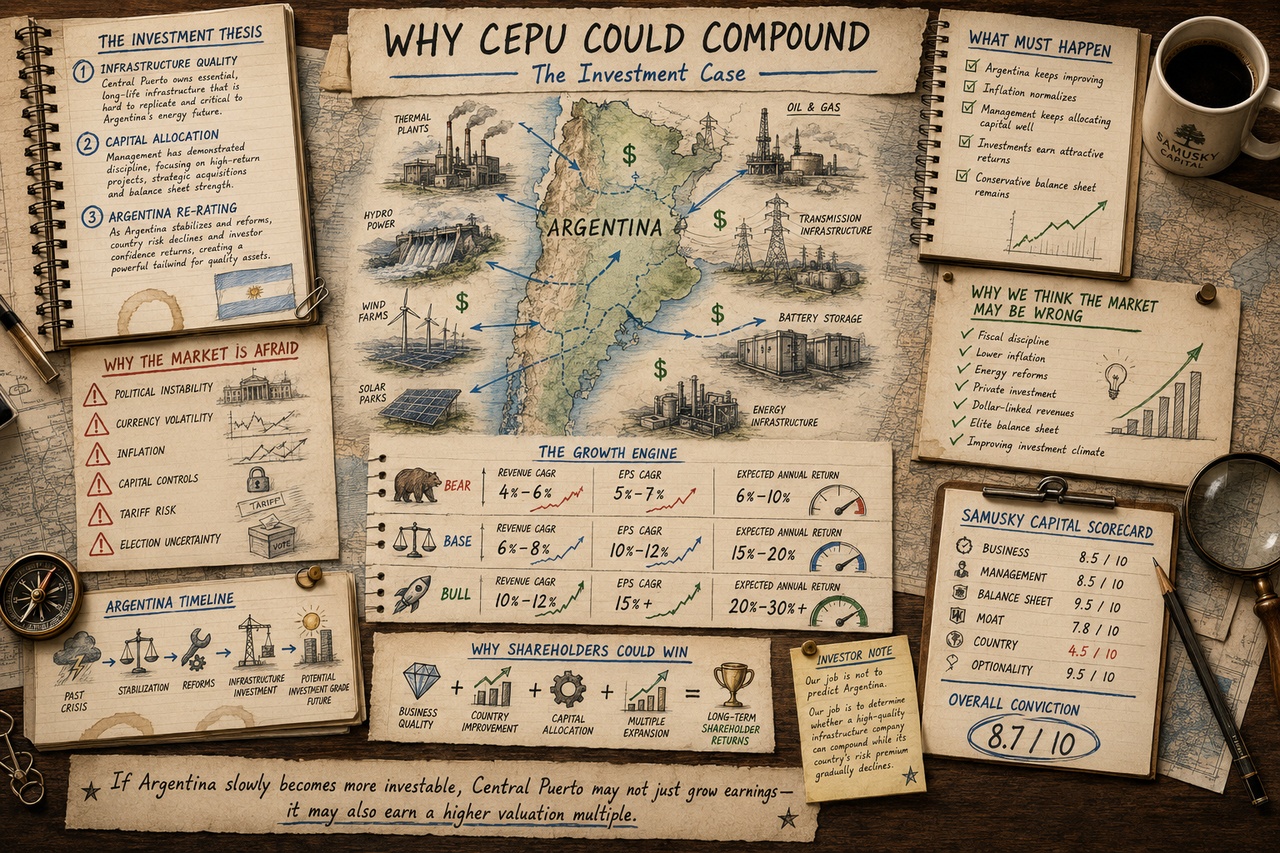
🐻 Bear Case

The political reform process stalls, regulation remains restrictive, and new projects deliver disappointing results.


Expectations

Revenue growth (CAGR) -> 4–6%

Earnings per share growth (EPS CAGR) -> 5–7%

Expected shareholder return -> 6–10% p.a.


⚖️ Base Case

Current reforms continue, and management remains disciplined in capital allocation—Patagonia and battery storage are contributing increasingly to earnings.


Expectation

Revenue growth (CAGR) -> 6–8%

Earnings per share growth (EPS CAGR) -> 10–12%

Expected return to shareholders -> 15–20% p.a.


🚀 Bull Case

Argentina is experiencing sustained economic normalization, the country’s valuation discount is narrowing significantly—and infrastructure investments are accelerating.


Expectation

Revenue growth (CAGR) -> 10–12%

Earnings per share growth (EPS CAGR) -> over 12%

Expected shareholder return -> potentially 20–25%+ p.a.
attachment

This scenario assumes both successful operational execution and a significant revaluation of Argentine assets.


Why is the market cautious?

The valuation discount primarily reflects sovereign risks rather than operational weaknesses.


⚠️ Among the biggest concerns are:

  • Political uncertainty
  • Historically high inflation
  • Exchange rate volatility
  • Capital controls
  • Government intervention in the energy sector
  • Argentina’s overall reputation as an investment destination


Why We Believe the Market Might Be Wrong

The underlying company appears to be significantly stronger than its home country’s reputation would suggest.


✅Positive factors:

  • Solid balance sheet
  • Disciplined management
  • Essential infrastructure
  • Long-lasting assets
  • Diversified power generation
  • Revenue Partially Denominated in U.S. Dollars
  • Continuous investment pipeline


attachment


🔎The investment thesis requires consistent execution

✅ Argentina is continuing its reform course.

✅ Management remains disciplined in its capital allocation.

✅ New investments are generating returns above their cost of capital.

✅ The balance sheet remains conservative.

✅ Free cash flow continues to grow over the long term.


🫗Investment Kill Switches

❌ Argentina significantly rolls back its economic reforms.

❌ Capital allocation becomes permanently value-destroying.

❌ Debt rises sharply without adequate returns.

❌ Regulatory interventions permanently impair profitability.

❌ Growth investments fail to improve the return on capital over the long term.


💭Open Questions❓

❓What long-term return on capital will Patagonia actually achieve?

❓What returns will the battery storage projects generate?

❓How will future extensions of hydropower concessions affect profitability?

❓What will the normalized owner earnings be after the current investment cycle is completed?

❓When will resuming the dividend make economic sense?


🗺️Role in (my) portfolio

An infrastructure compounder from an emerging market. The company increases geographic diversification while aligning with the portfolio’s preference for essential infrastructure and capital-intensive quality companies.


Drivers of expected returns:

Earnings growth + disciplined reinvestment + gradual revaluation of country risk.


Unlike many other holdings, CEPU could benefit from both successful corporate performance and an improved macroeconomic outlook for Argentina.


🙏Investment Committee’s Assessment


Company Quality

⭐⭐⭐⭐☆ (8.5/10)


Management

⭐⭐⭐⭐☆ (8.5/10)


Balance Sheet

⭐⭐⭐⭐⭐ (9.5/10)


Capital Allocation

⭐⭐⭐⭐☆ (8.5/10)


Competitive Advantage (Moat)

⭐⭐⭐⭐☆ (≈7.2/10)


Country Risk

⭐⭐☆☆☆ (4.5/10)


Long-Term Optionality

⭐⭐⭐⭐⭐ (9.5/10)


Overall Conviction

High interest – Further due diligence is warranted.


Final Statement from the Investment Committee

Central Puerto appears to be a fundamentally strong infrastructure company operating in a structurally weak government environment. While the operating business exhibits many characteristics of a long-term compounder—essential assets, conservative financing, and disciplined capital allocation— the investment case ultimately hinges on whether recent investments generate attractive returns and whether Argentina continues on its path toward greater macroeconomic stability. Based on current information, the company’s quality appears to be higher than its market valuation reflects. At the same time, the discount due to country risk remains both the greatest risk and the most significant potential opportunity in this investment thesis.


That’s all from me for now. I’d of course welcome comments and any attempt to convince me otherwise 😅 or to challenge my investment thesis—I’ll do what I want anyway :) But I find it very interesting to read and examine other opinions.

19
9 Comments

profile image
Hey @Stocktective,

First off, kudos for the honesty in the introduction—you can tell right away that ChatGPT did the legwork here. It’s nicely formatted, sure, but let’s strip away the AI fluff and run this through a real, tough filter. You asked for other opinions, so here’s my take on Central Puerto S.A.—unflinching and without rose-colored glasses:

1. The balance sheet joke (9.5/10 stars):
You (or rather, your “investment committee”) are seriously giving the balance sheet 9.5 out of 10 stars because the debt-to-EBITDA ratio is 1.1. That’s fantastic in a normal country. But we’re in Argentina here! What good is “low debt” if revenue is generated in a currency (the peso) that’s essentially in free fall, while parts of the debt or investments must be serviced in hard U.S. dollars? A balance sheet in a country with capital controls and a history of hyperinflation will never get 9.5 stars. Period.

2. The ROIC Trap:
You write yourself: ROIC at about 7%. That’s okay for an infrastructure company in the West. In Argentina, however, the cost of capital (WACC) is astronomically high due to the massive country risk. If the cost of capital is 15% or 20%, but the company only generates a 7% return on its investments (such as forestry and batteries), then the bottom line is active capital destruction.

3. The Dividend Illusion:
Hidden under “Open Questions” lies the real nail in the coffin: “When will resuming the dividend make economic sense?”
Translation: The country’s largest private electricity producer is not currently paying dividends reliably because it either needs the cash for acquisitions or it’s tied up in the Argentine system.

My Conclusion:
For my own strategy, this stock is pure poison because it’s stuck right in the “dead middle”:
As a cash cow, it’s completely useless because it lacks a reliable dividend. As a speculative investment, it’s the wrong vehicle, because a cumbersome power plant in Buenos Aires is no growth rocket.

Your entire thesis (“bull case”) is based on the hope that Javier Milei will normalize the economy. Anyone who buys this stock isn’t investing in a power plant—they’re heading to the casino and betting everything on the “Argentine politics” color.

Nice formatting, but anyone who overlooks the dividend for an emerging-market utility and rates a peso-denominated balance sheet with 9.5 stars is definitely drinking the wrong beer at the beer garden! 😉 No hard feelings, and thanks for the input!
•
5
•
profile image
@Raketentoni Thanks for the honest feedback and the points you raised👍
I’ll chime in again because I think you’re trying to get off a little too easily with your assumptions 😁

For now, I’m objectively evaluating a company’s balance sheet here; we factor country risk into our assessment elsewhere. Just because $CEPU is based in Argentina doesn’t mean the balance sheet has a -7 starting point, but we can agree on 9 😉 I’d let the peso argument count if we were 100% dependent on the peso here, but that’s no longer the case.
-> USD PPAs (no devaluation due to inflation)
-> Export business is slowly being developed (USD)
-> Revenue comes in hard currency (USD-linked)
In December 2025, management stated that approximately 97% of energy revenue was in USD or USD-linked. There’s no longer a free fall here; the situation has changed.

ROIC isn’t a trap but the foundation of the thesis—though it remains an open question; past performance isn’t a guarantee of future results. Why would the IFC support projects that have no chance of profitability from the start? The assumption of a 15–20% WACC is all well and good, but where does that figure come from?
Incremental ROIC is still pending—what if it turns out to be 15% instead of 7%?

The dividend issue, for example, made me dig a little deeper and got me curious: why suspend it to make a bad investment? Could management be anticipating a high future ROIC here? Would I prefer to take on more debt given the country risk and pay out dividends? I don’t think so.

By the way, if you’d been drinking real beer, you’d have noticed that the thesis isn’t based solely on Javier Milei—it’s about quality infrastructure, a strong balance sheet, hopefully excellent capital allocation, and Argentina’s steady progress 💸

Probably not really a fit for your strategy, unless it skyrockets on a re-rating if Milei provides a tailwind 🤣
•
3
•
profile image
Thanks for the fantastic presentation🙏🏽 Feel free to do this more often 😏 It’s definitely very varied!

Stocktective, Jack here ✌️ I’m in the mood to dissect you. Let’s go!

The regulated cash cow on the Rio de la Plata
Central Puerto ($CEPU) doesn’t operate as a dynamic tech or growth stock, but rather as the indispensable, critical backbone of Argentina’s energy infrastructure. As the country’s largest private electricity generator with an installed capacity of approximately 6.9 GW, the company essentially operates a technological and physical toll booth for electricity.
The fundamental core thesis is based on a simple reality: Regardless of economic crises, political leanings, or the global business cycle, electricity remains a non-negotiable basic necessity. Anyone in Argentina who turns on a light, operates a factory, or charges their smartphone indirectly pays CEPU. The company owns long-lived assets (power plants) whose replacement costs are so astronomically high that they form a natural, physical moat against new competitors.

🛠️ DNA Check:
Operating Margin Power: Despite a heavily regulated and politically charged market environment, CEPU operates with a remarkable EBITDA margin of approximately 40–45% and an operating margin of over 30%. This demonstrates that the inherent cost structure of power plants (particularly hydroelectric and efficient thermal plants) is extremely profitable once electricity is fed into the grid.

The Financial Fortress (Debt Maturity Buffer): A standout feature on the balance sheet is the company’s debt. Even after the strategically significant acquisition of Patagonia Energía, the ratio of net financial debt to EBITDA stands at just 1.0–1.1x. For a capital-intensive infrastructure company, this is a phenomenally low figure. In an emerging market, this buffer is vital for survival, as it protects the company from liquidity shortages if the local credit market freezes up.

Robust FCF & Diversification: With an adjusted free cash flow margin of 18.4%, the company generates reliable liquidity. This is supported by a diversified generation mix consisting of thermal power plants, hydropower, and wind and solar facilities. This technological diversification provides protection against extreme weather events (e.g., droughts that paralyze hydropower plants).

🚀 Growth Leverage & Catalysts (Stocktective’s Deep-Value Case)

Stocktective rates the stock with an overall conviction score of 8.5/10 for corporate quality and management. Its expanded catalysts are based on the following pillars:

Countercyclical and disciplined capital allocation: Instead of distributing cash to shareholders in the form of dividends in an inflationary currency—where it would immediately lose value—management uses the cash flow for strategic reinvestments. Recent projects include the development of battery energy storage systems (BESS), efficiency improvements at existing thermal power plants, and the launch of a forestry platform as a hedge against inflation. Stocktective awards 8.5/10 points for capital allocation.

The Bet on “Re-Rating”: The investment opportunity explicitly does not depend on Argentina becoming a highly developed economy overnight. It is entirely sufficient for the gradual economic normalization and deregulation to continue. As soon as the market begins to reduce the massive, historically driven country risk discount, this will lead to a massive expansion in multiples.

Attractive asymmetry in the scenarios:
Bear Case: Even with stagnant reforms and restrictive regulation, Stocktective forecasts EPS growth of 5–7% and a shareholder return of 6–10% per annum.

Base Case: If discipline continues and initial returns from the Patagonia acquisition materialize, an EPS CAGR of 10–12% and an expected shareholder return of 15–20% per annum are projected. The current stock price essentially reflects only the fearful status quo.

⚠️ Valuation & Risks
Where the value investor sees opportunities, the Moat Reaper’s ruthless, mathematical framework exposes systemic weaknesses. The system terminated the analysis early based on the following points:

The ROIC Trap (Structural Value Destruction): CEPU reports a normalized ROIC of just 7.1%. In a stable economic environment like the U.S. or Europe, that would be solid for a utility. In Argentina, however, the real cost of capital is drastically higher due to country risk and inflation.
This means that, from a purely business perspective, the company is not earning its cost of capital and is, in mathematical terms, destroying economic value with every dollar reinvested. Whether the new projects (battery storage, forestry) will ever raise this ROIC above the WACC threshold is purely a matter of faith, not fact.

Macroeconomic distortions in the financial figures: The historical 5-year EPS growth stands at -8.2%. The discrepancy between seemingly high operating margins and shrinking real profits stems from hyperinflationary accounting under IAS 29 and the ongoing devaluation of the Argentine peso. This turns a reliable DCF projection into a guessing game.

Regulatory concentration risk: Although revenue is partially pegged to the U.S. dollar, payments are made through the state-owned grid operator (CAMMESA). Should the government reintroduce price controls or freeze payments in the wake of political unrest (a historically common pattern in Argentina), the investment thesis would collapse like a house of cards.


Jack’s Verdict:
“Central Puerto is the classic test of faith between the stark mathematical reality of the present and the political hope for the future. Stocktective is entirely correct in singling out an operationally strong company that is significantly better than its home country’s reputation. Anyone willing to bet that the Argentine risk premium will shrink will find here a disciplined, tangible-asset anchor with enormous leverage.
From the Moat Reaper’s perspective, however, the lackluster ROIC of 7% precludes blindly jumping on the bandwagon. It’s a highly exciting macro casino with an attached power plant. The stock definitely belongs on the watchlist—but it should only be bought at the bottom or when the return on invested capital beats inflation.”

Reaper Rating: WATCHLIST
Reaper Score: 4/10
•
3
•
profile image
@Aktienhauptmeister Thanks 🙏 I’ll probably give it a try every now and then. But I think the places I find interesting—or that I dig up—aren’t really that captivating for the community, so you always have to question whether it’s worth it 🤣
You know exactly how much work that is, but still...

I’d be interested to know what WACC Jack assumes for AR; I’m looking at around 10–12% if the risks don’t worsen. Sure, the ROIC isn’t—or wasn’t—groundbreaking right now, but instead of talking about a matter of faith, the investment thesis is based on the future and an incremental ROIC of 12–15%, not on the past.
Past returns ≠ Future returns
Management has to prove it can build a solid engine capable of generating very good returns.
And what’s the bottom line here? 😅
•
1
•
profile image
@Stocktective I’d love it if you did these kinds of features more often and took some of the load off me 🤣 Just kidding, but some of the places I’ve featured aren’t always that interesting either 🤷🏼‍♂️.

Jack’s on the mic. So, now let’s get to your specific questions and calculations. Buckle up!

THE ARGENTINA WACC CHECK
Stocktective estimates the WACC for Argentina (AR) at 10–12% if the risks don’t worsen.
This is where the Moat Reaper comes in hard: That’s just mathematical wishful thinking.
Even under Milei’s reform agenda in 2026, you can’t squeeze Argentina into a German or U.S. risk framework. Why?

Risk-Free Rate (R_f): The U.S. 10-year Treasury, as a global benchmark, currently stands at around 4.0–4.5%.
Equity Risk Premium (ERP): The standard Damodaran approach for developed markets is approximately 4.2–4.5%.
Country Risk Premium (CRP) for Argentina: Even after significant declines, the country risk (measured by the EMBI+ spread or Damodaran’s country table) for Argentina has historically and currently rarely fallen below 10–15% (additional premium!).
If we add these up—even with a conservative beta of 0.8—you end up with: ~16–18%

Jack’s WACC assessment for CEPU: A WACC of 10–12% is simply too low and massively underestimates the structural country risk. My system calculates a dynamic WACC of at least 16–18% on a USD basis here. Anyone discounting at 10% is artificially inflating the fair value.

📈 INCREMENTAL ROIC VS. HISTORICAL PERFORMANCE
Stocktective is absolutely correct in arguing: “Past returns ≠ Future returns.” His thesis is based on an incremental ROIC of 12–15% driven by the new investments (Patagonia, storage projects).

That is the Achilles’ heel of the entire case. Let’s take a look at the incremental return on invested capital (ROIC) model:
The current state: An ROIC of ~7% (as cited by Stocktective) means brutal capital destruction given a real WACC of ~20%.
The bet on the future: If management manages to invest the new capital at a rate of 12–15%, the negative gap relative to the cost of capital will narrow, but the company still won’t be earning its true cost of capital.
The reality: For Central Puerto to truly create shareholder value, the incremental ROIC would have to exceed the WACC—meaning it would need to be >22%. Given regulated electricity rates in South America, this has historically been an incredibly rare feat.

🚪 “AND WHAT WILL THE BOTTOM BE?”
Stocktective wonders where the stock’s final bottom lies. If you apply the real, hard WACC of ~18%, the market is factoring in exactly this hefty risk discount.
My system bottom (bargain-hunting limit): Remains rock-solid at $10.50.
Why? Because at this price, the physical assets of the power plants (6.9 GW of installed capacity) are trading so far below replacement cost that the country risk is mathematically completely absorbed. That’s the moment when a shaky quality bet turns into an asymmetric value gamble.
•
1
•
profile image
@Aktienhauptmeister Haha, we'll see—since I don't really have a "framework" yet, I'll probably just do this on the fly from time to time. If I think there might be some interest and I can come up with a “reasonable” thesis—I’m not really done with $CEPU yet, and I’ve now stumbled upon a stock that might be even more interesting but is “similar” 😅
•
1
•
profile image
@Stocktective And what do you think of Jack's calculations? Do they make sense to you, or not so much? 🧐 I'd be curious to know—maybe I can tweak Jack a little based on that. 🙇‍♂️
Oh, really? 😏 Then why don’t you show us that gem one of these days? 😬 But I know that situation all too well. 😅
•
1
•
profile image
@Aktienhauptmeister Phew, since I'm a complete beginner, I definitely can't give you any "good" input on this. To me, though, assuming a WACC of >20%—given that the IFC is also providing financing—seems a bit high. I find it hard to believe that they’d finance this much if they were already assuming extremely high opportunity costs to begin with, so I’d tend to be a bit more bullish.

I went back and forth on this for quite a while, but I decided to introduce $CEPU anyway, since it seems to be a really well-managed, high-quality company—just in Argentina. How this plays out in the future remains to be seen; getting in now is probably more speculative. I think I’ll actively track the earnings for now and see what kind of ROIC the investments yield. Then I think we can reassess the country risk in relative terms and see if there’s more to come of it.

For me, the market is kind of interesting, since I’m in the energy industry myself and was even in Argentina last year. I’m happy to take a risky bet with a small percentage of my portfolio, but I tend to go for companies that are already generating cash and have a certain level of substance and infrastructure in place. On the other hand, my portfolio is accordingly boring and unspectacular.

I’ve recently started looking into $VISTAA; I don’t know if I’ll end up buying any shares. You could run it through Jack here and see if we do better than we did with $CEPU 🤣 And whether he might mess up the listing and not apply such a steep discount.
•
1
•
profile image
@Stocktective Jack again ✌️ Looks like someone’s gotten a taste for this

This is a fantastic find by Stocktective! Vista Energy is the absolute favorite among experts when it comes to exposure to Argentina. Since Stocktective works in the energy sector himself and values operational substance, this comparison between CEPU (electricity producer) and VIST (shale oil/Vaca Muerta) is a real treat for Jack’s analysis engine.

Let’s run $VIST straight through Jack’s logical filter and see if the New York Stock Exchange (NYSE) listing dilutes the country risk compared to Central Puerto.

⚡ MODE E: ULTRA-QUICK-SCAN – VISTA ENERGY (NYSE: VIST)

1. Sector Type & K-Base
Sector: Oil and Gas Exploration & Production (E&P) – focused on unconventional shale oil (Vaca Muerta).
K-Base: 5 (Commodity/E&P Specialist Override active). When it comes to E&P companies, Jack pays extremely close attention to break-even costs and the infrastructure needed for operations.

2. Big Five DNA & Financial Reality (as of Summer 2026)
Operational Momentum (Q1 2026): Production rose 67% year-over-year to approximately 135,000 boe/d (barrels of oil equivalent per day). Among other factors, this was driven by the integration of the La Amarga Chica acquisition. 
Revenue & Profitability: LTM (Last Twelve Months) Adjusted EBITDA stands at a massive $1.77 billion. EBITDA margins are phenomenally high at over 60% (typical for top-tier shale oil centers). 
Leverage Ratio: Net debt temporarily rose to 1.71x Adjusted EBITDA due to acquisitions. This is well within the acceptable range for a rapidly growing E&P player, but noticeably higher than CEPU’s extremely conservative range of 0.3x to 1.1x. 
Growth potential: By 2028, Vista plans to ramp up production to 180,000 boe/d and is targeting EBITDA of $2.8 billion. 

🗺️ Does the NYSE listing disrupt the “steep discount”?
Stocktectives’ question—whether Jack is disrupting the listing and giving Vista a more moderate discount—hits the core of modern valuation theory.
No, Jack isn’t blinded by Wall Street, BUT:

The NYSE listing itself does not reduce the fundamental country risk (CRP)—after all, the physical assets (wells, pipelines) are located in Argentine soil. But Vista has two unbeatable structural advantages over CEPU that justify a significantly lower discount (i.e., a lower WACC):

Customer Risk:
CEPU: Local (CAMMESA/Argentine government). Tariffs are subject to direct political regulatory risk.
Vista Energy: Global (crude oil is exported at world market prices). No dependence on local purchasing power.

Currency Inflows:
CEPU: Although PPAs are USD-linked, payments are often made in local currency.
Vista Energy: Genuine, hard USD inflows directly from international oil exports.

Capital Controls:
CEPU: Significantly affected when it comes to dividend repatriation.
Vista Energy: Privileged by special regulations for the energy export sector (Vaca Muerta is Argentina’s foreign exchange lifeline).

Jack’s WACC Assessment for VIST:
While we must apply a conservative WACC of 16–18% to CEPU due to its purely local electricity rates and the risk associated with government as a customer, Vista gets away with a WACC of 10–11% thanks to its global export revenues. The NYSE listing also ensures excellent liquidity for the stock, which lowers the equity risk premium (ERP).

Why Vista Scores Better with Jack:

1. The business model is “less Argentine”: Vista merely leverages Argentina’s geological conditions (the shale deposits in Vaca Muerta are among the cheapest in the world outside of OPEC), but is a global player from an operational standpoint. The oil is loaded onto tankers and brings in real, physical U.S. dollars.

2. Free Cash Flow (FCF Story): Vista expects cumulative free cash flow of $2.8 billion for 2026–2028. Given a current market capitalization of around $6–7 billion, this represents a staggering FCF yield, even after deducting high capital expenditures (Capex). 

3. Growth Profile: CEPU is a classic infrastructure acquirer (M&A-dependent). Vista grows organically by developing its massive, verified reserves (588 million boe).

🎯 Conclusion for Stocktective
Stocktective’s strategy is paying off in full here. If you want to take a controlled risk in the speculative portion of your portfolio (the “satellite”) where “money is being printed and there is underlying value,” Vista Energy ($VIST) is the absolute gold standard.
While CEPU operates like a boring, solid bond with political regulatory risk, Vista is a true, globally competitive growth compounder in the guise of an emerging-market stock.
•
1
•
Join the conversation