13H·

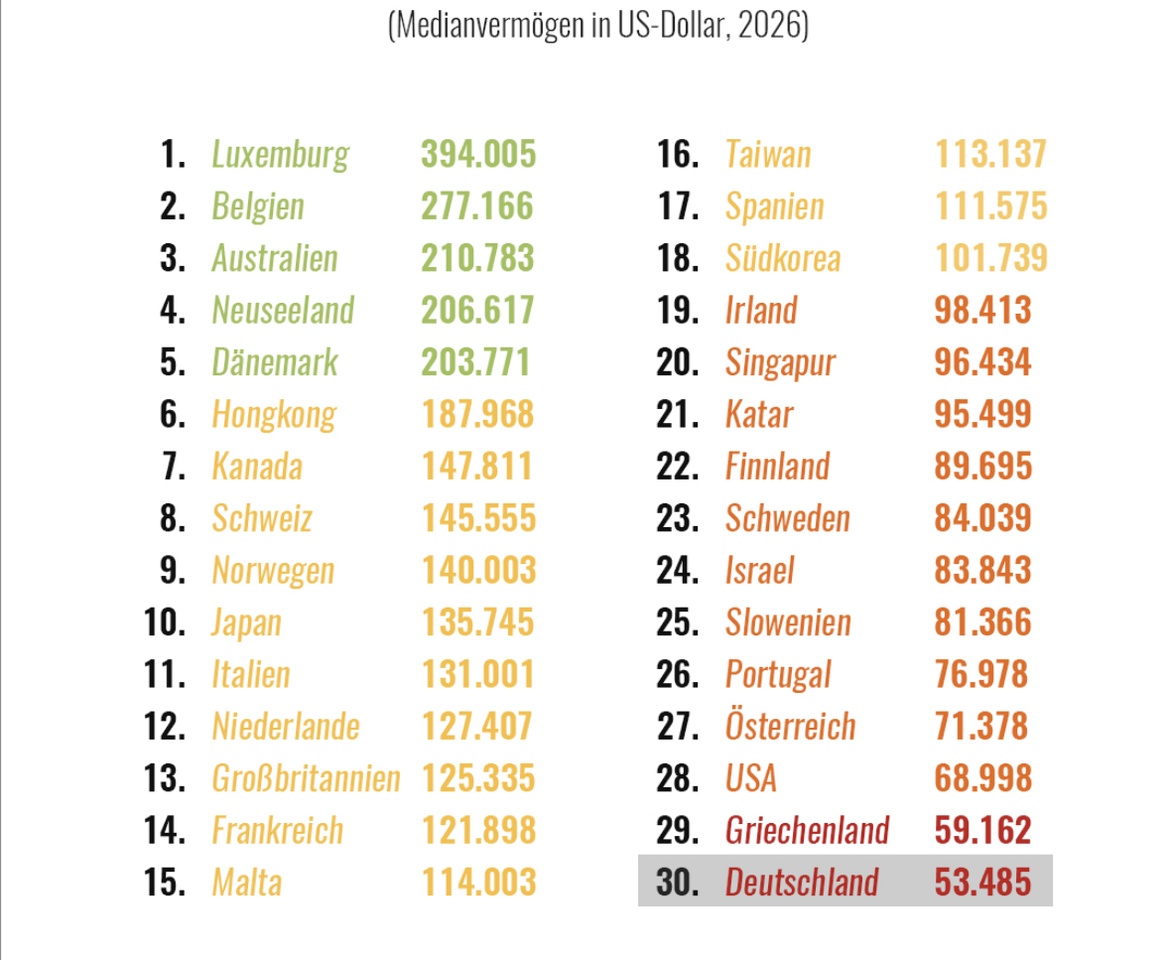
🇩🇪 Germany: A wealthy country—but ranked last in terms of median wealth.

You really have to look twice at this chart...


According to the UBS Wealth Report 2026, median wealth in Germany stands at just 53,485 U.S. dollars. That puts us in last place on this list—even behind Greece and miles behind the top spots... 🤕


And after all, we’re talking about Germany here—one of the world’s largest economies. And when it comes to the wealth of the average adult, things suddenly don’t look so rosy anymore. The reasons why this is the case are probably clear to most people... it starts with “S” and ends with “taxes.” But putting that aside…


When you scroll through this forum, you regularly see investment portfolios well above the median wealth, which is pretty cool—it means that most people here are doing quite well, at least financially (though there’s always room for improvement, of course 😉)…


But we mustn’t forget that, unfortunately, the majority isn’t doing so well, and many can barely afford to save even 50 euros a month. The image from the Wealth Report reminded me of that again.


Here’s the link to the report: https://www.ubs.com/global/de/media/display-page-ndp/de-20260630-gwr-2026.html


By the way, our median net worth has shrunk since 2020! That doesn’t bode well for the immediate future...
attachment
10
54 Comments

profile image
You absolutely must take into account what counts as assets in each country.
In Germany, the statutory pension is generally excluded. With an average of 20 years of benefits and 1,000 euros per month, that adds up to over 200k…
•
8
•
profile image
@Wealth-Accelerator Good point—that’s excluded in all countries, which makes sense to me in a way. The UBS Wealth Report measures only readily available assets (stocks, cash, real estate) that can be converted into cash at any time. Pension entitlements are excluded from that.

(By the way, I don’t consider my pension entitlements to be assets either... 😉)
•
3
•
profile image
@Part_Time_Joe Me neither 😉
I've just noticed many times that countries that already have something like a stock-based pension plan rank much higher, because it's factored into the calculation.
•
1
•
profile image
@Wealth-Accelerator So, according to the report, this is factored out—at least that's how I understood it. But if you take that into account, the order could certainly change again... it's quite possible 🙂
••
The results clearly show us that Germans pay too much in taxes and fees, and that the money is flowing out of Germany somewhere else...
How else can it be that a nation that has ranked third among the world’s economies for years is now in last place here...
•
5
•
profile image
Maybe it’s also because Germany has the lowest number of working hours per year. Productivity aside, working fewer and fewer hours and taking more and more vacation time speaks for itself.
By comparison: in Switzerland, people still work 40+ hours and, in many professions, are entitled to 20 days of vacation per year under collective bargaining agreements—not 28, 30, or 35 days. Some professions still can only dream of 100% paid sick leave.
Other countries have taxes, too. I used to do a lot of business in Italy. Compared to there, Germany is a land of milk and honey. Just as an example. Official statistics aside.
•
3
•
profile image
@Olli68 I don't quite understand the reasoning. From a macroeconomic perspective, you're right. That's why we're losing growth. But as an employee, you’re entering into a contract—let’s say for 4,000 euros a month? When it comes to building your wealth, it doesn’t matter whether you work 160 hours a month or just 140 hours. The latter is actually better for you...
••
profile image
@Part_Time_Joe But you won’t earn as much with 140 hours. At my company, 183 hours a month at 100% is actually the norm. That used to be the case in Germany, too.
And it should be a simple calculation that you can’t build up the same level of wealth with 140 hours.
On top of that, there’s the vacation comparison: 20 days instead of 30 days.
When you go to the doctor, you have to pay out of pocket first (I think up to about 800 CHF) until health insurance kicks in. In Germany, people take to the streets over 10 euros per quarter.
••
profile image
@Olli68 For me, there are two key issues:

1) How much of your salary can you save: The only things that matter to me here are: What’s your take-home pay at the end of the month, and how much can you save? Regardless of the number of hours worked, etc.

2) Work ethic: This is an issue that can negatively impact a country’s economic performance in the long term and is linked to many factors. In the broadest sense, it comes down to whether work is still worth it—and that, of course, is something that must be assessed on an individual basis.
••
profile image
@Part_Time_Joe Then we have different views. That’s okay, though.
All I can tell you is this: I’ve worked in various countries throughout my life and run my own business as a self-employed person.
In most countries, the prevailing belief was that if I wanted to earn more, I had to work harder—or work better. Go the extra mile, so to speak.
In Germany, there’s a culture of entitlement. Earn as much as possible, work as little as possible, get as many perks as possible, and get as much as possible for free. That’s why the unions in Germany are so strong.
And I’m sorry to say that your thoughts reinforce my conviction.
Maybe things will have to get really bad in Germany before people realize that prosperity doesn’t come from working as little as possible and having as much free time as possible.
•
2
•
profile image
@Olli68 But you have to distinguish between the self-employed and employees! For the self-employed, it’s probably true that… more work = more money (at least there’s a positive correlation). For employees, however, this is only true to a very limited extent. I can tell you about my employer, for example. It doesn’t matter at all whether I work 40 hours or 60 hours. Overtime isn’t paid. It also has no impact on promotions. On top of that, pay raises only come with promotions (there’s no adjustment for inflation). Where’s the incentive on an individual level to do more if it’s not worth it? Quite the opposite. The incentive structure actually pushes you to do less when the purchasing power of your salary declines every year due to inflation and higher taxes.

Ultimately, it’s an incentive problem. I don’t think people in Germany are lazier than in other countries. But people adapt to the system. That’s why communism doesn’t work, after all. If I’m not rewarded for working extra hours, I simply won’t work those extra hours anymore.
••
profile image
@Part_Time_Joe I think we agree on that. But is it really the government’s fault that the free market no longer operates on the principle of merit, but increasingly on the principle of entitlement? In that case, it doesn’t even matter how high taxes are.
Think about whether it’s really necessary in Germany for some retirees to receive more than 3,500 euros in pension payments—which, of course, are largely financed by taxes. It’s a matter of personal responsibility. But then people will surely argue that those individuals always paid in a lot, etc.
And this runs through many areas in Germany. Taxes could be quite a bit lower.
•
1
•
profile image
@Olli68 As long as the correlation holds (more work = more money), then yes. Then it (almost) doesn’t matter how high the taxes are—at least an extra or missing percentage point won’t make a difference.

I just don’t understand your point about pensions. Sure, there should be people who receive large pensions. The merit principle should apply there, too. Those who contribute a lot should also receive more. Above all, you can count these retirees on one hand. They’re certainly not the ones driving up costs (there are only 31,000 who receive more than 3,000 euros net).
••
profile image
@Part_Time_Joe Okay, so we’re really far apart on this. But I don’t really know how to explain it either. I believe you should deliver first, and then you’ll be rewarded. It’s just the principle of performance.
If I’m not rewarded (for my performance), the company isn’t right for me, and I’ll move on. That’s how I’ve done it throughout my career.
What you’re describing sounds more like an entitlement mentality. If I’m paid or rewarded accordingly, I’ll do more in return.
All I can tell you is that this works in Germany, but nowhere else.
••
profile image
@Olli68 Yeah, I think we have different opinions on this, but that’s okay! 😉 As for me, I enter into a contract with my employer. In exchange for X amount of work, I receive Y amount in salary. I want to be compensated for overtime. In my opinion, that’s more than fair. When you hire a contractor or someone like that to do something for you, they don’t do more than what was agreed upon. And for me, the relationship with my employer is exactly that—a kind of service contract.
•
2
•
profile image
It’s not the most popular opinion, but I still find it incredibly easy to make money in Germany. Anyone who wants to get ahead here can do so—even in the low-wage sector.

Let’s just take the minimum wage as an example: next year, it’ll be about 1,800 EUR net.
A part-time job brings in about 633 EUR—but due to hourly limits, you can only make about 500. So that would be 2,300 net, and that’s the lower limit. Do the math with salaries after you finish your apprenticeship or college.


Now find an employer who has a lot of work and, if necessary, lets you split 36 hours over 4 days—for example, you could work on Friday in a part-time job.

In the restaurant industry, you can also have a main job (gross) plus a side job (net) and double the tips (net).

There are so many ways in Germany to make 2,500–3,500 net. Just blaming politics and doing nothing won’t help.

Most problems can be solved on your own.
•
1
•
View all 2 further answers
It’s mostly down to ownership of real estate (namely primary residences). That explains why Spain has a higher median wealth than Germany despite having substantially lower average wages.
•
3
•
profile image
But maybe it's also because people have been living beyond their means for years—the main thing is to have the biggest car in the driveway and live in a house big enough for five families.
•
2
•
profile image
I think a lot of people would disagree with you on that.
•
3
•
profile image
@Part_Time_Joe It's possible, but let's take a different look at non-existent wealth and excessive consumption
••
profile image
@GoDividend Sure! But as far as I know, nobody in my circle really lives on credit. Sure, you’re deliberately exaggerating a bit here, but it’s not like everyone is driving a leased Porsche or living in a rented mansion (btw, I’d really love it if more people bought leased Porsches—as a shareholder, that is 😉).
•
2
•
profile image
@Part_Time_Joe I’m thinking more along the lines of renting a 100-square-meter apartment for two people, but also complaining about rent prices. At the same time, financing a car that costs 60,000 euros and, in the process, not being able to save anything because, after all, you have to live, and you can’t miss out on a long-distance vacation.

That’s just not going to work.
•
3
•
profile image
@GoDividend I get it. But how many people actually live like that? I just looked it up on Google. The average size of a rental apartment is 74 square meters—for two people. That’s not exactly excessive, in my opinion...

I’m all for incorporating frugality into your life in some way. But many people don’t have the option to do so without it turning into real deprivation. And you should be allowed to enjoy life every now and then.
•
1
•
profile image
@Part_Time_Joe Right...

So let's blame this shortfall on taxes and savings account assets instead of a lack of a stock market culture.

I think that's the real point. The other thing was just an anecdote that sometimes catches your attention.
••
profile image
@GoDividend In my opinion, one doesn't rule out the other. If I have more take-home pay from my gross income, I can invest more in stocks. And the lack of a stock market culture is, after all, a result of political decisions. After all, "the pension" was promoted. The debate over raising the capital gains tax—or taxing capital gains at the individual income tax rate—and potential social security contributions on those gains certainly doesn’t help change that either!

If they’d wanted to, they could have introduced a system like the one in the U.S., where you can buy stocks more or less tax-free in a special retirement account. But they didn’t do any of that.
•
2
•
@Part_Time_Joe That's interesting—I'm a square meter over that. But I live there alone. If there were two of us, I think I'd get claustrophobic.
••
profile image
@Solitair You're raising the bar! For that to work out, four people would have to live in a 75-square-meter space... 😉
••
@Part_Time_Joe I could always move to Luxembourg
•
1
•
View all 3 further answers
profile image
This isn't about labor productivity—that's complete nonsense—but rather about the fact that it's made far too easy for wealthy heirs to get away with paying minimal inheritance taxes. And labor is taxed far too heavily, while wealth isn’t taxed at all. So I share your view: It’s mainly due to taxes that lead to more and more wealth being concentrated in the hands of fewer and fewer people.

Beyond that, however, there are a few other reasons as well.
•
2
•
The most obvious explanation is to exclude the statutory pension. In most of these statistics, Germany is at a disadvantage because the pension systems in most other countries are based on financial investments, whereas our system consists of entitlements owed by the government.
•
1
•
profile image
Germans are mostly renters, not homeowners. They are savers, but not investors. They are engineers, but not entrepreneurs. None of this is really good.

And unfortunately, we also have a huge tax burden caused by a government that throws money around with both hands and maintains an unbelievable bureaucratic apparatus that costs us a fortune.

“German diligence” is, unfortunately, often more of a myth than reality. Compared to other countries, we have an extremely large amount of vacation time. When I look at some of our neighboring countries—for example, the Czech Republic or Poland—they really put their all into it and want to achieve something. Many of our people are simply “satisfied”—unfortunately!
•
1
•
profile image
Germany’s low median wealth deserves attention. However, the conclusions drawn go too far: 30th place on a top-30 list is not the lowest ranking in the world. Furthermore, greater wealth does not automatically mean a higher standard of living: According to Eurostat, 28.9% of the population in Greece was overburdened by housing costs in 2024, compared to 12% in Germany.

Taxes and social security contributions also fund health care, old-age pensions, and a basic income guarantee designed to ensure a minimum standard of living, including social participation. A pure wealth ranking does not fully reflect this level of protection; statutory pension entitlements are generally missing. The scope and accessibility of such benefits vary internationally. The study does not substantiate the claim that taxes are solely to blame or that this implies the majority is unable to save.
•
1
•
profile image
@comerciante A well-thought-out, well-written answer. Please post more often... 👈 😉
••
profile image
••
profile image
@investingbeginner well it's not clustered by age. They look at the median wealth of all adults (working force). Of course if you look at the ones 60 year's old they will be wealthier than the 20 year old ones on average.
•
1
•
profile image
What kind of nonsense is that?
Germany is in last place because of taxes? Take a look at what's going on in the other countries.
••
profile image
@Alpalaka Does Germany have one of the highest tax rates in the world? You can't save whatever you have to pay in taxes, after all.
•
1
•
profile image
@Part_Time_Joe I see it differently: https://de.wikipedia.org/wiki/Liste_der_L%C3%A4nder_nach_Steuerquote

Are those nasty, nasty taxes really to blame for coming in last place?
••
profile image
@Part_Time_Joe Belgium, Denmark, and Norway have that, too.
••
profile image
@Alpalaka It depends a bit on what is being measured and how. From my perspective, when it comes to saving, the taxation of my income is particularly relevant (since that’s the only thing I can save). In this regard, Germany ranks second with a tax-to-income ratio of 53%.
••
profile image
@Part_Time_Joe But then “tax rate” is the wrong term.
That’s when you realize that simply using the word “taxes” can’t be a valid reason for creating a table.

As far as I know, Belgium is in first place, but in your table it’s in second place. Is it really the corporate tax’s fault?
•
1
•
profile image
@Alpalaka Taxes and social security contributions are certainly not the only reason, but they are one of the reasons—and there’s much more to it than that. You could write a 100-page essay on the subject. Another reason is the homeownership rate, which is twice as high in southern countries, or elder care (which the family takes on). However, reducing the tax and social security burden is the most effective lever in the short term!
•
1
•
Why does the American have so little? And why does the Dane have so much, despite record-high taxes?
••
profile image
@asset_sage_smmad Relatively simple (you could have Googled it ;)) In Denmark, retirement savings are included in net worth because they are funded. Pay-as-you-go systems are not included. The second reason is real estate prices, which have risen dramatically there in the past. This means that saving from one’s net income (which is difficult due to taxes) isn’t really that necessary.
••
The source shows something completely different from your graph
••
Take Belgium, for example. There's no way any of that could be true.
••
The U.S. is ranked 28th. That's nonsense.
••
profile image
@market_genius_2449 Why don't you take a look at the UBS Wealth Report? You can read all about it there in detail. The methodology is included as well.
••
profile image
It's really mind boggling. With a median salary that is double the one of countries such as Italy, Spain, Japan, how can it be that less is left in the pockets of people? Taxes? Italy has a pretty high tax rate as well. The only thing I can think about is people living above their means, borrowing to afford what they want. I really cannot believe that all the 40/50k auto that I see around are self financed. Similar to houses, it would be interesting to find a study about this, but if we compare for example the average German vs Italian home owner I have the feeling that the Germans have many more square meters in their name. I live and work in Germany as well, I can easily save 1000 euros/month, and this would still allow me for a high spending Life-Style. By staying in a small apartment and keeping an eye on my expenses I can almost double that number. I'm really puzzled by this statistics
••
Join the conversation