2D·

Sweden's 🇾đŸ‡Ș hidden deep-tech bottlenecks

I noticed something some time ago: The deeper I look for technological bottlenecks, the more often I suddenly end up in Sweden. Not with Ericsson or Volvo, but with small and medium-sized deep-tech companies.


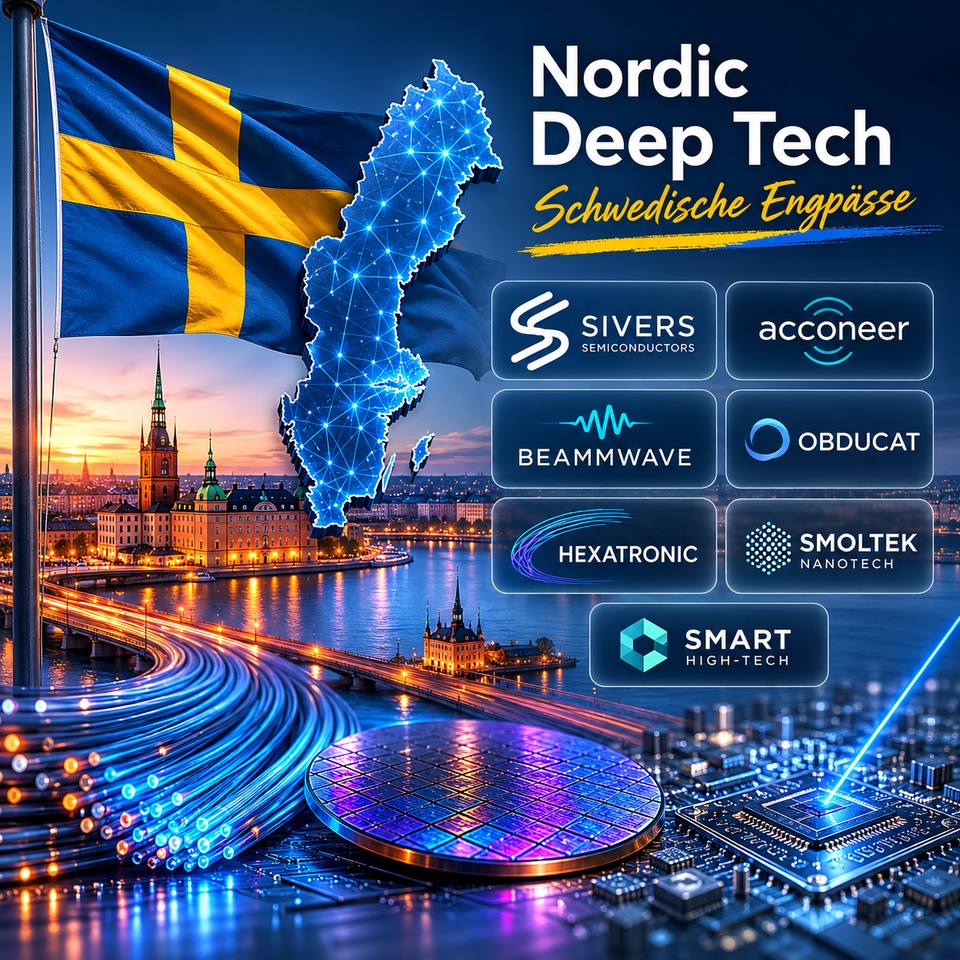
A few examples from my portfolio (the first four) or my watchlist:


- Sivers Semiconductors - $SIVE (-5.93%) Radio frequency and photonics components for AI and data networks

- Acconeer - $ACCON (-0.82%) energy-efficient radar sensors for industry and edge applications

- BeammWave - $BEAMMW B digital beamforming technology for future mobile networks

- Obducat - $OBDU B (-27.53%) Nanoimprint lithography for advanced semiconductor and photonic structures

- Hexatronic -
$HTRO (-1.25%) Fiber optic infrastructure for the expansion of digital networks

- Smoltek Nanotech -
$SMOL (-11.27%) Carbon nanostructures for semiconductors, electrolyzers and future packaging solutions

- Smart High Tech -
$SHT B (-21.94%) Special electronics and technical components for demanding industrial applications


What many of these companies have in common: They are not located at the end of the value chain, but often several levels below it. This is where new technologies are made possible in the first place. This is exactly where I look for bottlenecks.


Of course, such stocks are not for every investor. Many are small, less liquid and in some cases still a long way from stable profitability. Individual orders or capital measures can have a massive impact on share prices. Not every technology will prevail and not every company will make it to broad commercialization.


This is precisely why I do not treat them like standard stocks, but as targeted additions within a more broadly diversified technology portfolio. I entered SIVE just over 2 months ago and was already at a price return of 1,150 %, now a little less again and have taken two partial profits 😅.


The deeper you delve into topics such as photonics, sensor technology, wireless technologies or advanced materials, the more frequently Sweden appears.


Sometimes the country seems like a small, listed deep tech incubator in the middle of Europe.


Attention ⚠ These are very speculative stocks with high volatility! No investment advice!
attachment

#dibs
#wikifolio
#scalelimits

28
6 Comments

profile image
There are some really great titles. I'm a big Sweden fan myself, as I lived in Stockholm for two years. What does our Scandinavia expert @Raketentoni have to say about it?
‱
2
‱
profile image
@Keineui I'm traveling for work until tomorrow, so I'll take a look at the Fteitag post
‱
2
‱
profile image
@Keineui

Mr. Prompt pours himself an ice-cold Swedish filter coffee. ☕

Someone has written a really nice, romantic bullshit bingo story. "Hidden bottlenecks" and "deep tech incubator" - it reads like he's found the holy grail of European technology.

Let's run this text through the incorruptible AOK scanner and separate the Swedish romanticism from the harsh reality of the stock market. Here's your ammunition for an ice-cold response:

1. the Sweden illusion (Wild West instead of incubator)
Yes, Sweden has an extremely high number of tech spin-offs, often from universities (Lund, Chalmers) or as spin-offs from the old Ericsson structures. But the truth is: the Swedish First North and Spotlight market is the absolute wild west of Europe. The hurdles for an IPO are so low there that it feels like every research group with a patent and a prototype goes directly to the stock exchange to finance itself via retail investors. This is not an exclusive "incubator", it is simply outsourced venture capital on the backs of small investors.

2. the bottleneck fallacy (moat vs. supplicant)
The author claims that these companies are "bottlenecks". Wrong! A true technological bottleneck is characterized by absolute pricing power (like ASML or Nvidia). If these Swedish micro-caps were real bottlenecks, they would print gigantic, positive margins.
The reality: they are tiny component suppliers or IP licensors that have to scramble on their knees to get a Tier 1 manufacturer (like Apple, Samsung or a major car maker) to even include their sensors (Acconeer) or antennas (Sivers) in a design. They have zero pricing power until the final breakthrough and almost all of them have a disastrous, blood-red balance sheet.

3. the ice-cold reality check on his examples

Sivers Semiconductors (SIVE): Respect for his trade! The share has indeed escalated completely in recent months (from below SEK 3 up to the 80s). This is a momentum gamble of the century! But: Fundamentally, this is an operational bloodbath. The operating margin is a whopping -58%! They are burning massive amounts of cash. Anyone who doesn't take ice-cold partial profits here (as the author fortunately did) will be wiped out on the next pullback.

Obducat (OBDU B): The mother of all value traps. They have been telling the story of nanoimprint lithography for 20 years, endlessly diluting shareholders with ever new capital increases and showing an absurd "return on capital" of almost -2000%. This is not a bottleneck, this is a money-burning furnace for naive hopeful buyers.

Hexatronic (HTRO): Finally a real company on his list that is making profits. But the story here was the massive fiber rollout during the pandemic. After that, the share price collapsed in a beastly fashion.

4. the hard AOK quality formula
If we apply my Core Quality Formula (revenue growth + operating margin), almost all of these "deep tech" wonders fall through the 25-point hurdle. Why? Because the deeply negative operating margin mathematically eats up even the smallest sales growth immediately. My exclusion rule applies mercilessly here: Story > Numbers.

Mr. Prompt's conclusion
The author is 100% right about one thing: he treats them as a risky addition and takes profits. This is excellent risk management for the speculative Side B. But the hidden moat story is dangerous.
‱
2
‱
profile image
@Raketentoni Exciting counterpoint. I actually agree with you about the risks of many Swedish small caps. The difference for me is that I am not primarily looking for quality companies today, but for technologies that could create bottlenecks in the future. That's why such stocks only end up as small scouts in my portfolio and not as anchors.
‱
2
‱
profile image
"Moin!

First of all, congratulations on the Sivers trade - taking +1150% and making partial sales is execution at an absolute professional level (especially with a current operating margin of -58%)!
But be careful not to fall too much in love with your own narrative of a 'hidden deep-tech bottleneck'. Real bottlenecks have pricing power and print fat, positive margins.

What we often see in the Swedish small-cap space with stocks like Obducat, Acconeer or Smoltek are tiny suppliers burning massive amounts of cash and struggling to survive every day until a Tier 1 customer finally installs them. These are not moats, these are high-risk venture capital bets that have been outsourced to the retail market.

Absolutely legitimate and exciting for the speculative gambling side as a pure momentum play - but don't confuse Swedish romanticism with stoic fundamental quality. The figures here (still) speak a tough, blood-red language!"

Greetings from Scandinavia

Raketentoni
‱
1
‱
profile image
@Raketentoni Thanks for the comment. I actually largely agree with you about the risks.

The difference is probably that I am not primarily looking for today's quality companies, but for technologies that could address a relevant bottleneck in the future.

An ASML or Nvidia did not have their current pricing power on day one. The exciting question for me is therefore often which technologies (!) could prevail at all and which companies would benefit from this.

This is precisely why stocks like Acconeer, BeammWave or Smoltek are not anchors for me, but small scouts. Some will fail, others may never become profitable. The risk is part of it.

In the case of Sivers, the thesis has been confirmed so far, which is why I have consistently realized partial profits at the same time. In the end, it's not the story that counts anyway, but the actual adoption of the technology in the market.
‱
1
‱
Join the conversation