
Good morning, everyone,
To kick off the week, here’s an introduction to a company that’s not entirely unknown to many of you.
Are you already familiar with this company, and what do you think of it?
When I look at Samsara , I see one of the most exciting bets on the second wave of AI: the leap of artificial intelligence from purely digital processes into the real world. Simply put, the company operates a cloud-based platform that enables corporations to centrally monitor and control their vehicles, machinery, locations, and field staff via sensors—in industries that together account for over 40% of global economic output. The most recent quarter has convinced me: 30% growth in recurring revenue.
The portfolio ranges from telematics solutions for vehicle fleets to sensor technology for logistics and construction sites, as well as intelligent safety and efficiency systems. New AI-powered tools for fleet navigation, asset maintenance, and workplace safety are currently driving an increase in new customers.
Physical AI is accelerating growth, and large enterprise customers are driving record results.
Record with large enterprise customers: Samsara has acquired 242 new customers with more than $100,000 in ARR and 20 with more than $1 million in ARR—both quarterly records. AI products are driving new business: New products already account for more than 20% of newly signed annual contract value (ACV), while usage of new AI features has more than quadrupled in two months. The platform is gaining traction: 96% of large customers use at least two Samsara products, and ARR from million-dollar customers has been growing for three consecutive quarters.

380,000+ accidents prevented
Supported by AI-powered dashcams, real-time in-cab alerts, automated coaching, and other safety technologies that help operators proactively reduce risky behaviors.
Samsara Inc. operates a connected operations platform—an open platform that connects employees, assets, and operating systems, enabling the derivation of actionable insights and the optimization of operational processes. It consolidates data from IoT (Internet of Things) devices, connected assets, and third-party systems, and enables companies to access, analyze, and act on this data using cloud dashboards, custom notifications and reports, mobile apps, and workflows. The suite of applications and agents enables companies to implement a digital, cloud-based strategy across their entire operation. The solution connects physical operational data to a connected operations platform consisting of the data platform, the applications, and the agents. The data platform collects, aggregates, and enriches data from IoT devices, connected assets, and third-party systems, making this data usable for specific use cases via applications and agents. It serves the construction, transportation and logistics, field service, and food and beverage industries.
Number of employees: 4,100
Latest News
Samsara Inc. – Samsara Tracking-Label zu den besten Erfindungen 2026 von TIME benannt
Samsara Inc. – Die Einführung von Samsara-KI-Agenten beschleunigt sich in den physischen Abläufen
Samsara’s agent-based capabilities now reach people wherever work takes place:
- Samsara Assistant answering questions in the dashboard and turning them into action. Pre-built agents handle general safety, maintenance, and compliance tasks.
- Agent Studio provides teams with a developer for custom chat and voice agents tailored specifically to their operations, and extends AI beyond the dashboard to the field.
- The recently launched Samsara MCP transfers live Samsara data—within each customer’s existing permissions—to the AI tools their teams already use, including Claude, ChatGPT, and Copilot.
Everyone operates within the same operational context and permission model, whether they’re speaking with an agent on the go, working in the Samsara dashboard, or using another AI tool.
Samsara Inc., Q2 2027 Earnings Call, Sep 03, 2026
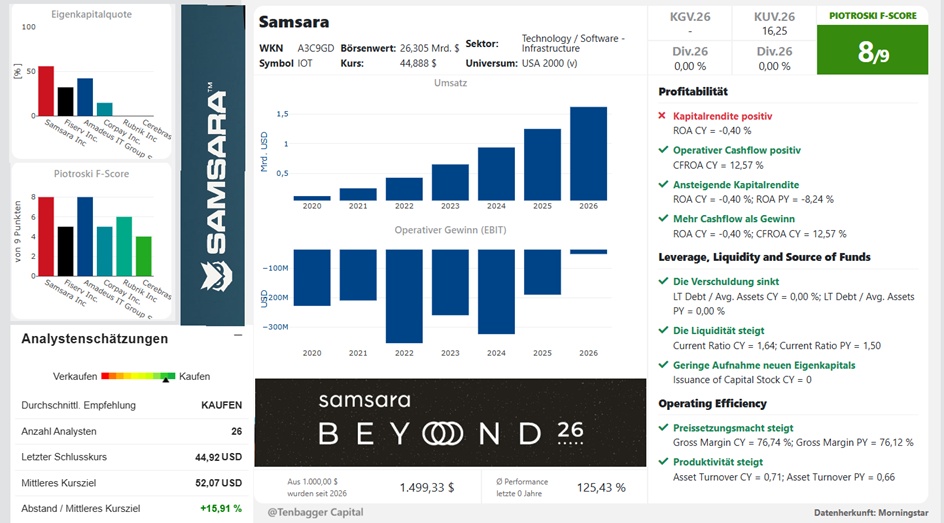
The publication date is March 5, 2026, so forecast revisions are not yet included here.
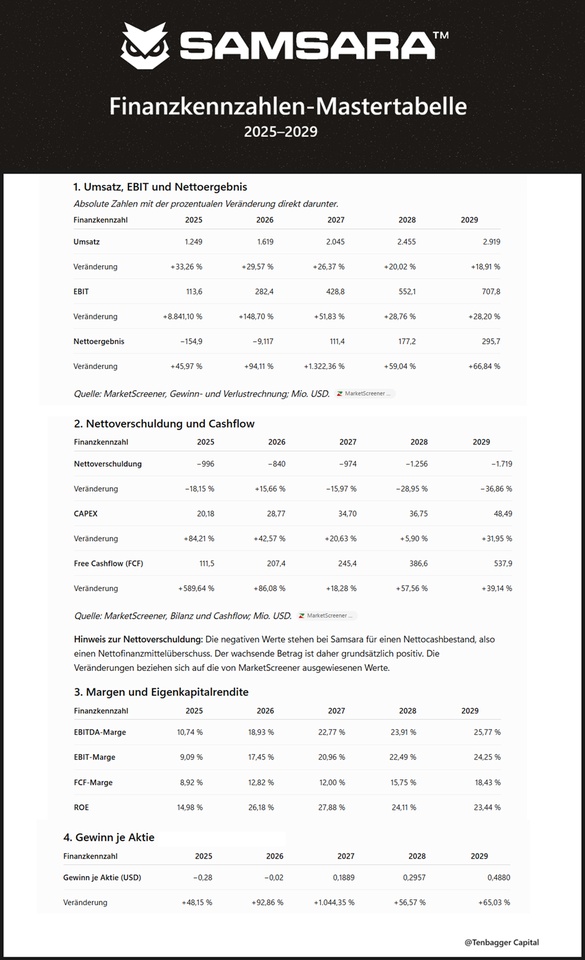
5. My Assessment for the 2036 Portfolio
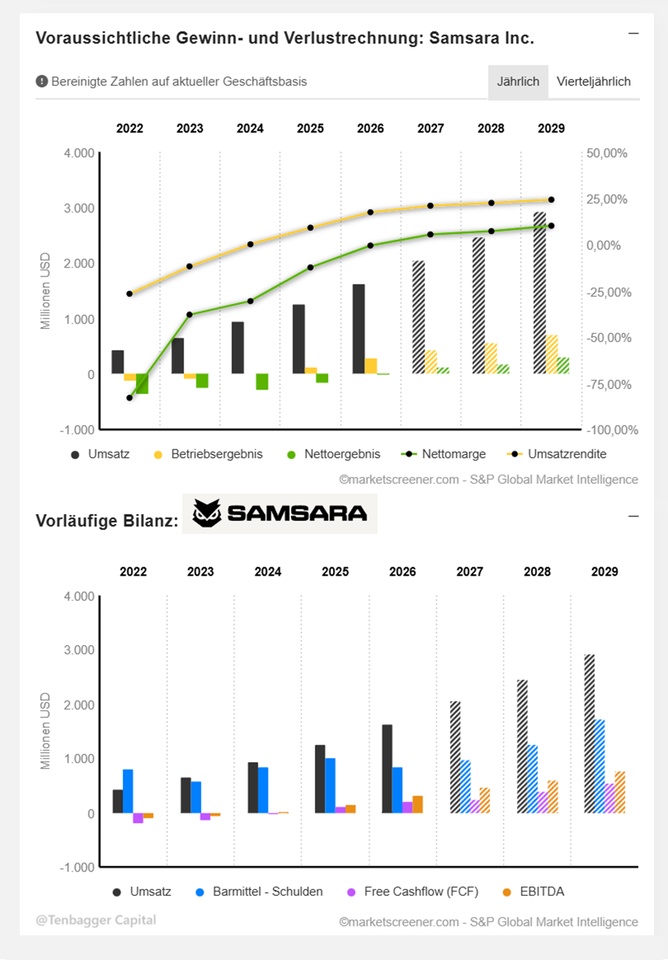
The forecasts show a significant improvement in Samsara’s operating profitability.
Change 2025–2029:
Revenue +133.7%
EBIT +523.1%
Free cash flow +382.4%
EBITDA margin +15.03 percentage points
EBIT margin +15.16 percentage points
(Changes for 2025–2029 calculated based on reported annual figures.)
What particularly stands out to me
- Growth: Revenue is expected to rise to $2.919 billion by 2029. That represents more than a doubling compared to 2025.
- Operating leverage: According to the forecast, EBIT is growing significantly faster than revenue. The rising margins point to economies of scale.
- Cash Flow: Free cash flow is expected to reach USD 537.9 million in 2029. That would represent a significant increase compared to 2025.
- Profitability: Net income is expected to shift from losses to profits. MarketScreener is already forecasting a net profit of 111.4 million USD for 2027.
- Return on Equity: According to estimates, ROE will peak at 27.88% in 2027 and will still stand at 23.44% in 2029.
My Conclusion
- Samsara shows an interesting pattern in this forecast: strong revenue growth, rising operating margins, and robust growth in free cash flow.
- For a long-term investment decision, however, I would weigh this trend against the current valuation. The figures are forecasts and do not guarantee actual business performance.
Data source: Exclusively from the MarketScreener link, using the publication date of March 5, 2026, as a reference for the estimates at that time.
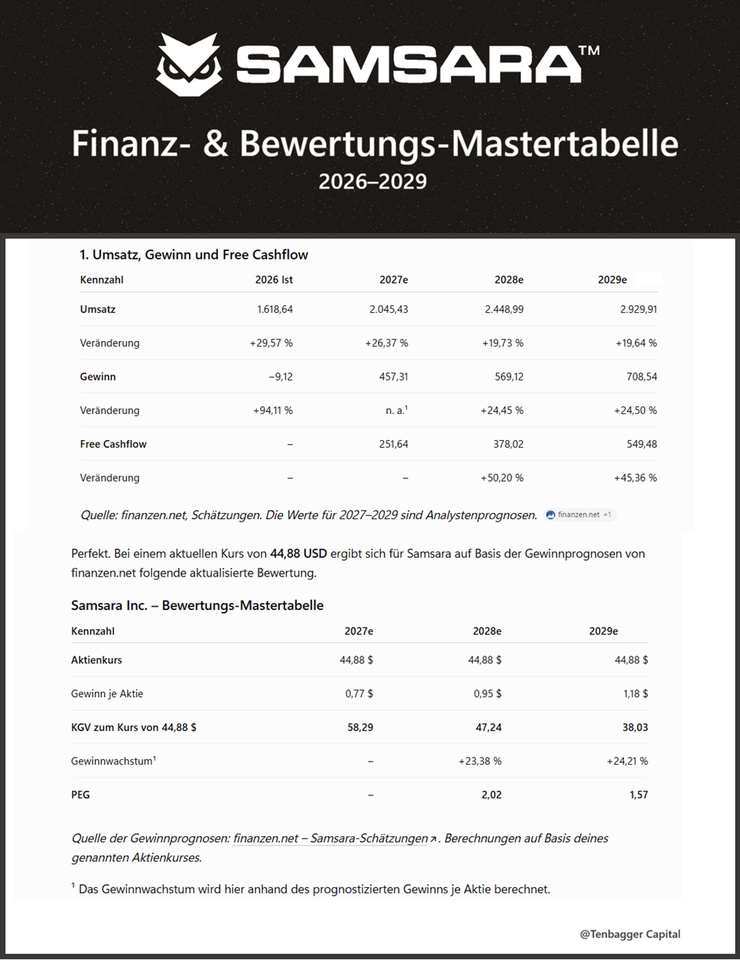
My assessment for the 2036 portfolio
- 2027: With a P/E ratio of around 58, Samsara is ambitiously valued.
- 2028: The P/E ratio falls to about 47. The valuation remains high.
- 2029: With a P/E ratio of around 38, the valuation continues to decline, provided that earnings forecasts are met.
My conclusion: Samsara must continue to grow strongly to justify its current valuation. A PEG of about 1.57 for 2029 would be significantly more attractive than a PEG above 2, provided the projected earnings growth is actually achieved.
Important: The PEG is a simplified valuation metric. Here, I calculate it as the P/E ratio divided by the annual percentage growth in EPS. It is therefore my own calculation and not a value reported directly by finanzen.net.
39.60 EUR -0.40 EUR -1.00%
07:38:04
October 26, 2026
44.88 USD +1.09 USD
