

Reading time: about 4–5 minutes
Anyone who buys a stock and later sells it at a profit has generated a return. That’s the simple version. The more interesting question is: Where did this return actually come from?
Depending on the source of a return, it varies in terms of reliability, repeatability, and risk. If you don’t distinguish between these sources, you’ll make poorer decisions about when to hold a position and when not to.
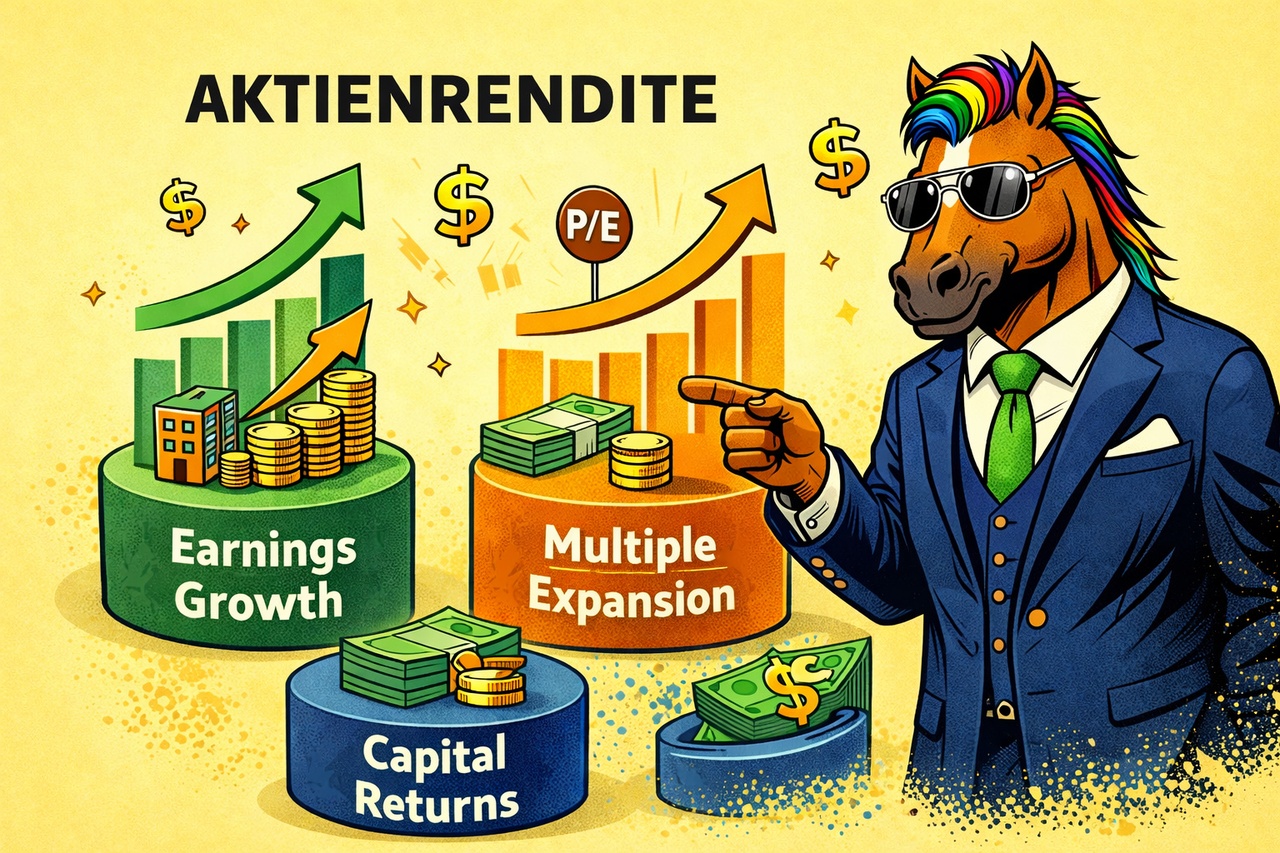
Essentially, there are three sources of stock returns.
The first is earnings growth. The company is earning more than before. Revenue is rising, margins are improving, and profits are growing. The stock price follows suit because a company that earns more is simply worth more.
The second is multiple expansion. The company isn’t necessarily earning more, but the market is paying a higher price for the same profit. The price-to-earnings ratio rises. The valuation expands.
The third is capital return. The company distributes profits or repurchases its own shares. Dividends and buybacks increase the value per share without requiring operational growth.
In practice, these three sources rarely operate in isolation. They overlap, reinforce one another, or work against each other. Nevertheless, it is worth distinguishing between them.
In the long term, earnings growth is the most robust of the three sources. A company that increases its earnings over many years is highly likely to see its stock price rise as well. Markets may react irrationally in the short term. Over five, ten, or fifteen years, however, stock prices almost always follow earnings growth.
$GOOGL (-0.22%) (Alphabet) is a good example. Anyone who bought the stock ten years ago achieved a return of well over 500 percent. The vast majority of that return did not come from changes in valuation. It came because Alphabet systematically earned more. Revenue has multiplied, operational levers have improved margins, and the cloud segment has grown from zero to billions.
Earnings growth is sustainable because it’s based on operational realities, not market psychology. At the same time, it’s harder to achieve. Not every company grows. And even good companies don’t grow at high rates forever.
Multiple expansion is the source that can generate the highest returns in the short term. But it is also the most unreliable.
Here’s a simple example. A company earns ten euros per share. The market values it at a P/E ratio of 15, and the share price is 150 euros. If the P/E ratio rises to 22 without any change in earnings, the share price suddenly stands at 220 euros. That’s a return of nearly 47 percent, even though the company hasn’t earned a single additional euro from operations.
Periods of falling interest rates favor higher multiples. Improved sentiment, new narratives, or capital inflows into an industry can drive valuations higher. Those who are well-positioned can achieve rapid and impressive gains.
The problem is reversibility. What has been created by valuation expansion can disappear just as quickly through valuation contraction.
$CCO (+1.06%) (Cameco) and other uranium producers did not just benefit from rising spot prices between 2020 and 2024. A significant portion of their share price gains resulted from multiple expansion. The market began to take the structural supply deficit seriously and paid higher valuations for it. Those who positioned themselves early benefited from both sources simultaneously: rising profits and rising multiples. Those who entered late were already paying for the narrative.
In my portfolio, this is one of the lessons I’ve internalized from the uranium sector. The structural arguments remain intact. But returns driven by multiple expansion should be evaluated differently from returns driven by operational improvements. The first source can reverse quickly. The second is more fundamentally anchored.
The third source is most often underestimated, especially by investors focused on growth.
When a company repurchases its own shares, the number of outstanding shares decreases. This increases earnings per share, even if total earnings remain constant. Over many years, this effect can be significant.
$HON (+0.89%) (Honeywell) is an example. The company is growing at a moderate pace. But over the past few years, Honeywell has systematically returned capital to shareholders through dividends and buybacks. Part of the return on this position did not come from spectacular growth, but from this mechanism: a high-quality company that uses its free cash flow in a disciplined manner.
If a company can find no better use for its capital than repurchasing its own shares, that is often a rational decision—provided the stock is not massively overvalued. A buyback at an inflated valuation destroys value; at a fair or undervalued price, it creates it.
The most attractive investments are often those where all three sources are at work simultaneously. A company that is growing, fairly valued, and also returning capital offers a structurally favorable opportunity profile. $GOOGL (-0.22%) Alphabet is another good example. Growth has been the dominant source for many years. In recent years, Alphabet has also begun repurchasing significant amounts of its own shares. The return of capital has become a complementary source, without replacing the growth narrative.
The reverse pattern is just as important. If a return has stemmed almost exclusively from multiple expansion, the position is more vulnerable to shifts in sentiment, even if nothing has changed operationally.
That’s why I regularly ask myself this question regarding my positions: Where did the return to date come from? And what source will drive future returns?
In hindsight, stock returns often look the same. A stock rises by 80 percent. But that 80 percent can come from completely different sources. From earnings growth, which is likely to continue. From valuation expansion, which can reverse at any time. Or from capital returns that are structurally embedded. Earnings growth unfolds its value over time. Valuation expansion unfolds it quickly and takes it away just as quickly.
Capital returns work quietly but reliably in the background.
The next post will examine the second of these sources in detail. Valuation expansion is the phenomenon that generates the highest returns in the short term and is, at the same time, the least understood. What really drives changes in valuations? And when do investors pay for it without even realizing it?


