1D·

The bull market as camouflage - Why structural problems remain invisible for so long

Reading time: approx. 3 minutes
attachment

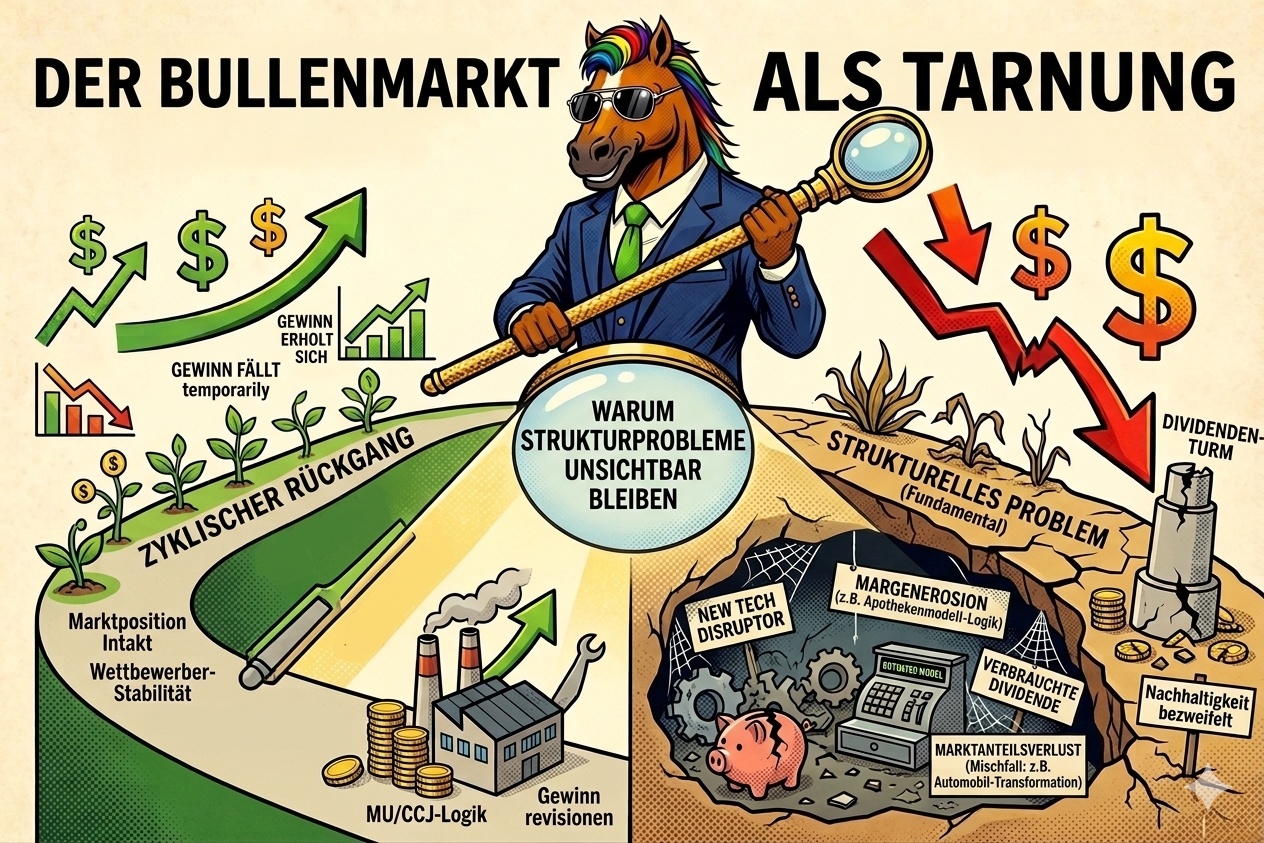
There is one mistake that I consider to be one of the most expensive in investing: confusing a cyclical downturn with a structural problem. Or vice versa. Both cost money, but in very different ways.


The cyclical downturn is temporary. A company earns less because demand is currently weak. The business model is intact, as is the competitive position. Profits recover when the cycle turns. If you sell during this phase, you make a loss and miss out on the recovery.


The structural problem is something else. Here, something fundamental changes in the business model itself. A competitor makes the product redundant, or demand disappears permanently. Profits do not recover because there is nothing to recover. Those who hold on in this phase are waiting for a normalization that never comes.


The difficulty: both look identical on the chart. Price falls, sentiment turns. The difference lies not in the price trend, but in the cause.


I therefore start with a simple question: does the company have a problem, or does the sector have a problem? And if the industry has a problem: Does it resolve itself because it arises from oversupply or temporary weakness in demand? Or is it permanent because a competitor or a technology is changing the basis of the business model?


$MU (-2.19%) Micron Technology is perhaps the most textbook example of the first case. The memory chip market operates in periods of pronounced oversupply and shortage. When prices fall, Micron's numbers look catastrophic. When they rise, profits explode. 2022 was brutal. Demand collapsed, stocks piled up, analysts outbid each other with price target cuts. Anyone who sold back then and bought again in 2023 incurred transaction costs twice and still missed out on the recovery. The core business was never fundamentally called into question.


$CCO (+7.23%) follows a similar logic, with an important overlay. The uranium cycle is slower and politically driven. After Fukushima, it took the market years to separate structural demand from political sentiment. Reactors were shut down and the uranium price collapsed. For many, this looked like a structural problem. But it wasn't. The demand for electricity remained. Nuclear power as a technology remained. What changed was the perception. When that changed, so did the cycle. Those who understood the difference took the reassessment with them.


$CVS (-0.98%) is the counterexample. The pharmacy model has been under pressure for years: pharmacy benefit managers are squeezing margins, bricks-and-mortar retail is losing footfall and the core business is shrinking. CVS is still operating on a large scale and delivering sales. But the market is increasingly pricing in structural margin erosion and regulatory risk, and for good reason. Despite this, CVS was traded as a cheap dividend stock for years. The high dividend yield was seen as a selling point. However, an unusually high dividend yield is often more an indication that the market doubts the sustainability of the payout. This was confirmed in the case of CVS. Anyone waiting for the cyclical recovery was waiting for something that structurally could not come.


$VOW (-0.54%) is the more difficult case, and therefore instructive in another way. The loss of market share in China to BYD and other local manufacturers has a structural core: Chinese suppliers are now competitive in terms of quality and price, this is not a temporary phenomenon. At the same time, a cyclical decline in demand in the premium segment is overshadowing the structural issue in the short term. The two cannot be clearly separated. This makes VW a mixed case: structural core, cyclical overlay. This is not a failure of analysis, this is the reality of many companies in transformation phases. And that is precisely why, in a case like this, I need to at least know which part I attribute to the cycle and which to structural change. Without this separation, a position size can hardly be justified.


What I avoid is holding a cyclical with structural arguments when the cycle is recovering. This is the most common form of self-deception. The story sounds convincing, the share price rises, and at some point you realize that you didn't understand the sector but only participated in the bull market.


The tool that helps me most with this distinction is earnings revisions. That's what the next article is about.

21
18 Comments

profile image
Thanks, always exciting. I had Micron and also aixtron in my portfolio when nobody wanted the shares. It's nice to see how the PEG is getting smaller and smaller. But let me tell you, the stock market is pricing in the future. I had to wait a long time for investors to rediscover both shares. Micron could even become a non-cyclical. But at the moment I have the impression that a cyclical picture is creeping into the charts of some of our very popular moat stocks. Perhaps an exciting topic for a change.
‱
2
‱
profile image
@Tenbagger2024 Congratulations on the timing, e.g. with Micron! You have to sit it out while everyone else looks the other way. The fact that the stock market always prices in everything is apparently not always correct! Sometimes the market needs someone to turn on the lights. Your thought about the popular quality stocks that suddenly seem cyclical is spot on. Maybe some of them are crumbling?
‱
1
‱
profile image
@schlimmschlimm Hello my dear. Yes, just the values where the moat seems to be cracking. A good example here would be $CSU, $FICO where AI causes the cracks. But with values like $CTAS or $UFPT I can't quite understand the long correction. I also sit it out with these values. With Micron, I have always seen the great valuation compared to the growth rates. And I asked myself what you see here that investors don't see. And now I know that everything is still fine with my eyes. Diving for pearls means recognizing good fundamental key figures early on.
‱
3
‱
profile image
@schlimmschlimm @Aktienhauptmeister Many people may be a little annoyed by my many company presentations. But they often mean the same thing as with micron. A company with good fundamental figures, still ahead of the masses.
‱
3
‱
profile image
@Tenbagger2024 You know my opinion, my dear. I'm certainly not annoyed. You can't have enough of companies that you don't really have on your radar. There's definitely something for everyone - you just have to "sort out" what makes the most sense for your portfolio and what doesn't. But that doesn't mean that your company ideas are bad.
On the contrary, I'm grateful that you go on the hunt for us to find and present undiscovered gemsđŸ«
‱
5
‱
profile image
@Aktienhauptmeister I have nothing to add to that. That's exactly how you should see it. We can be glad that we become aware of such companies through the high quality search by the dear @Tenbagger2024. Everyone has to decide for themselves what to do with it. Ignore it or edit it and put it on the WL. And one thing has to be said, many of them have been high-quality hits so far.
‱
3
‱
profile image
@Tenbagger2024 That's the right attitude and it also somehow proves that you're not so wrong. If the fundamentals are right, waiting is really just a question of discipline - even if it sometimes feels like an eternity. With $CSU and $FICO, the AI debate is actually tipping the scales, but there are other examples too: Is it just a brief scare or is the moat really crumbling? It is often the case that the market simply lets the air out after extreme runs without much changing operationally. Sitting it out is often the best strategy as long as the figures don't show any cracks. Your Micron case proves you absolutely right in retrospect! Just to name one ;-) The selection of companies you present is already very large and that means a lot of work for anyone who wants to know where to invest next. Nevertheless, after an initial pre-selection, I always look at them, sometimes more intensively, sometimes less, depending on whether I understand the investment or not. Personally, I like your knack, your instinct, your strategy for evaluating a company. Call it what you like, you're doing something right ;-) You should think carefully about what you can learn from it.
‱
1
‱
profile image
@schlimmschlimm I'm really pleased about that. Someone once wrote here that he or she would see a platform here that would be the private platform of a small group. Unfortunately, I notice that again and again, and one small group has grown particularly close to my heart. Somehow it's usually always the same users who like and make great comments. Or even start a discussion with comments. But somehow I also think it's a shame not to be able to take more people with me. It's such a great journey that we've embarked on here. And our train is long and we still have plenty of seats available. Anyone is welcome to join us
‱
3
‱
profile image
@schlimmschlimm Many people cannot withstand these often very long consolidations. But they are always surprised not to have a multi or ten bagger in their portfolio.
‱
2
‱
profile image
@Tenbagger2024 Well, as I said, I really appreciate being able to draw on the knowledge of some people here, presumably the same people you mean. It helps me. But it's like it always is, you can have the best team, there are always people who have to cross the line and torpedo it. I'd like to sit at a table with some of the people who disrespectfully let it all hang out here in the anonymity of the internet. The discussion culture of some people is disgusting. Fortunately, the positive aspects outweigh the negative :-)
‱
3
‱
profile image
@Tenbagger2024 Laugh...we recently had this topic with AMD. Sold at 120%. But I just had to take some profits now, it was already a very high 4-digit amount.
‱
1
‱
View all 7 further answers
Join the conversation