17H·

Inheritance ... and then?

When parents die, you are usually no longer very young yourself. It's better not to make your own pension provision dependent on your inheritance and - because of your advanced age - to be reasonably secure (yes, I wouldn't take out an insurance policy today, that's just the way it was done). You might also have a property, in my case an owner-occupied condominium and two smaller units to rent out.


And then, somewhat unplanned and unexpectedly, an inheritance comes along, which in my case increased my assets by two thirds. Whew.


That sounds great at first, but you're actually quite sad.

I feel it is my duty to handle the money responsibly and sensibly, to make the achievements of my ancestors "permanently usable" and to honor them.

But how?


Perhaps others have similar situations and questions to mine in this case, which is why I am sharing my thoughts and decisions in broad outline.


My "background" and experience with investments:


As you can see, I only joined the forum in April 2025 and I don't have much more experience with investing and the like. For the last 5 years, I only had a €300 savings plan on the S&P 500, yes, but it was all very passive.

Since April, I've bought a few individual stocks with "free capital" (<€25k) in addition to the ETF and had fun with them, e.g. with $IREN (+1.3%) which I picked up at €13 or €14, and I also enjoyed following analyses and thought processes here. It was all experimental and there were plenty of failures.


In the middle of the learning process, the inheritance came quite suddenly and I had to deal with it.


A planning approach


The money can't just "lie around".

What do I actually want to achieve?

  • Bring retirement forward by x years (I would still have to work regularly for 9 years) -> how much non-working time can I buy myself? 5 years would be great. So in 4 years I would start paying myself €40-50,000 a year, which I could then significantly reduce again when I officially retire.
  • A mobile home (<60k) would be nice.
  • But I don't want to spend the money. It would be nice if some of it could be inherited with a high probability (we have two children).


Investment strategy


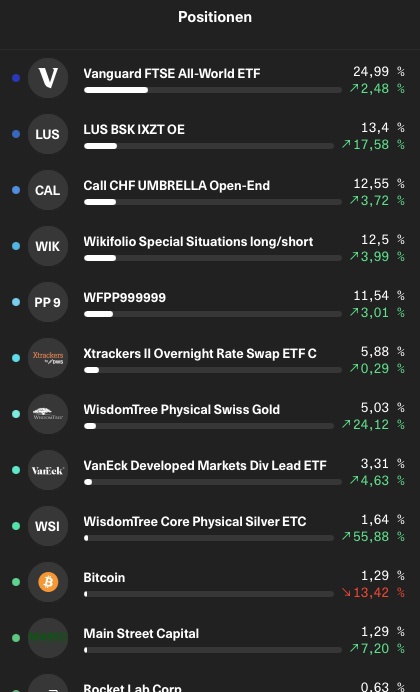
If I have already saved for my retirement myself, then I can also invest for a few more years with moderate risk. growth to make all my wishes come true. I've been thinking about this for a while and explain the result in the screenshot that shows the current portfolio:


My current allocation:
attachment


Explanations


The FTSE All-World as the bread and butter core investment covers 25%.

wikifolios (because hopefully people there have a clue) provide growth with 50% of the invested capital.

@Epi s 3xGTAA for momentum (S&P 500 and Nasdaq are covered)

Umbrella and PPInvest low Vola (WFPP999999) for growth with a very good risk/reward ratio (approx. 2!)

Special Situations long/short as an opportunity if Trump goes completely crazy (there is currently 50% cash in there for good reason)

A few percent cash as a reserve in the $XEON (+0.01%)
A few percent gold, silver and bitcoin (teaching money) as diversification

Investment income: $TDIV (-0.05%) and $MAIN (-1.39%) . These are my test field to see whether this is a suitable retirement strategy for a regular dividend income. Most of my savings currently go into these two. Profit-taking should also end up there.


Opportunities/risk assessment


The share-weighted Sharpe ratio across all these investments (excluding equities) should be pretty much exactly 1.

It should be clear that the previous internal rate of return of 24% since 10.11.2025 to date can certainly not be maintained. However, it is certainly my hope that I could - without having to put in a lot of effort - end up with 15-20% p.a.


And I'm keeping the 5-7% in individual shares for fun and learning, because I simply find the topic exciting. Perhaps this will lead to a reorientation in the distribution, but for the time being I'll start like this.


If I do something stupid with my plan, just say so!


Links to the wikifolios:

19
20 Comments

profile image
My father died two years ago and I was in a similar situation last year.
My sincere condolences!
3
profile image
@Isus01010 And how did you organize your investments if you inherited something?
1
profile image
My case was slightly different because the estate consisted largely of a portfolio of individual shares. It was then up to me to liquidate the shares of the other heirs and incorporate the rest into my existing portfolio.
In the course of this, I switched from a pure ETF strategy to a mixture of ETFs and individual shares. I have kept some pearls with great price gains because I wouldn't be able to get them for the entry price. New capital is currently flowing into the ETFs to push the proportion of individual shares back below 30 percent.
I first entered the portfolio here a few months before I had access to the stocks. In the meantime, I worked out the strategy. When I got access, I implemented my plan quickly and unemotionally. So I bought and sold directly without timing. I would do that again
1
profile image
@Isus01010 Ah, quite different, but also interesting.
I can really understand the point about "umemotional and immediate". There are soooo many rational decisions to make in this situation and I also sold my parents' house quickly, for example.
1
profile image
Yes, I deliberately didn't memorize the prices at which I sold and then removed the old portfolio. Everything I still have is now in my portfolio. I reinvested some of it myself and concentrated on a coherent overall result. I was only too hesitant to buy the S&P 500. But even there I am now where I want to be.
1
profile image
Thanks for sharing!

I like your approach of letting others do the content work to get an excess return when you have just started in the stock market.

But one question: Assuming your plan works and you generate 20%pa until retirement. Why would you want to swap such a superior strategy for a sub-optimal one? Just go ahead and withdraw what you need. Incidentally, this approach significantly changes the calculation of the optimal retirement date. 😏
3
profile image
@Epi I am pleased that you can understand my approach and that you like it so far. I just have to prove whether my assumptions are correct. If everything goes as I think it will, the dividend values may not be necessary.
As you can see, I'm currently running test sizes there.

The strength of comparatively stable dividends could come into play in weak or declining markets. People always talk about cycles, but you never know for sure where you are in the wave.
1
profile image
@en-sx Note: Markets are weak when profits are falling. And when profits shrink, so do dividends.
I find the total return approach safer. If you mix a few uncorrelated ones, then you are already well hedged against weakness. Better than with dividends in any case.
1
profile image
@Epi Total return means that you can earn amount X over a time y with a probability of z?

Thanks for pointing this out. Of course, dividends are also canceled or at least significantly reduced in the absence of profits, but often with a delay, if I have observed this correctly.
1
profile image
@en-sx Total return approach means that it tries to generate a certain return regardless of the general market. So basically a straight line in the chart from bottom left to top right, without the zigzags of the markets.
1
profile image
@Epi Ah, all right. Nice graphic explanation for dummies.
The PPInvest low Vola definitely comes closest if @PPinvest manages to maintain the price of the last two years.
1
profile image
@en-sx Exactly, PP's wikifolio would be a good example if the chart were older than 10 years. Things have been relatively peaceful on the stock markets since mid-2024.
Very few manage a constant long-term return. Usually at some point there is a massive collapse and all the gains are gone. E.G. LTC 1997.
1
profile image
@Epi Which is why you don't put all your eggs in one basket and always have to keep an eye on it ...
1
profile image
I've also been dealing with this issue for a few weeks now... my mother-in-law is still here, but it's foreseeable that the day will come at some point and with it the inheritance. I'm currently drawing up a kind of private balance sheet to get a better overview of all our finances and what we can still expect (not including the inheritance)
I don't yet know exactly how I will create it when day x comes.
Keep it simple.
I'm currently spending more time on Epi's account and in other forums to get ideas on how to structure it optimally.
First of all, thank you very much for your contribution and my condolences.
What's wrong with retiring early and traveling the world in your motorhome?
As you know, various health restrictions come with age, some more than others. That's why I wouldn't push the idea too far into the distance.
I would look forward to a continuation of this article.
Until then, good luck 🍀
1
profile image
@FrauManu First of all, thank you and I wish you all the best and that the farewell "succeeds". I found it very comforting and reassuring to have managed everything gracefully and well. It was the last possible thank you to the parents.

Why not retire earlier? Quite simply because I have a varied and responsible job that I enjoy and also gives me a lot of freedom.
In four years' time, however, there will be age-related staff changes and I will be losing my dearest colleagues. So I thought: this will be the right time, we'll leave together and make room for young people.

Maybe I'll write from time to time about how things are going with the wikifolios and the mix, if that's of interest.
1
profile image
I can understand the situation. Of course you're sad and you have a lot of things to do and organize.

In my case, the whole inheritance process wasn't easy because the proportion of real estate was relatively high. Some of the properties were unrenovated and unrented, but full to the roof with all kinds of junk. So I first had to argue with the tax office about the valuation of the properties because of inheritance tax and then I had to devote myself to renovating and renting them out in order to generate any income at all. In the end, it was financially attractive, but exhausting.

If you have little investment experience, I would go for broadly diversified ETFs. In principle, you already have a few positions in your portfolio.

If you can avoid it, I would refrain from buying a motorhome, unless you plan to go on a long trip for several months a year. Renting a really cool motorhome for the time you use it is effectively cheaper than buying one. Of course, not everything is always rationally tangible - sometimes you have to act irrationally to fulfill your heart's desire.

I wish you the best of luck 🙂
1
profile image
@NichtRelevant Thank you for your story, for which I wish you continued luck and success.

The motorhome comes as a replacement for an old one and because we have been campers since we were children. It's just our hobby and hobbies are irrational by definition. :-D
1
profile image
@en-sx Okay. Then the mobile home is yours. The testator(s) will do the same if there really is an afterlife from which the ancestors are watching you 🙂 -> 🚐
1
profile image
Depending on how much money there is in total.

If you want to make the money "permanently usable", take a look at the endowment principle.
1
profile image
@Ape65 Thanks for the term, I even know it.
It's not that much after all (yet) :-D
Join the conversation