4D·

In the short term, the market is a voting machine; in the long term, it is a weighing machine ⚖️ 🤓


It currently seems as if many rock-solid companies are being sold off heavily, especially by small investors 😉. The background to this seems to be concern about the AI narrative, according to which artificial intelligence could make numerous business models and entire industries obsolete. 😂

This will not happen. On the contrary, it is precisely these companies that will benefit greatly and more efficiently from AI.

It may well be that one or two will fall by the wayside, but I currently see very attractive opportunities and am taking advantage of some of them.


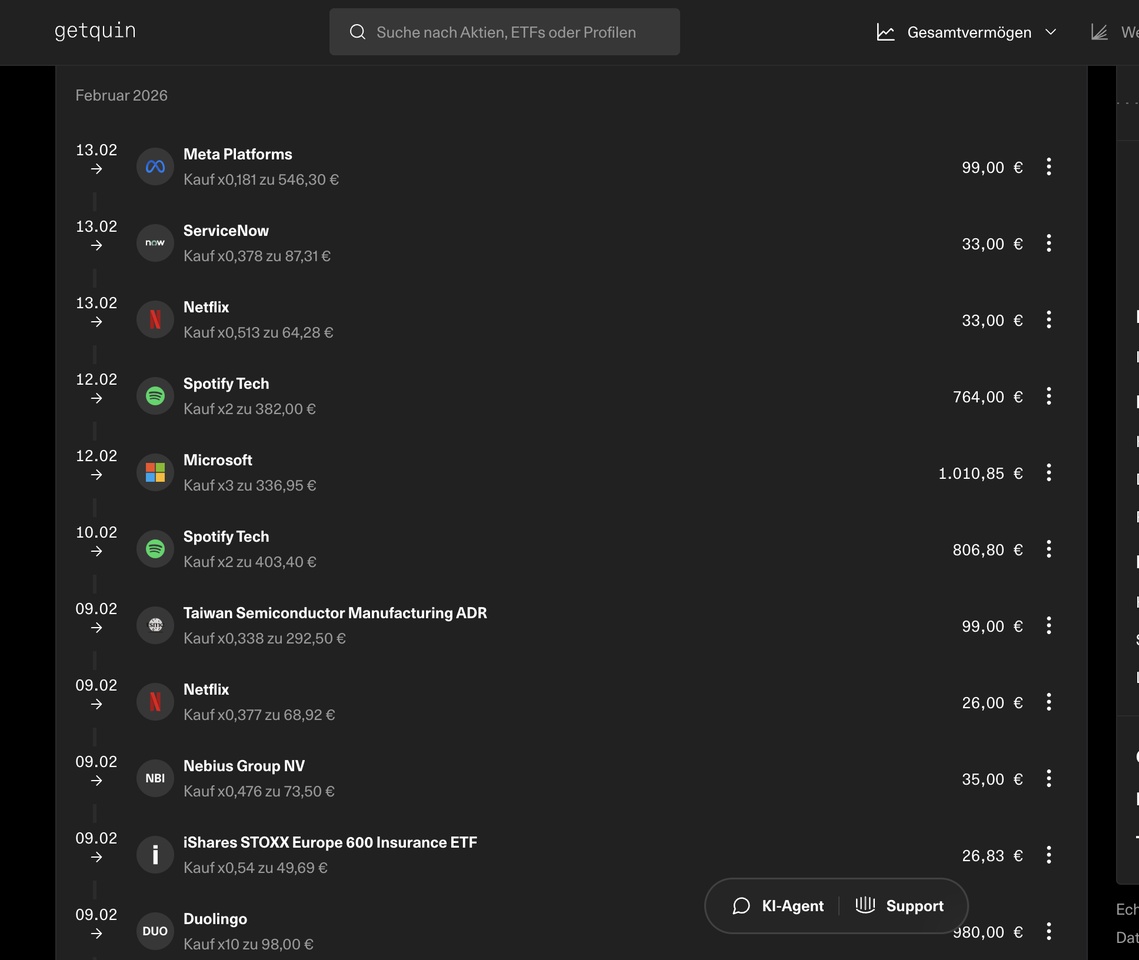
I bought the following this week👇 😎

(two-digit savings plan, three-digit purchase 🤑)
attachment

$MSFT (-1.73%)

$AMZN (+0.16%)

$META (+1.4%)
$SPOT (+0.74%)

$NFLX (-0.18%)

$DUOL

$TSM (-1.44%)

$NOW (-2.66%)

14
5 Comments

profile image
Be greedy now! It will surely pay off in the long term 📈📈📈
3
profile image
From this list, I only have $AMZN in my savings plan. In the long term, I expect a lot of growth here, especially thanks to AI, but also and above all thanks to the gigantic logistics network.

Otherwise, I see a lot of potential in financial stocks, as these can probably scale the most through AI with little effort.
I therefore recently added $JPM to my portfolio and have had $V in my savings plan for some time.
$JPM will have the resources and the necessary reputation to recruit the right staff and quickly set up and implement the necessary programs.
I'm just going to say that :)
2
profile image
So this small investor in particular will buy in heavily 😂
1
profile image
I like your loyalty to your companies.
1
profile image
The scales would rather speak against the companies already worth hundreds of billions to trillions, wouldn't it? The most valuable companies usually change every 10 years. And I wouldn't underestimate the AI risk for software. An acquaintance of mine recently copied the entire Salesforce suite with ease, using AI. The specific case doesn't matter now, but it shows that software is becoming vulnerable. And you may initially argue with the switching costs and network effects, but if the copy only costs 10-20%, then that is obsolete. Above all, the data can also be transferred seamlessly if an appropriate tool is used. This really shouldn't be underestimated and it's not the small investors, because they can't move prices in this way. Software is also becoming national again because everyone is afraid of dependency. I would therefore focus more on hardware again (preferably bottlenecks) and software only if there is a clear moat (e.g. political backing, valuable IP, niche.....).
1
Join the conversation