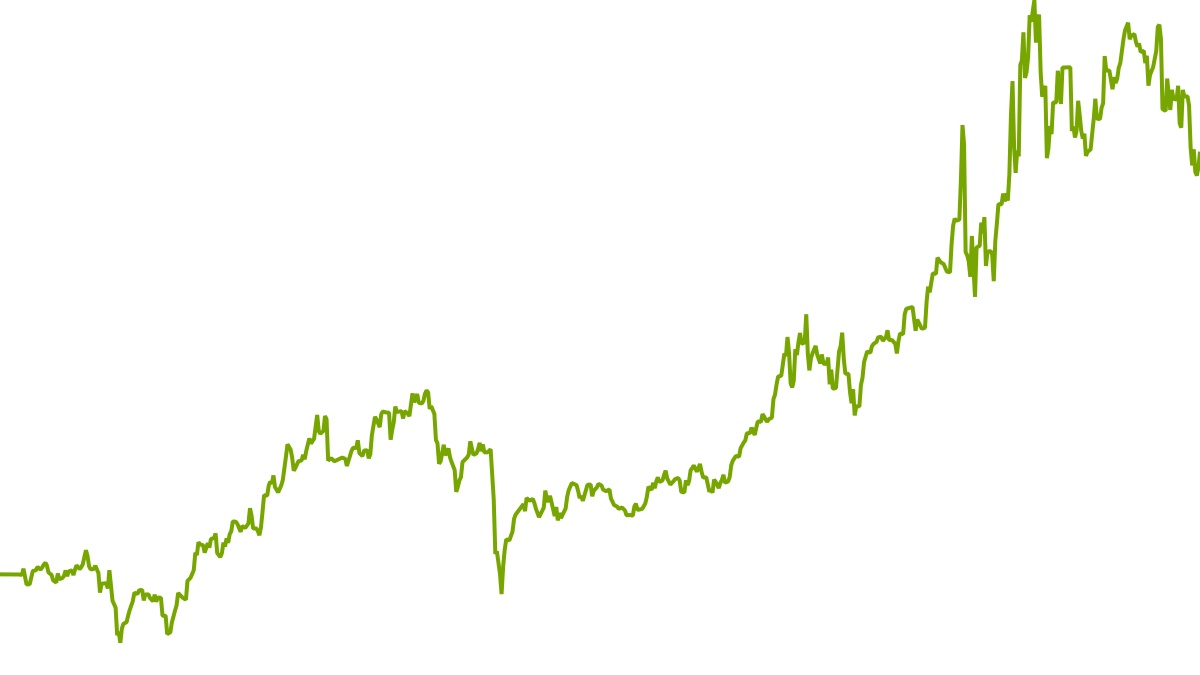
Finally, a completely normal month for the strategy again! Here’s the update:
Asset Performance 08/26 (July 31–August 31, according to Wikifolio)
3xUSDEUR: -2.3%
3xQQQ: +11.6%
3xEU50: -7.1%
3xGTAA Portfolio (Aug. 31, according to Getquin)
July 31, 2026: €124,540
August 31, 2026: €127,700
Wikifolio Certificate (August 31, average price according to Wikifolio)
July 31, 2026: €193.70
August 31, 2026: €198.60
Month: +2.5%
YTD: +21.5%
August 2026 Review
With a monthly performance of +2.5%, 3xGTAA barely moved in August. The gains in the Nasdaq 100 were almost entirely offset by losses in the Euro Stoxx 50 and the USDEUR—even though things looked significantly more positive at one point. A quick note for the record: the losses in these two asset classes had already been foreshadowed last month, as they had almost completely lost their momentum.
Outlook 09/26
There have been some shifts in momentum within the asset pool. The EU50 and USDEUR are falling back and are thus being removed from the active allocation. Replacing them are two old favorites: WTI and BTC. WTI has stabilized significantly and is now trading above the SMA150 again. Since the margin is narrow, the signal could still change on September 1. In that case, EU50 would remain in the portfolio. The price at approximately 12:00 p.m. on September 1 will be decisive, to allow enough time for execution (finding a favorable spread, partial sales in low-liquidity conditions). The situation is different for BTC, which is trading well above the signal line following the August rally and has also shown positive momentum overall over the past six months.
The allocation for 9/26 is therefore:
2xWTI
3xQQQ
1xBTC
Report from the 3xGTAA Workshop
As already mentioned in recent monthly reports, the issue of interest rates is increasingly coming into focus for investors. This is a good opportunity to take another close look at the bond asset class in the 3xGTAA.
As some of you may know, the dominant regime of falling interest rates over the past 40 years came to an end in 2022 and is now reversing. However, this also reverses the logic behind including bonds in portfolios and strategies. What has worked over the past 40 years will not necessarily work over the next 40 years. This is relevant—even for every ordinary B&H investor. In what way? Due to their negative correlation with stocks, bonds have served as a hedge or risk buffer in many standard portfolios. You’ll still hear this from your personal financial advisor. However, when inflation reaches around 3%, this correlation flips to a positive one, and the risks of both asset classes amplify each other. You won’t hear that from your advisor anymore.
What does this mean for 3xGTAA? The asset pool consists primarily of uncorrelated asset classes, of which—according to the plan—a few are always trending upward. If stocks now fall due to rising interest rates, then bonds will also fall, and there will be no diversification. One idea would be to add short bond ETFs—that is, ETFs that rise when bond prices fall or interest rates rise.
One problem with this idea is that the new interest rate regime was only implemented in 2022 and hasn’t been in place long enough to conduct meaningful backtests. Including such ETFs in 3xGTAA would therefore be purely speculative. A specific candidate would be the WisdomTree US Treasury 30y 3x Short $UL3S (-0.81%) (I’d call it the short -3xTLT).
Now my question for you: What do you think of the idea of adding a -3xTLT to the portfolio to potentially profit from rising U.S. interest rates? I’m still undecided on this (new interest rate environment vs. lack of backtests) and would appreciate any input!
Whatever your opinion may be: May the momentum be with you!
Yours, Epi
$DE000LS9U6W1 (+1%)
https://www.wikifolio.com/de/de/w/wf03x0gtaa