Have you ever wondered why some investors seem to rake in billions effortlessly, while others tread water despite hundreds of Excel spreadsheets?
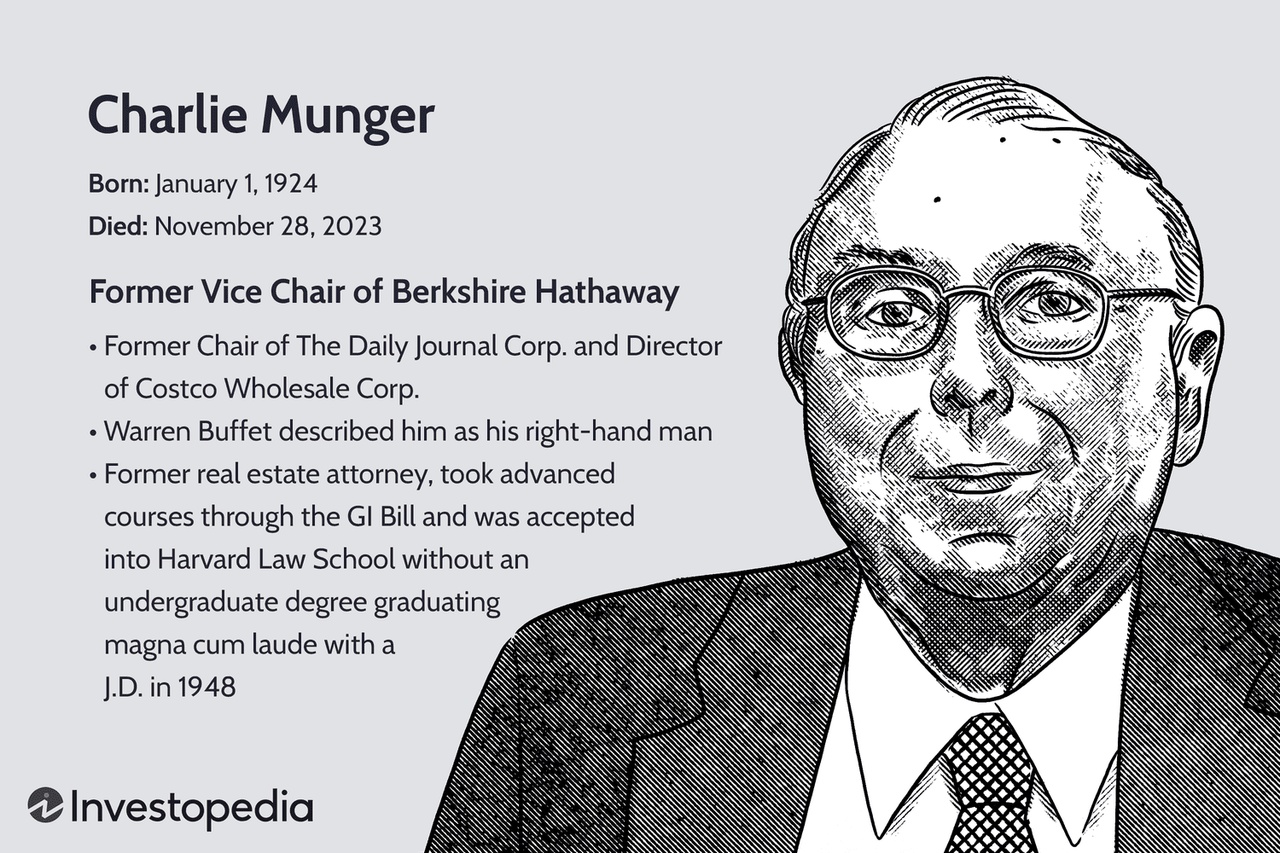
Charlie Munger, the legendary partner of Warren Buffett at Berkshire Hathaway $BRK.A (+1,32%)
$BRK.B (+1,79%)had an astonishing answer to this question: "You have to become worldly wise before you can be successful on the stock market."
Munger calls his approach the "Latticework of Mental Models", i.e. a mental grid model made up of various disciplines.
He urgently warned against using just one or two models, because for the man with the hammer, every problem looks like a nail - a phenomenon he humorously compared to a chiropractor who wants to cure every illness simply by adjusting it.
To become a really smart investor, you need about 80 to 90 of these models from fields like math, psychology, biology and physics, with only a handful really carrying the weight. These models have to form a network in your head, on which you classify your experiences - whether you have experienced them yourself or read about them.
The absolute cornerstone of your success is mathematics, or more precisely the probability theory of Fermat and Pascal.
If you have not mastered the basics of permutations and combinations - i.e. the theory of the arrangement and selection of objects - and do not routinely apply them in your everyday life, you will, according to Munger, go like a "one-legged man through an ass-kicking contest".
You have to learn to think automatically in terms of decision frequencies and probability trees. A probability tree is a graphical tool for visualizing the probabilities of successive events.
Look at the bare facts of Berkshire Hathaway to understand what this multidisciplinary approach does:
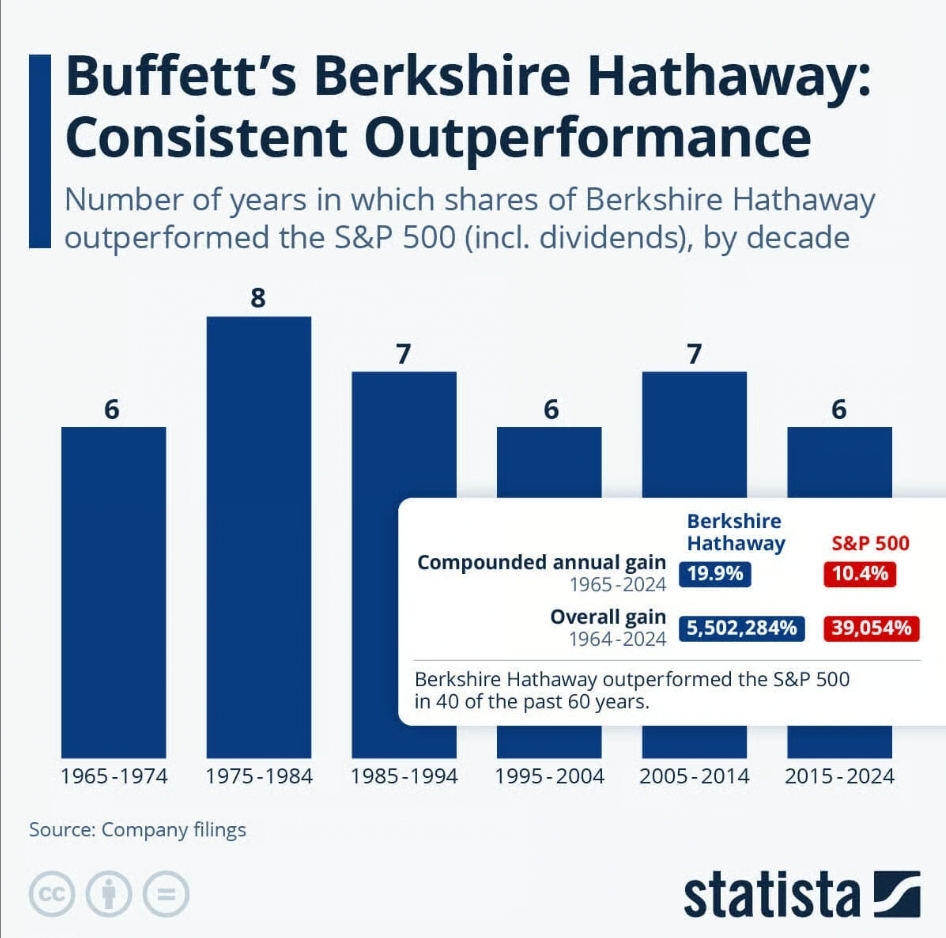
Between 1965 and 2024, the holding company generated a total return of an incredible 19.9% per year. By comparison, the S&P 500, the leading US index, returned 10.4% over the same period. Munger has therefore achieved almost double the annual return over six decades.
His best year was 1989 with a gain of 84.57 %, while the crisis year 2008 was his worst at -31.78 %.
However, it is noticeable that his lead over the market has shrunk in recent years, as it becomes increasingly difficult to beat the average as his size increases.
Another critical model is the psychology of misjudgment, which Munger called the "psychology of misjudgment".
Our brains often use shortcuts that can deceive us. One example is "social proof", where we subconsciously do what everyone else is doing.
This leads to investors buying overpriced shares en masse just because their neighbors are doing the same.
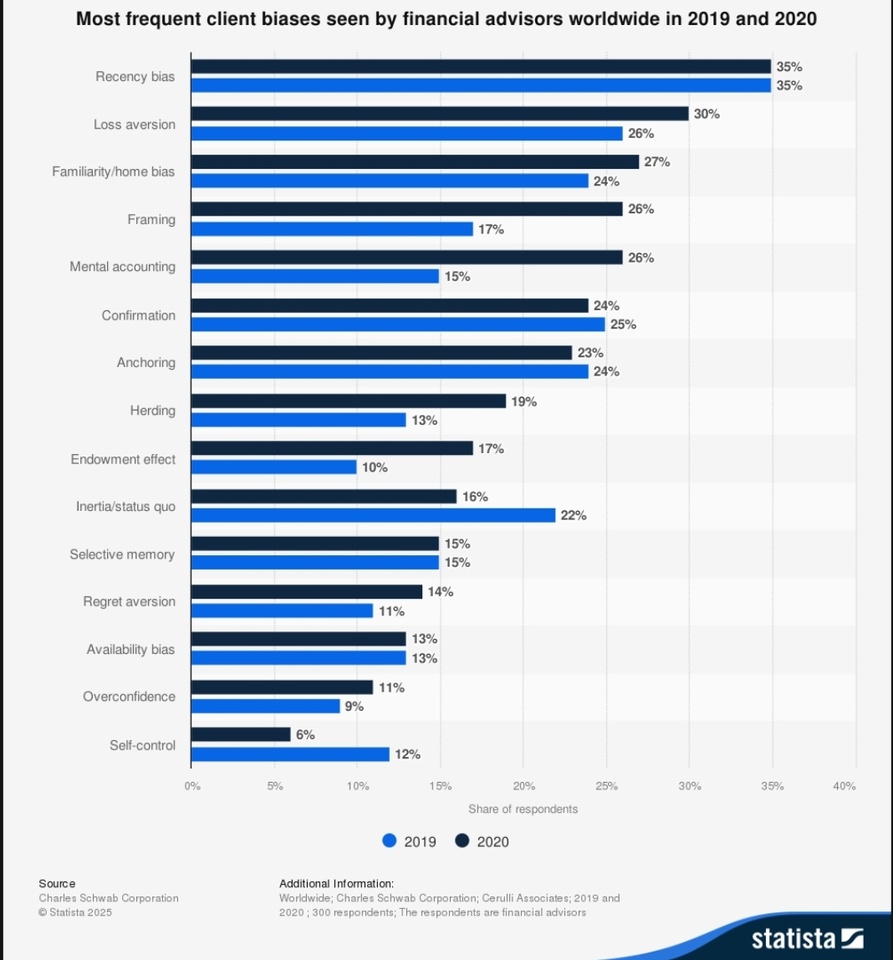
Statistics show that 64% of investors overestimate their own knowledge (overconfidence bias) and losses hurt around 2.5 times more than gains (loss aversion), which often leads to fatal mistakes.
Munger also used models from biology and microeconomics, such as the concept of niches in an ecosystem.
Just like animals in nature, successful companies specialize in certain small areas in order to occupy a dominant position and benefit from "good economics".
This is where economies of scale, i.e. cost advantages through size, come into play. Large companies such as Coca-Cola $KO (+2,95%) or Procter & Gamble $PG (+5,82%) use their huge volumes to drastically reduce costs per unit or to use advertising methods such as television so efficiently that small competitors hardly stand a chance.
Another important factor for your success is the "Circle of Competence", your personal circle of competence.
You need to know exactly where you have an advantage and where you don't.
Munger openly admitted that he and Buffett avoided the high-tech sector because they did not understand the technical developments in software or computer chips better than others.
So it doesn't matter how big your circle is, but it is necessary to know its limits.
If you play a game where others have the talent and you don't, you will lose. It is much easier to become the best plumber in a small town than the world's best chess player.
To put theory into practice, you should also master the language of business: accounting.
But be careful: Munger repeatedly warned that balance sheets are only rough approximations.
He liked to tell the story of Carl Braun, who fired all the accountants and had his engineers develop their own system because the standard methods for building oil refineries were, in his view, completely moronic.
So you have to understand the limitations of numbers, like estimating the life of a jet, which is often more guesswork than knowledge, even if it's in pretty tables.
》FAZIT《
If you only memorize facts and figures in isolation, you will probably fail on the stock market. Only those who internalize the big ideas of the world can really penetrate the complex dynamics of the stock market.