
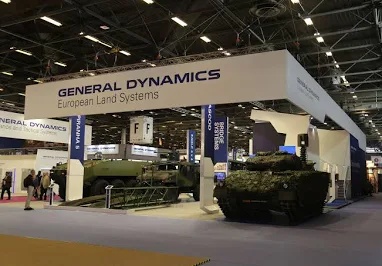
General Dynamics Corporation is one of the most established and financially strong conglomerates in the global defense and aerospace industry12. With a global workforce of over 120,000 employees and consolidated annual revenue of more than $52 billion, the company holds key structural positions in markets with extremely high barriers to entry345. Its business model differs fundamentally from that of broadly diversified industrial conglomerates: It deliberately avoids volatile mass markets and instead focuses on oligopolistic high-tech sectors6. Value creation is concentrated in nuclear sea-based deterrence, heavy and highly mobile land systems, military command and IT networks, and the top segment of the civil business aviation market
General Dynamics is headquartered in Reston, Virginia, and is traded on the New York Stock Exchange. The ownership structure is broadly diversified and is primarily held by large institutional asset managers such as Vanguard, BlackRock, and State Street. For many years, the company’s leadership has been characterized by exceptional continuity and strict operational cost discipline. Phebe N. Novakovic, who has led the company as Chairman and Chief Executive Officer since January 2013, has been instrumental in driving margin expansion and portfolio consolidation. Effective January 1, 2027, Danny Deep—who held leadership positions in the Land Systems and Combat Systems divisions for over two decades and most recently served as Group President—will assume the role of CEO, while Novakovic will remain on the Board of Directors as Executive Chairman.
The Four Operating Segments
General Dynamics’ corporate structure is divided into four independent business segments: Marine Systems, Combat Systems, Aerospace, and Technologies. Each segment is focused on specific procurement markets and has distinct margin and cash flow profiles.
.
Financial Performance and Global Market Position
General Dynamics recorded a steady increase in key earnings metrics during fiscal years 2024 and 2025. This trend was driven by higher procurement volumes from NATO countries in the naval and land systems sectors, as well as the normalization of delivery processes at Gulfstream.
The trailing P/E ratio of approximately 20.2 and the forward P/E ratio of approximately 18.9 are within the typical range for a defensive defense stock, though not particularly cheap. The expected EPS growth rate of about 7.3% per annum supports this valuation; a P/E ratio below 19 for 2026 is fair given the stable order backlog.
The dividend is secure and growth-oriented, but the yield is rather modest at less than 2%. For dividend investors, GD is more of a “dividend growth” stock than a high-yield stock.
GD has marginally outperformed the S&P 500 over five years but has been a significant underperformer over the past one to three years. This explains the relatively moderate P/E ratio: the market is not currently rewarding the fundamentals with a significant re-rating.
GD is a good candidate for a defensive, long-term core holding in a portfolio focused on quality and defense. From a fundamental perspective, the entry point is more attractive than it was a year ago, but technically it is not yet convincing; a staggered purchase or waiting for the price to stabilize above the 50- and 200-day moving averages would be the lower-risk option.