

Today, while taking a real estate investment course, I came across an interesting company: Rayonier Inc. $RYN (-1,22%)
What is it, anyway?
Rayonier isn’t a tech stock, it’s not a hype play, and it’s not a bet on the next quarterly earnings report. It’s an American Land Resources REIT—a publicly traded fund that owns physical forest land, harvests trees, develops properties, and is increasingly marketing its land for solar farms, CO₂ storage, and residential areas. Following its merger with PotlatchDeltic in January 2026, Rayonier is also one of the largest lumber producers in the U.S. The company manages 1.66 million hectares — an area larger than Schleswig-Holstein and Hamburg combined.
The Core Thesis: Why It’s So Strong
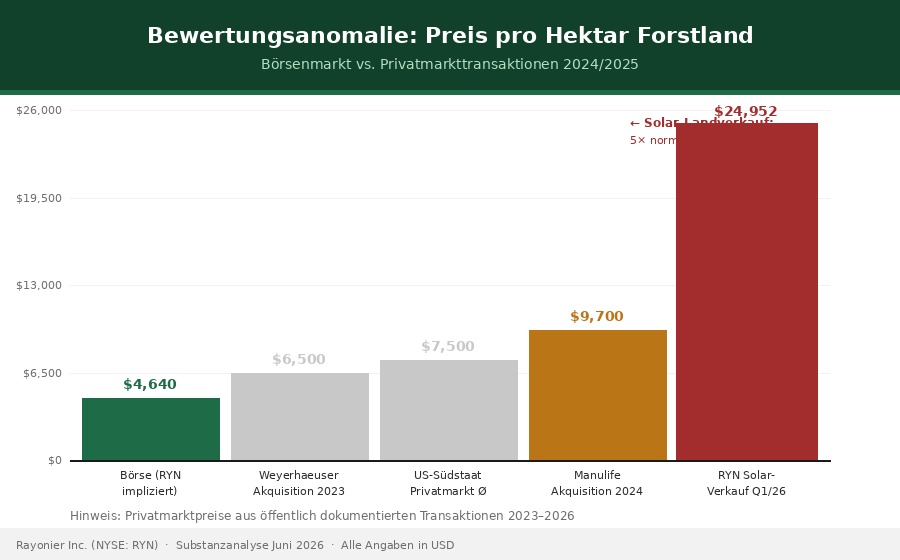
Institutional investors, pension funds, and private land acquisition funds are actively paying $5,000 to $15,000 per hectare for comparable U.S. forest land in direct transactions. Manulife purchased approximately 22,000 hectares in 2024 for over $9,700/ha. Weyerhaeuser acquired land in 2023 for approximately $6,500 per hectare. Rayonier’s own sale of solar land in Q1 2026 fetched the equivalent of just under $25,000 per hectare for a single rezoned parcel.
At a share price of ~$21.50, the stock market implies a value of just around $4,640 per hectare, a discount of 30 to 55 percent off the private market price of the same asset. This is not an opinion. It is a measurable, documented price difference between two markets for the same physical asset.
What the company earns — Q1/2026
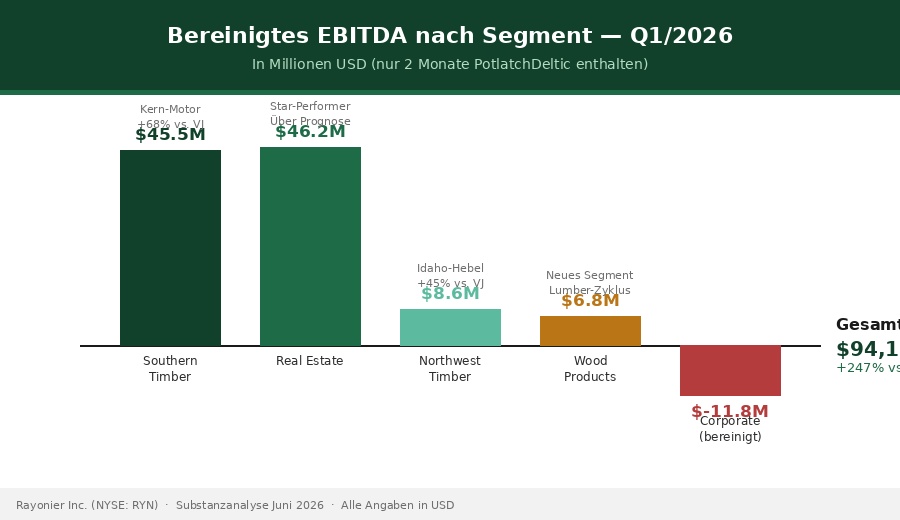
Adjusted EBITDA for the first quarter was $94.1 million — a 247% increase compared to Q1/2025, with the PotlatchDeltic figures covering only two months. The reported GAAP loss of $12.4 million looks worse than it is: it is almost entirely due to $69.5 million in one-time merger costs that will not recur. The adjusted pro forma result was +$17.4 million
The four segments: Southern Timber ($45.5 million EBITDA, +68% year-over-year), Real Estate ($46.2 million, above forecast), Northwest Timber ($8.6 million), and the new Wood Products segment ($6.8 million). The Real Estate segment is the real star—with an annual forecast of $180–200 million in EBITDA.
What is the company really worth?
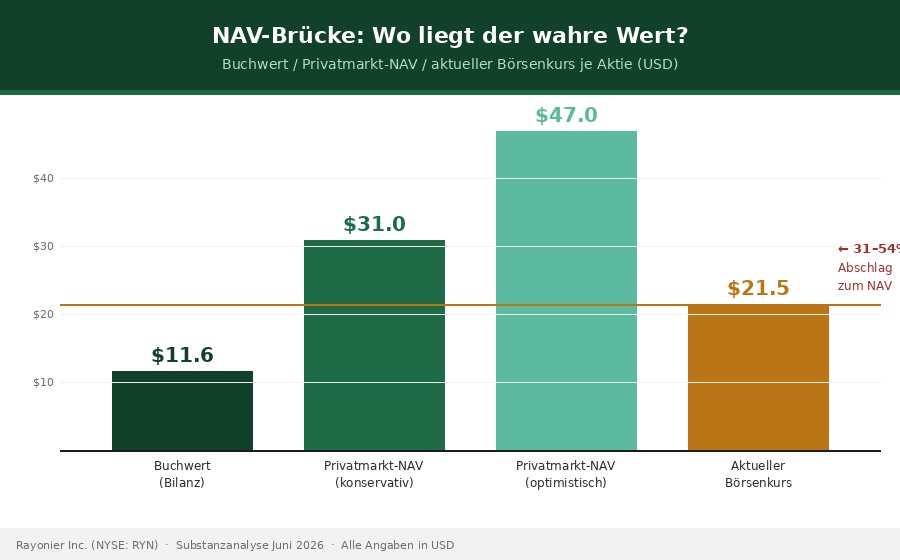
For forestry REITs, the P/E ratio is not a meaningful valuation metric—the key factor is net asset value (NAV): What would the individual components fetch on the private market?
The southern forest land alone is worth $7–8.5 billion on the private market; on the balance sheet, it is valued (after depreciation) at $2.76 billion—a massive hidden reserve. The solar and CCS potential adds $0.3–0.9 billion in additional value, which is not reflected in the book value at all. After deducting net debt of ~$1.4 billion, this results in a NAV equity value of $31 to $47 per share, compared to a market price of $21.50. Discount: 31 to 54 percent.
Why Forstland Is Unlike Anything Else
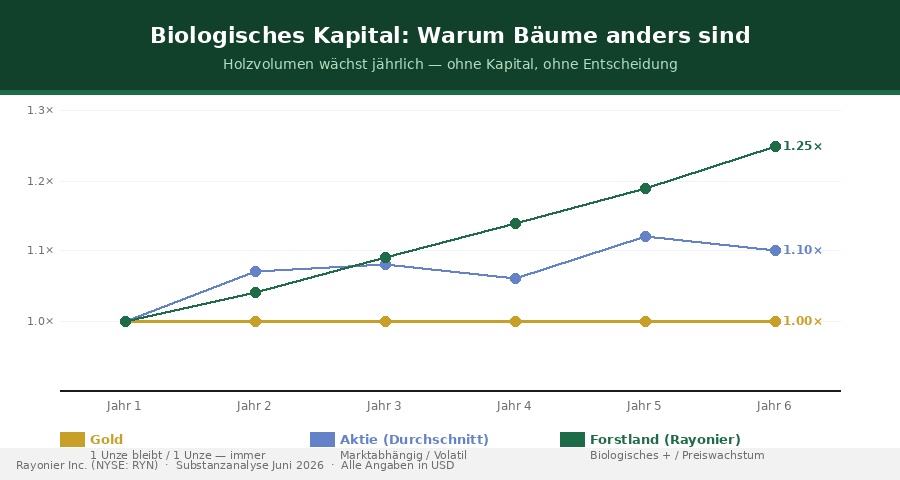
The most overlooked quality feature: The capital invested grows biologically on its own. An ounce of gold is still an ounce of gold next year. A loblolly pine in Georgia will have grown by 1–2 m³ in timber volume next year—without capital, without a decision, without technology. According to NCREIF, forest land shows an 82.3 percent correlation with inflation over long periods.
Added to this is storage flexibility: timber can be “stored on the stump.” When prices are low, you harvest less and wait. This option does not exist for oil, wheat, or semiconductors.
Four revenue streams from one hectare
Rayonier’s greatest strategic strength: Every hectare can do four things at once.
Timber harvesting: the classic core business, approx. $162 million EBITDA/year on an annualized basis.
HBU real estate: Wildlight (Florida), Heartwood (Georgia), Chenal Valley (Arkansas): residential development sites valued at 3–10× the price of forest land, projected $180–200 million EBITDA in 2026.
Solar land: 80,000 acres in the pipeline, 35,000 to mature by 2028; already generating $24,000+ per hectare.
Carbon Capture (CCS): 154,000 acres of subsurface leases for CO₂ storage, geologically unique and economically viable in the long term due to U.S. tax incentives (Section 45Q).
The major tailwinds
Three factors could drive the stock price significantly higher, and for all three, the question is not “if” but “when”:
First, the structural U.S. housing shortage of 3.8–4.5 million units. Every new single-family home built consumes ~36 m³ of sawn lumber. When pent-up demand is released, it will meet with a supply shortage caused by sawmill closures. Second, the Canadian import tariffs of ~35.9% on softwood—Rayonier is vertically integrated (trees + its own sawmills) and benefits directly. Third, mass timber in high-rise construction — new U.S. building codes allow wood structures up to 18 stories tall, a structurally new market with a 4.8% CAGR through 2030.
Plus: The $40 million in annual merger synergies have not yet contributed a single dollar to the income statement. At a 10× EBITDA multiple, this corresponds to $400 million in invisible enterprise value, which is completely missing at the current share price.
The risks
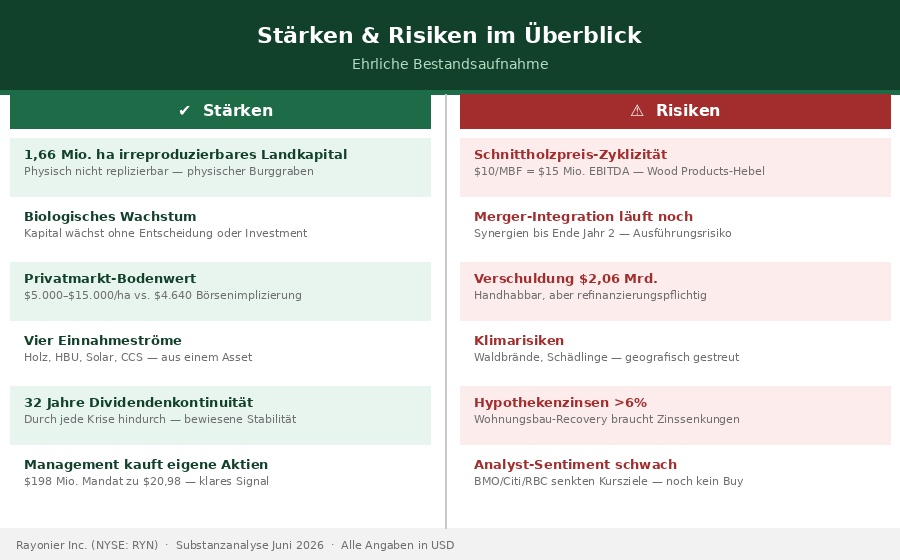
Lumber price cyclicality is real: Every $10 change per MBF equals $15 million in EBITDA. The Wood Products segment is struggling in the current downturn. Merger integration will continue for another two years. Gross debt of $2.06 billion must be refinanced (of which $200 million was already repaid in Q2 using internal funds). Climate risks from wildfires exist; 10,000 acres burned in Georgia in Q1 2026. And the analyst consensus is only “Hold,” with BMO, Citi, and RBC having lowered their price targets.
However: None of these risks are existential. The land value of the portfolio provides a solid valuation floor. A forestry company with 1.66 million hectares won’t go bankrupt—it will simply bide its time.
What Management Is Signaling
CEO Mark McHugh has consistently sold at a premium over the past three years (New Zealand for $710 million at 18× EBITDA) and bought on the cheap (treasury shares at $20.98 with a remaining $198 million mandate). At REITweek in June 2026, he publicly stated that share buybacks are currently “the best way to acquire forest land assets”—a remarkably direct comment on the company’s own undervaluation.
Price Targets and Entry Zones
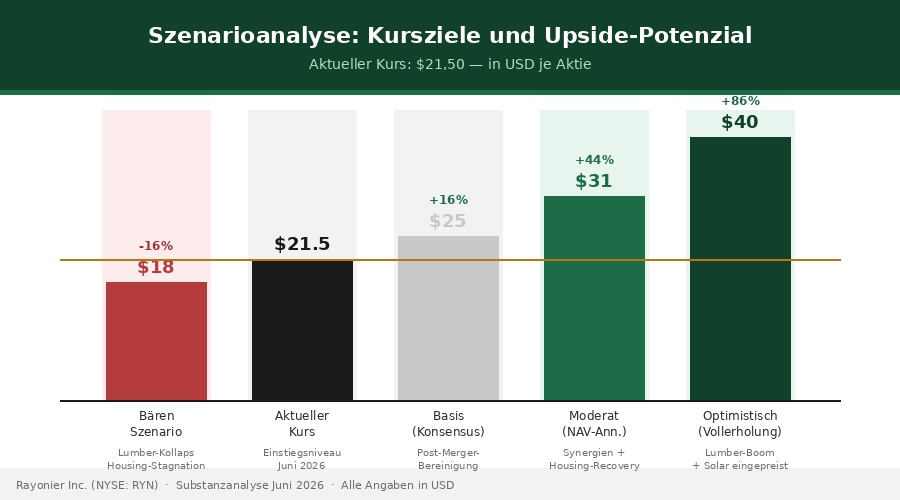
Base-case scenario (analyst consensus):
$25 (+16%): post-merger adjustments, lumber price stabilization. Moderate (NAV-based estimate): $31 (+44%): Synergies in the income statement, residential construction picks up. Optimistic:
$38–42 (+77–95%): Lumber recovery, solar optionality priced in. Still below the 2022 high of $40.
Zone 1 ($20–23): Current level, strong entry window.
Zone 2 ($17–19): If lumber prices continue to fall, aggressively increase holdings.
Time frame: 3–5 years. This is not a trade.
Conclusion
The five pillars of the thesis in one sentence: You’re buying 1.66 million hectares of irreplaceable, organically growing land assets at a 30–55% discount to the private market price, four income streams from the same asset, $400 million in intangible synergy value, and 32 years of uninterrupted dividend history—all while receiving a ~5% return while you wait.
The market prices in short-term uncertainties. The private market prices in what the land is worth. This difference is the opportunity.
