
The next wave of robotics won't be determined solely by which robot is the best, but also on how reliably, affordably, and autonomously it can be powered.
Our basic premise is therefore simple:
The more machines operate autonomously, the more important it becomes to have a dedicated energy infrastructure for robots.
A humanoid robot, an autonomous warehouse vehicle, a mining robot, or—in the future—a machine on the Moon all face the same fundamental problem: Power must be available without a human constantly monitoring the charging process.
This gives rise to a new infrastructure stack:
Power grid → Power electronics → Battery/BMS → Wireless power → Charging infrastructure → Energy management → Autonomous robot
Of particular interest here is inductive or magnetic-resonance charging. Traditional wired charging creates a point of interruption: The robot must stop, reach a station, and often be positioned precisely. For a world with millions of autonomous machines, a system in which robots can automatically recharge during normal operation or during brief stops would be more attractive.
This is precisely where our two investments come into play—albeit at different levels:
TDK $6762 (+3,04%)
— the technology shovel
TDK is the broader bet on the technological infrastructure behind wireless power. The company combines materials science, magnetics, capacitors, power electronics, and wireless power technologies. TDK already offers magnetic resonance wireless power systems for AGVs and logistics robots. ($6762 (+3,04%) )
The thesis is:
If wireless power becomes a standard component of autonomous machines, TDK can profit across multiple layers of the value chain—regardless of which robot manufacturer prevails.
This makes TDK, in our view, less of a pure robotics stock and more of a “pick-and-shovel” play on the electrification and energy autonomy of the physical world.
DAIHEN $6622 (+6%)
— the direct “charging shovel”
DAIHEN takes us one step closer to the actual application. With D-Broad , the company offers magnetic resonance wireless charging for AGVs. The system can transmit power reliably even with a distance or misalignment between the coils of approximately 20–40 mm and was developed specifically for continuous automated operation. ($6622 (+6%) )
Our thesis here is:
If autonomous machines are to operate 24/7, automatic charging is not a convenience feature but a necessary piece of infrastructure.
DAIHEN is thus making a more focused bet on robot charging, while TDK represents the broader bet on the underlying technology platform.
The overarching investment thesis
So we’re not trying to predict whether XPeng, Tesla, Figure, Agility, Amazon, or another manufacturer will dominate robotics.
Instead, we’re looking for the shovel sellers behind the gold rush.
If our long-term global thesis is correct— millions to billions of autonomous machines, permanent automation, and a growing shortage of human labor —then each of these machines must be powered, charged, controlled, and operated efficiently.
TDK + DAIHEN are therefore our joint “Robot Energy” position:
- TDK: broad technology portfolio
- DAIHEN: direct wireless charging shovel
- Joint bet: Energy supply will become an unavoidable bottleneck for physical AI.
- Time Horizon: 2031 → 2036 → 2046
- Goal: Don’t choose the robot—find the infrastructure that almost every successful robot might need.
The central question of the following analysis is therefore:
How large can this market become—and do TDK and DAIHEN actually possess a technological or economic moat that will allow them to benefit disproportionately from this robotics wave for decades to come?
Both stocks have lost significant ground over the past three months—Daihen 18.9%, TDK 26.7%. During the same period, neither company reported poor results. TDK reported a 53% increase in operating profit in the first quarter, while Daihen closed the fiscal year with a 16.1% increase and is sticking to a forecast that calls for 33% earnings growth. The decline in share prices reflects a valuation correction across the entire Japanese AI and semiconductor sector, not a reaction to corporate earnings.
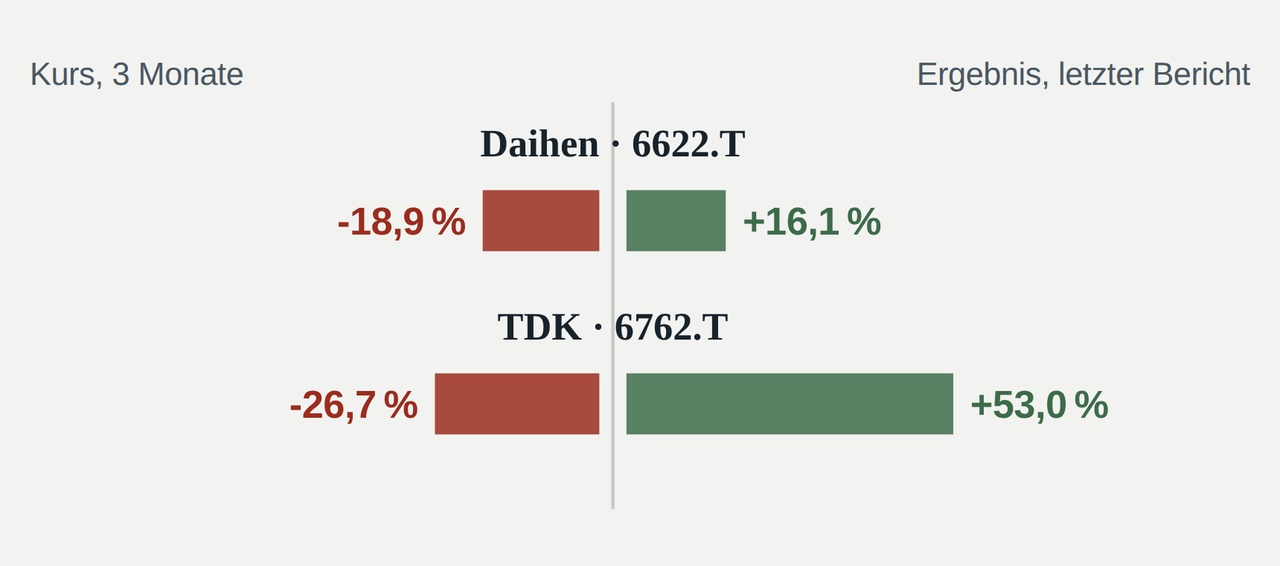
Share price performance over the last three months compared to the most recently reported earnings results. Daihen: Operating profit for FY 3/2026 compared to the prior year (+16.1%). TDK: Operating profit for Q1 of FY 3/2027 compared to the same quarter of the prior year (+53.0%).
Market context. The Nikkei reached its high of 72,366 points on June 25, 2026, and stood at 64,362 at the end of July. The TOPIX electrical appliances sector rose 52.6% in the April–June quarter—the highest increase ever recorded—and fell 9.4% in July. The price-to-earnings ratio of the Nikkei Semiconductor Index fell from 70 on June 22 to 27 on July 31. Both stocks were affected by this movement.
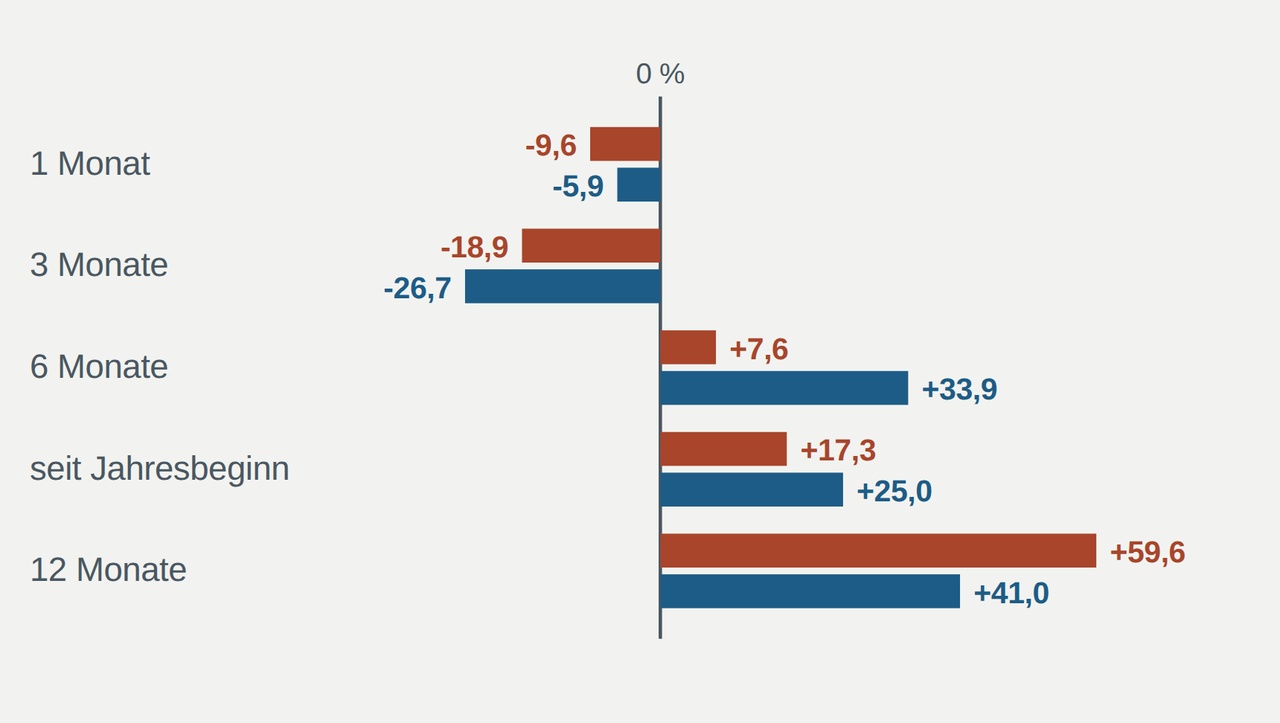
Price performance across five time horizons. Over a 12-month period, both are clearly in positive territory; the decline is limited exclusively to the third quarter of 2026.
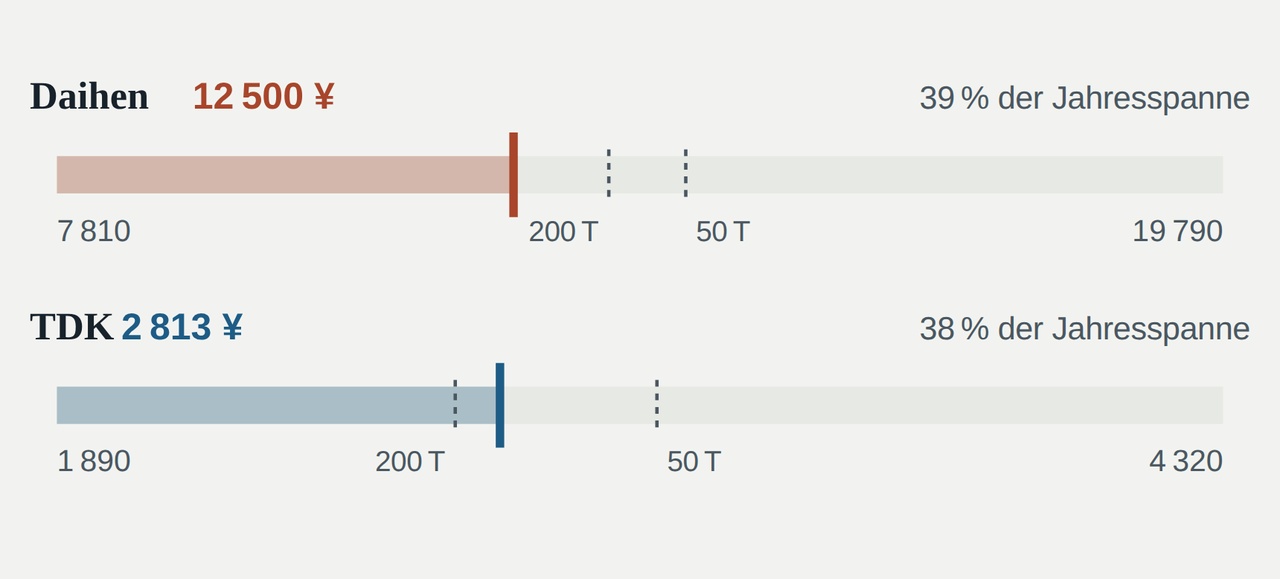
Position within the 52-week range. Both stock prices are below the 50- and 200-day moving averages and are roughly in the lower third of their annual range.
---
Daihen 6622.T $6622 (+6%)
Business Model
Daihen was founded in 1919 as Osaka Transformer, employs 4,542 people, and is led by Tetsuya Tajiri. The company has three core business areas, all of which are based on the same expertise—precise control of electrical energy:
- Power supply—transformers, switchgear, and solar inverters, primarily for Japanese utilities, with Kansai Electric as its most important customer.
- **Welding Technology and Mechatronics** – Welding and cutting systems, as well as industrial robots, including control systems and sensors.
- **Semiconductors and Flat-Panel Displays** – High-frequency generators, automatic matching networks for plasma processes, and cleanroom transfer robots.
The third segment is the most interesting: Daihen is one of only a few suppliers worldwide of RF generators and matching units for plasma etching systems. These components are integrated into the process recipes of the equipment manufacturers; switching suppliers requires requalification.
Growth Trend and Forecast
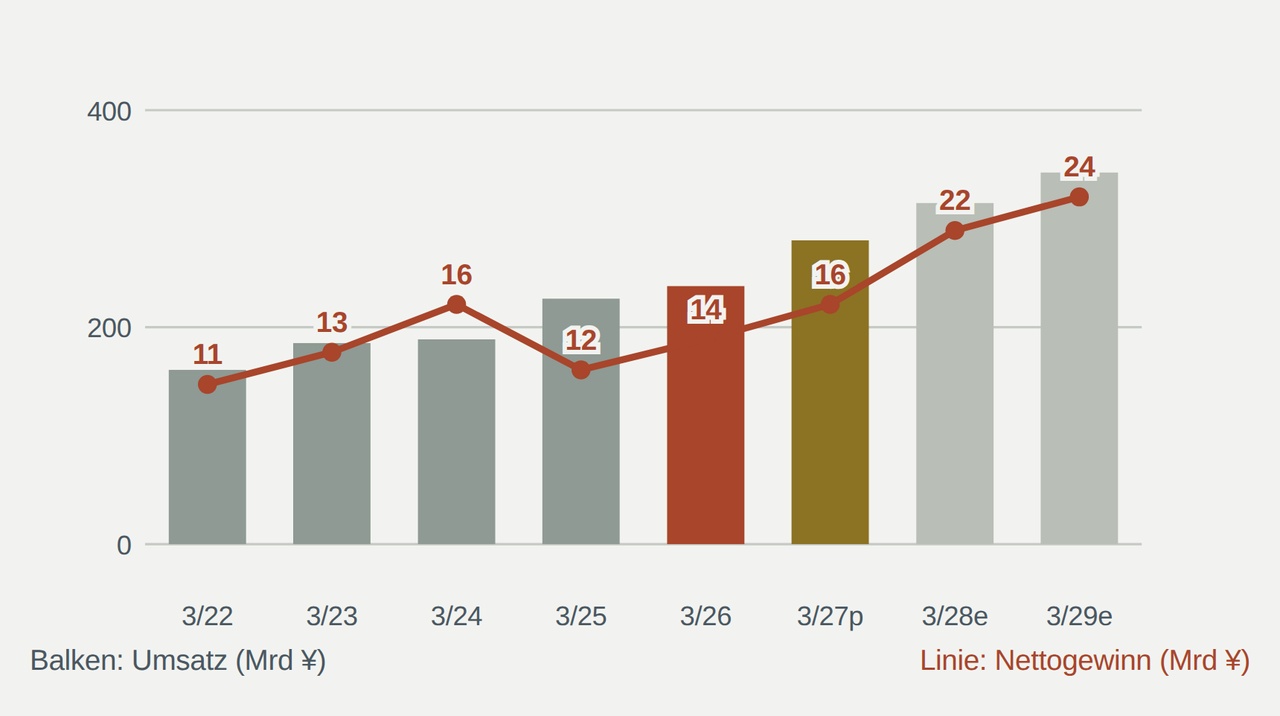
Revenue (bars) and net income (line) in ¥ billion. Through FY 3/2026: actual figures; FY 3/2027: company forecast as of May 11, 2026; thereafter: analyst consensus.
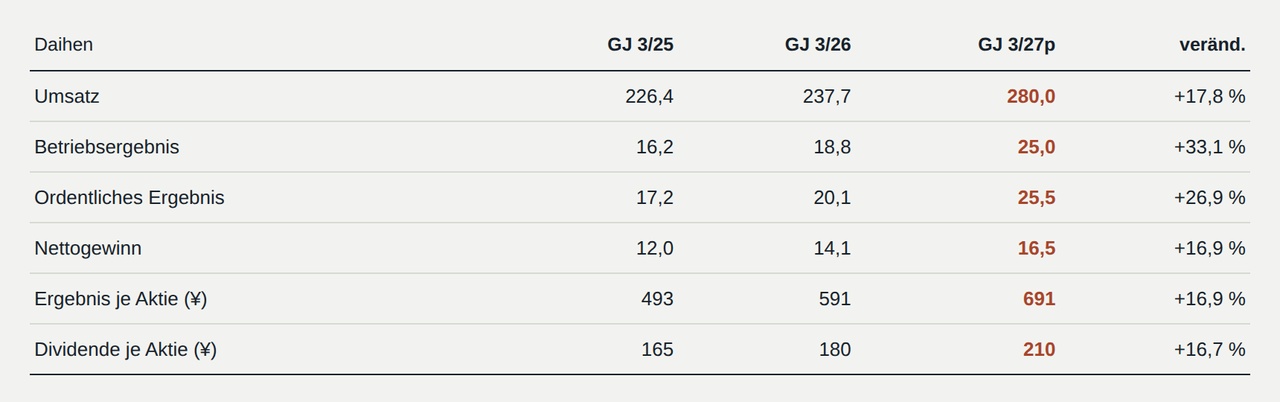
Figures in billions of yen, unless otherwise noted. Dividend prior to stock split.
Daihen is growing in revenue for the eighth consecutive year and in earnings for the third consecutive year. In terms of ordinary income, FY 3/2027 would be the second record year in a row. Noteworthy: The analyst consensus in mid-June stood at 26.4 billion ¥, exceeding the company’s forecast of 25.5 billion ¥—estimates were raised twice within two weeks. Following the first-quarter results on August 4, the forecast remained unchanged.
Competitive Advantage
In the transformer business, the advantage lies primarily in delivery times and approvals: grid operators take years to qualify suppliers, and the global shortage of power transformers currently provides pricing power. For RF generators, the advantage is technical in nature and more robust. However, neither of these factors translates into outstanding returns on capital—the return on invested capital is 5.1%, and the return on equity is 9.2%. This represents a solid, but not a wide, moat.
What Speaks Against Daihen
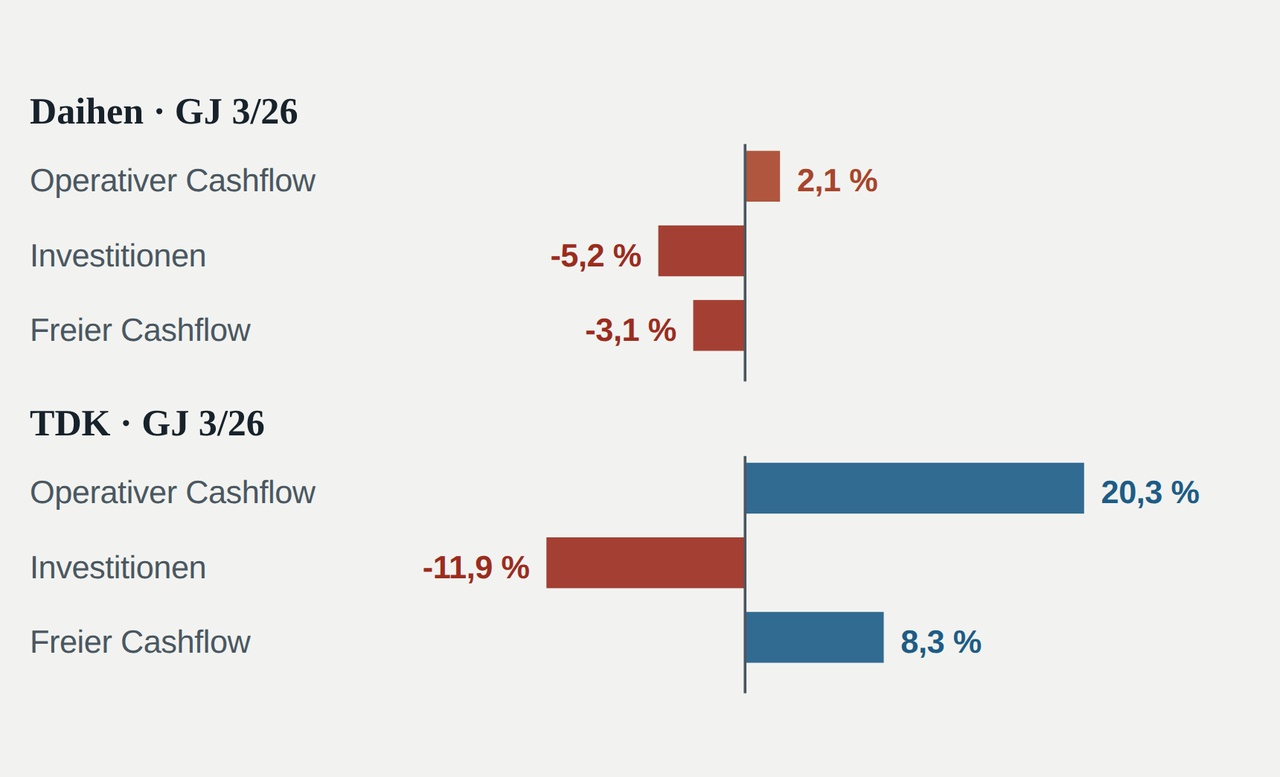
Operating cash flow, capital expenditures, and free cash flow for fiscal year 3/2026, each as a percentage of revenue. A direct comparison in absolute yen would not be meaningful due to differences in scale.
This is the most serious concern. Daihen reported operating cash flow of 4.9 billion yen in FY 3/2026—with net income of 14.1 billion yen. After capital expenditures of ¥12.4 billion, free cash flow was negative at −¥7.4 billion. The ratio of operating cash flow to net income is 0.35. The cause lies in current assets: Inventory ties up 233 days’ worth of sales, and the cash conversion cycle lasts 260 days, having lengthened from 196 days since FY 3/2022. Net debt rose from ¥2.8 billion (FY 3/2022) to ¥50.9 billion, and the debt-to-EBITDA ratio increased from 0.13 to 1.71.
Part of this is pre-financing for growth: If you want to increase revenue by 17.8% in a year, you have to produce in advance. However, free cash flow was negative in four of the last five fiscal years. This is a pattern, not an exception.
Furthermore, the most recently reported quarterly earnings per share missed the consensus by 19%, while revenue was in line with expectations at +0.6%. The margin was therefore the weak point, not demand.
Catalysts
- REAL – 1:5 stock split effective October 1, 2026.** The price of 12,500 yen will then be equivalent to 2,500 yen. With a minimum order size of 100 shares in Tokyo, the entry threshold drops from ¥1.25 million to ¥250,000—which significantly changes the investor base.
- REAL – Forecast upgrade. The consensus is already above the company’s guidance. The half-year results in early November are the most likely catalyst.
- **REAL – Grid expansion. Renewable energy feed-in and data center connections are driving demand for transformers among Japanese utilities.
- HYPE – “AI stock.” Daihen supplies components for semiconductor manufacturing and power systems for data centers, but it is an indirect, late-cycle beneficiary. Its correlation with the semiconductor index is higher than its fundamental dependence on the sector.
- PRICED IN – Price target 17,500 yen.** A major Japanese brokerage raised the target on June 9 from 15,000 to 17,500 yen—at a time when the stock price was higher. The consensus rating of 4.8 out of 5 is already close to the maximum and leaves little room for upgrades.
---
TDK · 6762.T
Business Model
TDK, founded in 1935, employs 109,289 people, is led by Noboru Saito, and, with a market capitalization of 5.34 bio ¥, is about eighteen times larger than Daihen. Four segments:
- **Passive Components** – Ceramic, aluminum, and film capacitors; inductors; high-frequency components. First-quarter revenue of 176.8 billion yen, up 28.0%.
- Sensors – Temperature, pressure, magnetic, and MEMS sensors.
- Magnetic Products – Read/write heads and suspensions for hard disk drives, magnets. A consolidated business with high market shares that thrives on the nearline storage cycle for data centers.
- Energy – rechargeable battery cells (via the subsidiary ATL) and power supplies. The largest and most volatile segment, heavily dependent on the smartphone cycle.
TDK is therefore not a pure-play AI company, but is present in nearly every data center in multiple ways: capacitors and inductors in the power supply of accelerator cards, hard disk heads in mass storage, and power supplies in the rack.
### Growth Trend and Forecast
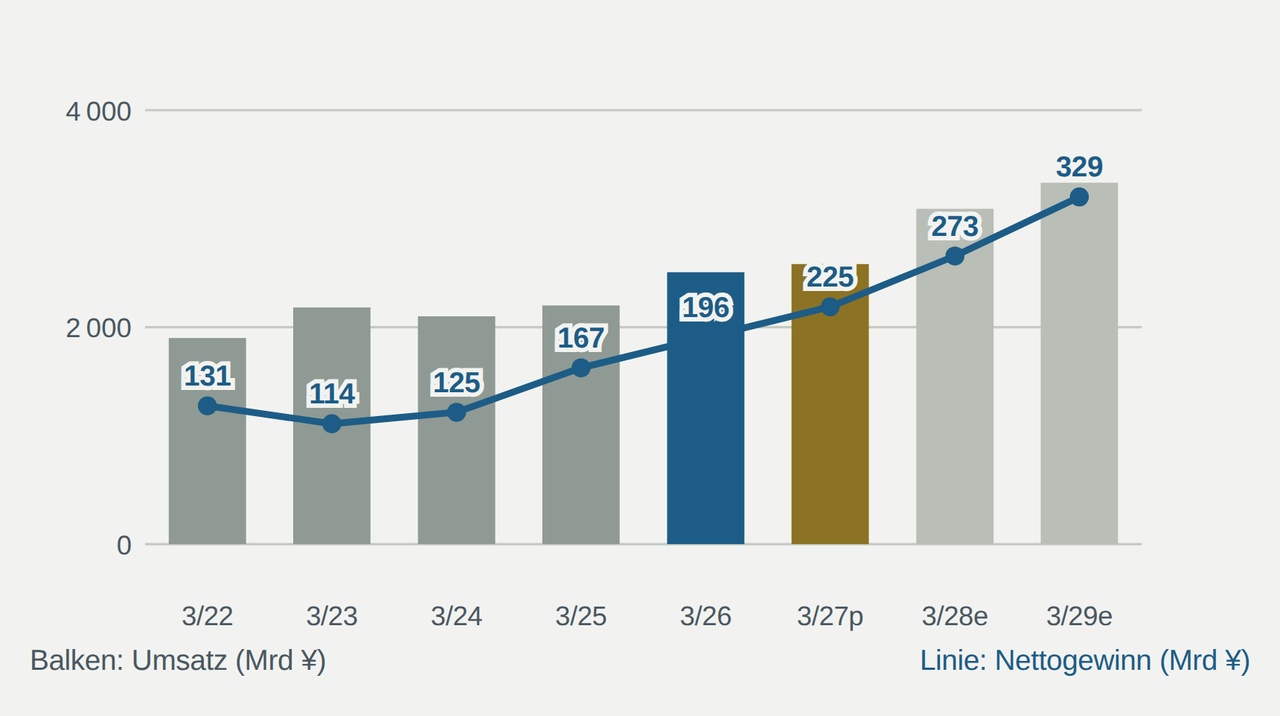
Revenue (bars) and net income (line) in billions of yen. Through FY 3/2026: actual figures; FY 3/2027: company forecast as of April 28, 2026; thereafter: analyst consensus.
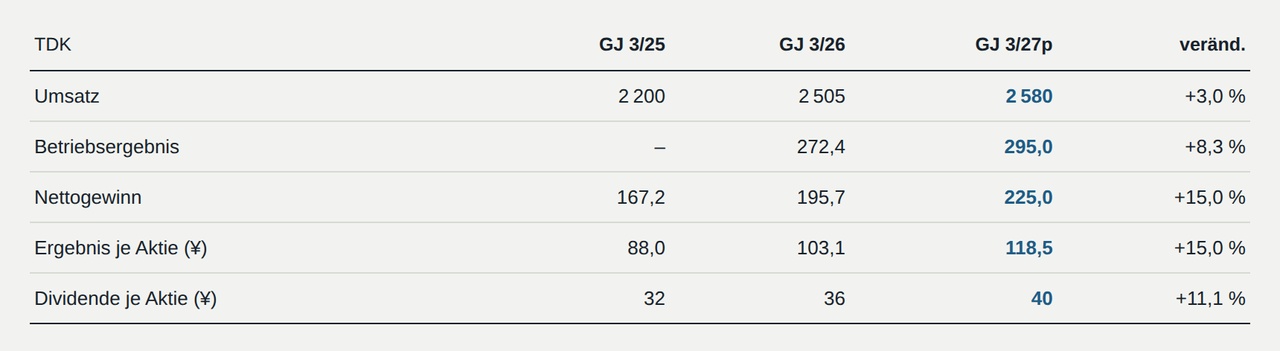
Figures in billions of yen, unless otherwise noted. Operating income for FY 3/26 calculated based on the company’s forecast.
The forecast is very likely too low.** In the first quarter of FY 3/2027 (April through June 2026), revenue rose by 38.3% to 741.0 billion yen, operating income rose 53.0% to ¥86.3 billion, and net income rose 94.3% to ¥80.5 billion. This means that, after just one quarter, 35.8% of the projected annual profit has already been achieved—the five-year average for the first quarter is 23.3%. Nevertheless, TDK has left its April 28 forecast unchanged. It also assumes an exchange rate of 150 yen per U.S. dollar starting in the second quarter, while the rate has recently been around 155 yen—an additional, unplanned tailwind.
The analyst consensus has already factored this in and projects revenue of 2.87 trillion yen and net income of 231.0 billion yen for FY 3/2027—about 11% above the revenue target and 3% above the net income target. Through FY 3/2029, it expects ¥3.33 trillion in revenue and ¥329 billion in profit, corresponding to annual profit growth of 19% starting in FY 3/2026.
Margins and Return on Capital
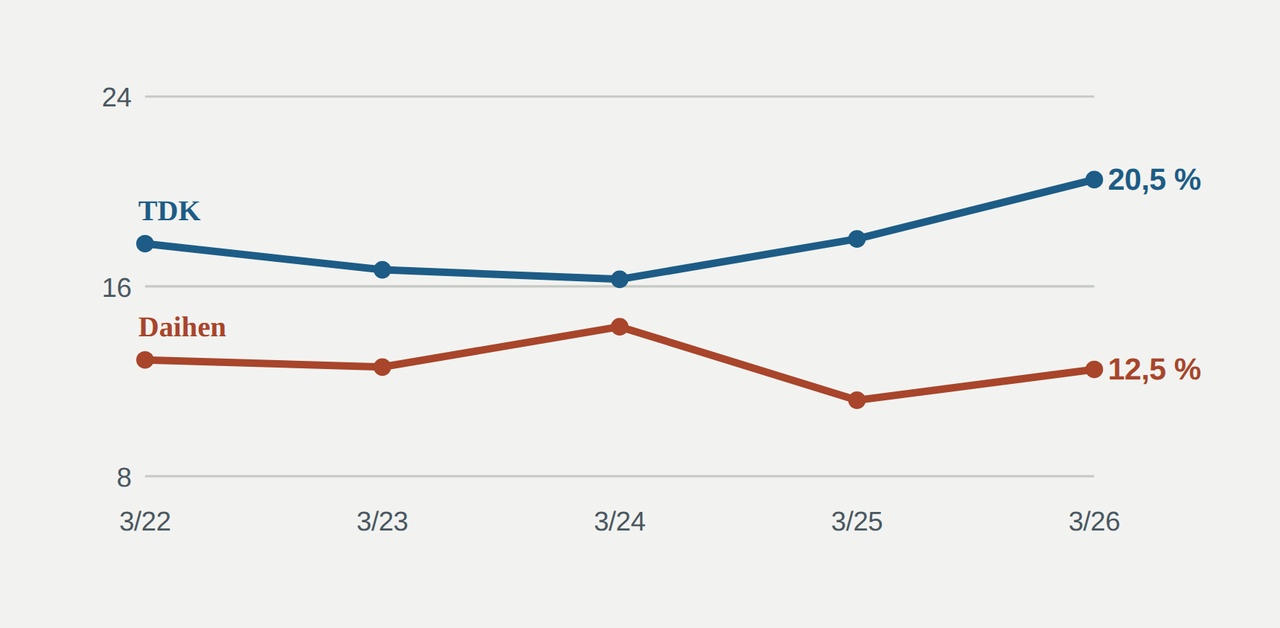
EBITDA margin in percent. TDK has improved by 4.2 percentage points since FY 3/2024, while Daihen has remained within a narrow range around 12.5% for the past five years.
This is the most significant structural difference. TDK’s EBITDA margin rose from 16.3% (FY 3/2024) to 20.5% (FY 3/2026), and its gross margin from 28.7% to 31.3%. Return on equity climbed from 7.3% to 8.9% and, over the past twelve months, to 11.1%. Daihen, by contrast, has been fluctuating within a range of 11.2% to 14.3% EBITDA margin for the past five years, with no discernible trend.
TDK achieves this through high capital intensity: 11.9% of revenue goes toward capital expenditures, and another 11.6% toward research and development. Together, these account for 23.5% of revenue—compared to 5.2% plus 2.7% at Daihen. TDK must maintain this pace to defend its position.
The balance sheet supports this: TDK has net liquidity of ¥226.8 billion, a debt-to-equity ratio of 0.28, and generated free cash flow of ¥209.1 billion in FY 3/2026. The ratio of operating cash flow to net income is 2.59, compared to 0.35 for Daihen.
Arguments against TDK
- Energy segment. The largest revenue driver is tied to the smartphone cycle and ATL’s manufacturing in China. A slump in demand for end devices or trade policy interventions would disproportionately impact TDK.
- Dependence on raw materials.** Rare earths and cobalt come from only a few regions. Export restrictions have a direct impact on production planning and costs.
- **Price pressure.** Electronic components are a business characterized by structural annual price declines. The current margin expansion depends on higher-value products offsetting the price decline more quickly than in the past.
- Currency.** A stronger yen has an immediate impact. The Bank of Japan is increasingly viewed as more restrictive; every move toward 140 yen per dollar erodes profits.
- **Valuation.** With a price-to-earnings ratio of 22.7 based on the last twelve months, TDK is at the upper end of its own five-year range of 12.9 to 22.6.
Catalysts
- REAL – Half-Year Results in Late October.** After achieving 35.8% of its target in the first quarter, an upward revision of the full-year forecast is the most likely single driver of the stock price.
- REAL – Exchange Rate.** 155 yen per dollar versus a budget assumption of 150 yen.
- REAL – Nearline hard drives.** The storage needs of AI data centers are driving a segment that was considered a sunset business for years.
-HYPE – Sector rotation.** The 26.7% decline in the stock price over three months has no apparent company-specific cause. Anyone holding TDK as a semiconductor beta stock is trading the index, not the company.
PRICED IN – Analyst target: 4,110 yen. As of September 8, 2026, the consensus rating is Buy, with an average target price 48.1% above the current price—with 9 votes for Strong Buy, 5 for Buy, 2 for Neutral, and 1 for Strong Sell. A target of this magnitude implicitly assumes a bull scenario.
---
## Valuation Comparison
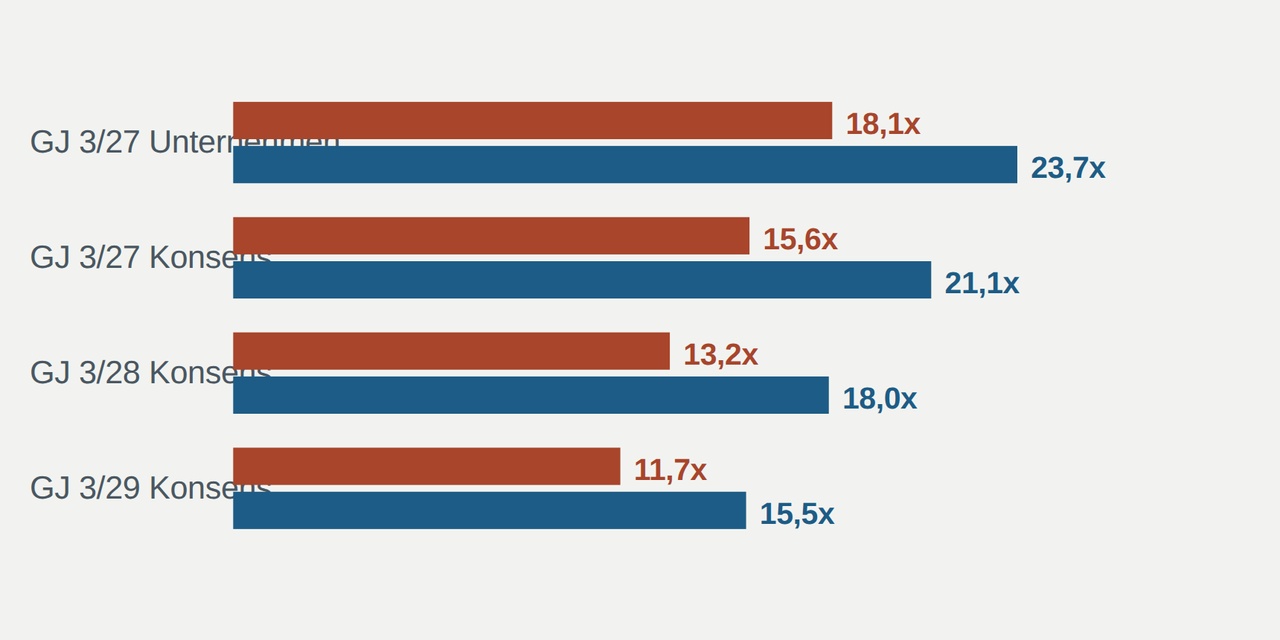
Price-to-earnings ratio based on respective earnings estimates, calculated using the stock prices as of September 9, 2026 (Daihen 12,500 ¥, TDK 2,813 ¥).
Daihen is significantly cheaper on an earnings basis—13.2 versus 18.0 based on the estimate for FY 3/2028—but generates lower margins, does not convert earnings into cash, and is operating with rising debt. TDK costs more, but in return delivers net liquidity, a margin that has been widening for two years, and free cash flow that covers the dividend threefold. Based on enterprise value to EBITDA—the metric that incorporates the balance sheet—the ranking is actually reversed: TDK, at 9.8, is cheaper than Daihen, at 11.4.
Forecast
The following scenarios are my own and do not represent the consensus. Each consists of an earnings assumption and a valuation multiple; both are explicitly stated so that they are transparent and can be refuted. Time horizon: twelve months; valuation basis: fiscal year 3/2028.
The most important point: For Daihen, the range of variation is greater in both directions, and the risk-reward ratio, at 2.9 to 1, is nearly twice as favorable as that of TDK. This compensates for the fact that cash flow quality is lower, the company is smaller, and analyst coverage is sparser. My expected return for TDK, at +13.8%, is significantly below the sell-side target of +48.1%—I consider the 25x valuation implied by this target to be a bull scenario rather than the base case.
---
Conclusion
**Daihen 6622.T $6622 (+6%) — Conviction Score 62 out of 100.** Attractively valued on an earnings basis, good risk-reward profile, clear catalyst in October and November—capped by a return on equity of 5.1%, four out of five years of negative cash flow, and a rating consensus that already stands at 4.8 out of 5.
**TDK 6762.T $6762 (+3,04%) — Conviction Score 71 out of 100.** The forecast is demonstrably too conservative, the balance sheet shows net liquidity, and the margin has been rising for two years—constrained by a valuation at the upper end of its own five-year range and high capital intensity.
The two stocks serve different purposes. TDK is the higher-quality investment: better margins, a stronger balance sheet, a business that reliably converts profits into cash, and a forecast that is highly likely to be surpassed by the half-year results. Daihen is the more asymmetric play: cheaper, smaller, less well-analyzed, with two scheduled events in the fourth quarter and a risk-reward profile that offsets its greater operational shortcomings.
### Invalidation Triggers
These points would invalidate the respective thesis—not weaken it, but end it:
- **Daihen** $6622 (+6%) – two consecutive quarters of negative operating cash flow coupled with inventory rising above 250 days; a downward revision of the full-year forecast; net debt-to-EBITDA ratio above 2.5; a decline in the semiconductor and display segments while the consolidated forecast remains unchanged (a sign that the forecast relies on the lower-margin business).
- **TDK** $6762 (+3,04%) – no upward revision to the forecast in the half-year results at the end of October despite achieving 35.8% of the target after one quarter; yen below 140 per dollar; Gross margin fell below 29%; visible slump in orders for hard disk heads or regulatory intervention at ATL in China.
---
## Sources and Notes
Data sources: Bigdata.com (stock prices, fundamental data, consensus estimates, as of September 9, 2026), Company announcements from Daihen (May 11 and August 4, 2026) and TDK (April 28 and July 31, 2026), Kabutan, Minkabu, IFIS Kabuyoho, Nikkei. The fiscal year designations used by data providers are inconsistent; here, they are consistently named according to the fiscal year-end, so FY 3/2026 refers to the year ending March 31, 2026. TDK’s operating income for FY 3/2026 was calculated based on the percentage figure from the company’s forecast, as the data providers use different accounting periods here.
Both stocks are quoted in yen—for an investor in the eurozone, currency risk is added to price risk, and when trading via German exchanges, liquidity for RDaihen differs significantly from that in Tokyo.
@Multibagger
@Tenbagger-Capital
@Raketentoni
@Klein-Anleger
and many more


