

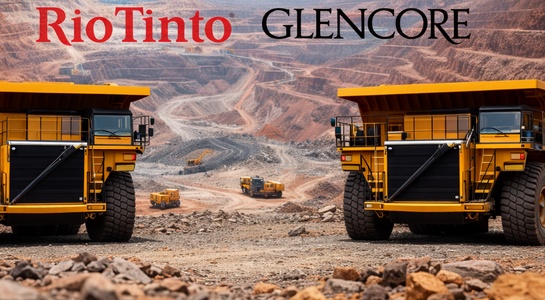
The international mining industry may be facing a tectonic shift due to a Rio Tinto $RIO (-0,97%)
$RIO (-0,88%) Glencore $GLEN (+1,85%) merger.
Talks are taking place behind the scenes that could permanently change the ranking of the world's largest commodity groups.
Nothing has been decided yet, but the dimensions are huge - and the consequences would extend far beyond copper and iron ore.
A closer look is also worthwhile for gold investors.
》Talks about a new industry giant《
Rio Tinto and Glencore have confirmed that they are once again in talks about a possible merger.
A transaction is under discussion which - depending on the structure - would lead to the creation of the world's largest mining group.
With a combined market capitalization of around 207 billion US dollars and an enterprise value of over 260 billion US dollars, the new heavyweight could even overtake industry leader BHP $BHP (+0,74%) and also overtake Newmont $NEM (-0,01%) the top position among mining companies.
It would be the second attempt in just over a year. Glencore first approached Rio Tinto at the end of 2024, without success at the time. Now, at the end of 2025, the environment seems to have changed significantly - both strategically and in terms of personnel.
》New CEO, new openness for major deals《
One key difference to the first round of talks is at Rio Tinto itself. Simon Trott has been the new CEO since August and is considered to be much more open to large-volume transactions than his predecessor. Trott is pursuing the goal of streamlining the Group, disposing of non-strategic peripheral activities and focusing the portfolio more clearly on future raw materials.
This is precisely where the strategic direction of both companies coincides: Copper.
Both Rio Tinto and Glencore see the metal as one of the key bottleneck factors in the coming decades - driven by the energy transition, electromobility, AI data centers and rising defence spending.
》Rio Tinto and Glencore focus on copper《
While gold is the emotional and strategic focus for many private investors, copper is currently the commodity that is driving merger fantasies in the sector.
Analysts believe that global demand for copper could increase by around 50% by 2040.
At the same time, a structural supply deficit of more than ten million tons per year is looming without massive new investments.
Glencore has already clearly positioned itself as a "copper growth stock" and is aiming to double its production to 1.6 million tons per year by 2035.
Rio Tinto, on the other hand, has a strong project pipeline, but is under pressure to realize growth faster than would be possible organically.
A merger could provide precisely this leverage.
》Old hurdles partially cleared out of the way《
A major stumbling block in earlier talks was Glencore's coal business. Rio Tinto already exited coal mining completely in 2018 and did not want to be burdened with the CO₂-intensive segment again.
This hurdle has now been removed: Glencore has spun off its coal activities into an independent Australian unit. This would make a spin-off or separate sale much easier - and makes a merger more politically and strategically viable.
However, it remains to be seen whether Glencore's extensive trading business would be part of a deal. This area in particular is high-margin, but culturally difficult to integrate with Rio Tinto.
》Market reactions and risks for shareholders《
The stock market reacted promptly to the news. Glencore shares rose by around 6% at times, while Rio Tinto shares came under noticeable pressure. Investors fear that Rio Tinto could pay too high a price in the event of a share swap. Analysts warn of possible value destruction if the premium is too high or the integration fails.
》In addition, there are cultural differences《
Glencore is seen as opportunistic, trade-driven and strongly focused on results, while Rio Tinto traditionally focuses more on operational stability and long-term projects. It remains to be seen whether this will result in a productive mix or a conflict.
And what would the Rio Tinto Glencore merger mean for gold - or for Newmont?
Even if gold is not at the center of the merger logic, the indirect consequences would be considerable. A new megacorporation would reorganize the balance of power in the commodities sector.
For Newmont Corp., currently the world's largest gold producer, this could be at least symbolically relevant: In public perception and among institutional investors, Newmont could lose its place at the top of the global mining giants - even if the focus of the new group is primarily on base metals.


