
Anyone who needs capital or wants to invest comes to S&P Global can hardly avoid S&P Global. The company earns from decisions that others have to make.
A rarity
Sooner or later, every share corrects, but for some it is particularly rare. S&P Global is one of them. Is the recent setback an opportunity?
S&P Global is one of the silent powerhouses of the financial world. The rating business is its foundation. Together with Moody's, S&P almost completely dominates this market.
The principle is simple: issuers pay to have their debt instruments rated. Investors use these ratings as a basis for their decisions. In practice, however, it is about much more than orientation.
The company rates countries, companies and financial products - and thus sets standards to which entire Märktealign themselves with.
A rating is often a prerequisite for obtaining capital in the first place. Many funds, insurance companies and banks are not allowed to invest without a corresponding credit rating.
The economic logic behind this is clear. Bonds with a rating are cheaper to finance than those without. In comparison, the costs for the rating are hardly significant. Issuers gain an immediate advantage that multiplies over the entire term. The willingness to pay for this service is correspondingly high.
Ratings pay for themselves
A study (Quelle) by the Federal Deposit Insurance Corporation shows that municipal bonds without a rating must offer significantly higher yields on average - around 48 basis points more than comparable rated securities.
On the other hand, the cost of a rating is around 8 basis points. Even if two agencies are commissioned, the ratings pay for themselves in the first year. This is a considerable advantage in the long term.
But this is by no means the only advantage. Ratings are now deeply integrated into the financial system. They are embedded in investment guidelines, loan agreements and regulatory requirements. Even if new technologies were to enable better analyses, this would change little. The decisive factor is not only the quality of the rating, but also its acceptance in the system.
This is precisely where the moat lies. There are numerous providers who could also produce creditworthiness analyses. But without recognition by regulators and market participants, they remain meaningless. The name S&P is the real currency.
An elegant business
However, the business does not end with credit ratings. S&P sells data, analyses and software solutions that are deeply integrated into the processes of banks, funds and companies. Decisions are data-driven, and S&P provides the basis for them.
Added to this is consulting. Large corporations and governments have been relying on its expertise for years. It's about market analysis, risk assessment and strategic planning. These long-term relationships ensure stable revenues and strengthen loyalty to the company.
Perhaps the most elegant source of revenue, however, is the index space. The S&P 500 is the global benchmark for equities. Countless ETFs and funds replicate it and pay license fees for it.
This means that S&P earns money every time capital is passively invested. Without own Risiko.
That speaks for itself
The figures show that this system works. Over the past ten years, S&P Global has more than doubled its turnover from USD 5.66 billion to USD 15.34 billion.
At the same time, profitability has improved somewhat, with a recent operating margin of around 40%.
During this period, earnings more than tripled from USD 5.35 to USD 17.83 per share.
In addition, the company is constantly buying back its own shares. Dilution only took place in the course of the takeover of IHS Markit took place. Apart from acquisitions, the number of shares outstanding is falling steadily - last year, for example, from 315 million to 306 million.
All this has made S&P a long-term outperformer and, if current forecasts are to be believed, this is likely to continue in a similar way.
Earnings are currently expected to rise by 10% this year to USD 19.60 per share.
S&P Global thus arrives at a forward P/E of 21.3, which puts the valuation at a similar level to the low of 2022 or 2020.
Disappointing record result
It is also possible that expectations are too low. After S&P presented "disappointing" figures and a "disappointing" outlook in the last quarter, forecasters are likely to be cautious.
In reality, Q4 earnings of USD 4.30 were slightly below expectations of USD 4.33 per share and revenue of USD 3.92 billion was slightly above estimates of USD 3.90 billion.
For 2026, S&P is forecasting a jump in earnings to USD 19.40 - 19.65 per share. The previous forecast was USD 19.82 per share.
In the big picture, this news was almost irrelevant in my view. However, the fact that every fly is made into an elephant on the stock market is nothing new
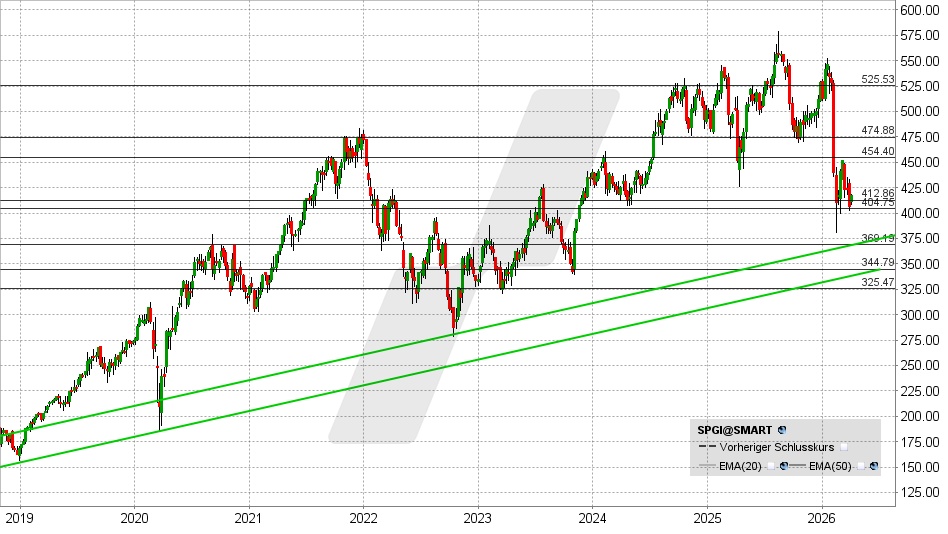
S&P Global share: Chart from 31.03.2026, price: USD 417.59 - symbol: SPGI | Source: TWS
S&P Global appears to be attracting interest at the USD 404 - 413 support zone. If a bottom is formed at this level, this could trigger a recovery towards USD 450 - 455. A procyclical buy signal would be issued above this level.
If, on the other hand, the share falls below USD 404 at the end of the week, further price losses to USD 390 or 370 must be taken into account.
Source


