
$AXON (+3,84%) Today, let’s take a look at Axon Enterprise. Most of you are probably already familiar with the company, but as I was browsing through some information today, I noticed that there isn’t a proper analysis of it, so I figured I’d fill that gap.
1. Basic Data
Current Price: $442.08 (equivalent to approximately €383.20 at an exchange rate of 0.8668)
P/E Ratio (NTM – Forward P/E): 49.2
Market Cap: $36.24 billion
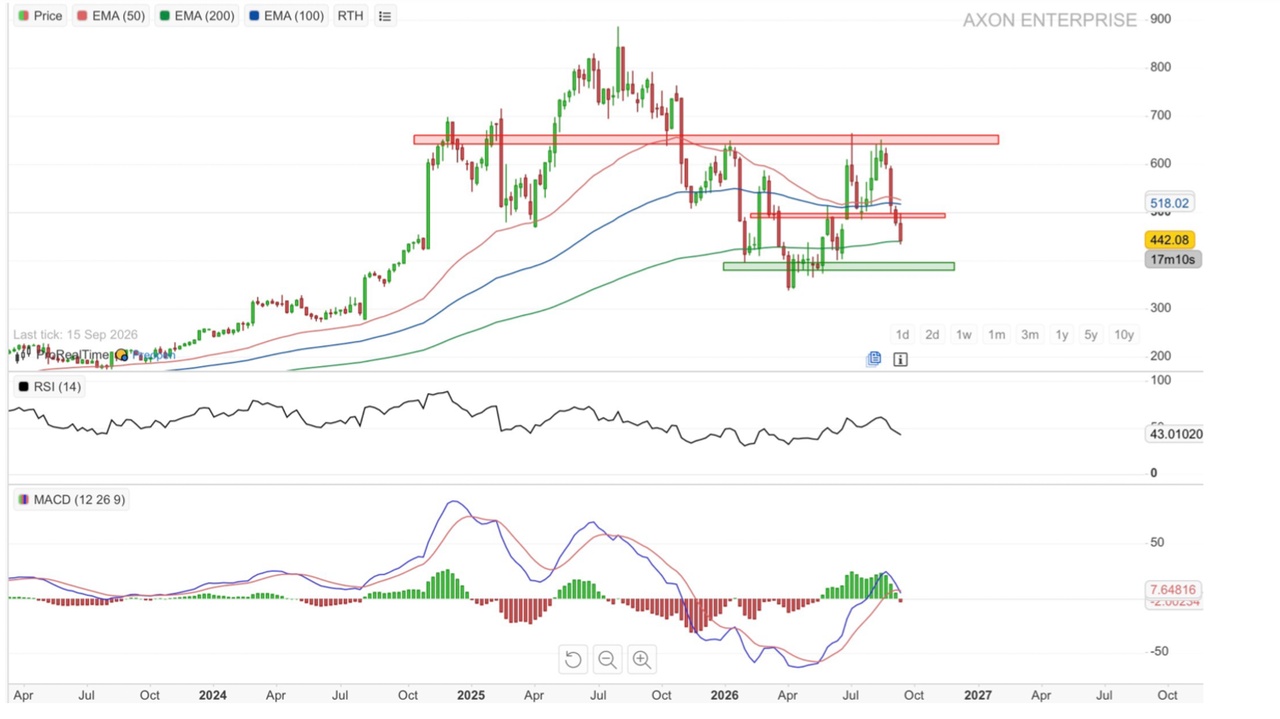
2. Business Model: What Does the Company Do?
Axon Enterprise (formerly TASER International) is the global market leader in de-escalation and security technologies for the public sector (police, judiciary, military) and is increasingly expanding into the corporate sector. The business model is divided into two main segments:
1. Connected Devices: Stun guns (TASER 10), camera systems (Axon Body 4, in-car cameras), and drone defense (acquisition of Dedrone).
2. Software & Services (SaaS): The cloud-based Axon Evidence platform (evidence management), Axon Respond (real-time situational awareness), and new AI solutions such as Draft One (automated creation of police reports via voice AI).
Axon combines hardware with highly profitable, long-term software subscriptions. Annual recurring revenue (ARR) most recently exceeded $1.6 billion (+39% YoY) with a net retention rate of 126%.
3. Moat & Disruption
Rating: 9/10 points
Reasoning: The moat is protected by immense switching costs (lock-in effect) and strong network effects. Once a police department uses Axon’s hardware and software, all evidence, workflows, and court databases are integrated into Axon Evidence. Switching to another provider is extremely risky and costly for reasons of data protection, training, and legal certainty. Axon effectively holds a global monopoly on TASER weapons.
Risks & Disruption: One point is deducted due to potential risks: As the company expands into new sectors (private security/retail), Axon faces established competition and does not enjoy the same monopoly position it holds with government agencies. In addition, AI features (such as automatic facial recognition or AI-generated reports) pose social and regulatory risks regarding data privacy and misinformation.
4. Financial Figures, Margins & Growth
Rating: 8/10 points
Rationale: Operational growth is simply outstanding:
Revenue Growth: In the most recent quarter (Q2 2026), revenue rose 35.3% year-over-year to $904 million—the 10th consecutive quarter with growth exceeding 30%. The full-year forecast for 2026 was raised to 32–34%.
Margins: The adjusted gross margin stands at a strong 62.9%. The adjusted EBITDA margin is 26.8%.
Growth Outlook: Organic revenue growth of approximately 25% per year is realistic for the next 3 to 5 years.
Why not a 10/10? GAAP profitability lags far behind (net margin of only 3.3%). The reason for this is extremely high stock-based compensation, which alone will consume around $590 million to $620 million in 2026. Free cash flow was also just under -$1 million in Q2 2026, as inventory was built up massively to meet the enormous demand.
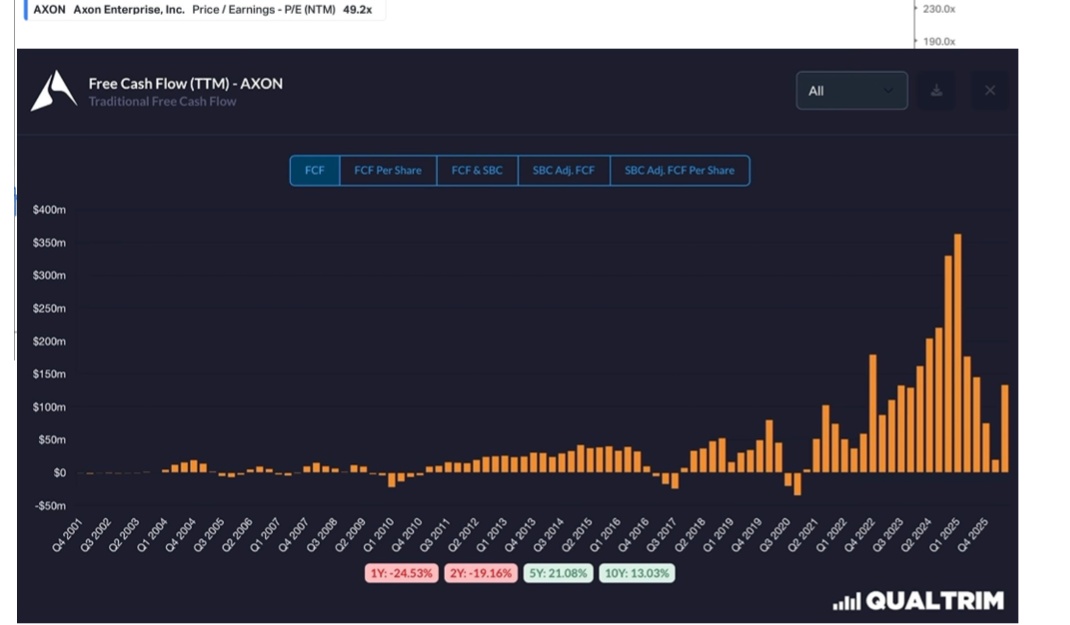
The free cash flow chart shows that we have investment cycles here as well, but each time free cash flow has turned negative, it has subsequently rebounded more strongly. So we could now be at the end of the investment cycle again and soon see significantly higher free cash flow—which is also the forecast.
5. Valuation (P/E Ratio & PEG Ratio)
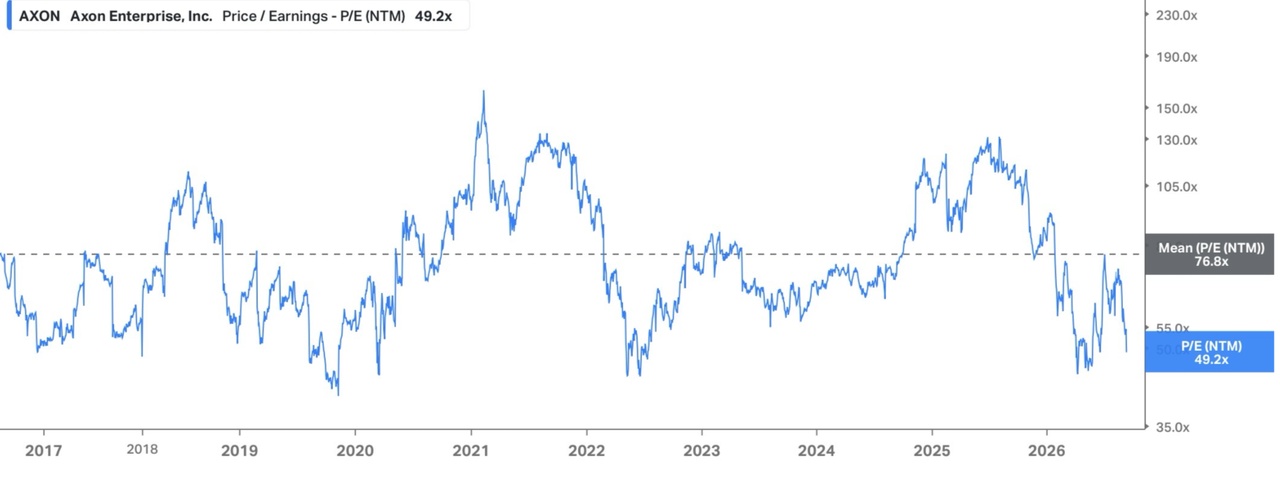
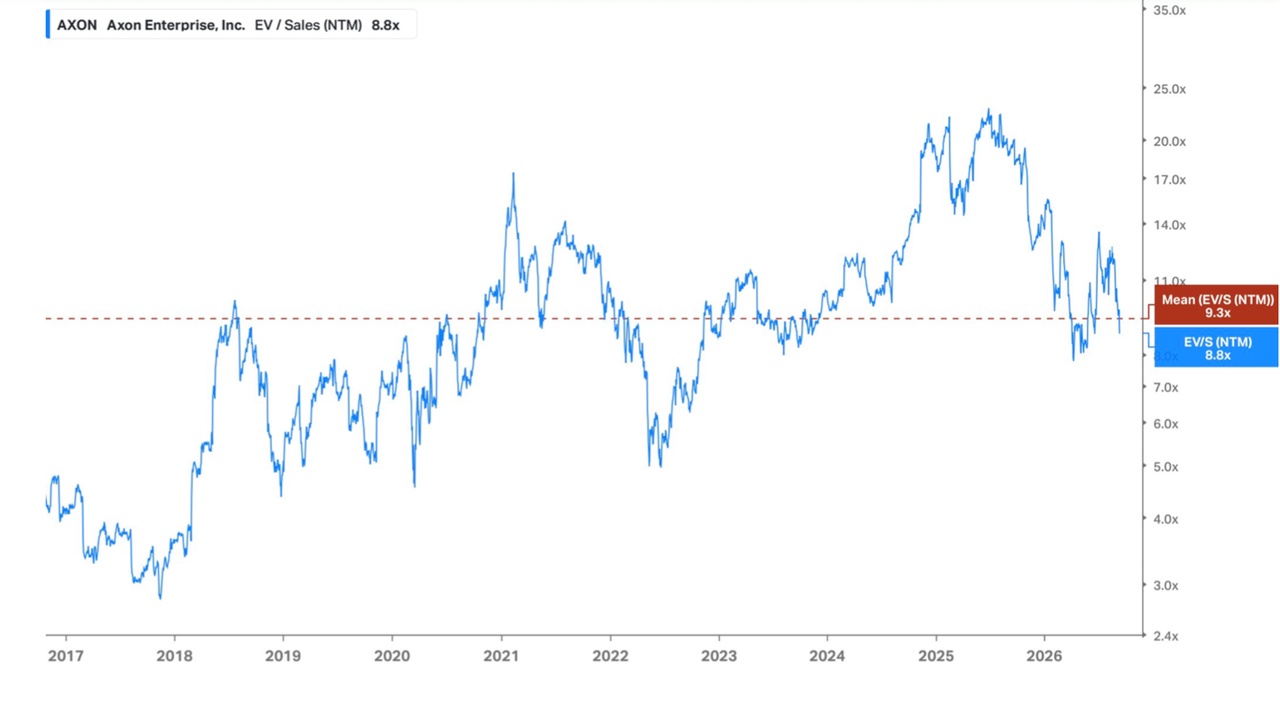
The forward P/E ratio stands at 49.2.
Historical comparison: The historical forward P/E ratio over the past 10 years was 76.8. The stock has corrected sharply (-44%) from its all-time high of just under $792.
Why has the P/E ratio fallen? The market has driven down the P/E ratio for two reasons: On the one hand, interest rate and valuation adjustments among highly valued tech stocks led to profit-taking. On the other hand, the announcement of a $1.0 billion convertible bond maturing in September 2026 temporarily unsettled the market.
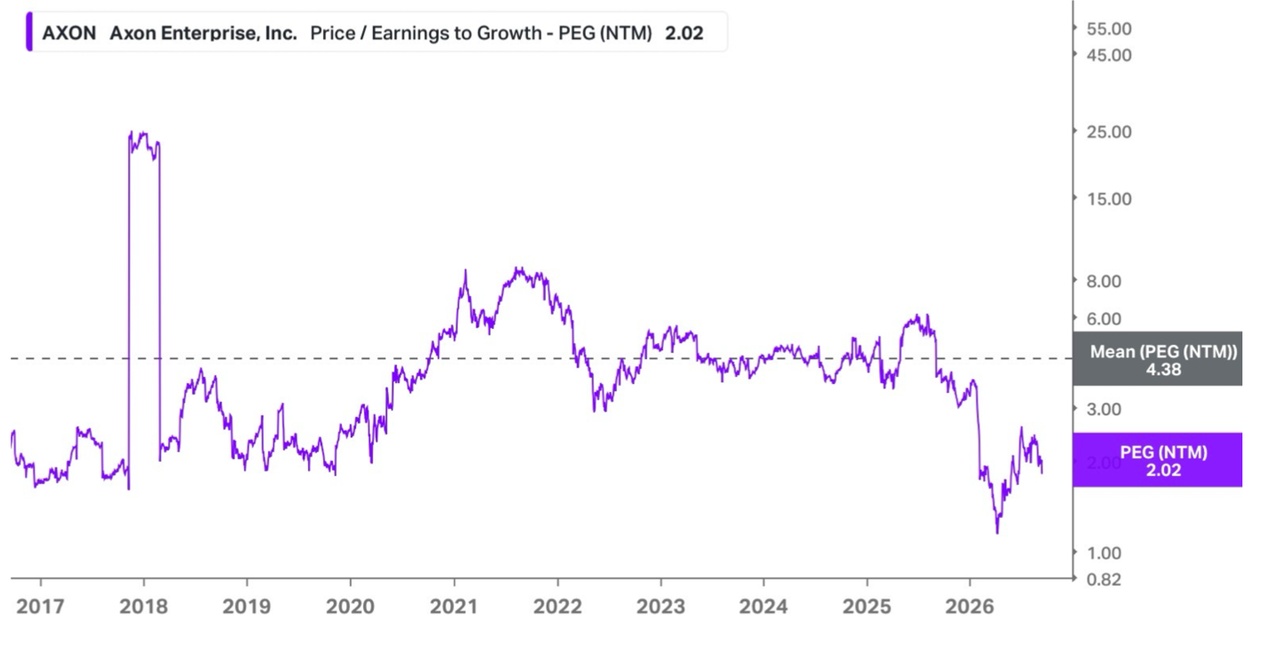
The PEG ratio stands at approximately 2.02, assuming sustainable EPS growth of an estimated 25% per year. For a software/hardware monopoly with over 30% growth, this is absolutely reasonable by industry standards.
Verdict: Historically speaking, the stock is significantly undervalued and, following the 44% price decline, is fundamentally attractively valued.
6. Balance Sheet Review
Debt Level: Prior to the most recent capital transaction, Axon was virtually debt-free. In September 2026, management announced the issuance of $1.0 billion in 0% Convertible Senior Notes maturing in 2031.
Leverage & Cash Flow Coverage: Since the convertible note bears 0% interest, there are no ongoing interest expenses. Cash holdings are therefore rising sharply again.
Conclusion: Thanks to the 0% interest rate, the debt burden does not pose a liquidity risk; however, there is a risk of slight equity dilution if the notes are converted into shares.
7. Management & Capital Allocation
Share Buybacks vs. Dilution: This is a weak point. Axon does not engage in significant share buybacks. Instead, the high stock-based compensation (SBC of ~$600 million in 2026), combined with the new convertible bond, leads to steady dilution of existing shareholders.
Strategic Directions: CEO Rick Smith is a visionary. Management is driving two massive future markets:
1. AI & Software: The “AI Era Plan” is posting growth of nearly 700% year-over-year. The Draft One software saves police officers hours in report writing.
2. Military & Enterprise: With the acquisition of Dedrone (drone defense, already >$100 million in revenue) and cameras for retail/healthcare (“Axon Body Mini”), huge new target markets are being tapped.
Verdict: Operationally and strategically outstanding, but its own compensation policy (SBC) comes at the expense of shareholders.
8. Analyst Consensus
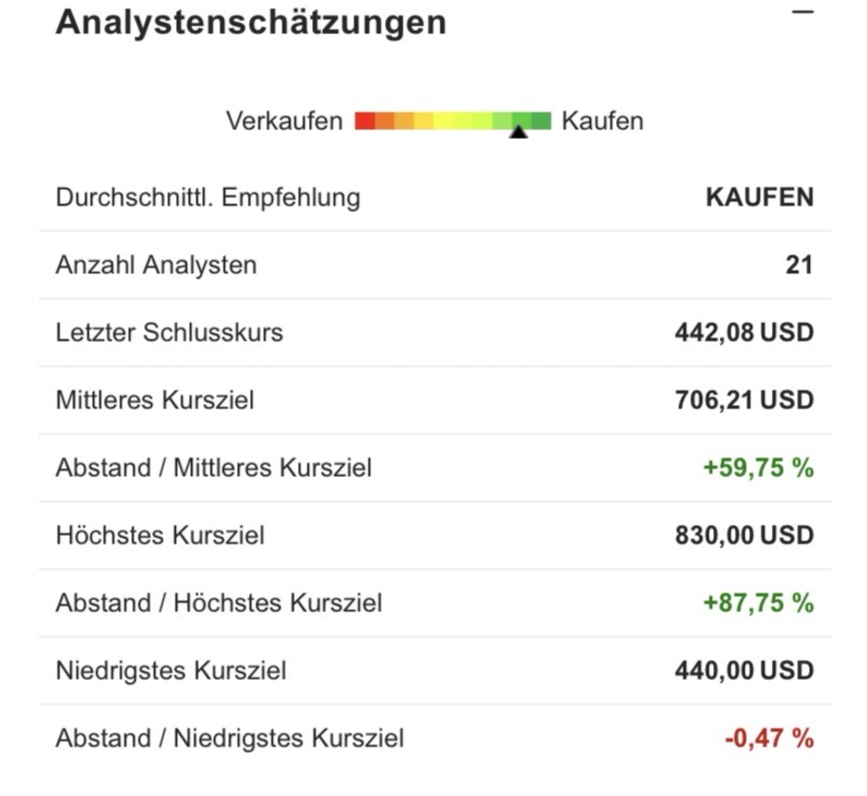
Of 21 analysts, 18 assign a Buy rating and 3 assign a Hold rating. The average 12-month price target is $706.21 (an upside of approximately 59.75% from current levels). The market views the recent price drop as a clear overreaction.
9. Macroeconomic Outlook & Specific News
News: In its Q2 2026 earnings report, Axon beat expectations (EPS of $1.88 vs. an estimated $1.84) and raised its full-year forecast. The subsequent price slide in September 2026 to $442 was triggered by the convertible bond announcement and the CEO’s 10b5-1 insider sales.
Is this a problem? No. The operational engine is running at full speed. Future contracted bookings rose 41% year-over-year to a staggering $15.1 billion.
Macro (tailwinds vs. headwinds): Axon is enjoying strong tailwinds. Increased efficiency for law enforcement, transparency through body cams, and de-escalation are politically desired across party lines in nearly all Western countries and are prioritized with public funds.
10. Conclusion
Axon Enterprise is a technologically dominant, high-quality company with a quasi-monopolistic moat among law enforcement agencies. Its reliable SaaS model ensures predictable and highly profitable cash flow.
The flip side of the coin is significant dilution from equity-based compensation and the recent convertible bond issuance. Nevertheless, investors with a 3- to 5-year horizon now have the opportunity—following the 44% sell-off—to add a market leader with >30% revenue growth to their portfolio at a historically low P/E ratio.
Rating: BUY
What are your thoughts on this? Does the high valuation put you off?
... Etc.
Of course, everyone else’s input is welcome, too
This is not investment advice. It’s just my personal opinion and a record of my portfolio. Investments carry the risk of loss. #notinvestmentadvice


