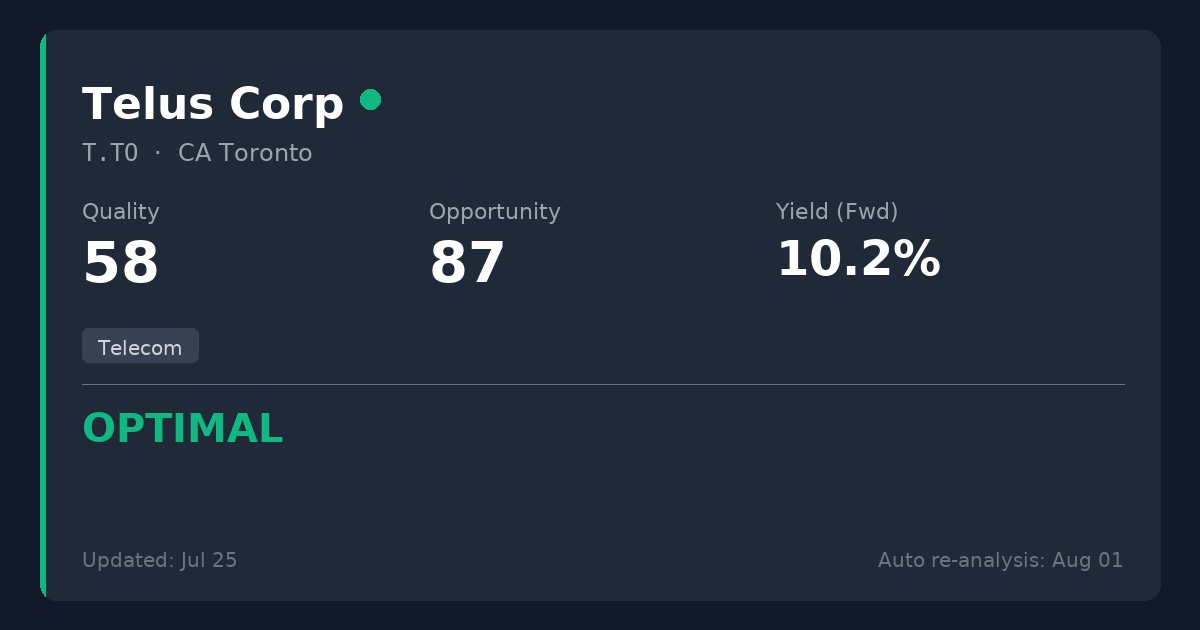
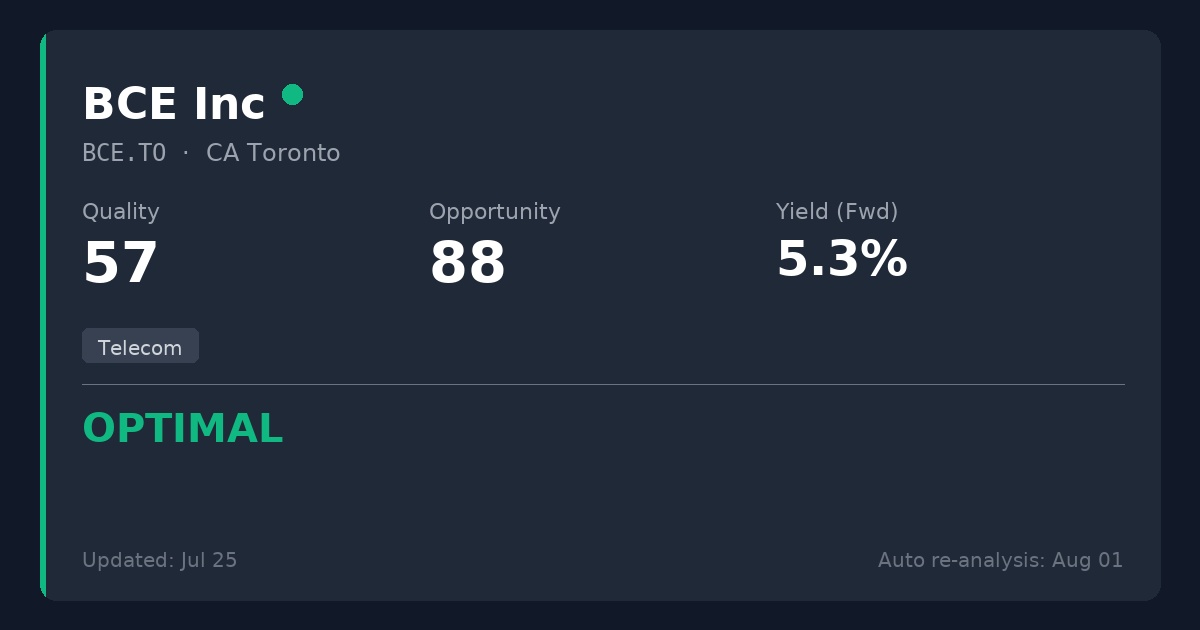
This week, the top 2 Opportunity scores in my entire database belong to Canadian telecoms. My algorithm rates both 🟢 OPTIMAL — but let me be transparent about the Quality side.
BCE Inc ($BCE (-1,83%)
)
Quality 57 / Opportunity 88
Yield: 5.79% | P/FFO: 4.2× | Forward P/E: 11.6
Fair value estimate: C$71–106 vs C$30 today
BCE just went through a brutal 42% dividend reset. The market hated it. But the new payout is now covered 1.39× by FCF with a 30% cash flow payout ratio. The core telecom operation prints 60% EBITDA margins. The elephant in the room: a $2.1B non-cash impairment on legacy media assets and CRTC-mandated wholesale fiber access that caps their domestic rollout at 8M homes.
Telus ($TU (+0,06%)
)
Quality 58 / Opportunity 87
Yield: 11.61% | P/FFO: 4.6× | AFFO Payout: 21%
Yes, you read that right. An 11.6% yield with only 21% of AFFO going to the dividend. CEO abruptly left in July. AI-related securities class action at the digital subsidiary. Wireless competition heating up domestically. But 8 consecutive years of dividend growth and a 5Y CAGR of 6.9% tell a different story than the headlines.
Why Quality barely clears the bar (57-58/100)
Both face genuine structural headwinds:
- CRTC wholesale fiber mandates permanently alter network economics
- BCE's legacy media division is in terminal decline ($2.1B impairment)
- Telus has a leadership vacuum and legal noise
- Both carry elevated absolute debt (BCE C$27B, Telus ND/EBITDA 4.0×)
But Quality asks a simple question: "is this a great business?" In a protected oligopoly with essential infrastructure, massive spectrum barriers, and recession-resistant demand — the answer is still yes. Barely.
The Opportunity trade
At P/FFO of 4.2× and 4.6×, these are priced like they're going out of business. The market is pricing CRTC regulatory doom. I'm pricing regulated cash flows at a deep discount. BCE's fair value estimate of C$71-106 vs C$30 implies 137-253% upside. Telus at C$31-47 vs C$14 implies 117-229%.
I've been holding off on Canadian telecoms because of the regulatory overhang. But at these valuations, the margin of safety is becoming hard to ignore.