

Hello, everyone,
To kick off the week, I’ve found an exciting company from Israel for you.
Here, we’re in a field that’s gaining importance thanks to AI, and is causing are suffering increasing losses.
That’s why this might be a company that some investors haven’t even noticed yet—or are just now discovering.
What are your thoughts on this, and do you see a investment case ?
AI Is Transforming E-Commerce—and Making Fraud More Dangerous
Artificial intelligence opens up enormous opportunities for e-commerce—but at the same time, it’s also being exploited by fraudsters. AI makes phishing, identity theft, fake accounts, and automated fraud attempts faster, more professional, and harder to detect.
The more online retail grows and the more transactions are processed digitally, the greater the importance of identity, fraud prevention, and risk intelligence.
This is exactly where Riskified comes in: The company uses artificial intelligence, machine learning, and a vast database to distinguish between a genuine customer and fraudulent behavior.
The compelling investment case: The more digital transactions Riskified processes, the more data is generated—and the better the models can become. In the long term, this data flywheel could create a real moat in digital commerce .
Riskified Ltd is an Israel-based company operating in the software industry. The company offers the “Riskfield” e-commerce risk management platform, which provides security solutions to its customers. The platform uses machine learning, which drives cost savings while ensuring transaction security. The company’s platform analyzes hundreds of data points per transaction to make real-time decisions. This enables merchants to approve more legitimate orders while minimizing fraud and policy abuse. By identifying the individuals behind online interactions, the technology allows merchants to deliver seamless customer experiences, regardless of how quickly their business grows. The company leverages a network of historical transaction data—over one billion historical transactions and 400 million unique consumer profiles—to continuously adapt its model to evolving fraud patterns.
🛡️ What exactly does Riskified do?
Riskified is an AI/data platform for e-commerce risk. The key point: Riskified doesn’t just try to detect credit card fraud at checkout—it supports the entire customer journey:
Login → Checkout → Payment → Order → Returns/Claims → Chargebacks
To achieve this, it offers features such as Account Secure, Chargeback Guarantee/Adaptive Checkout, Policy Protect, and Dispute Resolve.
https://ir.riskified.com/static-files/fdb936a4-5f62-4235-8cdf-191c1447075d
The really exciting part: the data flywheel
This is where I see the potential moat.
Riskified now has:
- 5+ billion historical e-commerce transactions
1.1 billion+ individual consumers in its network- Customers/consumers in 170+ countries
- Approx. 750 billion USD in cumulative GMV processed since founding
- currently approximately $163 billion in GMV on a LTM basis.
Investor Presentation August 2026
🧠 Why this dataset is valuable
For me, this is the most important point.
Riskified doesn’t simply ask:
“Is this credit card fraudulent?”
Instead, it tries to determine the understand the identity and behavior behind a transaction .
In doing so, it combines behavioral, device, transaction, and historical data, for example. According to the company, the platform has billions of data points from its merchant network and combines machine learning, identity resolution, behavioral analytics, and—most recently—agent-based intelligence.
This is far more interesting than pure rule-based or blacklist-based fraud software.
🔥 The strongest part of the moat is the data network effect
A new competitor could theoretically build better AI.
But what they cannot simply buyis:
5+ billion historical transactions + 1.1 billion consumers + 170 countries + merchant data built up over decades.
That’s what I find particularly interesting about Riskified.
The presentation even shows specific comparative tests in which Riskified achieved lower chargeback rates or higher approval rates than competitors at selected merchants. However, these tests date from 2022/23 and should therefore not be considered current, independent evidence.
🤖 And now things get particularly interesting for 2036
Riskified is evolving from a fraud detector to an AI risk intelligence platform.
The company is expanding the platform beyond the traditional checkout process:
Fraud
→ Account Takeover
→ Payment
→ Policy Abuse
→ Returns
→ Chargebacks
→ Identity Intelligence
→ Agentic Commerce
And in 2026 came ARIA—AI Risk Analyst .
This could become important in the long term because e-commerce is evolving through AI agents / agentic commerce .
If, in the future, it’s no longer just people making purchases but AI agents carrying out transactions, the question
“Who or what is behind this transaction, and is it trustworthy?”
become even more important.
Riskified addresses precisely this problem.
The presentation refers to agentic commerce and AI-driven shopping environments as future growth areas.
📈 And the operational performance aligns with this
I also like this:
Q2 2026:
Revenue: $98.7 million
+22% YoY
According to the company, this was the strongest revenue growth in more than four years.
At the same time, adjusted EBITDA rose to approximately $3.9 million, an increase of 84% year-over-year. Operating expenses fell from 47% to 42% of revenue.
Even more interesting:
Riskified has raised its 2026 revenue guidance to $400–410 million and adjusted EBITDA to $33–39 million .
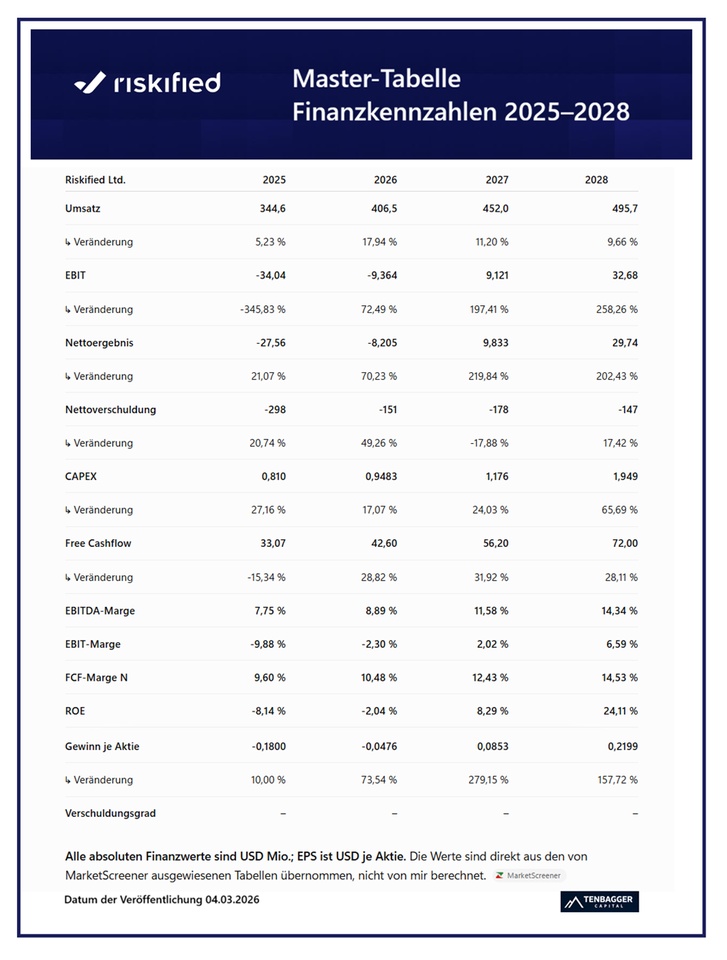
This aligns very well with the picture from my MarketScreener table below:
Revenue grows → Costs scale more slowly → Margins rise → FCF rises.
⚠️ What still makes me cautious
The moat is not free.
I see the main risks in:
Competition – Fraud prevention is an attractive market.
Large customers have bargaining power.
Merchant concentration can be problematic.
AI competition — large payment, cloud, and commerce platforms can develop their own solutions.
False positives are critical: A legitimate customer who is declined results in lost revenue.
Data Protection/Regulation are becoming more important as the use of identity data increases. The presentation explicitly cites data protection, AI regulation, and data security as risks.
🎯 My assessment for the 2036 portfolio
I would currently classify Riskified something like this:
Riskified = 🛡️ “Data Moat + AI + E-Commerce Infrastructure”
And to me, that’s more exciting than a typical SaaS company.
The actual investment case isn’t:
“Riskified is growing alongside e-commerce.”
But rather:
“The more e-commerce transactions Riskified processes, the more valuable its data and identity network becomes—and the more the company can evolve its platform from a fraud-detection tool into the central risk intelligence layer of digital commerce.”
That’s a true moat approach.
⭐ My score for the Portfolio 2036 mindset
Technology: 9/10
Data Advantage: 9/10
Network Effect: 9/10
Growth Market: 9/10
Moat:
8/10
Current profitability: 6/10
2036 Potential:
8.5/10
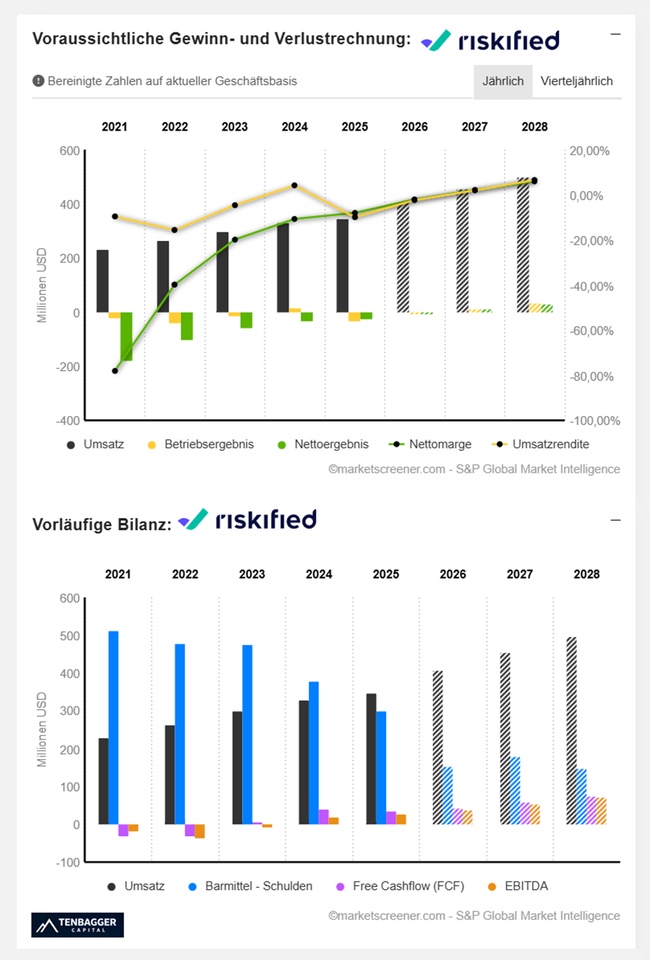
And I find the combination of moat + turnaround: MarketScreener expects Riskified to simultaneously see rising revenue, rising margins, and a strong increase in FCF. That makes the stock, in my view, a “early stage of operational leverage”—and not just a mature software stock.
Leading e-commerce brands rely on Riskified to secure every step of the customer journey—from login and checkout to refunds and returns.
E-commerce has many complex pain points
+$231 billion in global revenue lost due to false declines *1
+$56 billion in global fraudulent e-commerce orders *2
+$77 billion in losses from return fraud in the U.S. *3
*1 Data Insights: Global e-commerce revenue lost to false declines in 2026
*2 Juniper Research: The Cost of Global CNP Fraud in 2025
*3 NRF: Losses from return fraud in the U.S. in 2025
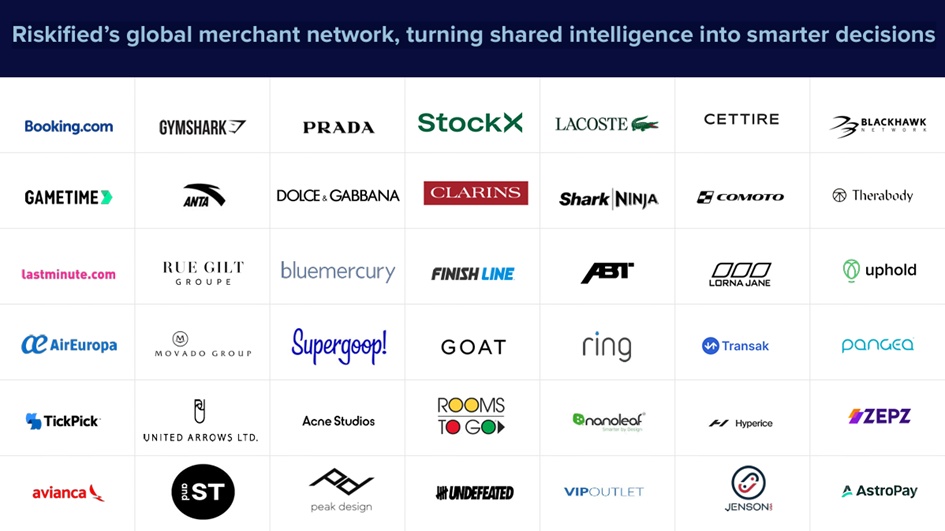
The more transactions Riskified processes, the more data the network collects. The larger the dataset, the better the models can become—and the better the models perform, the more attractive the platform becomes to additional merchants.
For me, this makes Riskified interesting for one reason above all: The company sits at an intersection shaped by e-commerce, AI, and the increasing digitization of identity and payment processes could become increasingly important over the long term.
Riskified: Truist Raises Price Target to $9 Due to Growth Prospects
September 28, 2026
Key Takeaway: Truist Securities raises its price target for Riskified from $7.50 to $9.00 and maintains its Buybecause growth, new customers, and operational improvements are stronger than expected.
📌 Key Points
- Strong stock performance: Riskified has risen by 50% , while the Nasdaq and IGV have risen only 2–3% . The stock is currently trading at $7.85, near the 52-week high of $8.17. +105% in six months.
- Rationale for the higher price target:
- Accelerated growth momentum
- New customer acquisition in several end markets
- Strong positioning in the area of e-commerce fraud prevention and risk intelligence
- Products such as Muse and Instinct are driving usage and revenue
Key Q2 2026 Results:
- Adjusted EPS: $0.02 (in line with expectations)
- Revenue: $98.7 million (above expectations of $89.18 million)
- Revenue growth: 22% YoY, the highest rate in 4 years
- Multi-product usage is rising
- Annual forecast raised:
- Revenue: 400–410 million ILS
- Adjusted EBITDA: 33–39 million USD
Additional analyst reactions:
- DA Davidson: Price Target $6 → $7.5, Rating Buy
- Goldman Sachs: Price Target 4.75 → 5.50 USD, Rating Sell (Reason: New customer growth + effects from sporting events)
Assessment: Truist continues to view the stock as undervalued. According to its fair-value model, InvestingPro confirms an undervaluation.
🎯 Takeaway for you
Riskified shows clearly improved operating metrics, strong revenue growth, and rising customer activity. Several analysts are raising their price targets, with Truist raising its target significantly. Despite the strong performance, the stock continues to be viewed by some firms as undervalued .
Geographic revenue breakdown:
2025 (USD)
United States 187 million
Europe, the Middle East, and Africa 102 million
Asia-Pacific 33.99 million
Americas 21.84 million
🎯 My Conclusion on Riskified
What matters most is not revenue, but operational leverage.
Revenue:
344.6 → 495.7 million USD
➡️ solid growth of about 44% 🚀
EBITDA:
26.72 → 71.08 million USD
➡️ More than doubled (+166%) 🚀
EBIT:
-34.04 → +32.68 million USD
➡️ A company that was previously posting significant losses has become clearly profitable.
FCF:
33.07 → 72.0 million USD
➡️ more than double. 🚀
EBIT margin 📈 +16.47 percentage points
In this forecast, Riskified is primarily focusing on a profitability/margin story with growing cash flow —rather than a pure revenue growth story.
If Riskified actually achieves the projected scale, operating profit could grow significantly faster than revenue.
🔎 What stands out immediately?
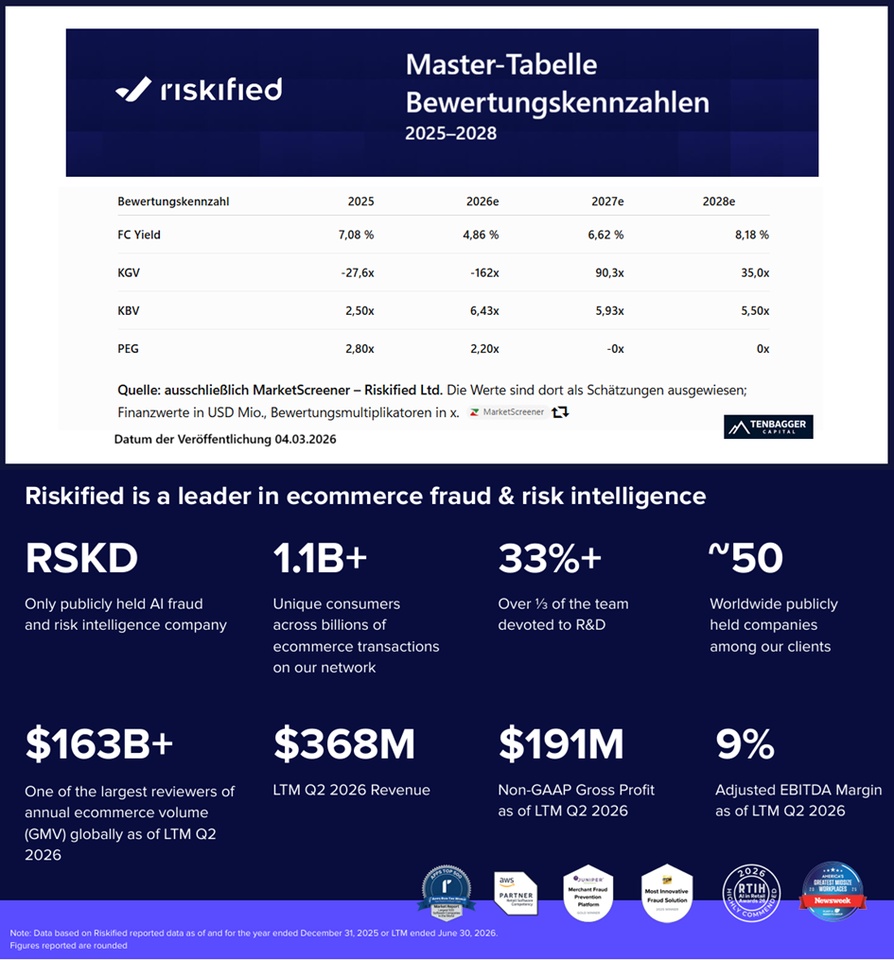
FCF Yield:
7.08% → 4.86% → 6.62% → 8.18%
➡️ By 2028, the valuation on an FCF basis would once again be significantly more attractive.
P/E ratio:
In 2025 and 2026, due to negative earnings, cannot be interpreted positively. Riskified will not become profitable until 2027: 90.3x → 35.0x.
PEG:
2025 2.8x, 2026 2.2x, then 0x according to MarketScreener. However, this should be interpreted with caution when using Riskified, because the transition from loss to profit significantly distorts the PEG calculation.
My take on the valuation: For me, the interesting point is not so much the current P/E ratio, but rather the combination of rising FCF and sharply increasing profitability. If the MarketScreener forecasts hold true, Riskified will be fundamentally much easier to value starting in 2027/28.
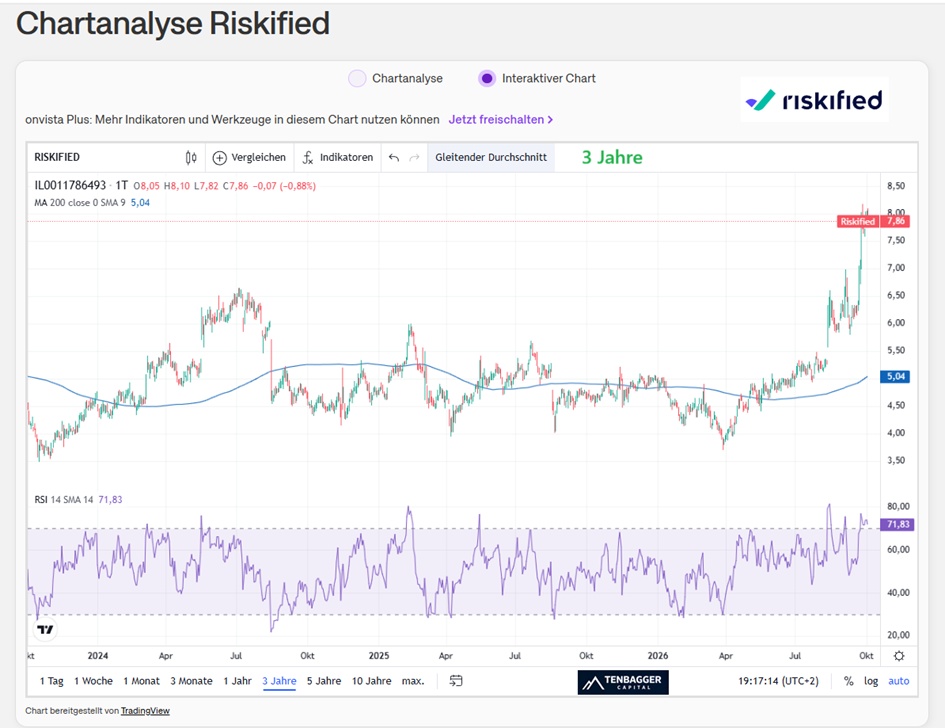
The key here is not to jump in after the rapid surge, but to wait patiently for the next correction.
October 2, 2026, 9:59:50 PM •
Lang & Schwarz (EUR)
6.850 EUR