
Healthcare Giant vs. MedTech Specialist
Last week, AstraZeneca $AZN (+0,27%) and Roche $ROP (+0,18%) —two companies where the discussion almost inevitably revolves around drugs, patents, and clinical trials.
Today, while we’re staying in the healthcare sector, we’re shifting our perspective:
Johnson & Johnson $JNJ (+1,37%) and Abbott $ABT (+1,76%)
make their money not only from individual active ingredients, but from entire platforms, devices, diagnostics, and long-term relationships with hospitals and doctors.
Johnson & Johnson is the larger and more diversified company: Innovative Medicine meets MedTech, ranging from immunology and oncology to cardiovascular products, orthopedics, and surgery.
Abbott is more focused on medical technology, diagnostics, nutrition, and established medications—with FreeStyle Libre as its most visible growth driver and Exact Sciences as a new building block in cancer diagnostics.
This makes the comparison particularly intriguing:
Will Johnson & Johnson’s enormous research and financial strength prevail—or does Abbott, with its device- and diagnostics-focused model, offer a more balanced mix of recurring revenue, innovation, and valuation?
Note: Prices from the provided charts or closing prices from November 12–13, 2026. Financial figures from Q3/LTM 2026, annual reports, proxy statements, and primary sources.
TWO PLATFORMS, DIFFERENT RISK DRIVERS
J&J reported third-quarter revenue of $25.4 billion, up 5.9 percent. Innovative Medicine generated $16.8 billion, while MedTech generated $8.6 billion.
Abbott reported $13.0 billion in revenue and approximately 7 percent comparable growth; Medical Devices was the largest segment at $5.83 billion.
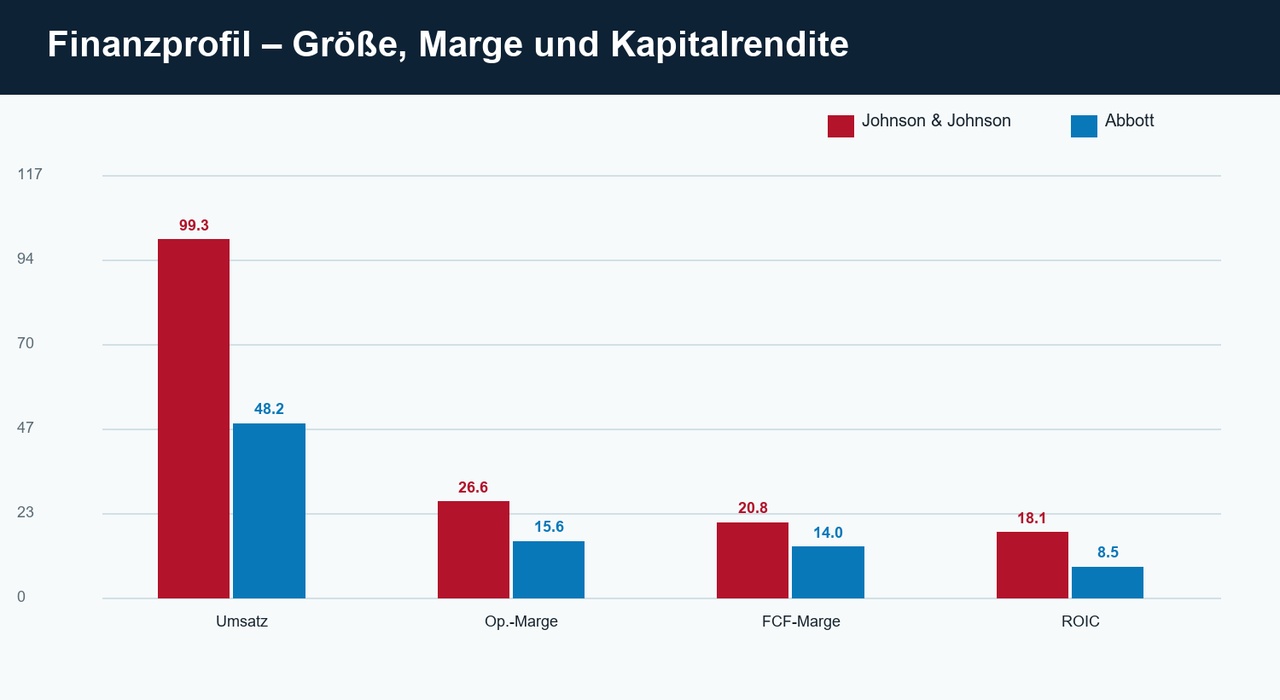
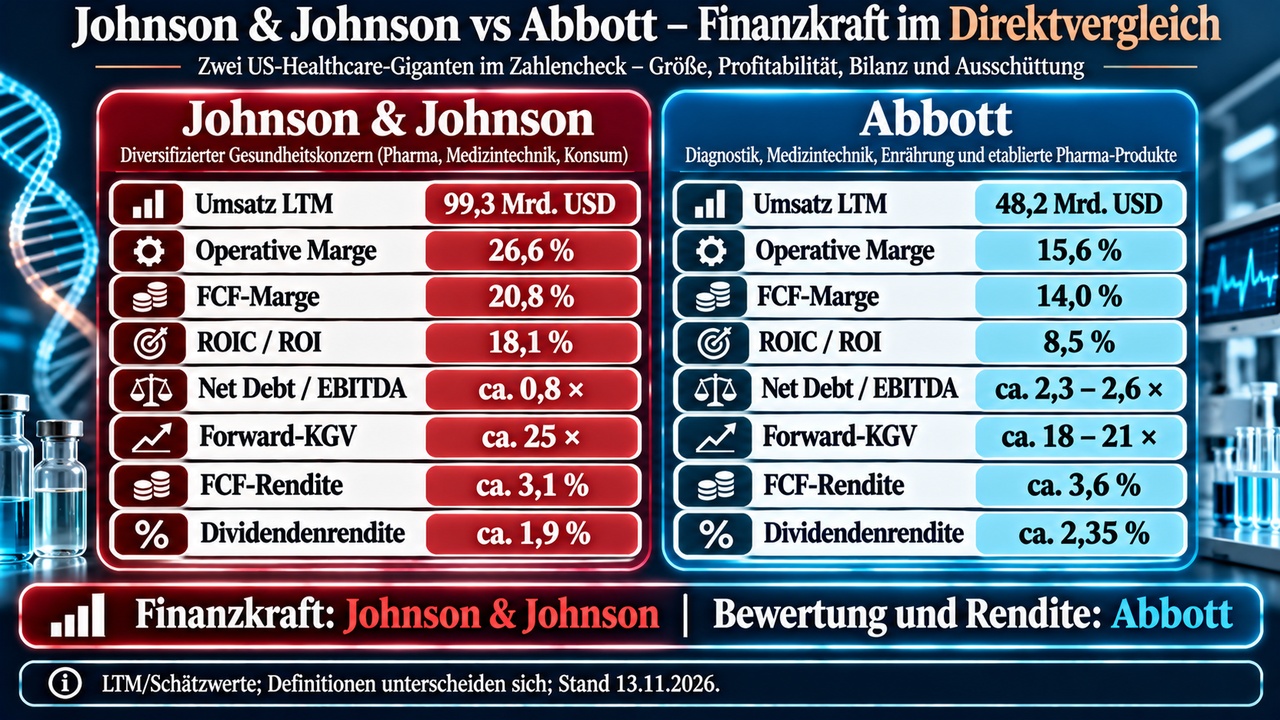
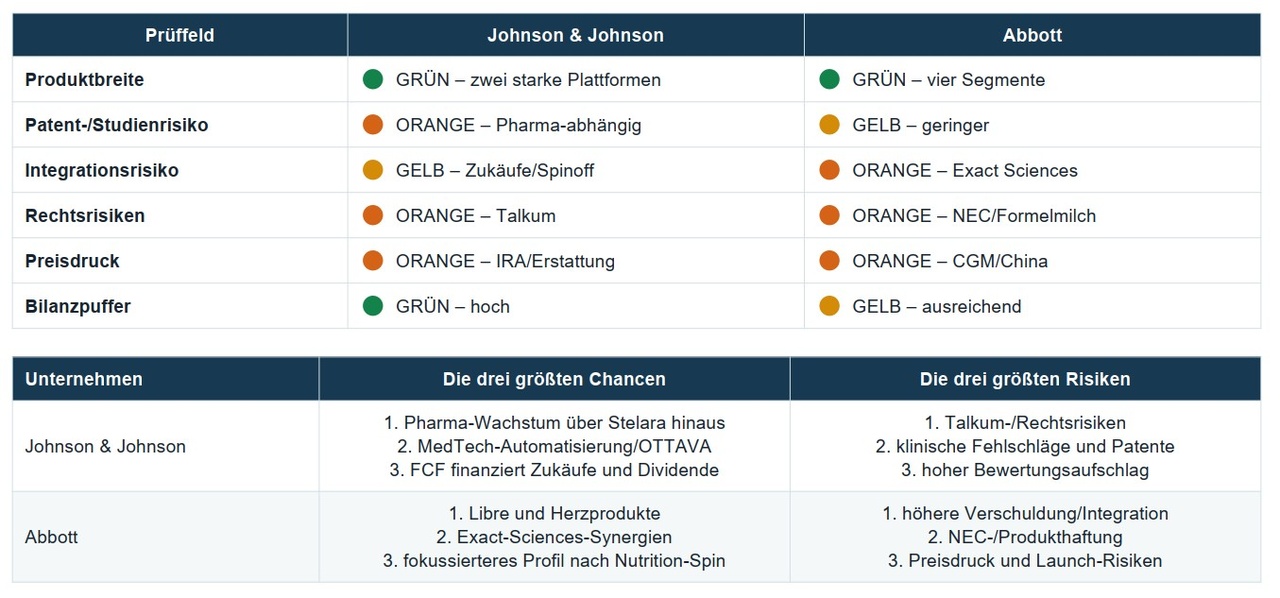
J&J clearly wins the financial comparison. Abbott is cheaper and offers a higher current yield, but is clearly carrying more debt following the Exact Sciences acquisition.
Reported earnings in Q3 were heavily impacted by approximately $7 billion in one-time charges; therefore, the trailing P/E ratio is not very meaningful.
Abbott is carrying noticeably
more debt following the Exact Sciences acquisition, but remains strong in terms of operating cash flow.
J&Jis in a different league in terms of size compared to traditional medtech companies.
Abbott competes in devices and diagnostics with Medtronic, Boston Scientific, Dexcom, Roche Diagnostics, and Guardant.
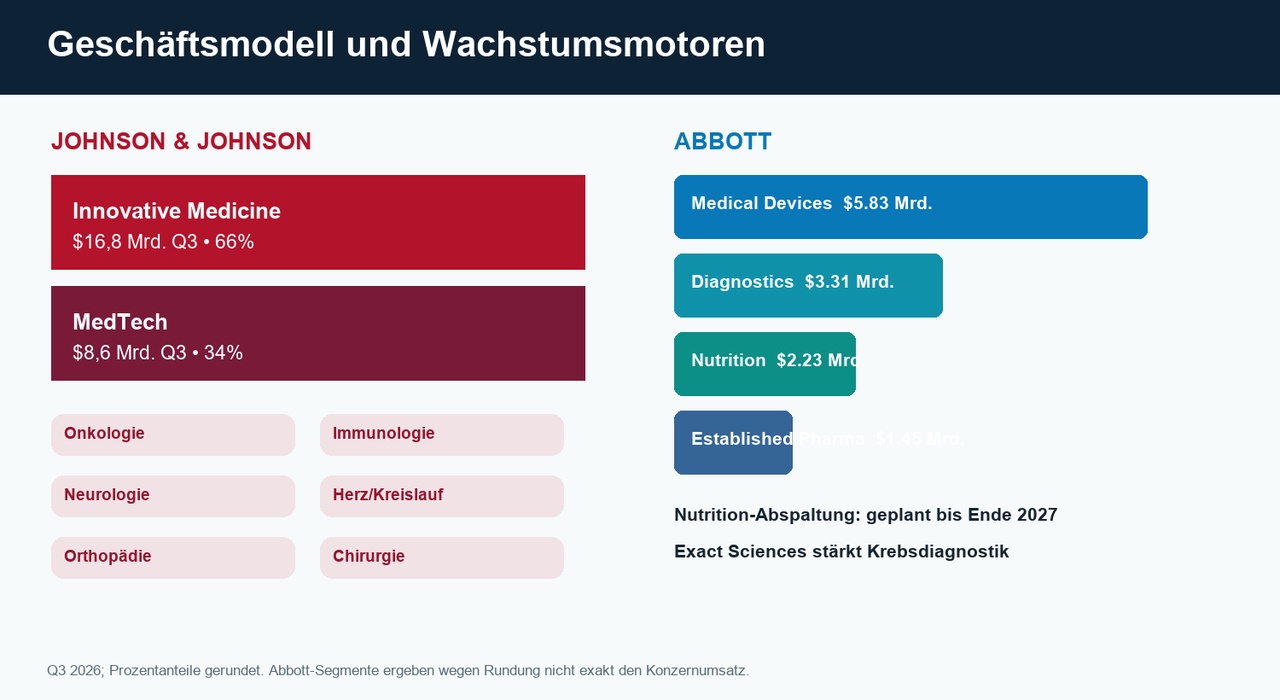
Size creates sales power, but not a monopoly: Competition is intense in electrophysiology, glucose monitoring, and cancer diagnostics.
Pipeline and Growth Drivers
THE INVESTMENT THESIS COULD FALL APART ON SEVERAL LEVELS
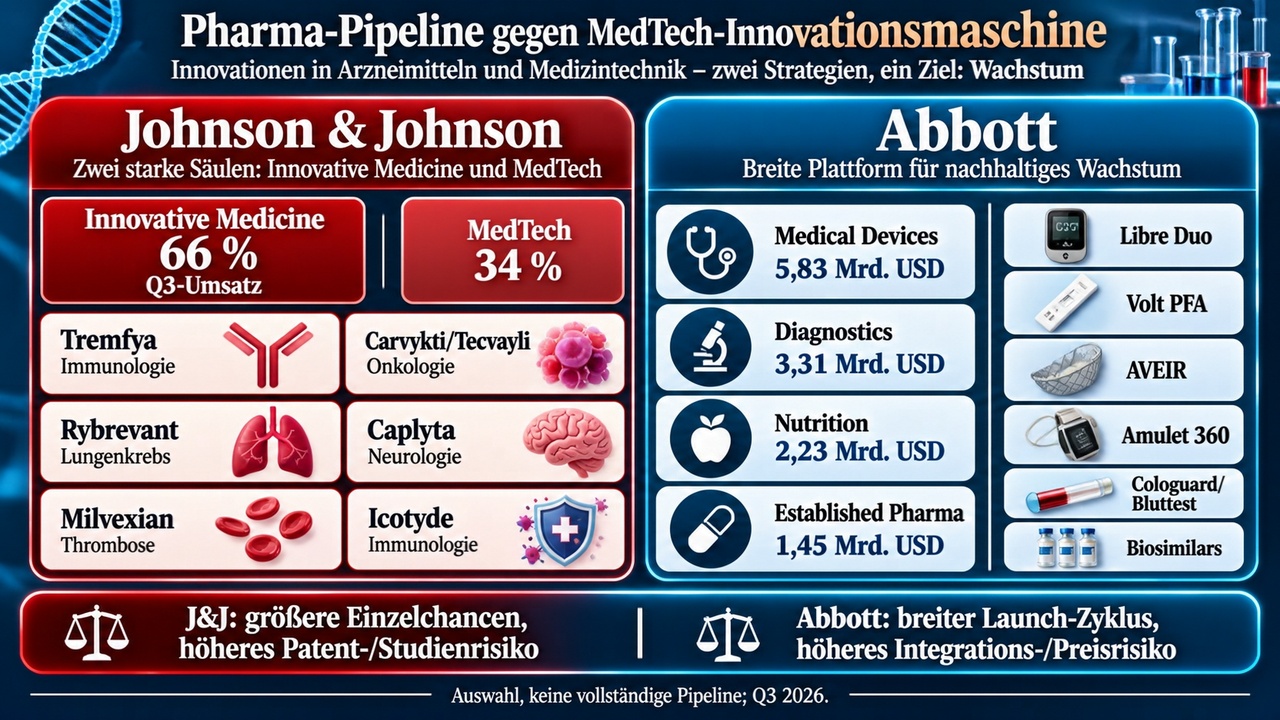
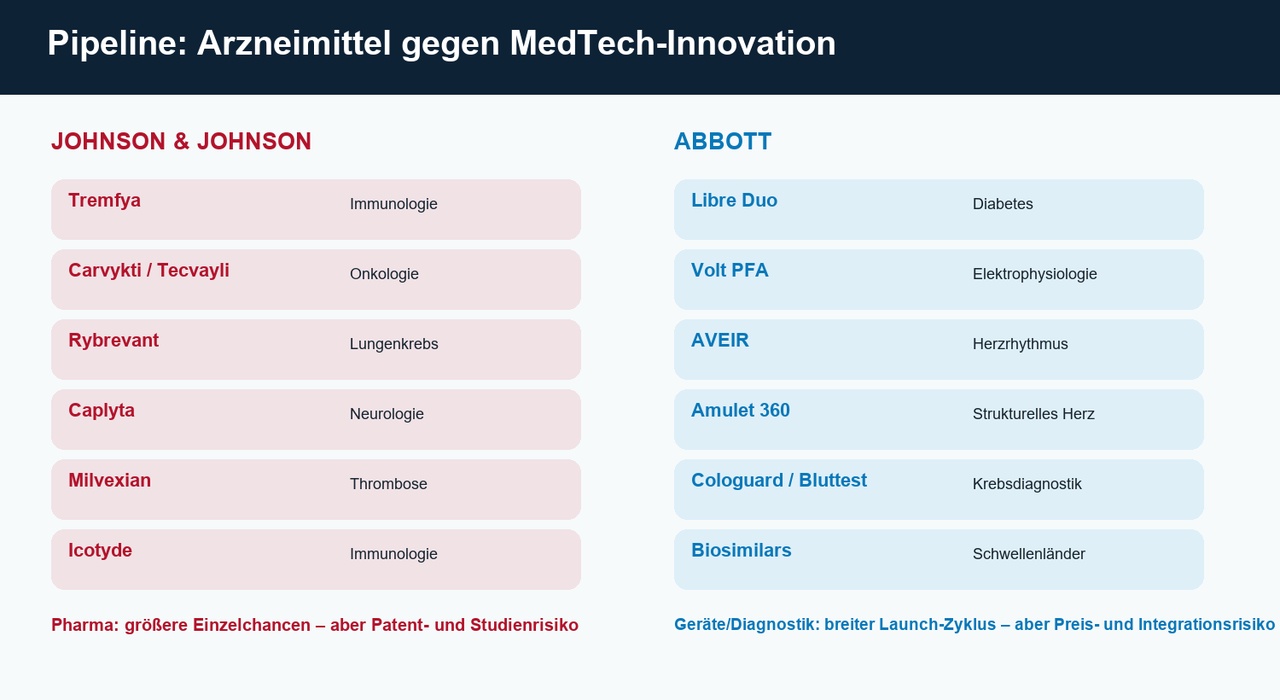
J&J is growing through Tremfya, Tecvayli, Caplyta, and Rybrevant; Carvykti, Milvexian, and Icotyde could form the next wave. Early trial signals should not be treated as confirmed revenue.
Abbott is spreading its opportunities across Libre Duo, Volt PFA, AVEIR, Amulet 360, structural heart products, and cancer diagnostics. Exact Sciences is expanding the addressable market but increasing integration and debt.
Customer Concentration, AI, and Moats
Neither company publishes a reliable top-10 customer share.
Lack of disclosure does not automatically mean diversification. Dependencies exist with respect to healthcare systems, payers, wholesalers, hospitals, laboratories, and reimbursement regimes.
AI can accelerate research, study design, pharmacovigilance, surgical planning, sensor algorithms, and diagnostics.
However, the moat is built only through validated data, regulatory approval, manufacturing, distribution, and integration into clinical workflows. The direct risk of substitution is low for both companies.
Dividends and Capital Allocation
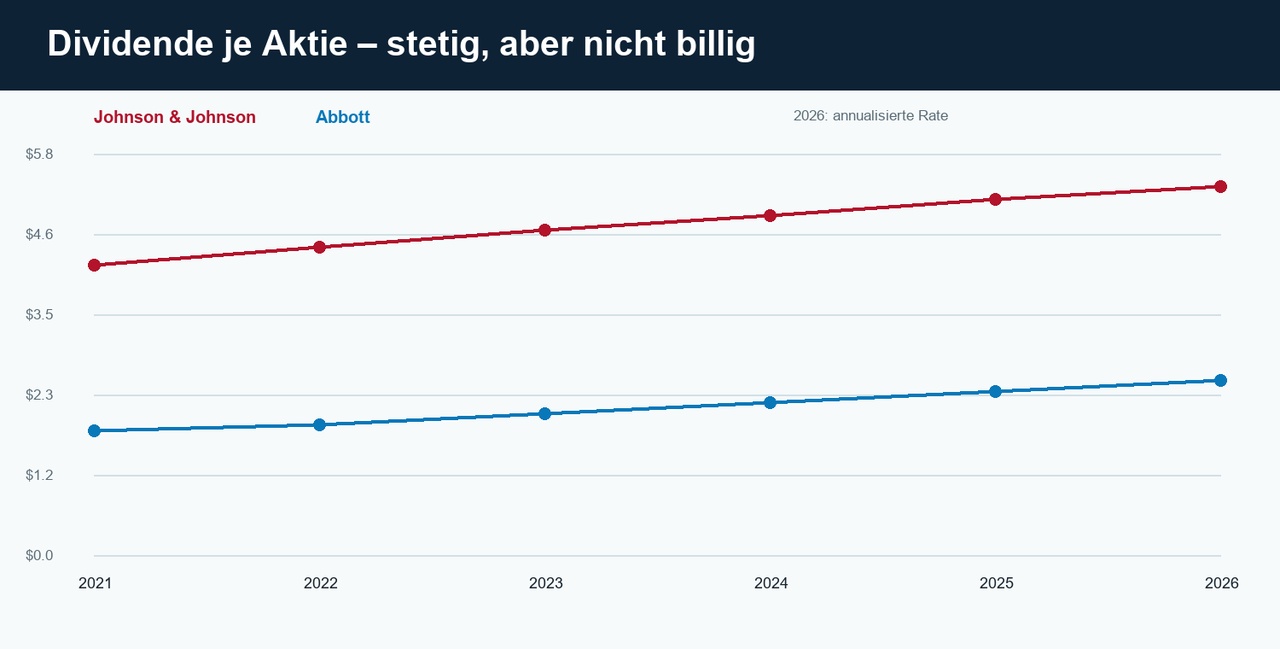
J&J pays an annualized dividend of $5.36 and has increased it for 64 years.
Abbott pays $2.52 and has been increasing its dividend for 54 years.
Abbott currently offers the higher yield, J&J offers the larger absolute FCF buffer. Both companies are also planning major restructuring measures: DePuy Synthes at J&J, and Nutrition at Abbott.
Valuation and DCF
Model basis: approximately $21 billion in normalized free cash flow for J&J and about $6.75 billion for Abbott, each allocated to the current number of shares. The model is intentionally conservative and uses equity-adjusted free cash flow without additional acquisition synergies. Even small changes in the discount rate and terminal growth rate significantly shift the value.
The result is clear: J&J; outperforms even the optimistic scenario; Abbott falls between the base and bull cases.
This does not make J&J a bad company—but it does make it a stock with very high expectations. Abbott is relatively cheaper, but is attractive only if integration, debt reduction, and product growth are successful

Technical Analysis and Entry Strategy
J&J
The daily chart is well above the 50-day and 200-day EMAs; the RSI and MACD are positive, but the price is trading close to the upper Bollinger Band. On the weekly chart, the structure confirms the long-term uptrend. Resistance is at $285 to $290, with initial support at $270 to $265, and further support below that at $253 to $249.
My preferred setup is the pullback. A breakout above $290 would be technically strong, but fundamentally even more expensive.
Event risks can cause stops to be skipped due to price gaps; the levels mentioned are scenarios, not order recommendations.
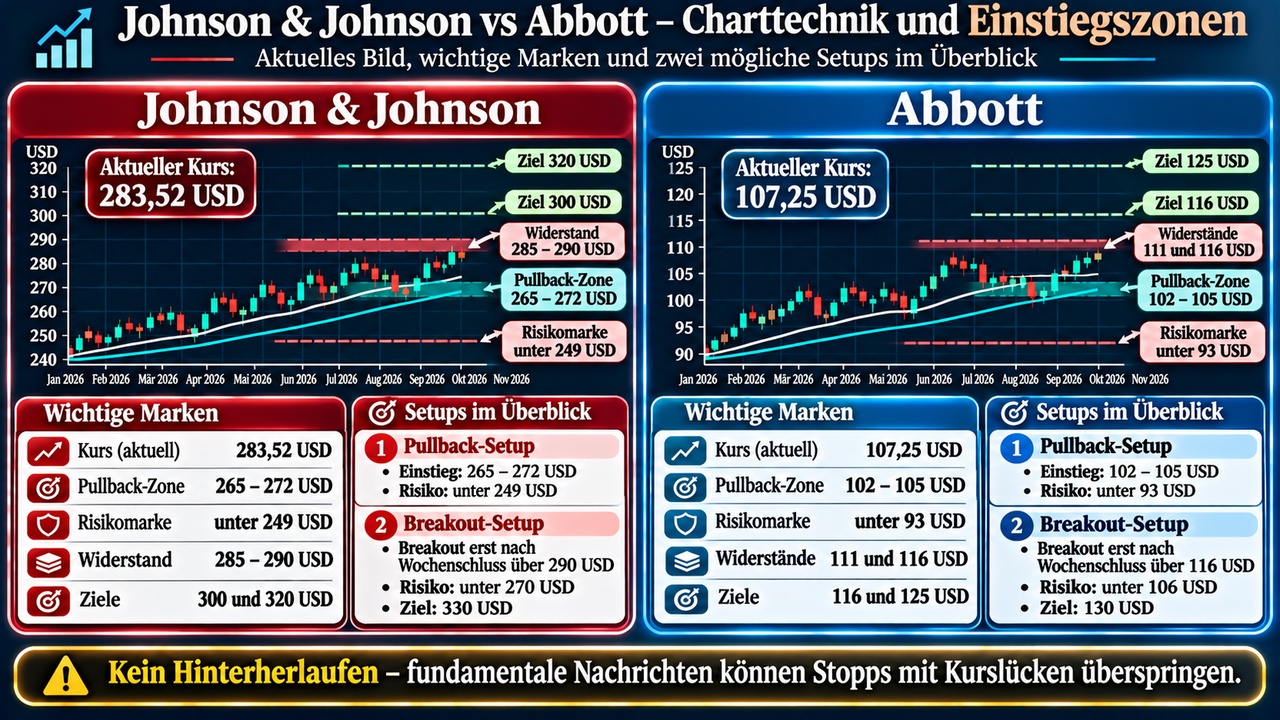
Abbott is stabilizing around the moving averages on the daily chart; the RSI is neutral and the MACD is positive but flatter. On the weekly chart, the $111 to $116 zone remains the key resistance level. Support levels are at $105 to $102, with deeper support around $98 and $93.
The pullback offers the better risk-reward ratio. A breakout is only worth considering after a confirmed weekly close above $116. The chart is less overextended than J&J’s, but not yet as clean.
Final Assessment and Conclusion
THE WINNER IS NOT AUTOMATICALLY THE NEXT BUY
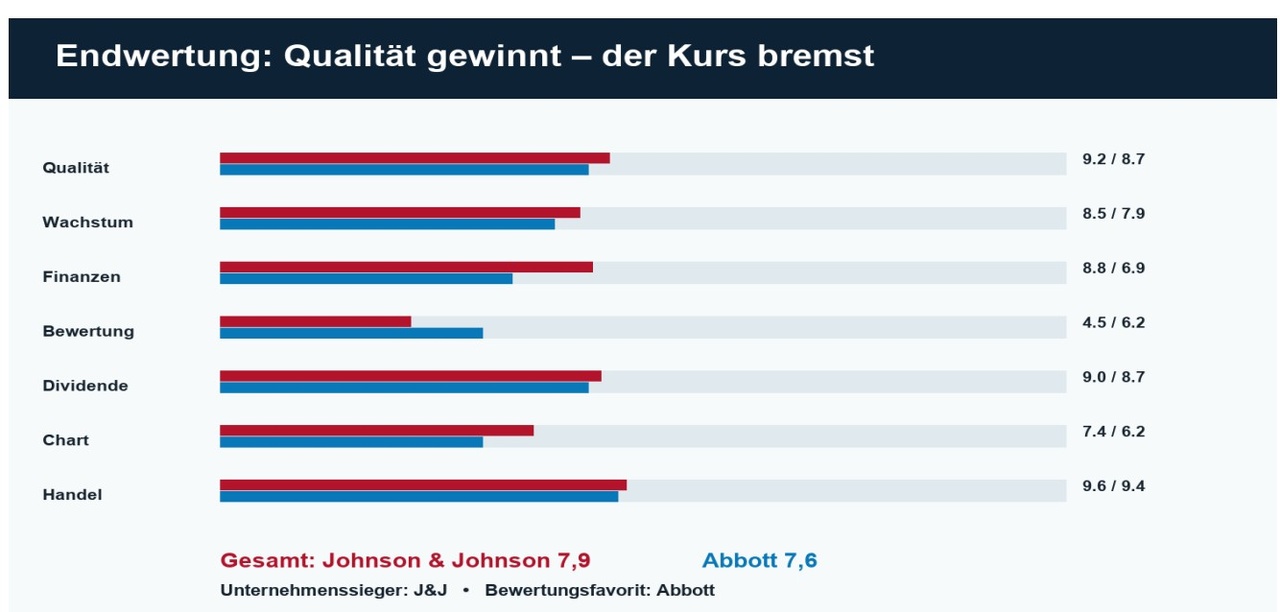
Johnson & Johnson wins this head-to-head comparison for me as a company. The combination of pharmaceuticals, medtech, free cash flow, balance sheet, and depth of research is hard to beat. Abbott remains an outstanding company and, at today’s price, is the more reasonably valued favorite.
As a stock, however, I wouldn’t chase either of them. With J&J, I much prefer the $265 to $272 range to a buy near the resistance level. For Abbott, $102 to $105 would be an initial range to watch; alternatively, I’d wait for a confirmed breakout above $116. Those who focus solely on quality will end up with J&J; those who place greater weight on valuation and entry risk can choose Abbott.
What do you think? Is Johnson & Johnson the clear quality anchor despite its high price—or is Abbott, with Libre,
cardiovascular products, and cancer diagnostics, the more exciting candidate for the coming years?
In the next stock showdown, Danaher $DHR (+0,48%)
and Thermo Fisher Scientific $TMO (-0,39%)
will face off: two indispensable suppliers to the research, diagnostics, and biomanufacturing sectors—with very different growth and valuation profiles.
And, of course, everyone else :)


