Hello my dears,
As promised, the second part of Hexcel, which should be just as exciting as the first.
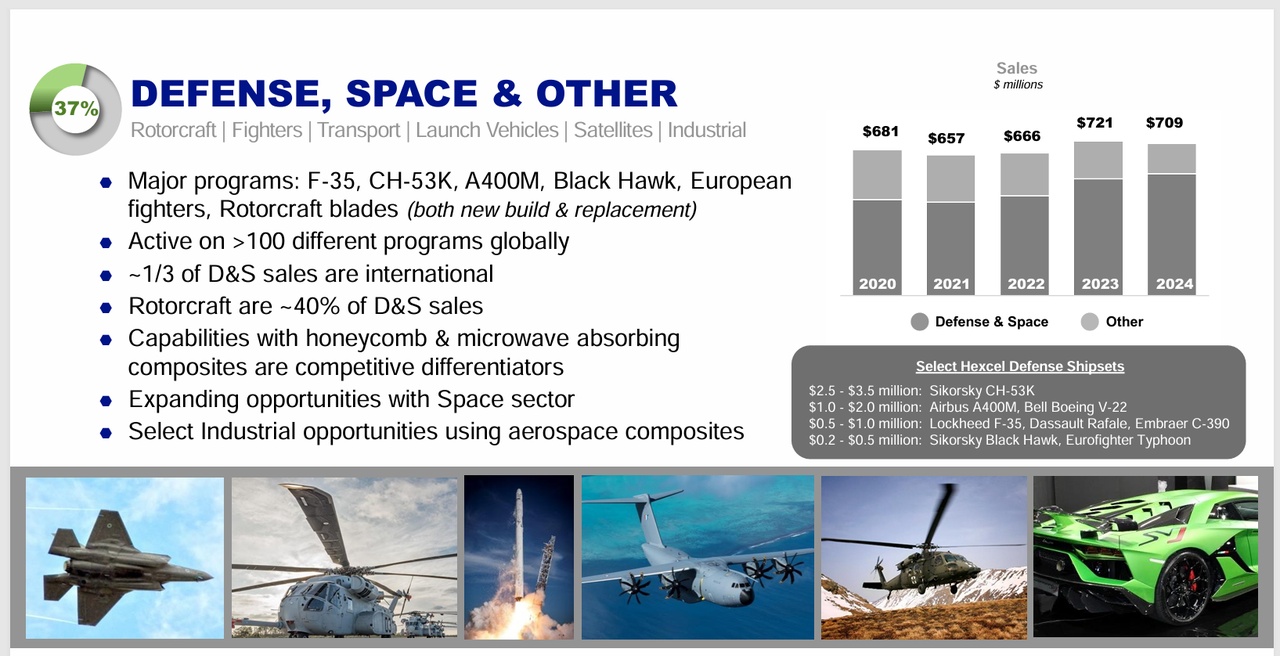
Hexcel Corporation offers advanced lightweight composite technology. The company's product portfolio includes carbon fibers, specialty reinforcements, prepregs and other fiber-reinforced matrix materials, honeycombs, resins, engineered cores and composite structures for use in commercial aerospace, defense and industrial applications. The company operates in two segments: Composite Materials and Engineered Products. The Composite Materials segment includes the carbon fiber, specialty reinforcements, resin systems, prepregs and other fiber-reinforced matrix materials, honeycomb cores and pultruded profiles product lines. The Engineered Products segment includes lightweight, high-strength composite structures, materials for absorbing radio frequencies/electromagnetic interference (RF/EMI) and microwaves, technical cores and specially processed honeycomb products with additional functionality as well as thermoplastic additive manufacturing.
Number of employees: 5,894
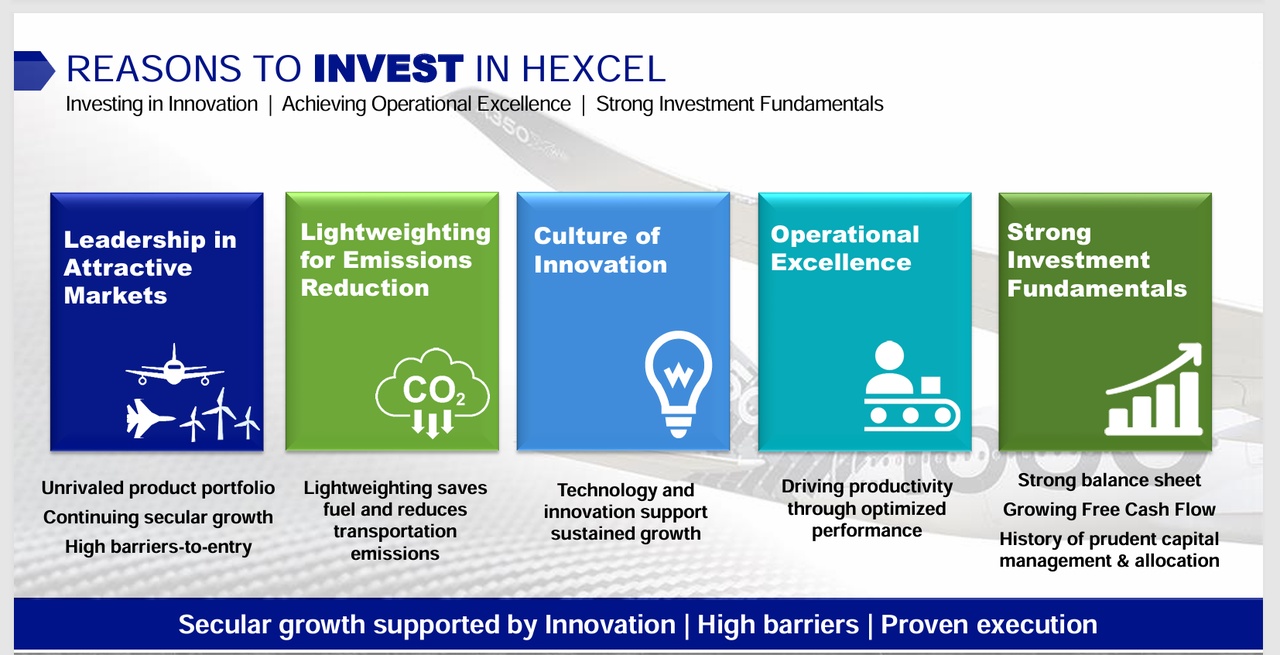
Innovation is one of our four values and is reflected in our pioneering products. Hexcel currently holds more than 1,350 patents and pending applications worldwide. At Hexcel, striving for an unrealistic goal or challenging a long-standing paradigm are springboards for discovery and thinking "outside the box". We embrace the curiosity to explore ideas, the passion to challenge the impossible and the conviction to successfully exceed expectations.
Research & Development
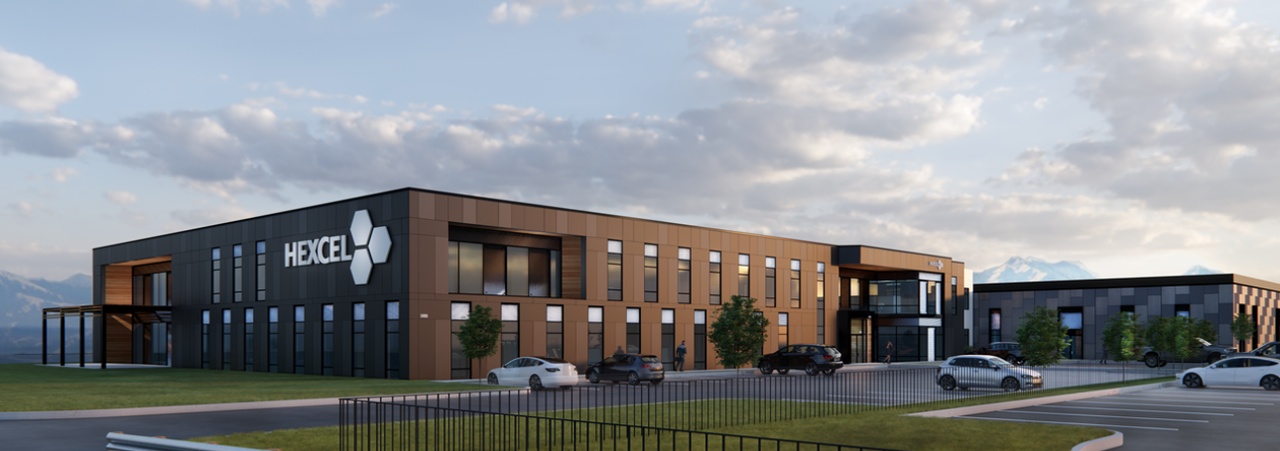
Hexcel employs more than 250 people in research and technology. The company has more than 1,350 patents and pending applications worldwide.
Many of our production sites have research and technology centers where scientists and engineers work on site-specific projects. In addition, we have primary R&T centers in the USA (Salt Lake City, Utah) and Europa (Duxford, Cambridgeshire, Großbritannien) .
1USD in millions
estimates
year
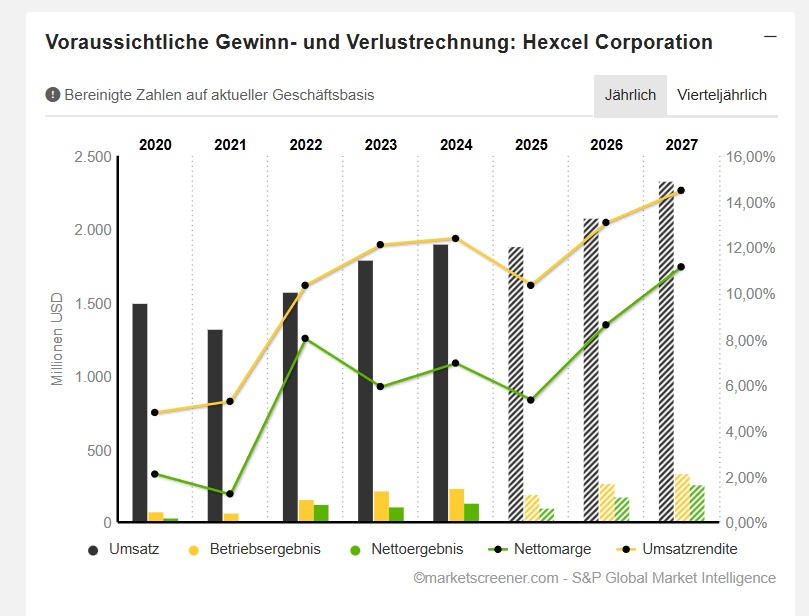
Turnover
Change in
2025 1.885 0,94 %
2026 2.083 10,5 %
2027 2.332 11,98 %
Year
EBIT
Change in
2025 195,4 -17,22 %
2026 272,4 39,37 %
2027 337,8 24,03 %
Year
Net result
Change in
2025 100,8 -23,71 %
2026 179,9 78,51 %
2027 260,3 44,7 %
Year
Net debt
Change in
CAPEX
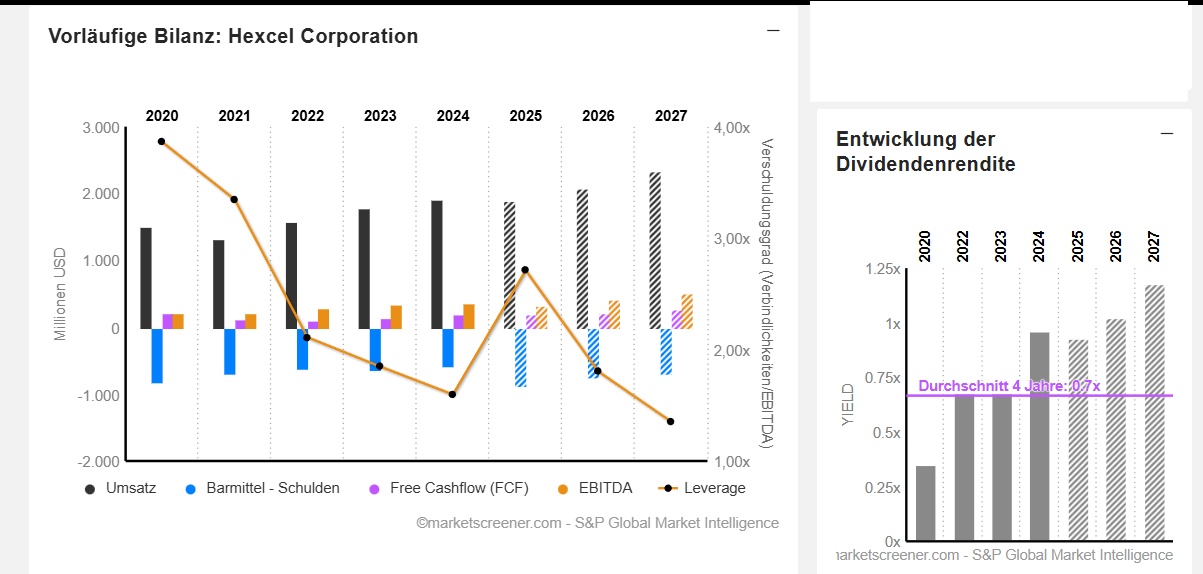
2025 881 53,14 % 82,44
2026 741 -15,89 % 93,08
2027 685 -7,56 % 94,85
Year
Free cash flow
Change in
2025 189,1 -6,82 %
2026 222,2 17,54 %
2027 266,1 19,75 %
Year
EBIT margin
ROE
2025 10,37 % 8,89 %
2026 13,08 % 14,26 %
2027 14,48 % 17,38 %
Year
Earnings per share
2025 1,282
2026 2,387
2027 3,505
No. of shares (in thousands) 79,606
Market value 5,815
Year
P/E RATIO
PEG
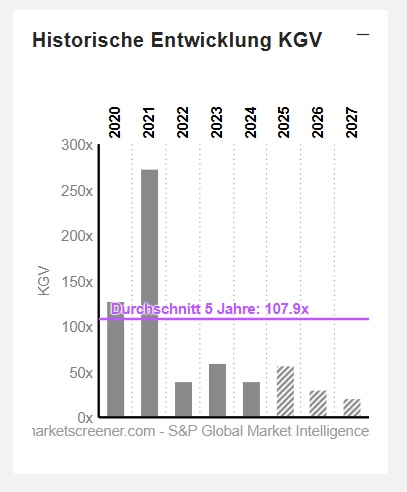
2025 57x -2.9x
2026 30.6x 0.4x
2027 20.8x 0.4x
Year
Dividend
Yield
2025 0,6825 0,93 %
2026 0,7445 1,02 %
2027 0,8609 1,18 %
Conclusion:
The estimates are actually what investors should want.
I could therefore imagine that the share should receive a few recommendations in the near future.
Net profit is rising faster than sales. Free cash flow and the EBIT margin are also rising, while debt is falling.
As a result, the P/E ratio is returning to a reasonable valuation.
And I also like the PEG below 1 very much.
I also like the robustness and the fact that this is a traditional company.
After a rather modest year in 2025, the estimates suggest that things should be on the up again.
Compared to Rheinmetall, Hexcel has a more favorable valuation and higher growth.
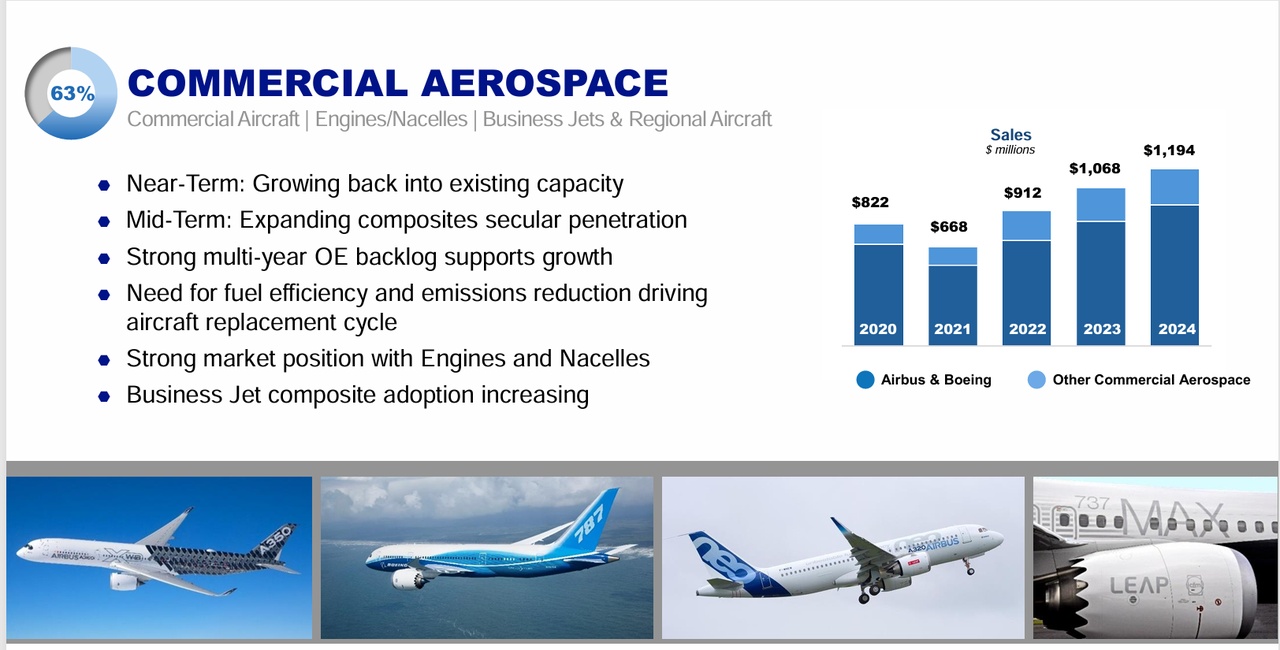
I have already informed you about the potential in the individual areas in the first post.
Dear readers, who shares my opinion here? Or who has a different opinion?
Feel free to share in the comments
History
From Roger Steele's post-war laboratory in the basement of a suburban home to the production of the lunar struts of the Apollo 11 lunar module, Hexcel has been synonymous with innovation throughout its history. Hexcel was ready when the defense aerospace industry needed strong lightweight materials after World War II, and our company continues to lead the way in providing innovative advanced composite solutions for our customers.
The house that Berkeley built
The company that became known as Hexcel originated and developed in the San Francisco Bay Area of Northern California. It was developed by a fraternity at the University of California at Berkeley. The bond of Hexcel's co-founders Roger C. Steele and Roscoe T. "Bud" Hughes was formed on the soccer fields of Piedmont High School and was further strengthened during World War II by their joint assignments in the Navy. From soccer games to fraternity rituals to fighting for one's country, it's no wonder Hexcel was able to demonstrate remarkable cohesion in its early years.
In fact, the pioneering spirit and sheer tenacity that Hexcel - or, as it was first called, California Reinforced Plastics - has always embodied were the very qualities that characterized its early leaders - Roger Steele (1920-2014), Bud Hughes (1920-2014). 86), Paul V. Ammen (1920-81), Ken Holland (1923-1990) and Ed Rule (1918-2011). As Hexcel's first management team, these Bay Area veterans had a fortuitously well-matched and diverse group of talents. Steele provided the visionary spirit and unrelenting conviction that "honeycombs were and are the most efficient structure man will ever achieve." Bud supported and funded this vision and brought exceptional sales skills to commercialize Roger's inventions.
Paul was the only member who had not attended Berkeley or studied engineering. He served as Chief Financial Officer after graduating from Stanford with a business degree. A friend from Piedmont High, Paul joined in 1948, and not a bit too soon. "I went to the bank every Friday to get loans for the accounts receivable so we could make payroll without being late," Roger says. In addition to his business background, Paul brought the good faith and financial skills of his mother, Vera, who financed many of Hexcel's early offices.
Ken Holland, a fraternity ally of Roger's, joined the company with Paul in 1948. He brought with him a chemist's experience in resin and adhesive technology. This expertise soon proved invaluable as Roger struggled with the challenges of manufacturing the fiberglass honeycomb core that resulted from the company's first contract with the military.
Eventually, Hexcel was able to enlist the management and manufacturing talents of Ed Rule, who Roger says was "the backbone of Hexcel for decades." Ed Rule, who was a late addition to the inner circle and had met Steele after the war, took perhaps the biggest risk on this newly born project. He quit his job as chief engineer of an established tool and company in 1951 to join a company that was operating on a shoestring and struggling to make sales. Rule quickly assumed all manufacturing responsibilities and managed every aspect of factory engineering and production design for the next 30+ years. By the time Ed retired, Hexcel had grown into a global company with more than 3,500 employees.