
Nabaltec had a challenging year in 2025, in which the share price fell by around 13 % decline. The main reasons for the decline were the ongoing weakness in the steel industry and the temporary stagnation in the European e-mobility sector. Nevertheless, the fundamental data points to a significant undervaluation.
Strategic assessment
- Causes of the share price decline: A slight decline in sales in 2025 (approx. -2%) and increased operating costs weighed on the EBIT margin, which fell to approx. 9 % fell. This led to a defensive stance on the part of investors.
- Outlook for 2026: Analysts (including Baader Bank, NuWays) see an average price target of approx. 16,75 € to 18,00 €. This corresponds to an upside potential of over 30 %. The expansion of electricity grids and growth in data centers (demand for flame-retardant fillers) will provide impetus.
- Business model: High stability thanks to market leadership in ecological niches (halogen-free flame retardants). The extremely low level of debt makes the company crisis-proof.
- Shareholder structure: Over 55 % of the shares are held by the founding families (Heckmann & Witzany). This guarantees a long-term strategy, but leads to a low liquidity of the share (small cap).
Expert conclusion: Nabaltec is a "fortress" in terms of its balance sheet. The share is currently trading at a significant discount to its fair value. As soon as the end markets (steel/electrical) stabilize, a revaluation can be expected.
Last but not least: analysis of the debt burden
Nabaltec's financial stability is exceptional compared to the rest of the industry. While many competitors suffer from high interest burdens, Nabaltec operates from a position of strength:
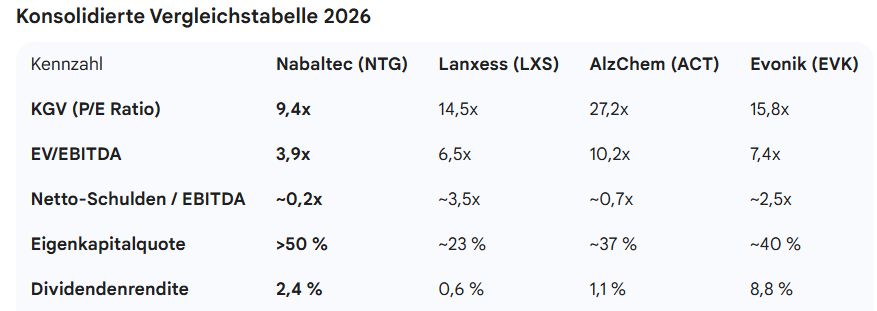
- With a ratio of net debt to EBITDA ratio of approx. 0.2x the company is effectively debt-free. In comparison, Lanxess is financed at 3.5 times (or higher), which is significantly riskier.
- Interest coverage ratio: The operating result (EBIT) covers the interest expenses by more than 9-fold. This makes Nabaltec immune to the ECB's current interest rate policy.
- Financial flexibility: The high equity ratio of over 50 % enables the company to finance future expansions (e.g. the expansion of US production) entirely from cash flow or favorable credit lines without jeopardizing its existence.


