
Why I Still Consider Infineon One of Europe’s Most Interesting Technology Companies
Many investors still associate Infineon primarily with the automotive industry. In my view, that could be one of the reasons why the company is often underestimated by the market.
When people talk about artificial intelligence, most immediately think of NVIDIA. Yet they often forget that every data center, every AI server, every charging station, every wind turbine, and every modern vehicle requires power semiconductors. It is precisely in this area that Infineon ranks among the global market leaders.
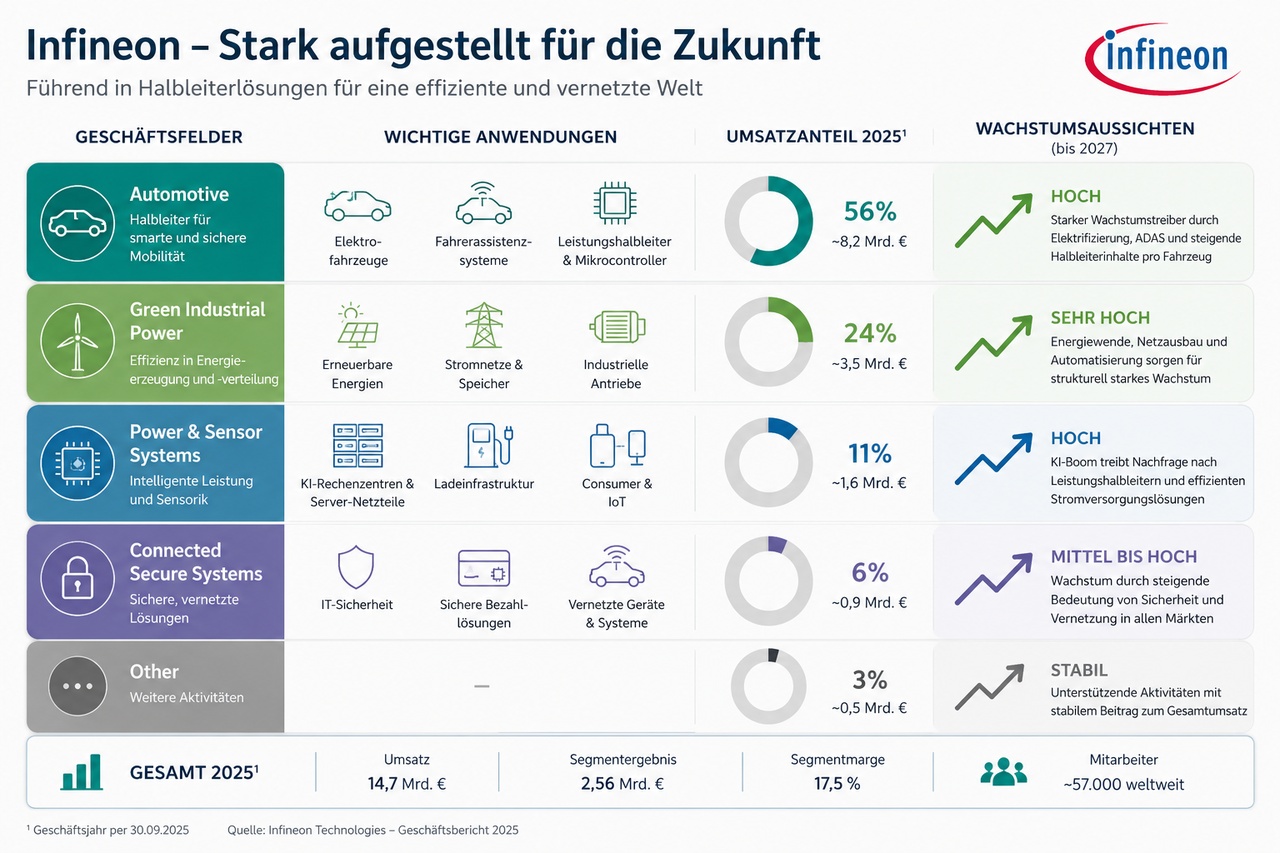
A look at the company’s business segments shows just how broadly diversified it has become:
• Automotive – electrification, driver assistance systems, and autonomous driving
• Green Industrial Power – energy transition, power grids, battery storage, and industrial applications
• Power & Sensor Systems – AI data centers, power semiconductors, and power supplies
• Connected Secure Systems – cybersecurity, digital identities, and connected devices
I find the developments in the AI sector particularly interesting. Management expects revenue from power supply solutions for AI data centers to rise from around €700 million in 2025 to approximately €2.5 billion by 2027. That would represent more than a threefold increase within just a few years.
Key Figures for 2025:
• Revenue: €14.7 billion
• Segment earnings: €2.56 billion
• Segment margin: 17.5%
• Approximately 57,000 employees worldwide
What I like: Infineon is benefiting not from a single trend, but from several megatrends simultaneously.
• Artificial intelligence
• Electrification of transportation
• Expansion of power grids
• Renewable energy
• Industrial automation
• Digitalization and IT security
In my view, the current valuation still strongly reflects the cyclical nature of the automotive industry. The question, however, is whether, in five to ten years, Infineon will still be seen primarily as an automotive supplier or rather as an indispensable technology partner for energy efficiency, AI, and electrification.
For me, the key question isn’t which company develops the best AI chips.
The key question is: Who provides the infrastructure that allows these chips to operate in the first place?
That’s exactly where Infineon fits in.
That’s why I continue to view the stock as one of the most exciting long-term positions in my portfolio.
What do you think? Is the market still valuing Infineon too much as a cyclical semiconductor stock, or is a European compounder for the next 10 years taking shape here?

