Hello, everyone,
Over the past few days, I've introduced you to a few stocks in the photonics sector.
But the company I'm featuring in the Portfolio 2036 —and where photonics is a sub-sector—I haven’t introduced to you yet.
I’d like to make up for that today with the quarterly results.
For a long time, the stock was considered rather boring.
STMicroelectronics stock is benefiting from strong quarterly revenue and a more optimistic outlook for the last three months. AI remains a growth driver.
Quarterly results provide a boost to the outlook
- STMicroelectronics increased quarterly revenue by 17.9 percent compared to the previous year.
- For the fourth quarter, the company expects a gross margin of 39.0 percent.
- AI data centers and satellite communications are expected to support growth in 2026.
On October 29, 2026, STMicroelectronics reported third-quarter results and raised its outlook for the final quarter. The semiconductor company cited rising demand, strong order intake, and improved visibility in its target markets.
The real-time share price of STMicroelectronics-Aktie stood at 42.14 euros on Monday, November 2, 2026, at 10:15 a.m. Berlin time on Lang & Schwarz.
Revenue and Margin on the Rise
In the third quarter, STMicroelectronics generated net revenue of $3.76 billion. Compared to the same quarter last year, this represented an increase of 17.9 percent. The gross margin reached 37.3 percent, operating income was $367 million, and net income was $291 million.
On an adjusted basis, the company reported operating income of $429 million and net income of $344 million. Adjusted earnings per diluted share were $0.37, compared with $0.31 based on U.S. GAAP figures. STMicroelectronics stated that quarterly revenue was above the midpoint of its own forecast range.
Q4 Outlook Exceeds Previous Target
For the fourth quarter, STMicroelectronics projects net revenue of $4.15 billion at the midpoint of its forecast. This represents a sequential increase of 10.5 percent and a year-over-year increase of 24.7 percent. The expected gross margin is 39.0 percent and includes approximately 40 basis points for underutilized capacity.
For the full year 2026, the midpoint of the forecast indicates revenue of approximately $14.5 billion. The company expects year-over-year growth of 22.8 percent. The expected gross margin for the full year is 36.4 percent, or 36.6 percent on an adjusted basis. STMicroelectronics estimated the improvement in the adjusted margin compared to 2025 at 270 basis points.
AI and Satellites as Growth Drivers
In addition to the cyclical recovery in end markets, STMicroelectronics sees its own growth drivers as a key support. According to the company, these include, in particular, AI data centers and communications via satellites in low Earth orbit. Demand continues to outstrip supply, which is why ST is expanding capacity as part of its strategic planning.
For investors, the focus is now on the realization of the Q4 outlook. The key question remains whether demand from communications and data center applications will persist and whether the expected margin improvement will be achieved despite capacity costs. The forecast also includes assumptions regarding future business development and is therefore subject to execution and market risks.
STMicroelectronics is already an active position in Portfolio 2036.
Today, we do not intend to consider the company as a new candidate, but rather to evaluate its additional role within the photonics and AI infrastructure.
I would classify ST in three strategic areas going forward:
Area
STMicroelectronics’ Positioning
Semiconductors
Traditional core business
AI Infrastructure
Chips and components for data centers
Photonics
Silicon Photonics, PIC100, and optical data transmission
Of interest for the 2036 portfolio
STMicroelectronics could thus benefit from several investment waves at once:
Expansion of the semiconductor industry.
Rising demand for AI computing power.
Transition from electrical to optical data transmission.
My assessment: STMicroelectronics is not only a semiconductor investment in the 2036 Portfolio, but increasingly also a potential photonics component.
This is important for my portfolio strategy: We don’t always have to look for new companies, but should also examine which existing positions gain additional growth prospects through new technology trends.
STMicroelectronics is also active in the photonics sector
Yes! And in fact, much more so than one might assume at first glance when looking at STMicroelectronics. STMicroelectronics has become a major player in the field of silicon photonics.
Particularly interesting: ST is positioning itself directly in the growth market for optical interconnects in AI data centers.
What is STMicroelectronics doing in the photonics sector?
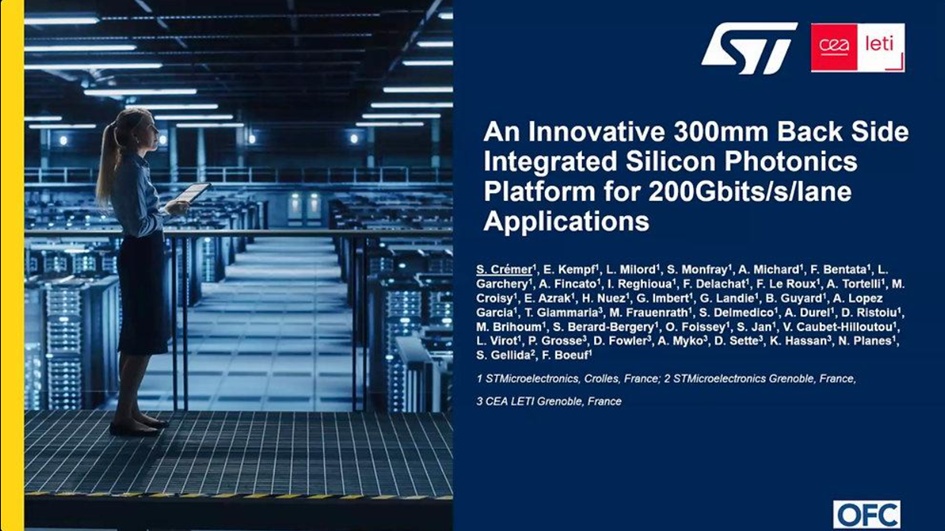
Three technologies are particularly important:
Technology
Function
Significance
Silicon Photonics
Integrates optical functions onto chips
High-speed data transmission
BiCMOS
Electronic signal processing
Driving optical transceivers
PIC100
Photonic Integrated Circuit
800G and 1.6T transceivers
ST has now brought its PIC100 platform into volume production. Manufacturing takes place on 300-mm wafers in France.
Particularly ambitious: ST plans to more than quadruple production capacity by 2027.
Siliziumphotonik – STMicroelektronik
My Personal Conclusion
I would no longer view STMicroelectronics merely as a traditional semiconductor manufacturer, but also as a strategic provider of optical infrastructure for the next generation of AI.
I find the combination of semiconductor manufacturing, silicon photonics, and BiCMOS particularly exciting.