China is one of the clearest convictions in my portfolio.
My exposure comes through $BABA (+0,55%) , $JD (+1,67%) , Pictet China
and a broader Emerging Markets fund. This is not accidental diversification: I have deliberately decided to overweight a market that I believe remains undervalued and underrepresented in many portfolios.
However, having conviction does not mean ignoring uncomfortable data.
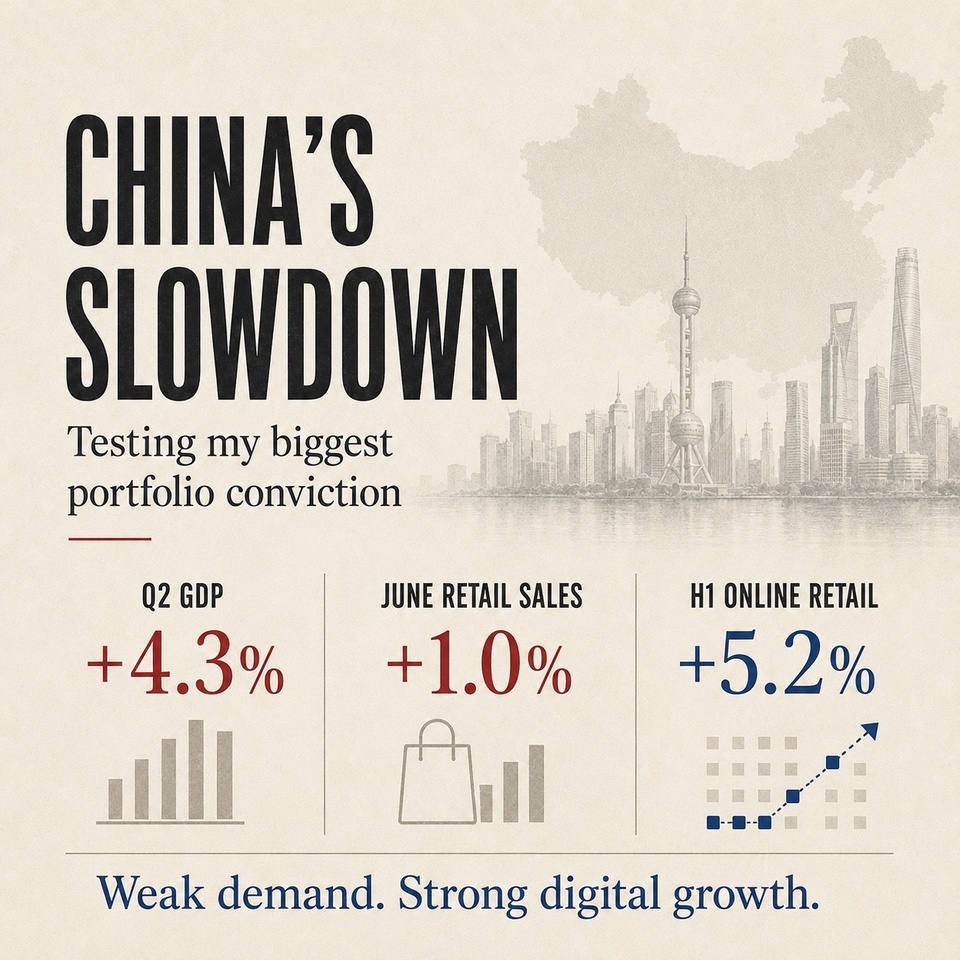
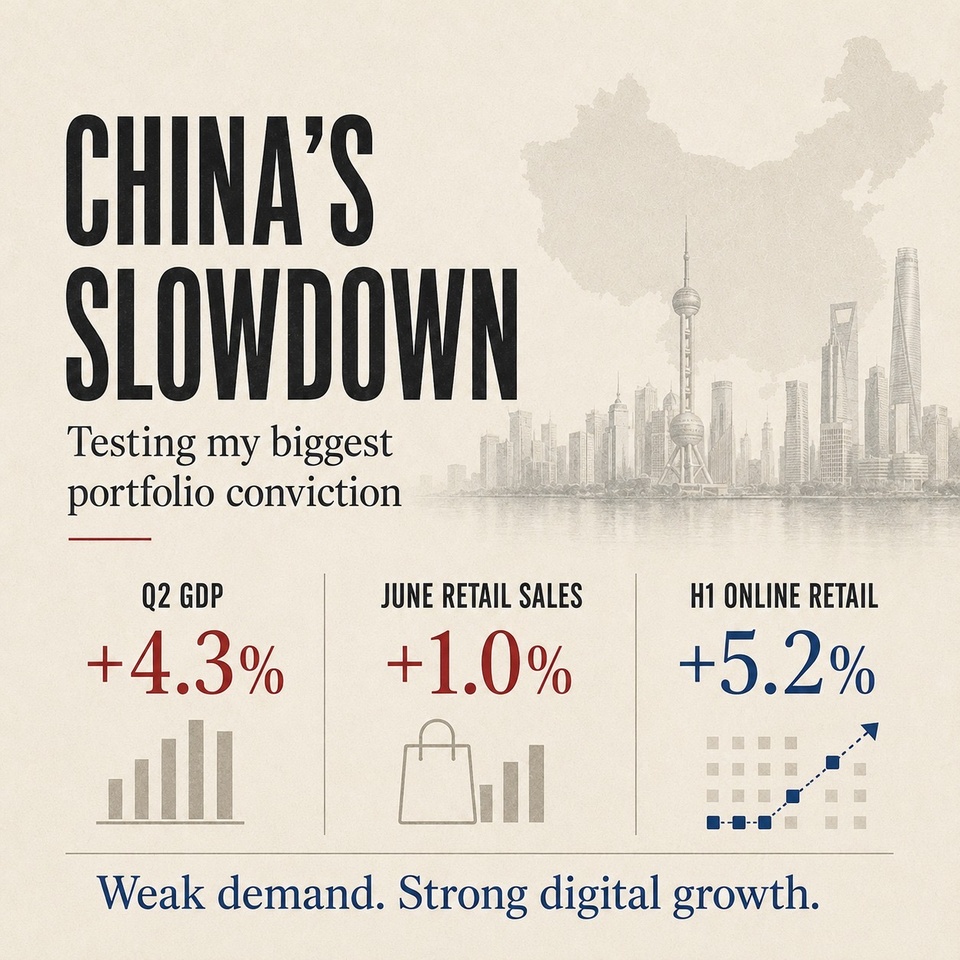
China’s economy grew by 4.3% year-on-year in the second quarter, down from 5% in the first. Retail sales increased by only 1% in June, fixed-asset investment fell by 5.7% during the first half of the year and real-estate investment declined by 18%.
Those are not numbers that support a simple “China is back” narrative.
The main weakness remains domestic demand. Chinese households are still cautious, the property crisis continues to weigh on confidence and the economy remains too dependent on industrial production and exports.
For my portfolio, this matters particularly for JD.com. Its core retail business is directly exposed to Chinese consumption. The company managed to increase JD Retail’s operating margin from 4.9% to 5.6% in the first quarter of 2026, but a business cannot rely indefinitely on efficiency improvements if the underlying consumer remains weak.
Alibaba is slightly different. Its commerce businesses face the same economic environment, but Cloud and AI provide an additional source of potential growth. As I discussed in my previous post about Qwen, Alibaba is no longer only a bet on Chinese e-commerce.
There are also some positive divergences beneath the weak headline data. Online retail sales increased by 5.2% during the first half of the year, while information, software and technology services grew by 10.7%. China’s traditional growth model is clearly struggling, but parts of its digital economy continue to expand considerably faster.
The policy response may now become the most important part of the thesis.
This week, China approved a plan to increase total retail sales from 50.1 trillion yuan in 2025 to approximately 60 trillion by 2030. The objective is clear: increase household consumption and reduce the economy’s dependence on investment, property and exports.
The difficult question is whether this will be supported by sufficiently strong measures.
Targets alone will not restore consumer confidence. China may need more direct support for household income, a stronger social safety net and a credible solution to the property crisis. Without those changes, consumers may continue saving instead of spending, regardless of how ambitious the government’s plans sound.
For now, the latest data do not make me abandon my China thesis, but they do raise the standard of evidence required to maintain it.
I will be watching whether retail sales genuinely accelerate, whether JD can continue improving its core business without destroying profitability elsewhere, whether Alibaba’s Cloud and AI growth translates into cash flow, and whether the government’s consumption plan produces concrete measures rather than only long-term targets.
Being overweight China remains one of the highest-conviction decisions in my portfolio. It is also probably the one that requires the most patience and the most frequent reassessment.
Conviction should not mean refusing to change your mind. It should mean knowing exactly what evidence would make you change it.