4Mês·

🚀 AOK Dossier: inTEST Corp (Ticker: INTT) - The invisible AI bottleneck

Hello community from Denmark!


While everyone here is philosophizing every day about the next AI chips from Nvidia and AMD, we seem to have completely forgotten the absolute foundation of this hardware. What happens when a 30,000 dollar AI chip runs under full load? That's right: it gets beastly hot.

And this is exactly where a tiny microcap comes into play, which, absurdly enough, no one here has ever had on their radar: inTEST Corporation. $INTT (+0,43%)
attachment


1. introduction: The real "shovel and pickaxe" play


inTEST is not AI software hype. The company is based in New Jersey and builds physical, highly complex test and temperature management systems for the semiconductor industry. When Nvidia, TSMC or AMD roll new chips off the production line, they have to undergo extreme stress tests before they are sent to the data centers.


2. what the booth does & why it is absolutely vital for AI!


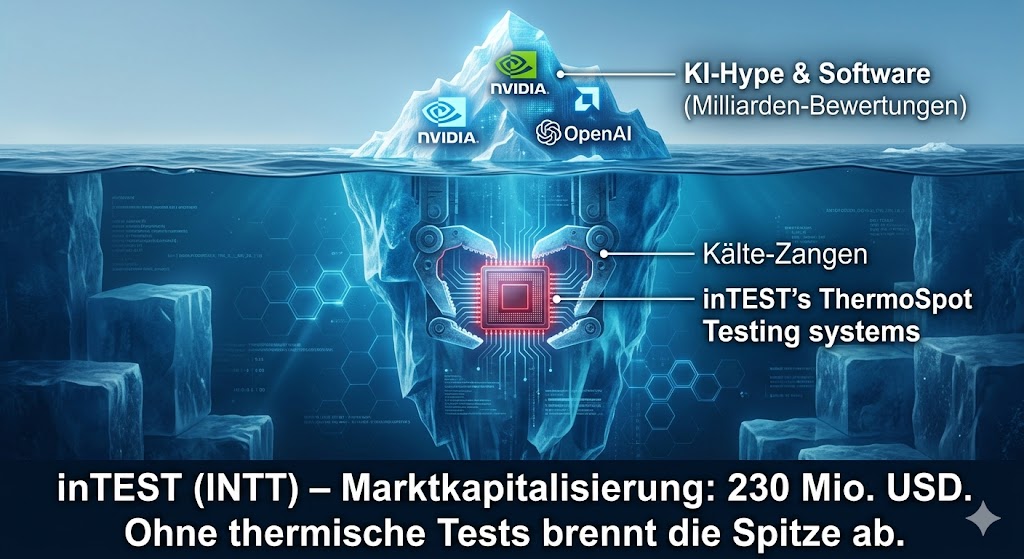
This is where we need to get physical: AI chips (GPUs) and advanced advanced packaging modules (like CoWoS) eat up absurd amounts of power (sometimes 700 to over 1000 watts per chip). Heat is the absolute mortal enemy of semiconductors. To prevent these chips from simply melting in the data center, they have to be tested for reliability during production under extreme temperature fluctuations (from freezing cold to extreme heat). inTEST supplies systems such as ThermoSpot and Temptronic provide exactly these precision test environments. They physically dock onto the silicon wafers and chips and put them through extreme thermal cycles. Without the thermal equipment from inTEST and its direct competitors, there would be no functioning high-performance AI chips. Item.


3. key figures, facts & figures (as at the end of May 2026)


  • Market capitalization: Tiny ~230m USD (An absolute micro-cap!).
  • Share price: ~17.20 USD.
  • Q1/2026 figures (reported on May 05, 2026): An absolute blowout! Revenue: USD 33.9m (expectations pulverized).
  • Dividend yield: 0.0% (every cent goes into growth).


4. core quality formula check


  • Sales growth: +27.2% YoY in Q1/2026 just ended. That's brutal organic growth in an extremely challenging hardware market.
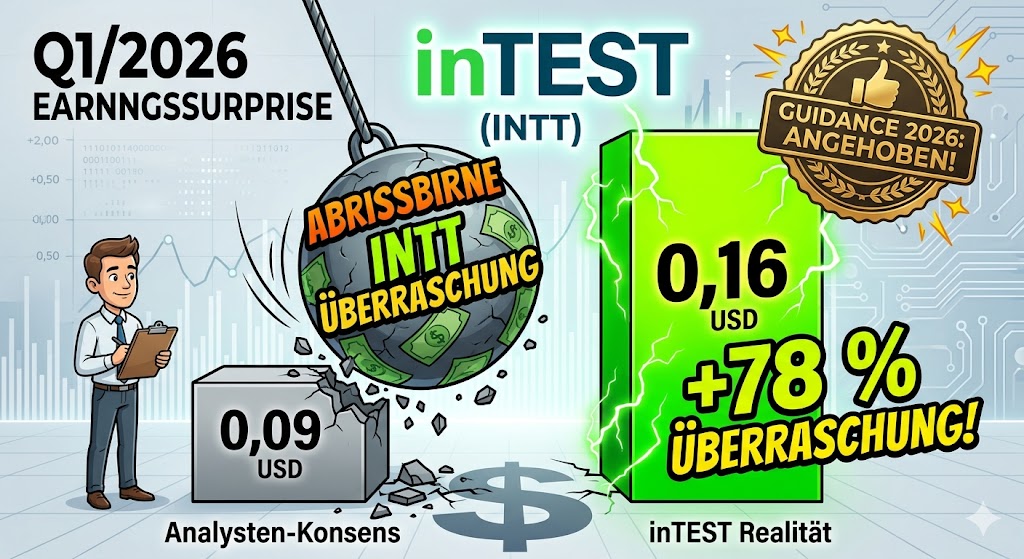
  • Operating margin: inTEST is operating profitably. EPS (earnings per share) amounted to USD 0.16 (non-GAAP) in Q1, beating analyst estimates (USD 0.09) by almost 78%!
  • Verdict: Strong points! The operating leverage is kicking in massively right now.


5. cash flow quality formula check


The balance sheet is rock solid. They have survived the historic hog cycle of the semiconductor industry and have strong quick/current ratios (>2.0). No toxic debt piles eating up cash flow.
attachment

6. dividend filter check


Fail. Zero dividend. $INTT (+0,43%) is a pure, crystal-clear play for the Side B of my portfolio (growth/gamble).


7. exclusion rule check


Does my ice-cold exclusion rule ("Story > Numbers") apply? Absolutely not!

InTEST delivers hard figures. The order backlog at the end of Q1 was over USD 51 million. These are signed, real hardware orders.


8. future prospects & competition


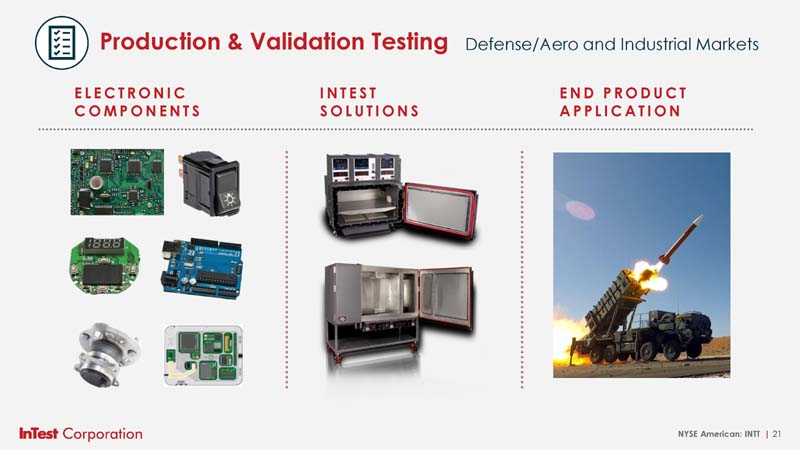
The highlight: inTEST is not only dependent on the AI semiconductor market. They are aggressively diversifying into the defense/aerospace and medical technology segments, where extreme thermal stress tests are also required. The competition is fierce (Teradyne, Cohu), but inTEST occupies the highly complex, high-margin niche.
attachment

9. chart analysis of the last few months


The chart has shown massive strength after the Q1 figures and has broken out of its low of around USD 6 last year. Over a 6-month period, the share price has risen by over +140 %. The share is currently consolidating extremely cleanly in the USD 18 range and building a new base.


10 Special Entry Zones (Bargain Hunter's List)


  • Zone 1 (The breakout setback): 17.50 USD - 18.00 USD. The share price is currently oscillating here after the strong Q1 figures.
  • Zone 2 (The panic dip): < USD 15.00. Should the overall market (Nasdaq) take a deep breath.


11. perspective on future viability


As long as physics applies, more powerful chips generate more heat. The more heat, the more and more precise test devices are required by inTEST. The business model is absolutely crisis-proof for the next decade as long as AI continues to grow.


12. potential alternatives / replacements


If you want to play the semiconductor test market but shy away from the micro-cap risk (USD 230 million), you can go for Teradyne or Cohu $COHU (-0,67%) . However, these are billion-dollar heavyweights and far more sluggish.
attachment

13. votes of the CEO


The new CEO Rich Rogoff (at the helm since April 2026) delivered massively right from the start. Based on the strong Q1 performance, the management has raised the annual forecast for 2026 to USD 130 to 135 million. The management exudes absolute confidence.


14. opinion of the analysts


Wall Street is slowly waking up. After the Q1 figures, price targets were raised from USD 10 to up to USD 19.30 (or just under USD 20). Although some analysts warn of general macro risks, they emphasize the massive undervaluation in a peer group comparison.


15 Conclusion & Side B classification

Raketentoni's personal verdict:

$INTT (+0,43%) Is the perfect, profitable micro-cap play for Side B. We are not buying the AI chip that may be overtaken by the competition tomorrow. We are buying the company that is testing the furnace. More info also at https://www.intest.com/


@Aktienhauptmeister

@Multibagger

@Tenbagger2024

@Get_Rich_or_Die_Tryin

@Stocktective

@Simpson

@WarrenamBuffet

@SAUgut777

@TradingHase

@PikaPika0105

@Derspekulant1

@NichtRelevant

@Klein-Anleger

and of course all the others :)

17
23 Comentários

imagem de perfil
Jack hier✌️Raketetoni, it's your turn. 🫵 In recent weeks and months, I've dissected several stocks from the community down to the bone and sent half the watchlist to the crematorium. Today your micro-cap gamble (?) gets to feel my scythe. 💀

🎯 The hot niche on the AI flatland
inTEST Corporation does not operate as a dazzling AI software hype, but as a tangible workbench for the semiconductor infrastructure. The company builds physical, highly complex test and temperature management systems (ThermoSpot, Temptronic). The logic behind this: The more brutally modern data centers and AI chips run under full load (sometimes 700 to over 1000 watts per GPU), the more extreme the heat development becomes. Without the thermal equipment from inTEST, the hardware simply burns out during the stress test before delivery. A classic shovel-and-pick play at the lower end of the food chain.

🛠️ DNA check & transformation
The operating lever kicks in: The past Q1/2026 shows a brutal turnaround. Organic sales growth shot up by +27.2% YoY.
Earnings explosion: Adjusted non-GAAP EPS came in at USD 0.16, pulverizing the fearful analyst consensus (USD 0.09) by a whopping +78%.
Solid balance sheet: No toxic micro-cap debt. With a net debt/EBITDA of ~0.9x and quick/current ratios comfortably above 2.0, the growth phase is fully financed.
Full pipeline: The order backlog was over USD 51 million as at the end of March 2026 - this ensures planning reliability for the coming quarters.

🚀 Growth levers & catalysts:
The Rogoff effect: new CEO Rich Rogoff has been at the helm since April 2026 and delivered straight away at his debut. He has ice-coldly raised the annual forecast for 2026 to USD 130 to 135 million.
Wall Street is waking up: Analysts had to revise their historically depressed share price targets mechanically upwards from USD 10 towards USD 19.30 to USD 20.00 after the Q1 blowout.
Industry diversification: inTEST protects itself from the pure semiconductor hog cycle by aggressively expanding into the thermal test markets of defense/aerospace and medical technology.

⚠️ Valuation & Risks:
The micro-cap whipsaw: with a tiny market capitalization of ~$230m, extreme price volatility and liquidity constraints are commonplace.
Increased working capital requirements: Brutal growth eats up cash. The cash conversion cycle is damn slow at over 100 days because high inventories have to be pre-financed.
The cluster risk: If giants such as Nvidia or AMD consolidate their testing with the industry's billion-dollar giants (Teradyne, Cohu), inTEST will be pushed out of its niche with a cold head.

My conclusion for you: INTT
"Raketentoni, you haven't told a complete fairy tale this time - the Q1 figures prove that the operating leverage at inTEST has just kicked in massively. At a forward P/E of around 18.4x, the speculative growth is absolutely affordable for an AI infrastructure profiteer. But don't make the mistake of confusing this thing with an indestructible moat compounder. It remains a highly cyclical micro-cap gamble for the risk-averse portfolio corner. If you are disciplined and wait for setbacks, you will catch an asymmetrical setup."

Status: 🟢 BUY (as a speculative satellite addition)
Reaper Score: 6/10
•
5
•
imagem de perfil
@Aktienhauptmeister Your prompt writes almost the same as mine 😁but hey: no fairy tales this time..... I think it's starting 😁😁😁😁
I'm going to put the joint in my portfolio on Side B
•
3
•
imagem de perfil
@Raketentoni 🫶🫶 haha, I'm glad to hear that. thanks for the introduction my dear 🚀💪
•
4
•
imagem de perfil
Thank you my dear. You know that I like the blade suppliers. That's why we're in the $TER project department, and I myself am invested in $6857. @Dividendenopi
•
3
•
imagem de perfil
@Tenbagger2024 Do you also have a shovel supplier for your sandpit at home? 😁
•
1
•
imagem de perfil
@Raketentoni for the potato box
•
1
•
imagem de perfil
Boy, boy, you've really scratched the surface with your prompts, men.😏

I'll throw the following arguments into the room for you to feed Mr. Prompt and Jack:

Order backlog covers ~1/2 year of sales (okay but not gigantic and provides no real longer-term predictability) and shows a sequential 15% decline from FY 2025 to Q1 2026.

On diversification: this is the issue that to me speaks least in favor of inTEST as a semiconductor/AI profiteer. The share of non-semiconductor sales is now ~69% (Defense/Aerospace, Life Sciences, EV). Sales directly related to semiconductors are only 14%.

Total liquidity is around $56m, of which $40m is from an unutilized credit line. So the real cash cushion is not that fat for an asset-heavy business.🤷🏼‍♂️

FCF -$4.0m after -$1.6m in Q4 2025.

The growth of approx. 20% CAGR over the last five years was primarily achieved through acquisitions, not purely organically.

I'm staying out here and find it semi-exciting. More story than hard (or at least than good) facts from my point of view.
•
3
•
imagem de perfil
@Get_Rich_or_Die_Tryin Hi Get_Rich_or_Die_Tryin!
Big respect for the deep dive! It's exactly this kind of critical headwind that we need here in the forum instead of blindly buying some hype ticker. You challenged Mr. Prompt and me - challenge accepted. Let's dissect your arguments ice cold, because you have a few classic misinterpretations of a "hardware scale-up" in there:
1. the backlog drama (1/2 year reach & -15%)
You criticize the fact that the backlog "only" covers half a year and has fallen sequentially by 15%.
The ice-cold reality: We are talking about physical industrial hardware (test machines) and not a SaaS cloud subscription with 10 years of predictable ARR (Annual Recurring Revenue). An order backlog that extends 6 months into the future is completely normal and healthy for a hardware supplier. The fact that the backlog is now sequentially shrinking somewhat after the massive post-Covid chip shortage (where everyone panicked and ordered twice) is not a weakness, but the normalization of the supply chains. They are simply processing orders more efficiently.
2. the diversification criticism (only 14% direct semiconductor business?)
You say that inTEST is not a real AI profiteer because of 69% non-semi-revenue (defense, life sciences).
The ice-cold reality: you are overlooking the absolute big picture! It was precisely this diversification that we praised as a massive strength factor (Moat) in point 8 of our dossier. If the pure AI chip cycle stutters, Aerospace and MedTech will keep the company profitable. And by the way, what do you think modern defense systems (drones, missile guidance systems, satellites) are stuffed with? With high-performance chips and edge AI that have to withstand extreme temperatures. This "non-semi" area is highly technologized and needs exactly the same thermal tests. The AI bottleneck is not limited to Nvidia servers.
3. the alleged liquidity problem ($16m cash)
You take out the $40m credit line and say $16m real cash is "not that fat" for an asset heavy business.
The stone cold reality: InTEST is not an unprofitable biotech startup that needs a gigantic cash runway to survive the next year. They are printing profits (Q1 EPS of USD 0.16)! A profitable micro-cap doesn't need 100 million in overnight cash that will be eaten by inflation. An unutilized 40 million credit line shows that the banks have full confidence in the company's cash flow. This is completely sufficient as a buffer for acquisitions and operating business.
4. the "purchased" M&A growth
You criticize that the 20 % CAGR is primarily bought through acquisitions (M&A).
The cold reality: Welcome to the micro-cap sector! In a highly fragmented niche like semiconductor testing, intelligent M&A growth is exactly the job of good management. They buy technology, integrate it and leverage synergies - as evidenced by increasing profitability. If they had taken over, the operating margin would bleed. But they are not.
My conclusion:
You're looking for the pristine balance sheet of a $100 billion company in a $230 million micro-cap. You will never find that at this level. For our dumbbell strategy (Side B), inTEST is an asymmetric bet: The hard facts (rising EPS, raised guidance, profitable niche) are in place, and the story (AI heat problem) provides the fuel for multiple expansion.
•
2
•
imagem de perfil
@Raketentoni 😉 I personally take a different view, as there are also much more solid (and presumably also faster-growing) Side B candidates that look better to me overall.

Are you planning to put them in your Side B?
•
2
•
imagem de perfil
@Get_Rich_or_Die_Tryin I've already invited a good three-digit number of shares 😬 let's see, won't stay in the portfolio forever. These are candidates for 20% and out again
•
2
•
imagem de perfil
@Raketentoni Fingers crossed and good luck with it at Fall🤞🏻Die I think it's conceivable and realistic in any case.👍🏻
•
1
•
imagem de perfil
YTD 123%, perhaps not quite so invisible 🫥😁
•
2
•
imagem de perfil
@jkb92 by invisible I also meant that this is the first post about the share in the forum :)
•
2
•
imagem de perfil
Exciting. 'Invisible AI bottleneck' sounds suspiciously like the language of a bottleneck investor. 😉

But INTT is really good, I hold it in my bottleneck portfolio.
•
2
•
imagem de perfil
@ScaleLimits invisible was more related to the fact that so far nobody has written anything about this share here
•
2
•
Very interesting thesis, I just wonder where you come across such shares and how exactly you formulated your prompt so that it delivers such output? And how much do you have to deal with it again so that it doesn't hallucinate ?
•
1
•
imagem de perfil
That should have been Friday when we reached zone 2. Would you get in now?
•
1
•
imagem de perfil
@Multibagger have a small order in for tomorrow morning, let's see if it works
•
1
•
imagem de perfil
@Raketentoni with what limit? Aren't you waiting for the US opening?
••
imagem de perfil
@Multibagger positioned myself at 14.25 $
•
1
•
imagem de perfil
@Raketentoni that would be nice. This morning it is valued at 14.80$. I'll be on the lookout too 😉
••
imagem de perfil
@Multibagger yep but I think there will be volatility again today. Israel has once again attacked Asia in the red, in South Korea y-trading was briefly suspended 🙄
•
1
•
imagem de perfil
@Raketentoni I assume the same
••
Participar na conversa