1D·

Oil | Oil market under pressure

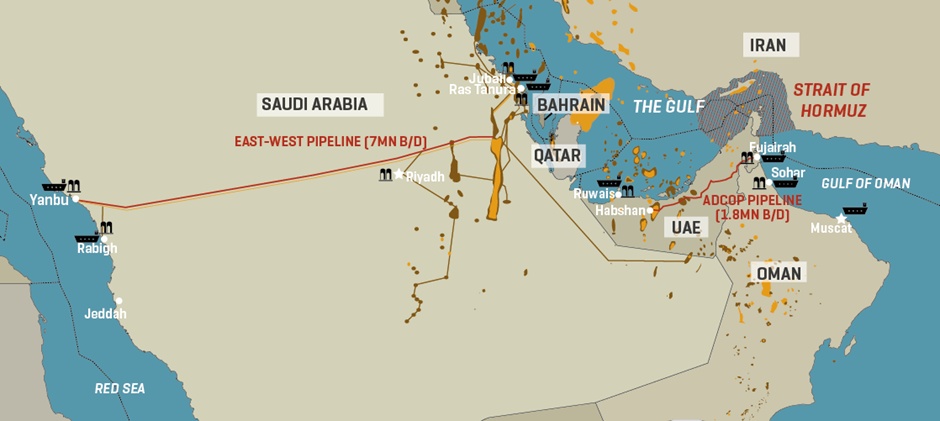
The geopolitical situation in the Middle East continues to deteriorate. According to General Cane of the US Department of War, the second phase of the war has now begun. Oil has (of course) reacted particularly to the second Iran war. In recent days, attempts have been made to transport the oil, which primarily flows through the Strait of Hormuz, via pipelines to ports such as Yanbu in Saudi Arabia or Fujairah in the UAE. The King Fahad Industrial Port in Yanbu is the largest exporter of crude oil, refined products and petrochemicals on the Red Sea with 34 berths and 10 terminals. It is used for $2222 as detour. Fujairah is a very good location for bunker oil and storage outside the Strait of Hormuz. The Fujairah Oil Terminal has 36 tanks with 1.2 million cubic meters of storage (approx. 18 million barrels) and 14 berths.
attachment

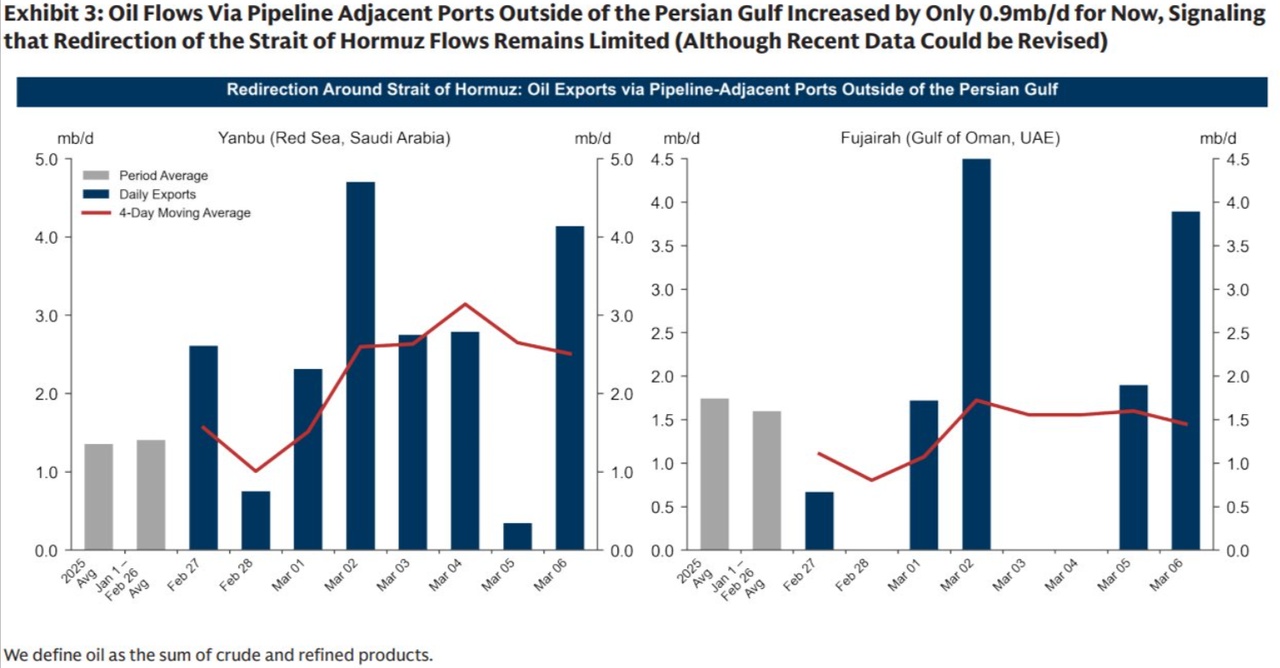
Currently, it can be stated that 4 mb/d was loaded onto VLCCs on Friday, giving a total of 8 mb/d. However, this is not in proportion to what is flowing through the Strait of Hormuz, 20 mb/d. They are currently trying to shift as much oil to ships to balance this out, but they are not succeeding. This is also due to the fact that oil storage facilities have now also become a target of the IRGC. On March 3rd, several drones hit the oil storage facility in Fujairah, which can be seen in the graphic, as no exports could take place and were still restricted on March 4th.
attachment

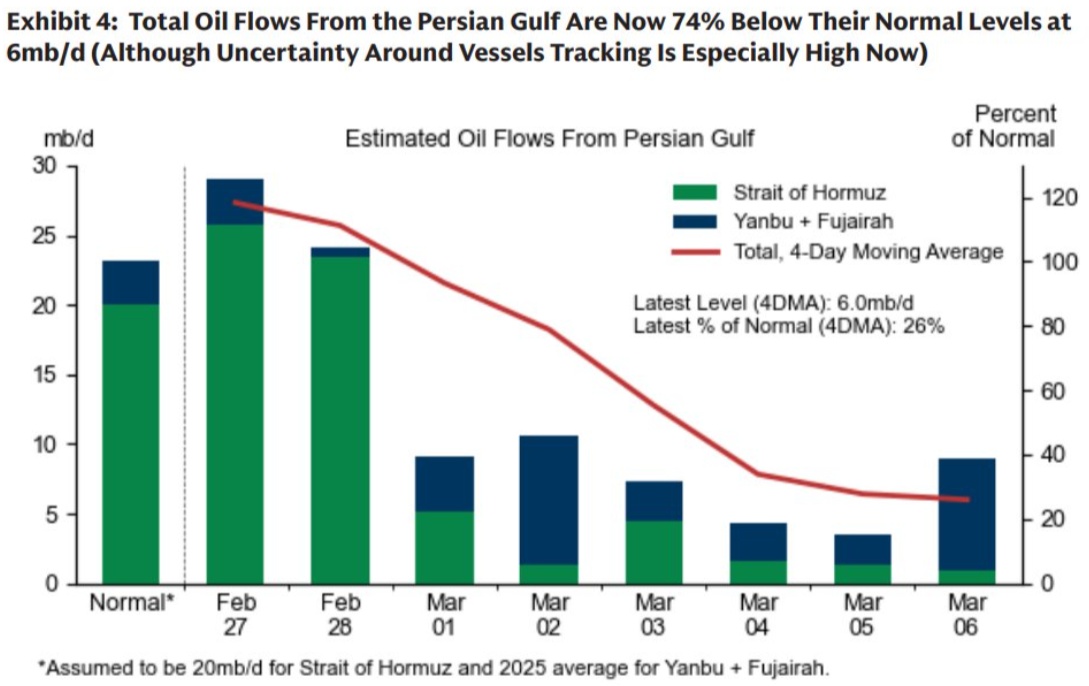
To see the extent of the current oil problem, an overview of total oil exports from the Persian Gulf is essential. This chart shows that flows have been reduced by 74%. Normally, around 20 mb/d flows through the Strait of Hormuz and 2.5 mb/d through the Yanbu and Fujaihra pipelines as a replacement/balancing valve. Due to the outbreak of war, the flow through Hormuz collapsed, partly due to fear of attacks by the IRGC and the closure by them on March 2nd (radio message).
attachment

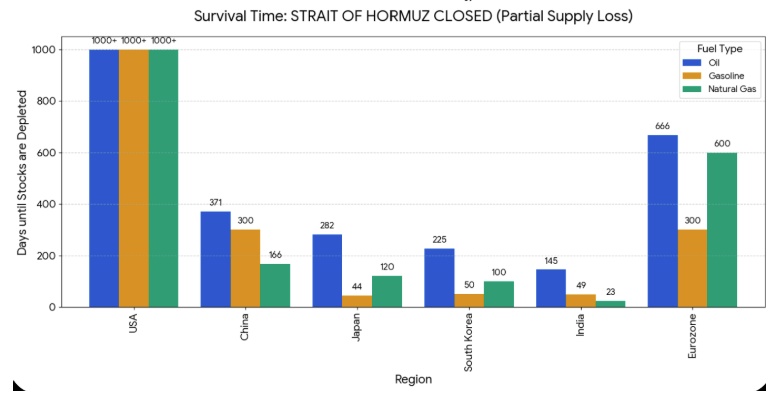
If you look at the strategic impact of a closure of the Strait of Hormuz, it hardly affects the USA, which can withstand +1000 days based on stocks. Countries in Asia, such as South Korea, Japan and to some extent China, are particularly affected, especially for gas. Europe is strategically moderately to well "prepared". The only problem is with gasoline. Those countries run the risk of having to buy expensive oil in order to maintain their normal operations.
attachment
20
39 Comentários

imagem de perfil
Now it's getting dangerous because a spiral has started! Oil price up => inflation => interest rates go up => recession => stock market crash 💣 I think we're in for a very uncomfortable time folks!
Last week was the most extreme rise in oil prices since 1982! Back then there was also a stock market crash and if it turns out stupidly, we will see the same thing again, only MUCH WORSE, because this time the AI fears are added and a madman is sitting in the White House!

If this scenario happens, then expect a crash of more than 70%!
12
imagem de perfil
@BavarianLion top if you're still young. Would be a great opportunity 🔥🤩
7
imagem de perfil
@Max095 Yes, definitely! That's why I'm holding back my money now, because I think a real horror scenario is realistic! And then I don't want to end up with empty pockets 😅 But to be clear, I'm not a fan of it happening as I described above, but I do think it's realistic 🤯
@BavarianLion The madmen are in Tehran. And if there is finally someone who can rid the world of this plague, then I am prepared to accept a little turbulence in my portfolio.
6
imagem de perfil
@BavarianLion Most extreme rise since 1982? Did you miss 2022? Oil was already at over 110$ in May/June 22 or over 140$ in July 2008. Then in 2008 it went down between 30-50%. I share your opinion that the oil price can trigger a spiral, but I think it's nonsense to talk about 70% or more.
7
imagem de perfil
@BavarianLion Hmm even if 70% discount would be nice, I don't really believe it. Just because there was a crash back then doesn't mean the chances are similar/higher today. If that was the last massive rise in oil and it levels off, the impact will probably not be great. Nowadays, the economy is a bit more stable, so I think there must be more to come. The guys at $JPM, for example, also reckon that the probability of an oil-induced recession is currently <40%. Maybe a nice correction? Who knows :D But I think I might wait until March before making any further investments outside of the savings plans.
2
imagem de perfil
@Solitair I wonder what you'll say when the "turbulence" turns into a global recession and a subsequent stock market crash!
I certainly won't shed a tear for those idiots in Iran, but what we are seeing now could be the start of a major conflict, the effects of which cannot yet be predicted in any way!
imagem de perfil
@Stocktective I also wrote that I'm not a fan of it happening like this, but it COULD happen, as we don't know how much more fuel Trump will add to the fire (the pun was unintentional 😅)
1
imagem de perfil
@Zerax I wrote, the most extreme increase within ONE WEEK!
imagem de perfil
@BavarianLion so tomorrow morning all-out and 100% cash quota ? :)
2
imagem de perfil
@Artiskon No way 😉 Now it's time to buckle up, put on your steel helmet and increase your savings plans!
We all know the saying: when there's blood on the streets, buy as much as you can 😜
1
Ver todas as 28 restantes respostas
Participar na conversa