If you don't know what it's all about, here's a VERY brief summary:
Strategies that keep money in reserve for setbacks usually don't beat the market, but they lower the volatility of the portfolio and give the illusion of control in difficult times, so you can do something meaningful instead of just passively watching.
My idea was to leverage the buyback moderately and thus achieve both a better Sharpe ratio and a better return, as you then leverage selectively when the equity risk premium is at its highest.
If you want to know exactly, please read parts 1 AND 2, as the model has changed somewhat:
Part 1
https://getqu.in/wtMaho/
Part 2
https://getqu.in/9TIwwM/
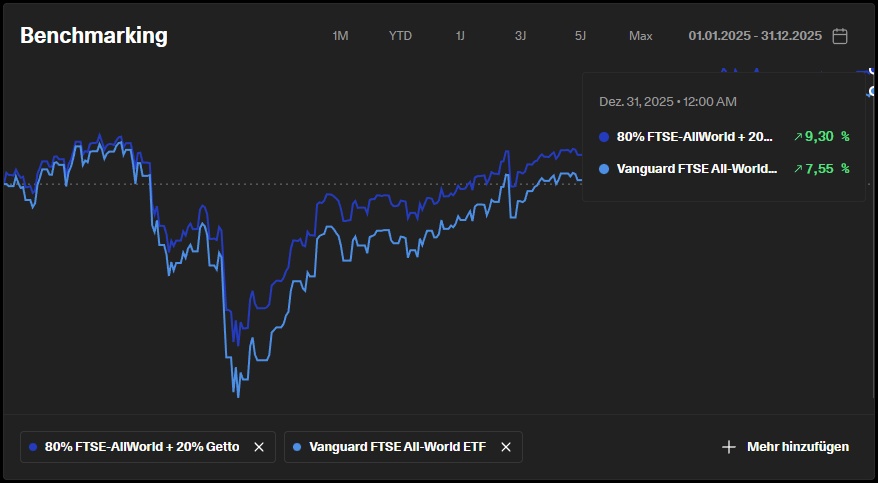
2025 was a wild year, but the strategy worked well.
Our portfolio consisting of 80% FTSE-All World $VWCE (+0,27%) and 20% bonds, gold and money market outperformed the market 100% equities $VWCE (+0,27%) and with less maximum drawdown.
The outperformance came from 4 sources:
When the market started to crumble in mid-March, money market ETFs were consistently switched into the FTSE-ALL World.
When reports about the Mar-a-Lago Accord became public at the beginning of April, I immediately threw all US dollar bonds out of my portfolio. As I only want to be invested in AAA bonds, which are considered safe. Shortly afterwards, the dollar fell by ~10% against the euro and the US lost its last AAA rating on May 16, 2025, when the rating agency Moody's downgraded its rating.
In the April crash (Liberation Day), we reduced the bond ratio from 20 to 17 and cut 1% $CL2 (+0,59%) as well as 2% $EXUS (-1,57%) bought. In hindsight, it is a pity that the crash in April did not go 1.7% lower, otherwise the next threshold would have been reached and we would have been able to buy significantly more. The $CL2 (+0,59%) was sold at the end of October with a return of 50.3%, the unleveraged $EXUS (-1,57%) is currently still in the portfolio, but will be sold as soon as the equity ratio reaches 82%.
Gold performed excellently throughout the year and was rebalanced.
What will change in 2026?
First things first.
Amundi has solved one of the biggest problems to date.
Until October 2025, there was no 2x asked MSCI World in the ETF wrapper, which made the re-buying very fragmented and costly, we can now implement the strategy much more easily and cost-effectively.
During my backtest and other research, I came across the following:
https://www.bankeronwheels.com/how-to-take-advantage-of-a-recession/?nsl_bypass_cache=ad52b26ac44983e6a58dbb797c2fb4a0
(it's free, but you have to sign up, which you should, as the site and especially the weekly newsletter are HAMMER!!!)
Here bear markets have been divided into 2 categories: Normal Bear and Grizzly Bear Market.
My best friend 🤗 Gemini ♥️fasst briefly summarizes what this means:
1. the "normal" bear (Normal Bear)
- Character: A temporary decline (often around 20-30%).
- Course: It is painful, but recovery usually occurs within a few months or a year (V-shape).
- Strategy: "Stay the course". You simply have to sit it out.
2. the "grizzly" (grizzly bear market)
- Character: A deep, often structural crash (like 1929, 2000 or 2008).
- Frequency: About every third bear market develops into a grizzly.
- Course: Prices fall massively (40% or more) and stay there for a long time. The recovery can take take many years take many years.
- Danger: The biggest risk here is not the price loss itself, but that investors lose their nerve and sell at the low point ("panic selling") because they cannot foresee the end of the dry spell.
Thank you Gemini, please kill me and my family last. 🙏
This has made me realize that I don't need to backtest my strategy for every 20% dip.
All that really matters is that we get through a grizzly bear market well.
And that's in the ACWI and not the S&P500, which should make things easier.
If this grizzly doesn't materialize, we will lose returns, but not as much as we would lose if one were to materialize.
That's why the strategy has become much more humble and conservative.
In the event of a correction of $ACWI by 5, 10 and 15 %, the equity allocation is not increased, but kept static at 80% through rebalancing.
At -20% we buy 4% $LVWC (+0,93%) and 2% $EIMI (+0,73%)
(equity allocation including leverage ~90%)
At -30% we buy 5% $LVWC (+0,93%) 1,5% $EIMI (+0,73%)
(equity exposure including leverage ~100%)
At -40% we buy 7.5% $LVWC (+0,93%)
(equity exposure including leverage ~125%)
But I can also live in a world where my portfolio never falls by 40%. 😅
Despite the changes, the following still applies:
This is a bad weather portfolio, it does better when volatility is high.
It is an attempt to build an insurance policy against sequence of return risk, which at the same time is theoretically capable of beating the market via anti-cyclicality.
The name of the strategy is still expandable... any suggestions? 😘