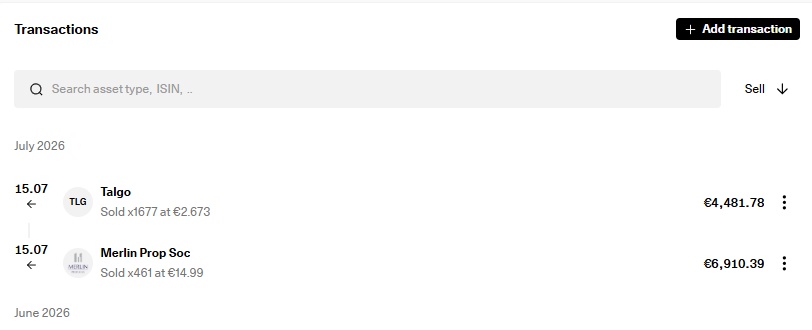
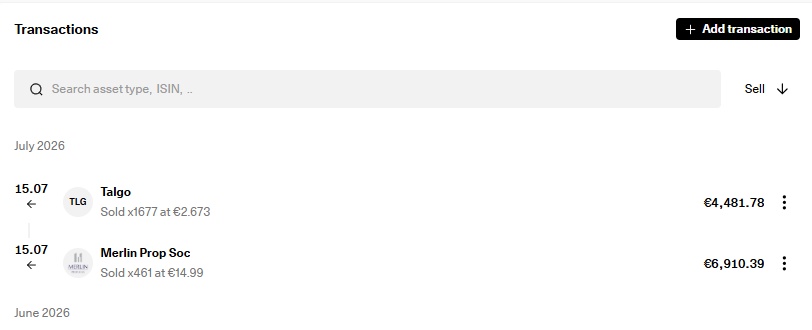
I’ve held Talgo for 5 years. My position is down 25% including dividends. I bought it because of its potential: high-speed trains, Spanish technology, and solid contracts.
With Merlin, it was a different story: a 30% gain in value and another 30% in dividends over a similar period. A Spanish REIT with quality assets. It seemed like a safe bet.
Both are in the Low Threshold quadrant on DividendQuad. The numbers don’t lie:
🔴 Talgo ($TLGO (+0,21%)
): Quality 15, Opportunity 10. Negative free cash flow (-€94M). Penalties from Renfe totaling €116M for missed deliveries. Debt-to-equity ratio skyrocketing to 3.27x. The government blocked a takeover by a foreign group. No dividend, no cash.
🔴 Merlin ($MRL (+0,71%)
): Quality 30, Opportunity 15. Cut the dividend by 93.9% in 2026 to finance its pivot to data centers. Current yield: 2.55%. Negative FFO per share (-€1.07). And the risk that the SOCIMI tax regime will be eliminated adds an extra layer of uncertainty.
This week I sold both and made purchases in the following stocks:
🟢 Vinci ($DG (-0,62%) ): Quality 80, Opportunity 85. Yield 4.18%. P/FFO 7.8x. Debt/EBITDA 1.48x. Monopoly concessions with inflation-indexed revenues.
🟢 Standard Life ($PHNX (+1,63%) ): Quality 80, Opportunity 85. Yield 6.14%. The reported losses are purely accounting-related (hedging). Adjusted operating profit grew 15% to £945M. Solvency II surplus of 153%.
🟢 EON ($EOAN (+0,92%) ): Quality 80, Opportunity 85. Yield 2.96%. P/FFO 7.4x. 75–80% of EBITDA comes from regulated networks. The recent net loss was a one-time accounting charge.
I’m glad that since I created my tool, these decisions have become much easier. It helps me separate the emotional aspect from the decision-making process.