
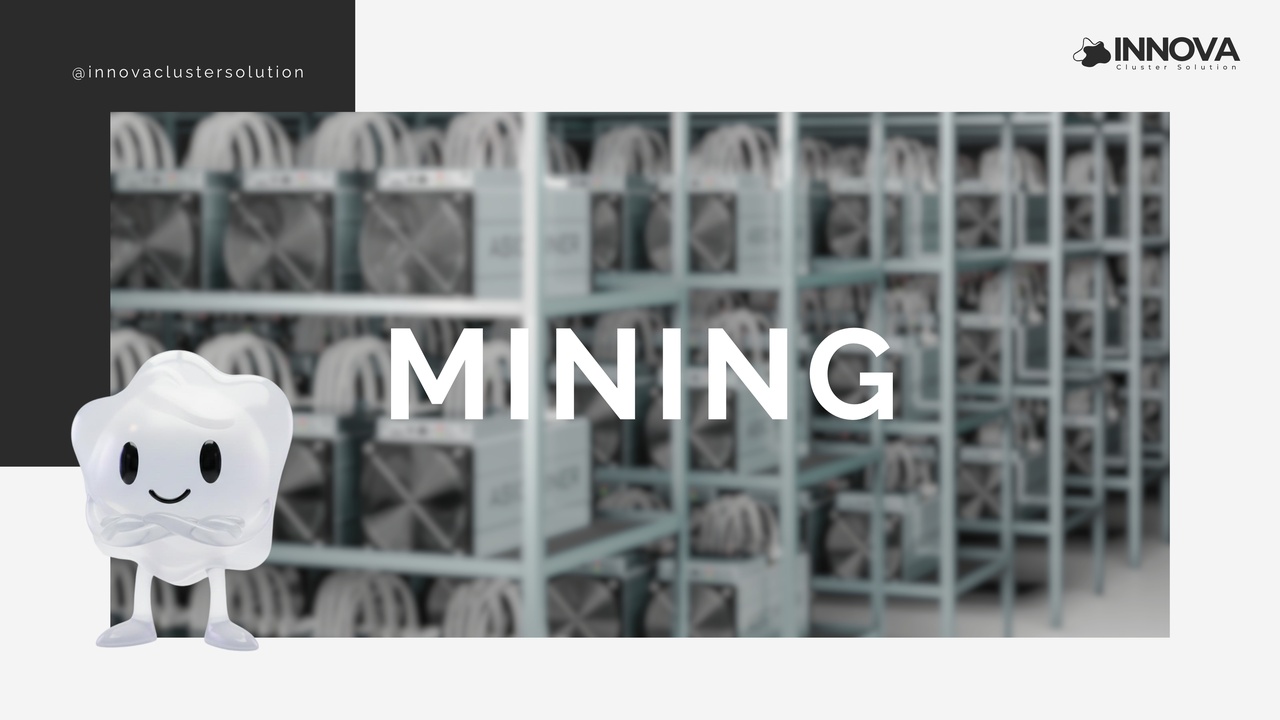
Bitcoin mining is the process by which new bitcoins are created and transactions are verified on the Bitcoin network. It is a combination of cryptographic calculations, economic incentives and decentralized coordination. Miners act as accountants and guardians of the network: they collect transactions in blocks, solve complex computational tasks to add a new block to the blockchain and receive a reward in the form of newly minted bitcoins and transaction fees.
Technical basics
The core of Bitcoin mining is the proof-of-work (PoW) consensus mechanism. PoW requires miners to provide cryptographic proof that they have performed a certain amount of computational work. Specifically, miners must find a hash value for a block that is below a certain target. The hash is calculated using the SHA-256 algorithm and includes block header data such as the previous block hash, a timestamp, the Merkle root of the transactions contained in the block and a variable nonce. Miners vary the nonce (and other variable fields) and repeatedly calculate SHA-256 hashes until a valid hash is found. Because hash functions are deterministic but practically irreversible and their outputs are randomly distributed, the only practical way is to try out many combinations - an energy-intensive, probabilistic process.
The difficulty of mining is automatically adjusted by the network approximately every 2016 blocks, so that on average a new block is found every ten minutes. If more computing power (hashrate) is available to the network, the difficulty increases and vice versa. This adjustment stabilizes the block time regardless of the total computing power invested.
Hardware development and mining infrastructure
Hardware development has taken a clear course: Initially, Bitcoin could be mined on normal CPUs, then GPUs showed significantly better performance due to their parallel computing architecture. Later came FPGAs and finally specialized ASICs, which are optimized exclusively for SHA-256 mining and drastically improved efficiency. Today's mining systems mainly consist of ASIC rigs that are bundled together in mining farms. Electricity costs play a central role in the construction and operation of a farm, as mining is energy-intensive; low electricity prices are often decisive for profitability. Efficient cooling systems are necessary because ASICs generate a lot of waste heat; air and liquid cooling as well as the choice of location in colder climate zones can increase reliability and efficiency. Space infrastructure, stable power connections, network bandwidth, maintenance and physical security against theft are also important factors. To reduce yield volatility, many miners join together to form mining pools, in which participants pool their hashrate and receive pro rata earnings according to the power they use, instead of rarely finding complete block rewards themselves.
The economics of mining
A miner's income is made up of the block subsidy and transaction fees. The block subsidy starts at 50 BTC per block and halves approximately every four years in a process known as halving. This limits the total number of Bitcoin to 21 million. Halvings reduce the newly issued bitcoins and thus influence the supply and potentially the market price. The profitability of a mining operation depends on several variables: the Bitcoin price, which determines the fiat currency yield; the electricity price, which is the main cost factor; the energy efficiency of the hardware used in joules per hash; the acquisition and depreciation costs of the equipment; pool fees and other operating costs such as cooling, personnel and site rent; and finally the network difficulty and overall hashrate, which influence the expected revenue per device. In the long term, recurring halvings and increasing difficulty can reduce returns, which is why miners are constantly looking for efficiency improvements, cheap electricity - such as from surplus renewable energy - and economies of scale.
Energy consumption and environmental issues
Bitcoin mining consumes significant amounts of electrical energy, which has led to criticism of its environmental impact. This debate is multi-layered: critics point to high CO2 emissions, especially if the energy comes from fossil fuels; supporters argue that mining can incentivize the expansion of renewable energy, make surplus energy economically viable and reduce environmental impact through heat recovery. At a regional level, mining can influence local electricity supply and prices, which can lead to regulatory intervention and social resistance. Approaches to reducing the environmental footprint include siting in regions with a high proportion of renewable energy, direct contracts with producers, seasonal mining during periods of surplus production and the use of waste heat for industrial or municipal purposes.
Security, attacks and decentralization
Bitcoin is considered resistant to many attacks, but the mining model entails specific risks. A theoretical attacker with more than 50% of the network hashrate could carry out a 51% attack, causing double spending, censoring transactions or forcing reorganizations of the blockchain. In practice, such attacks are rare due to the enormous computing power required, the associated costs and economic counter-incentives, as a successful attack would reduce the value of the cryptocurrency and thus cause economic damage to the attacker. Nevertheless, there are centralization tendencies due to economies of scale: Large farms or mining pools can control a significant proportion of the hashrate. Measures to maintain decentralization include economic pressure, geographic distribution of miner infrastructure and technical innovations that could lower barriers to entry. Additional threats include software and hardware vulnerabilities such as malware, physical attacks on data centers, and regulatory measures that restrict or prohibit mining in certain jurisdictions.
Regulatory and legal aspects
The regulation of Bitcoin mining varies greatly around the world. Some countries encourage mining through low energy prices or targeted support, while others impose strict restrictions or bans due to high energy usage, financial risks or money laundering concerns. Important regulatory issues relate to energy and environmental regulations, the tax treatment of mining revenues, possible licensing of crypto service providers as well as anti-money laundering and KYC requirements, especially when mining revenues are converted into other crypto services. Miners and investors must carefully examine local legal and tax regimes, as compliance risks can have significant financial consequences.
Economic significance and applications
Bitcoin mining creates economic effects beyond the mere creation of money. Jobs are created in the areas of technology, electrical installation and data center operation as well as new business models such as hosting services for miners, hardware design or energy projects that are specifically linked to mining. Mining can be a buyer for volatile surplus production and thus stimulate investment in renewable energies. At the same time, external effects such as grid load or conflicts over energy prices arise, which must be politically controlled so that local communities and consumers are not disadvantaged.
Future prospects and technical developments
The future of Bitcoin mining will be shaped by several forces. Recurring halvings reduce newly created bitcoins and shift the revenue base more towards transaction fees in the long term; whether these fees are sufficient to incentivize miners sustainably remains a subject of research and debate. Efficiency gains in hardware are possible, but ASIC design requires significant investment in time and capital, so margins may narrow over time. Major protocol changes, such as a move away from proof-of-work, are highly controversial politically and technically and are considered unlikely. At the same time, layer 2 solutions such as the Lightning Network influence the fee structure because they outsource many transactions from the main network. Innovations in energy management, such as flexible mining in response to grid conditions or direct integration with renewable sources, could improve sustainability. Overall, mining remains the backbone of Bitcoin security; its long-term viability depends on market prices, technological progress and the regulatory environment.
Conclusion
Bitcoin mining is a complex web of cryptography, economics, engineering and energy policy. It secures the blockchain, but creates challenges such as high energy consumption, risks of centralization and regulatory uncertainties. The balance between economic profitability, technical efficiency and environmental responsibility will be crucial to how the mining sector develops in the coming years.
The role of ASIC miners
Bitcoin ASIC miners are highly specialized hardware devices designed solely to run the SHA-256 cryptographic algorithm extremely efficiently. Unlike universal processors or graphics cards, ASICs do not have any superfluous computing units, but only the exact logical structures that are needed to calculate the hash function. This radical specialization means that modern ASIC miners achieve a computing power that surpasses other types of hardware by orders of magnitude.
ASIC chips
An ASIC chip consists of millions of transistors that are arranged in such a way that they carry out the double SHA-256 process in several pipelines working in parallel. These pipelines continuously process new block headers and nonces, resulting in an uninterrupted flow of data. The chip dispenses with flexible structures such as register files, complex memory controllers or instruction sets, which are typical for CPUs. Instead, the entire architecture is optimized to repeat the same computing step at maximum speed. It is precisely this structure that makes the ASIC an extremely energy-efficient and powerful computing unit.
A complete ASIC miner consists of several hashboards, each containing hundreds to thousands of specialized chips. The hashboards are connected in series so that data packets can be passed from one chip to the next. A controller board takes on the task of controlling these hashboards, monitoring the temperature, regulating the clock frequencies and establishing communication with mining pools. The housing of the miner is usually designed to channel the airflow and protect the hardware from dust and electromagnetic interference. The structure is supplemented by a powerful power supply unit, which often has to provide several kilowatts to operate the miners continuously.
Performance classes and efficiency development
The performance of ASIC miners is essentially described by two values: the hash rate and the energy efficiency. While the hash rate indicates how many trillions of hash calculations are carried out per second, the efficiency stands for the energy requirement per computing unit. Modern devices achieve hundreds to several hundred terahashes per second and work much more efficiently than previous generations. Smaller manufacturing processes such as five, three or even fewer nanometers, which enable more transistors per surface area and reduce electrical losses, are crucial to improving efficiency. Optimized voltage converters, precise conductor path architectures and improved chip layouts also contribute to ever more energy-efficient generations.
Thermal challenges and cooling systems
As ASIC miners run under full load around the clock, a considerable amount of heat is generated. Conventional air cooling uses powerful axial fans that blow through the entire device and dissipate the waste heat. However, these fans generate a noise level that is hardly compatible with living environments. For this reason, alternative cooling solutions have become established. With immersion cooling, the miners are completely immersed in a non-conductive special liquid so that the heat is dissipated very evenly. This reduces dust problems, extends the service life and even allows overclocking. Water cooling systems that use radiators and pumps are also becoming increasingly important, especially if the waste heat is also to be used as heating energy.
Optimization options through firmware and voltage control
In addition to the hardware itself, the firmware plays an important role in efficiency and performance. Specialized software can be used to adjust clock frequencies, voltage values and fan controls. Overclocking increases computing power, but leads to higher power consumption and increased thermal load. Undervolting lowers the chip voltage and significantly improves efficiency, while the hashrate drops slightly. Undervolting is particularly advantageous when electricity prices are high or in domestic use, as it reduces energy consumption and lowers the noise level.
Longevity and typical wear factors
The service life of an ASIC miner depends heavily on the environment in which it is operated. Continuous heat, dust, humidity and an unstable power supply are the main causes of defects. The hashboards and power supply units are particularly sensitive and can age more quickly under unfavorable conditions. Under ideal conditions, however, miners can achieve operating times of five to seven years or even more. Immersion cooling and regular maintenance can also extend the service life because they prevent temperature peaks and protect the components from environmental influences.
Technological development and future ASIC generations
The further development of ASIC technology is following the same trends as the semiconductor industry as a whole. Smaller structures, improved cooling concepts and more efficient power supply systems will lead to significant increases in performance over the next few years. At the same time, the importance of sustainable applications is growing. More and more projects are integrating ASIC miners into heating systems, hot water concepts or industrial residual heat utilization. Miners are also becoming increasingly important in the field of renewable energies, as they can be used as flexible loads and compensate for grid fluctuations.
Conclusion
Bitcoin ASIC miners are a prime example of technological specialization. They show how efficiently a system can work when it is completely tailored to a single task. Their development is progressing rapidly and is influencing not only the Bitcoin infrastructure itself, but also related areas such as energy supply, thermal engineering and semiconductor development. ASIC miners are therefore far more than just computing machines - they provide a link between digital infrastructure and the physical energy industry and play a central role in the technological development of the Bitcoin ecosystem.
---
Important note
The opinions and information provided by us do not constitute financial advice. They are for informational and educational purposes only and are not intended as a substitute for individual advice from qualified professionals.
---

