
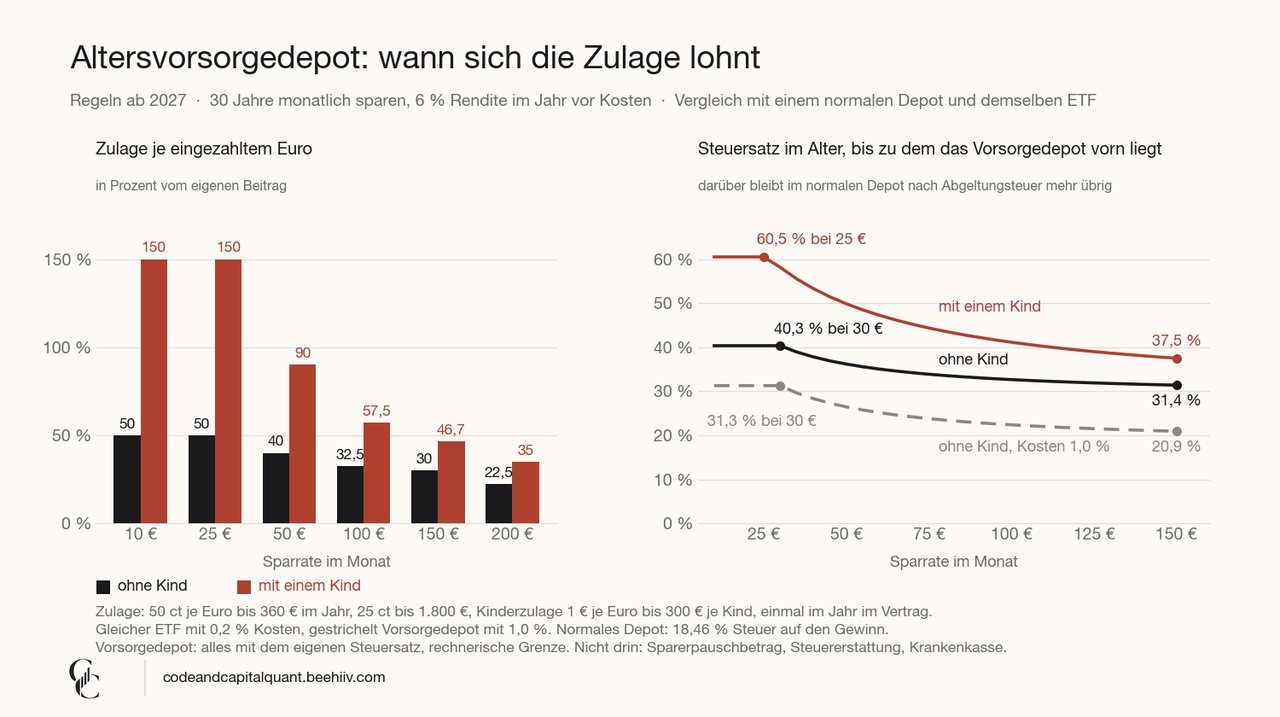
60.5 percent. That’s how high my tax rate would have to be in retirement for the retirement savings account to no longer be worth it with one child. That’s higher than the highest tax rate in Germany. We’re expecting our first child next year, so I did some research. Starting in January, the account will be available, and everywhere I look, I see the same number: a 540-euro annual allowance. That’s correct. But you don’t get the same amount for every euro, and when you retire, the tax office will want a portion of it back.
👶 Where the 60.5 percent comes from
For every child receiving child benefit, the government adds to every euro you contribute, up to 300 euros per year. On top of that, there’s the basic allowance: 50 cents per euro on the first 360 euros per year. If you contribute 25 euros a month, you pay 300 euros a year and receive an additional 450 euros. Once you reach 25 euros, the child allowance is maxed out; every euro above that only counts toward the basic allowance.
Over 30 years with 18 years of child allowance, you’ll end up with 52,958 euros in the retirement account. In a standard ETF account, the same amount of money leaves you with 20,914 euros after taxes. At 150 euros per month with a child, the limit is still 37.5 percent. Calculated with a 6 percent return before fees, using the same ETF with 0.2 percent fees in both accounts. This is a theoretical limit based on my assumptions. In reality, the payout is spread over many years, and the applicable rate depends on income in each respective year.
🤔 Why there’s a limit at all
In a regular investment account, you ultimately pay tax only on the profit—18.46 percent, including the solidarity surcharge and partial exemption for equity ETFs. With a retirement savings account, you’re taxed at your personal rate in retirement on everything derived from the subsidized contributions, including your own money and the government subsidies. At a certain tax rate, this eats up the subsidy.
Then there’s the lock-in period. The money is locked in until age 65—previously, this was only possible with a statutory pension. Anyone who wants to withdraw early must repay the subsidies and the tax benefits. When you start receiving your pension, you can withdraw a maximum of 30 percent at once, fully taxed without the one-fifth rule. The rest is paid out as a pension or through a payout plan until at least age 85. If you’re voluntarily enrolled in statutory health insurance in retirement, you generally pay health insurance premiums on these payments; pensioners covered by mandatory insurance do not.
📉 Without children, the picture is less rosy
At 30 euros per month, the limit is 40.3 percent. With 10,800 euros contributed, 25,097 euros remain under normal circumstances, and 42,074 euros are in the retirement account before taxes. At 150 euros per month, the figures are 125,486 versus 182,891 euros, and the threshold drops to 31.4 percent.
This is due to the structure of the tax credit. For up to 30 euros per month, the government matches half; from 360 to 1,800 euros per year, it matches only 25 cents per euro. At 150 euros per month, the match is still 30 percent; at 200 euros, it’s only 22.5 percent. The maximum is 540 euros; nothing more is added for amounts over 150 euros per month. The minimum must be 120 euros per year. Anyone under 25 at the time of enrollment receives a one-time bonus of 200 euros.
With a 4 or 8 percent return, little changes; at 30 euros, the threshold is 38.6 and 41.6 percent, respectively, and at 150 euros, it’s 29.3 and 32.9 percent.
💸 Costs matter more than the return
For a standard brokerage account, the effective costs are capped by law at 1.0 percent per year, including fund fees. That’s a cap—not a good price. If you pay the full amount, you’ll only reach 31.3 percent with a 30-euro investment and 20.9 percent with a 150-euro investment. Trade Republic and Scalable have announced that they will not charge account or savings plan fees for the standard account and will cover the ongoing costs for select ETFs. At Scalable, this coverage in the standard brokerage account is initially guaranteed until at least the end of 2027; over a 30-year period, that’s not much. At Union Investment, the fees range from 0.55 to 1.0 percent, depending on the product.
In 2026, the top tax rate of 42 percent will apply only to taxable income of 69,879 euros or more. Not included in this calculation are the saver’s allowance in a standard account, which lowers the threshold somewhat, and the tax refund during one’s working life, which raises it. The tax office pays the difference if the deduction for contributions yields more than the tax credit—for a single person making the full contribution, this applies starting at a marginal tax rate of about 23 percent. I didn’t factor in anything over 150 euros per month, as there’s no tax credit for that amount.
🧒 And what do the children themselves receive?
The Early Start Pension. The Bundestag approved it on October 16. From their 6th to their 18th birthday, the government will pay 10 euros per month into the child’s retirement savings account, totaling 1,440 euros. The program starts in 2027 for children born in 2020 and 2021. Parents are allowed to make additional contributions. Without a contract, the money will go into a government fund starting in 2028. Payouts will begin at age 65 at the earliest. As far as I know, the Bundesrat hasn’t approved it yet, so the law isn’t finalized.
For us, it’ll probably be the 25 euros; if we have a child over 15, the money stays freely available in the regular investment account. Are you setting up the retirement savings account, and how much are you contributing? Post your savings rate and number of children in the comments, and I’ll calculate the limit for you.
Which stock market rule should I check next? Just comment with the number:
1️⃣ The stock has doubled. Is it too late to jump on board?
2️⃣ What happens in the weeks following strong quarterly earnings
3️⃣ Holding leveraged ETFs for many years
➡️ Every Sunday, I send out my newsletter with the market barometer and the latest from Wikifolio: https://codeandcapitalquant.beehiiv.com/subscribe?utm_source=getquin
This is not investment or tax advice; do your own calculations. The rules apply starting in 2027, as of today.


