
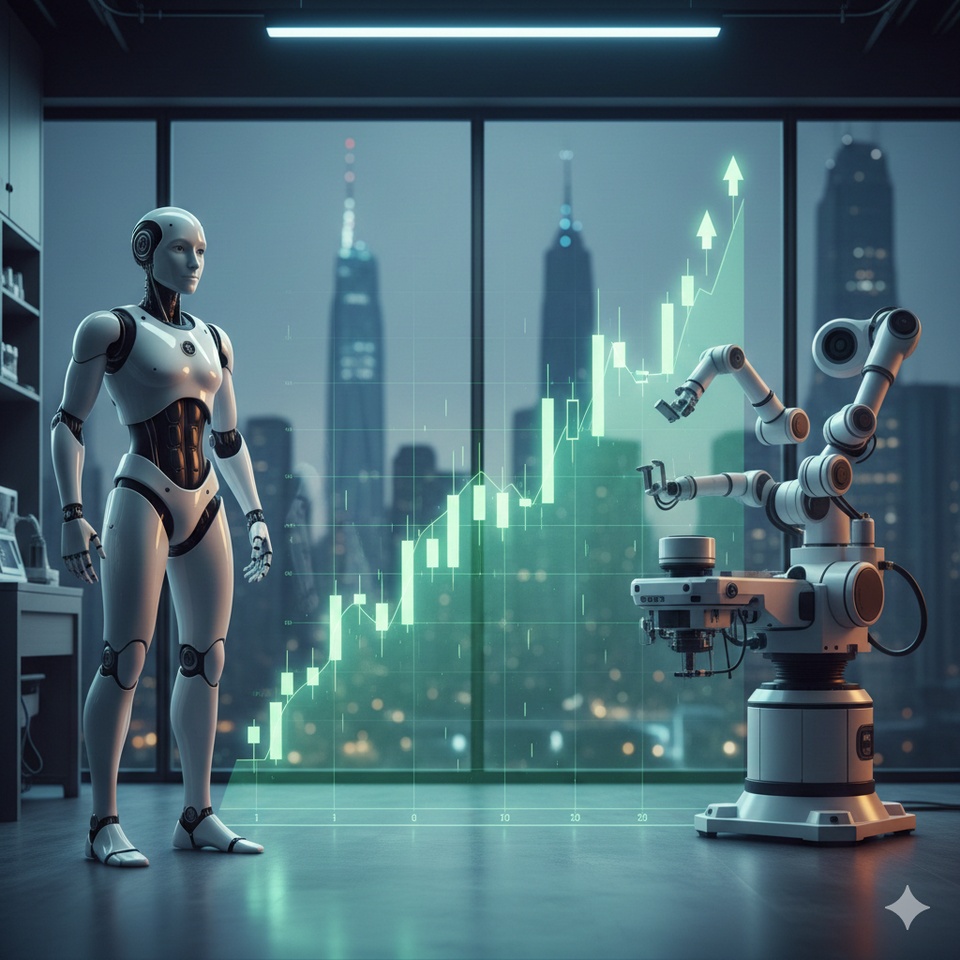
Hey getquin community! We are at a turning point in early 2026. While AI has so far mainly taken place in chatbots and image generators, the era of "physical AI" is now dawning. Robots are leaving the cages in car factories and learning to move autonomously in hospitals, warehouses and even our living rooms.
For us investors, this is a massive growth market that is expected to grow to almost USD 376 billion by 2035. But where are the real opportunities and who is just burning capital? I've taken a look at the most important players for you.
The market check: Who are the giants?
If we sort the market by market capitalization, there is no way around NVIDIA. $NVDA (+1,01%) there is no way around it. With a market capitalization of around USD 4.56 trillion, the company is the undisputed infrastructure king. Tesla follows directly behind $TSLA (+4,24%) with around USD 1.39 trillion - here you are investing less in a car company and more in the hope of the humanoid robot Optimus.
In the field of specialized robotics, Intuitive Surgical $ISRG (-2,86%) is the top dog in medical technology with USD 212 billion. Industrial heavyweights such as ABB $ABBN (+2,86%) (USD 69 billion), Rockwell Automation $ROK (+2,69%) (USD 46 billion) and Fanuc $6954 (+2,93%) (USD 38 billion) form the backbone of traditional automation. Exciting growth stories are rounded off by Symbotic $SYM (-0,13%) (USD 41 billion) and Teradyne $TER (+7,99%) (USD 34 billion) round off the field.
Valuation: Expensive hype or real growth?
The bare figures tell us a lot about expectations. NVIDIA may look expensive with a P/E ratio of 60, but the PEG ratio (ratio of P/E to earnings growth) is a sensationally low 0.51. This means that the stock is almost "cheap" for the explosive growth that NVIDIA is delivering.
The situation is completely different for Tesla. With an astronomical P/E ratio of over 300, you are buying pure dreams of the future here - the current business is nowhere near covering this price. Symbotic is also extremely ambitiously valued with a P/E ratio of 161 and a PEG of 5.37. The classics are more solid: ABB comes in at a P/E ratio of 21.5 (PEG 1.85), Rockwell at 34.8 (PEG 2.67) and Fanuc at 33.9 (PEG 2.40). Teradyne is in the golden mean with a P/E ratio of 44.3 and a PEG of 2.05.
The players in the critical spotlight
NVIDIA: The operating system of robotics
NVIDIA doesn't build its own robots, but almost everyone else does on its basis. Their moat is the Isaac software platform and the new GR00T N1.6 foundation model, which teaches robots to "think". Through partnerships such as with Hugging Face, they bind millions of developers to their ecosystem - a classic network effect. Management legend Jensen Huang has made NVIDIA an indispensable infrastructure.
Tesla: the vertical bet
Elon Musk is betting everything on Optimus. The advantage: Tesla manufactures batteries, chips and actuators itself and uses the AI data from its cars. The target is a cost of less than USD 20,000 per robot. But beware: many demonstrations are still remote-controlled, and Chinese competitors such as Unitree are already supplying real hardware, while Tesla is still struggling with fine motor skills.
Intuitive Surgical: the monopoly in the OR
With over 10,700 "da Vinci" systems installed, Intuitive Surgical has one of the strongest moats in the world. The switching costs for hospitals are enormous, as surgeons train on these systems for years. AI ensures safer operations through "force feedback". Dave Rosa leads the company with a focus on recurring revenue (75% of total revenue), which makes the model extremely stable.
The industrialists: ABB, Fanuc & Rockwell
ABB holds about 13-16.5% of the market and scores with cobots like YuMi that work directly with humans. Fanuc is the epitome of Japanese reliability with 11-18% market share. However, both are under price pressure from China. Under Blake Moret, Rockwell is fully committed to software subscriptions and US "onshoring".
Symbotic & Teradyne: The specialists
Symbotic is revolutionizing the warehouses of giants like Walmart with AI bots. Its moat is its huge order backlog, but customer concentration is a risk. Teradyne dominates more than 50% of the cobot market through its subsidiary Universal Robots and is perfectly positioned to make industrial production more flexible.
My favorite: Why NVIDIA is (still) number 1
If I have to pick a favorite, it's NVIDIA.
Why?
Asymmetric risk: It doesn't matter whether Tesla, Boston Dynamics or Unitree builds the "best" robot. Almost all of them need NVIDIA's Jetson chips and the Isaac simulation platform.
Unbeatable PEG ratio: A value of 0.51 shows that the earnings growth more than justifies the valuation.
Technological dominance: With Isaac Lab-Arena, robots can learn millions of scenarios in weeks that would take them years in the real world.
My "safe haven" tip: Intuitive Surgical is the first choice for anyone who likes things to be less volatile. An almost impregnable moat meets a highly profitable business model. I am invested here myself.
My conclusion: the robotics market in 2026 is no longer mechanical engineering, but pure tech evolution. NVIDIA is providing the shovels for the gold rush, while Symbotic and Intuitive Surgical have staked out the most lucrative claims.
What's your favorite in robotics? Let me know in the comments!
Disclaimer: No investment advice. Investments are associated with risks. Inform yourself independently.


