2G·

Investing in many growth sectors with one company

Investing in many growth sectors with one company is almost only possible in Japan.


Hello my dears,


Just before the end of the year is often the time to think about your portfolio.

To possibly carry out a rebalancing.


So I have come up with the idea of reducing a little in the semiconductor sector.

I see the biggest overlap in Tokyo Electron and ASML.

So my thought is to divest myself of Tokyo Electron.

However, as I would like to remain in Japan and in growth sectors, I have spent the last few days searching in Japan.


And I found a company that is active in several growth sectors.

Here I would also like to thank @EpsEra and @PikaPika0105 .


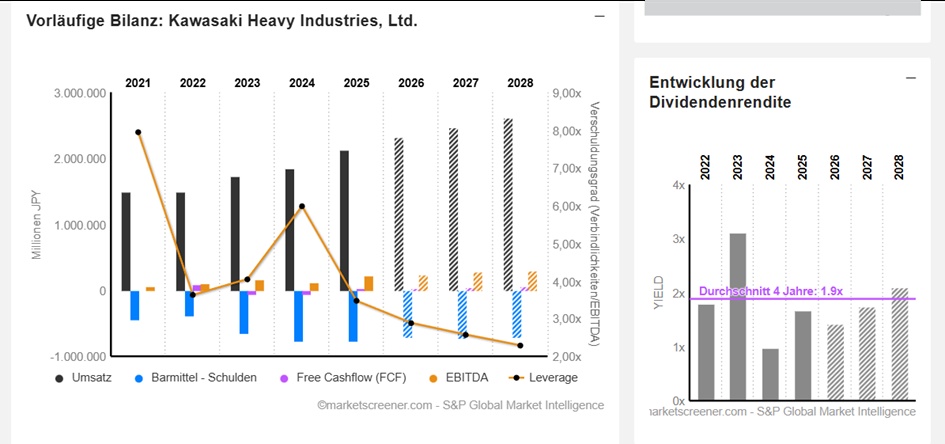
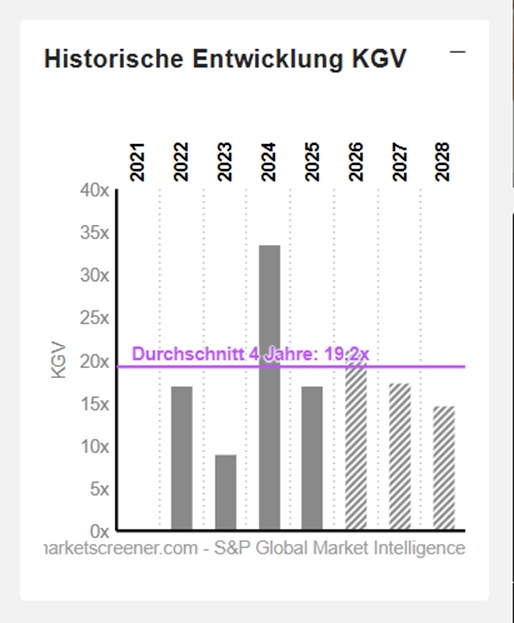
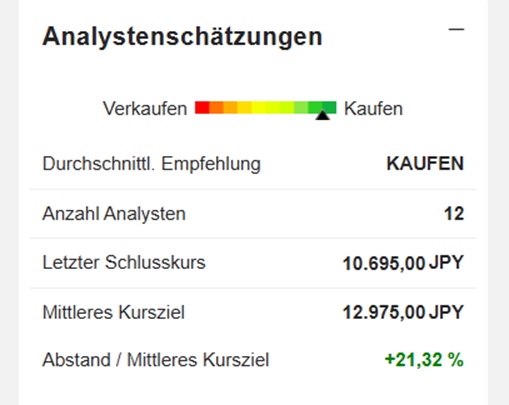
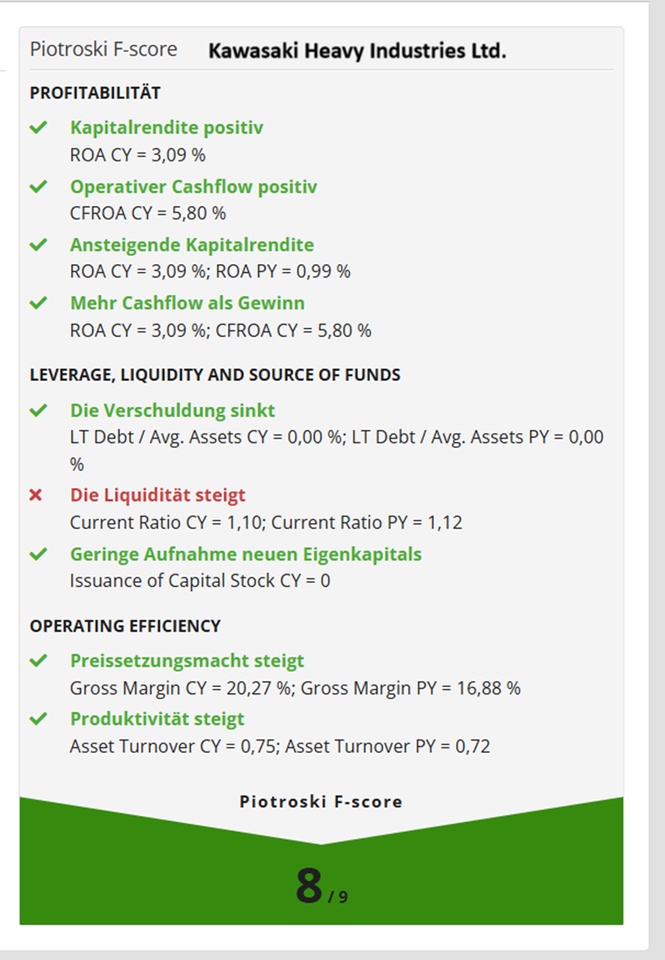
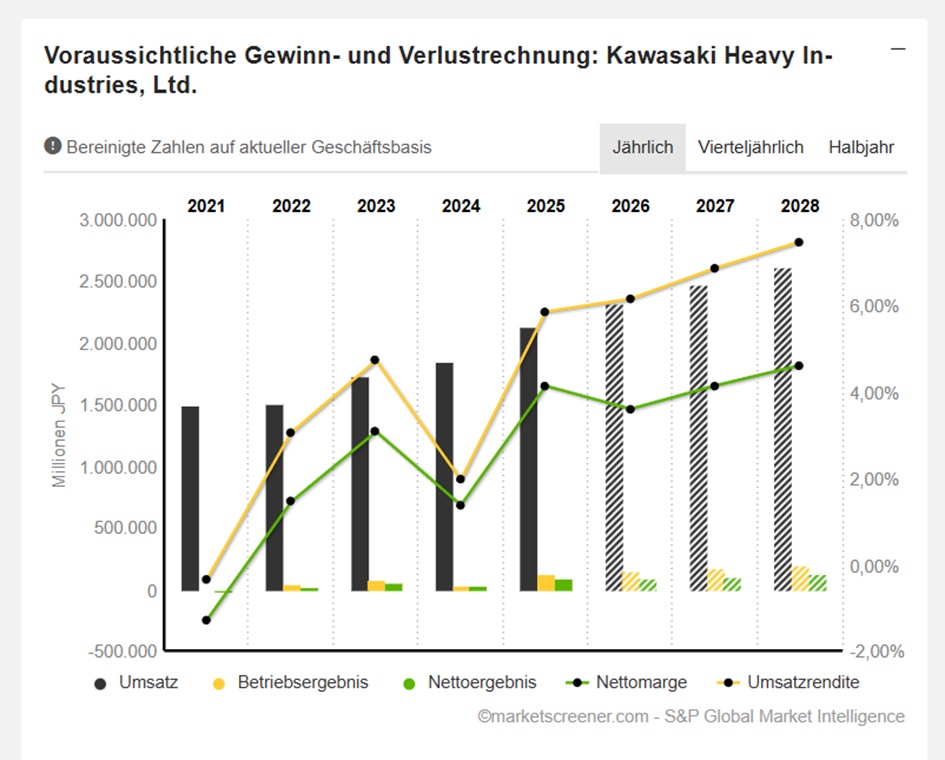
Those of you who have taken a close look at the key figures below. may now be wondering:


" What's wrong with the Tenbagger, he wants to invest in a company where next year's net result is declining, and the P/E RATIO is rising."


However, as earnings are set to rise again in double digits from 2027, I would assume that this effect will cause share prices to rise as early as next year.


Expectations instead of the present: Share prices reflect the sum of the expectations of all market participants. If investors believe that a company will grow in the future, the share price will rise today.


Dear all, do you think now is a good time to get in?

I look forward to plenty of comments.


$7012 (-2,89%)

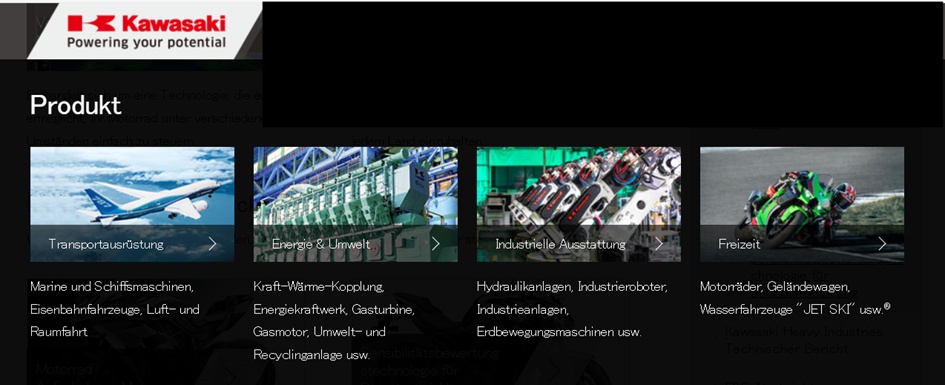
Kawasaki Heavy Industries, Ltd. specializes in the manufacture and sale of transportation and industrial machinery equipment. Net sales break down by activity as follows:

- Sales of motorcycles and engines (29.8%);

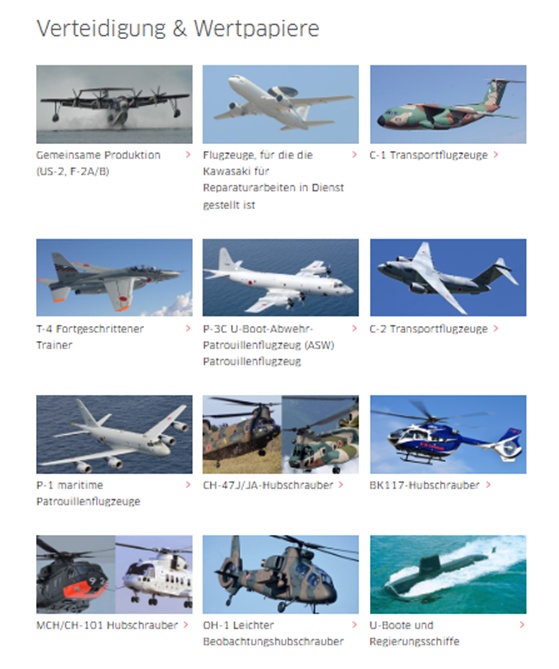
- Sales of aerospace equipment (19.9%): Aircraft, helicopters, missiles, electronic equipment, monorails, etc.;

- Sale of gas turbines (19.8%): Turbines for marine, naval and industrial applications, generators, propulsion systems, etc. The Group also develops shipbuilding (construction of ships, submarines, bulk carriers, oil tankers, etc.);

- Sales of precision machinery (16.8%): mainly hydraulic machinery. The Group is also developing an activity in the manufacture of industrial machinery (tunnel boring machines, curling machines, grinding machines, etc.);

- Sale of railroad equipment (8.4%): Train wagons, electric and diesel locomotives, monorails, etc.;

- Other (5.3%).

Number of employees: 40,640


The Kawasaki Heavy Industries Group has established the Group Vision 2030 "Responding to Trust ~Trustworthy Solutions for the Future~" as its vision for the future in 2030. The Group aims to transform its business structure into one that can grow even further with the areas it will focus on in the future: "safe and secure long-distance society", "mobility in the near future", and "energy and environmental solutions".


Hydrogen road

"The ultimate clean energy" We will open up a new future created by hydrogen, a hydrogen society.


Kawasaki Heavy Industries (KHI) is strongly committed to the hydrogen economy, particularly in transportation (e.g. Suiso Frontier liquid hydrogen tanker), power generation (hydrogen-capable gas turbines with partners such as RWE in Lingen) and logistics (partnership with Daimler Truck and HHLA for an LH2 supply chain in Europe), as well as in the development of hydrogen-powered vehicles, including a motorcycle with an H2 combustion engine and the four-legged robot Corleo. The projects aim to create a comprehensive hydrogen value chain and promote the use of hydrogen as a sustainable energy carrier.


Key projects and partnerships:


European logistics: together with Daimler Truck and HHLA, KHI is planning a European supply chain for green liquid hydrogen (LH2) via the Port of Hamburg to enable imports.

Hydrogen gas turbines: KHI is developing hydrogen-capable turbines, including a 34 MW plant for RWE in Lingen for the reconversion of green hydrogen into electricity, as well as a 1.8 MW turbine that can burn 100% H2.

Liquid hydrogen transportation: KHI built the world's first large liquid hydrogen tanker, the Suiso Frontier, which successfully shuttled between Australia and Japan.


Vehicle technology:

Motorcycle: prototypes with H2 combustion engines are based on the Ninja H2 platform and use direct injection.


Robot: The four-legged robot Corleo demonstrates bio-inspired locomotion with hydrogen propulsion.


Japanese projects: KHI is part of consortia (e.g. HySTRA, HEA) conducting hydrogen demonstrations in Japan and Australia to test the entire chain from production to utilization.


Goals:

Circular economy: create a global, sustainable hydrogen value chain.

Industrial application: Integration of hydrogen technologies into power plants and industrial processes.

Transportation: Development of hydrogen-powered vehicles for a CO2-neutral future.


https://www.daimlertruck.com/newsroom/pressemitteilung/daimler-truck-hhla-und-kawasaki-heavy-industries-starten-strategische-partnerschaft-zum-aufbau-einer-lieferkette-fuer-fluessigwasserstoff-in-europa-53246202


https://xpert.digital/kawasaki-corleo/#:~:text=Design%20und%20Konstruktion%20des%20Roboter,%E2%80%9Cberuhigenden%20Gef%C3%BChl%20der%20Einheit%E2%80%9D.


https://h2-news.de/produkte/wasserstoff-gasturbine-gewinnt-preis-fuer-h2-technologie-des-jahres/#:~:text=Auf%20der%20Connecting%20Green%20Hydrogen,mit%201%2C8%20MW%20Leistung.


Robotics

The company is one of the five largest producers of industrial robots. The largest car manufacturer Toyota relies on Kawasaki's robot roads. Cleanroom robots are also part of the product portfolio.


Kawasaki Heavy Industries Ltd. is one of the prime stocks in the robotics investment trend


Kawasaki Heavy Industries and NTT Docomo Business have signed a memorandum of understanding on strategic cooperation to create a new company through network links in the fields of robotics, mobility and social infrastructure.

Robotertechnologie & Forschung | Technologie | Kawasaki Heavy Industries Co., Ltd.


How Kawasaki robots are changing the pharmaceutical industry


Medical, pharmaceutical and biotechnology manufacturers are at the forefront of science and technology. While the potential for innovation is almost limitless, small and large companies alike face logistical, practical and regulatory hurdles. In order to keep pace and remain competitive in the long term, specially developed robots such as those from Kawasaki Robotics have become indispensable in the industry. These must meet the highest standards and certification criteria, but flexibility and reliability are playing an increasingly decisive role.

MC004V von Kawasaki Robotics - Wie Kawasaki-Roboter die Pharmaindustrie verändern - Automation.at


Ship and marine technology and research

Schiffs- und Meerestechnologie und Forschung | Technologie | Kawasaki Heavy Industries Co., Ltd.


Rail vehicle technology and research

Eisenbahnfahrzeugtechnologie und Forschung | Technologie | Kawasaki Heavy Industries Co., Ltd.


Aerospace and engine technology and research

Luft- und Raumfahrt- und Flugmotortechnologie & Forschung | Technologie | Kawasaki Heavy Industries Co., Ltd.


Energy and power generation technology and research

Technologie und Forschung von Energie- und Stromerzeugungsanlagen | Technologie | Kawasaki Heavy Industries Co., Ltd.


Plant and environmental technology and research

Pflanzen- und Umwelttechnologie & Forschung | Technologie | Kawasaki Heavy Industries Co., Ltd.


Infrastructure technology and research

Technologie und Forschung zur Infrastruktur | Technologie | Kawasaki Heavy Industries Co., Ltd.


Hydraulic systems technology and research

Hydraulikgerätetechnologie & Forschung | Technologie | Kawasaki Heavy Industries Co., Ltd.


Power Sports & Engine Technology and Research

Power Sports & Motorentechnologie & Forschung | Technologie | Kawasaki Heavy Industries Co., Ltd.


Kawasaki Heavy Industries plans to test its Japanese Tomahawk SSM in 2027.

Kawasaki Heavy Industries will conduct a test launch of its new anti-ship missile, known as the "New SSM" (Surface-to-Surface Missile), in fiscal year 2027. This announcement was confirmed by a company representative at the Tokyo International Aerospace Exhibition on October 17, 2024, highlighting the ongoing progress in Japan's defense capabilities.

Kawasaki Heavy Industries plant, sein japanisches Tomahawk SSM im Jahr 2027 zu testen


Exclusive: Kawasaki in talks to develop Taurus rocket engines, sources say

  • Summary
  • The companies signed a memorandum of understanding (MoU) on a project earlier this year, sources say
  • Latest agreement showing Japan's retreat from decades of pacifism.
  • Germany seeks parliamentary approval for Taurus modernization
  • Ukraine has repeatedly requested Taurus for use in war
Exklusiv: Kawasaki führt Gespräche zur Entwicklung von Taurus-Raketentriebwerken, sagen Quellen | Reuters

attachment

JPY in millions

estimates

Turnover

2025 2026 2027 2028

2.129.321 2.321.845 2.474.960 2.609.209

Change in

15,14 %
9,04 %
6,59 %
5,42 %


EBIT

124.574 142.772 169.767 194.956

Change in

244,19 %
14,61 %
18,91 %
14,84 %


Net result

88.001 83.545 102.474 120.291

Change in

246,77 %
-5,06 %
22,66 %
17,39 %


Net debt

756.734 708.461 716.592 702.120

Change in

-0,57 %
-6,38 %
1,15 %
-2,02 %


CAPEX

141.100 124.322 126.789 128.789

Change in

46,15 %
-11,89 %
1,98 %
1,58 %


Free cash flow

37.700 38.660 46.249 57.126

Change in

164,83 %
2,55 %
19,63 %
23,52 %


EBIT margin

5,85 % 6,15 % 6,86 % 7,47 %


ROE

13,2 % 10,99 % 12,56 % 13,42 %


Earnings per share

525,4 500,1 614,4 723,2

Change in

246,8 %
-4,83 %
22,85 %
17,72 %


P/E RATIO

17x 21.4x 17.4x 14.8x


PEG

0x -4.43x 0.8x 0.8x


Dividend per share

150 153,1 187 224,3

Yield

1,68 %
1,43 %
1,75 %
2,1 %


Market value JPY 1,495,616


Konsumgüterkonglomerate Change 3 Y P/E ratio (Y) Div. yield

KAWASAKI HEAVY INDUSTRI 266,27 % 21,39x 1,43 %


BERKSHIRE HATHAWAY INC. 62.59 % 17.87x


HITACHI, LTD 242.67 % 27.57x 0.98 %


HONEYWELL INTERNATIONA -10.25 % 19.33x 2.4 %


MITSUBISHI HEAVY INDUSTRI 675.65 % 49x 0.62 %


MITSUBISHI ELECTRIC CORP 232.19 % 25.02x 1.24 %
attachment
attachment
attachment
attachment
attachment
attachment
attachment
attachment
previw image
31
32 Commenti

immagine del profilo
Basically, I think your Japan decision is a very good one. I'm also a big fan of Japan and was invested in five or six Japanese stocks myself. In the end, I simply wanted to streamline my portfolio and therefore had to part with some stocks. Even though I still find many of them interesting.

Only $8031 and $7203 have remained in my portfolio. I have disposed of Mitsubishi, although the company remains exciting, but I see much better long-term growth opportunities in Mitsui. I have also sold SoftBank. We have already discussed the reason for this: Too much back and forth, too erratic, and the complete exit from NVIDIA was simply not a good signal for me. Kawasaki Heavy Industries was also part of my portfolio at one point, but had to make way for the same reasons.

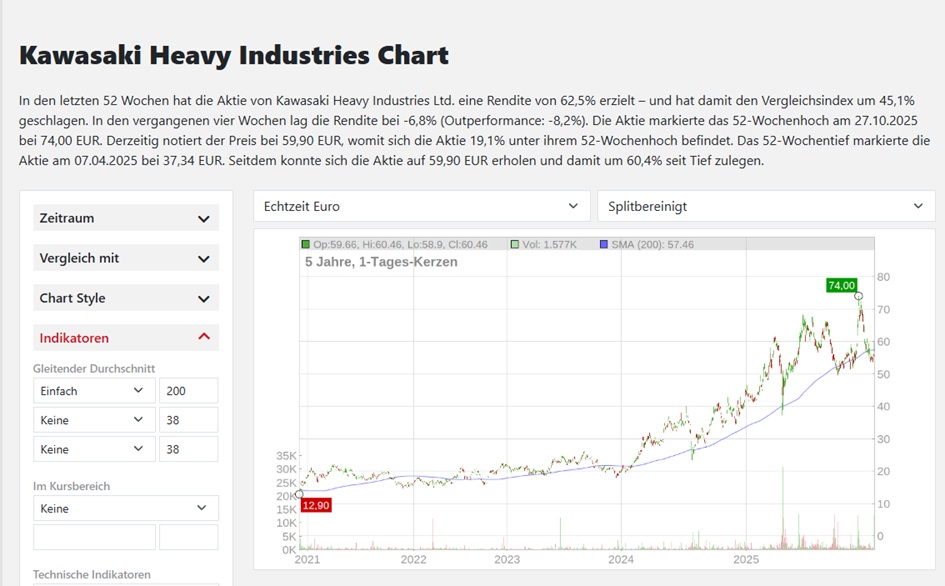
Of course, your analysis has now made Kawasaki attractive to me again. If I look at the chart, I would be interested in the EUR 60 to 55 range, precisely because the 200-day line is also moving there. These would be realistic entry zones for me if I wanted to pick up the stock again.
6
immagine del profilo
@EpsEra
Thank you my dear.
I find Kawasaki so interesting because it contains so many growth sectors. And there is also potential in the defense sector. And Taurus is also going to Europe.
Pikapika sees a lot of potential in the hydrogen project.
And you already mentioned the med tech sector.
I had just sent Kleinanleger a link to underwater technology.
You saw how much potential there is here with Kraken Robitics.
I was also interested in Fanuc, but you don't have such a broad base here.
And $5803 has run away from me and is now too expensive.
At Mitsubishi you have the Electric and the Industries share
2
immagine del profilo
@Tenbagger2024
Kawasaki remains exciting for me because the group bundles several strong growth areas in one company and much of it is classic dual-use, i.e. relevant for both civil and military applications. The underwater technologies also show how broadly Kawasaki is positioned technologically and what potential is still emerging there. The hydrogen project, including electrolyzers, also fits into the picture, especially as I see opportunities even in smaller stocks such as Plug Power and ITM Power. Overall, Kawasaki combines mechanical engineering, energy, robotics and defense in a way that is rarely found. It is precisely this combination that makes it attractive in the long term.
2
immagine del profilo
It would be good if you could go into the hydrogen strategy in more than one sentence, as this offers the greatest long-term growth potential. You are the only globally relevant player in this area.
2
immagine del profilo
@PikaPika0105
@PikaPika0105
You are right. I think I added a link. I have just sent @Klein-Anleger1 a link to underwater technology. Also a very exciting area
1
immagine del profilo
@PikaPika0105
I have added something about hydrogen.
Thanks for the great tip
1
I see that as the main problem. The future will simply not be a future with hydrogen. Not with the development on the battery market. It's simply physics and the loss of efficiency...
immagine del profilo
@Keineui Can you justify that? Nobody is talking about cars or anything like that......
@PikaPika0105 I'm not talking about cars either. But in general, I think hydrogen will only find a niche where there is no other option. Everything else can be solved with batteries. Hydrogen has never become the hype it was advertised as. Quite simply because there is a huge loss of efficiency during production and then combustion. And therefore there is no technical reason to rely on hydrogen, with some exceptions. So when I read that a company is fully committed to it, my alarm bells start ringing.
immagine del profilo
@Keineui
Production is also expensive due to high electricity prices. In the end, white hydrogen, which should ultimately be produced more cheaply using renewable energy, could be sustainable. And help companies in energy-intensive sectors, such as steel production, to achieve a better CO2 balance.
I think with increasing global warming and the end of the Trump policy, climate change will also come back into focus.
And therefore also hydrogen.
I can also see a future for trucks, airplanes and ships.
As it is only a sub-sector for Kawasaki, I see the risk as rather low in contrast to pure hydrogen players.
In addition, they are already earning money with hydrogen.
immagine del profilo
@Keineui @Tenbagger2024 Kawasaki's hydrogen division is currently at the crucial threshold between technical validation and commercial ramp-up - the moment when the final investment decisions (FID) for industrial scaling have to be made. While the technical feasibility of transporting liquid hydrogen at -253 °C has been successfully demonstrated by the "Suiso Frontier" pilot project, KHI is now working on the development of commercial super tankers. The technological leap is huge: the transport capacity will be scaled from 1,250 m³ to 160,000 m³ per ship - an increase by a factor of 128. In order to cover the immense capital costs of this infrastructure and to be able to deliver immediately, the start-up phase is based on "blue hydrogen" from Australian brown coal in combination with CCS (carbon capture and storage) technology out of pure economic pragmatism. This is necessary because purely green electrolysis projects are currently unable to deliver competitive prices and volumes for heavy industry.

The market potential is not based on ecological idealism, but on hard industrial necessities, which is reflected in massive growth forecasts. The International Energy Agency (IEA) forecasts an increase in global demand for hydrogen from around 95 million tons today to between 150 and 430 million tons by 2050, while Goldman Sachs estimates a global investment requirement of 5 to 11 trillion dollars in infrastructure. This means specifically for Kawasaki's core market of Japan: Import demand is expected to rise from around 3 million tons in 2030 to 20 million tons in 2050. In order to cope with this volume, a fleet of around 80 to 100 of these super tankers would be required by the middle of the century - a multi-billion order volume for the shipyards alone, flanked by the maintenance and construction of the unloading terminals.

Demand is concentrated exclusively on the "indispensable" sectors in which hydrogen is unrivaled. The dream of hydrogen cars no longer plays a role for KHI. Instead, the company is addressing the decarbonization of steel production, the chemical industry (ammonia for fertilizers) and, above all, the base load electricity supply. Battery technology is not a threat here, but a physically necessary addition. Due to their efficiency, batteries dominate short-distance transportation and daily storage, but fail due to their energy density and the costs for long-term applications. A battery cannot power a container ship across the Pacific, nor can it secure the energy supply of an industrialized nation like Japan over a two-week "dark doldrums" in winter. In this segment of seasonal energy storage and intercontinental energy transportation, hydrogen has a natural monopoly that KHI serves.

Politically and geopolitically, this market is secured by the Japanese state as a "market maker". As Japan has no significant resources of its own, importing hydrogen is a matter of national security in order to end its dependence on oil and gas imports from the unstable Middle East and replace them with an alliance with politically stable Australia. In order to achieve this goal, the Japanese government has launched the "GX Economic Transition Bond" with a volume of 20 trillion yen (approx. 130 billion euros). The central instrument is the Contract for Difference (CfD), under which the state assumes the price risk between expensive hydrogen and cheap fossil fuels for 15 years. This state guarantee makes the projects financially viable for investors.

However, the true economic potential for KHI lies beyond the Australia-Japan route in global scaling. This first maritime pipeline serves as a "proof of concept". Once the technology is established, KHI will have the blueprint for the global market, as other industrialized nations with few raw materials, such as South Korea or Germany, are also dependent on imports. Kawasaki's strategic goal is to cement its own LH2 tank and insulation technology as the global standard. If this succeeds, the company will transform itself from a pure shipbuilder into a technological monopolist that - similar to the French GTT in the LNG market today - generates license income worldwide as soon as liquid hydrogen is shipped anywhere in the world.
1
immagine del profilo
@PikaPika0105 Don't be surprised, I had AI write the text based on some of my research. It was just too much for me to write....
immagine del profilo
@PikaPika0105
There will probably be a rate hike in Japan on December 19. I think that could put further downward pressure.
Perhaps it would make sense to wait with an entry. ??
immagine del profilo
@Tenbagger2024 I'm already invested and have a savings plan. You'll never find the perfect entry point anyway, you should take a long-term view.
1
immagine del profilo
Thanks for the great preparation (as always)! 🙌
1
immagine del profilo
@ehrlichergauner
I'm glad if you like it
immagine del profilo
Thanks for the analysis after the teaser last days already 😉
1
1
immagine del profilo
Thank you for sharing ✌️
immagine del profilo
@Klein-Anleger1
Oh thank you, dear. You make me very happy.
I would be interested to hear your opinion on the company.
1
immagine del profilo
@Tenbagger2024 I think it makes sense to invest now, as you say, because next year the profit expectations for the year after next will probably be priced in. However, as my portfolio target is 20-25% PA and I have limited my maximum stock selection to seven, I will probably have to abstain 🙈🥲 -> In itself, I find the company very exciting and solidly positioned...
But I'm still waiting for the presentation of the new growth stock that you once hinted at 🤫😁 I think you meant something along the lines of $PNG sector, right? Maybe $OII? 😅🫥
immagine del profilo
@Klein-Anleger1
Yes exactly, I looked at that once.
But also have a look at Kawasaki.
Kawasaki is involved in underwater technology through its shipyard (ships, submarines), precision machinery (hydraulics for marine applications) and autonomous underwater vehicles (AUVs) such as the "SPICE" for pipeline inspection; the brand also develops hydrogen engines for small vehicles and, of course, produces the well-known jet ski water sports vehicles, which also represent water technology.
Automated underwater vehicles (AUVs): The "SPICE" is an autonomous vehicle with a robotic arm for inspecting pipelines at great depths without the need for human divers.
Marine hydraulics: Kawasaki Precision Machinery supplies robust hydraulic components and machines for use in extreme conditions at sea.
https://global.kawasaki.com/en/corp/newsroom/news/detail/?f=20210518_2075#:~:text=Subsea%20Pipeline%20Inspections-,Kawasaki%20Receives%20Order%20for%20SPICE%2C%20World's%20First%20AUV%20with,Arm%20for%20Subsea%20Pipeline%20Inspections&text=Kawasaki%20has%20undertaken%20research%20and,and%20features%20are%20as%20follows.
So maybe something for you after all
1
immagine del profilo
@Tenbagger2024 interesting 🧐 I associated Kawasaki more with motorcycles and jet skies and such 🙈 I'll have a look later at my leisure...
immagine del profilo
2
immagine del profilo
@Tenbagger2024 I don't think I'll be visiting Kobe in the next few days 😂😉
1
immagine del profilo
@TradingHase
Would be something for the bunny kids
immagine del profilo
Thank you for the presentation, very exciting. I'll definitely take a closer look at Kawasaki - the mix of industry, aviation and engine technology is broader than many people think at first.

My wife vetoed the Kawasaki Ninja back then - maybe at least the shares will work out one day. Operationally, the company looks quite solid in view of the global demand for industrial and aerospace equipment, even if the valuation does not necessarily call for an obvious undervaluation. Nevertheless, it could be interesting for a long-term mechanical engineering case if the margins remain stable and the cyclical dependency is managed properly.
immagine del profilo
@Liebesspieler
I still see some room for improvement in the margins.
@PikaPika0105 had just written an important addition. In which he once again emphasizes the hydrogen project
in which he sees great potential.
Could also be a reason for the fall in profits. Because there also needs to be good investment
immagine del profilo
@Tenbagger2024 Thank you, I agree with you. Margins still have room for improvement and the hydrogen segment is strategically exciting - high start-up costs, but long-term potential. If the scaling is successful, this could support cash flow and valuation in the medium term. I haven't done enough work on hydrogen myself to form a well-founded opinion on the technology, so I'm still taking a closer look at it.
1
immagine del profilo
@Liebesspieler
I see a big advantage here in that the risk is significantly lower compared to a pure hydrogen share. The problem with pure hydrogen players is usually the lack of cash flow.
That's why Kawasaki is very interesting for me as a hydrogen player
2
immagine del profilo
I already had this company on my watchlist before the reverse split (1:10!! in 2017). This corporate action finally put me off buying at the time. I find it far too uncertain for a long-term investment
immagine del profilo
@7Trader
Where do you see uncertainties?
Partecipa alla conversazione