11H·

For the 2036 portfolio, Ciena is much more than just a data center stock. So, who among you is up for the challenge?

Hello, everyone,

Given Celestica’s strong results, I took another look at Ciena yesterday.


Here’s my idea: to add Ciena to my 2036 portfolio as well, to set myself a little challenge.


$CLS (-2,35 %) It’s $CIEN (+3,94 %)


Celestica vs. Ciena: whichever stock performs better over the next 6 months gets to stay in the portfolio.


What do you think of this challenge?


For the 2036 portfolio, Ciena is much more than just a data center stock.

  • 🏢 AI data centers: High-speed connections between AI servers and data centers.
  • 🤖 Second wave of AI: As the use of AI applications and inference grows, so does the demand for high-performance networks. Ciena provides the optical networking technology to support this.
  • 🌐 Future-oriented industries: Fiber-optic networks, submarine cables, telecommunications, cloud infrastructure, and, in the future, networked physical AI systems and robotics.
  • 🚀 Growth potential: Ciena is expanding its addressable market beyond traditional telecommunications networks into data center infrastructure.


My Assessment for the 2036 Portfolio

Ciena is an interesting candidate for the second wave of AI. The company benefits not only from the development of AI infrastructure but also from the fact that AI will be used more and more in everyday life and in businesses in the future.


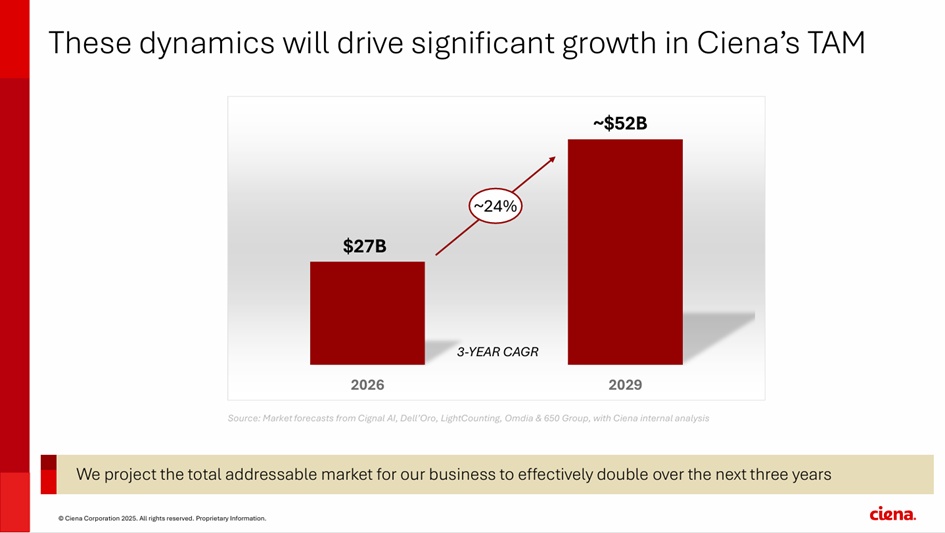
Ciena: 30% annual revenue growth through 2029! Ciena is delivering high-speed connectivity for the global AI era!


What exactly does the company do, and why is it doing so well?


$CIEN (+3,94 %)

Ciena Corporation is a network systems, software, and services company that provides hardware, software, and services to a range of network operators, enabling improved network capacity, service delivery, and automation. Its segments include Network Platforms, Platform Software and Services, Blue Planet Automation Software and Services, and Global Services. The Network Platforms segment consists of the Optical Networking and Routing and Switching portfolios. Platform Software and Services provide domain control management, analytics, data, and planning tools and applications to help customers manage their networks. Blue Planet Automation Software and Services encompasses asset management (BPI), multi-domain service orchestration, multi-cloud orchestration, route optimization and analysis (ROA), and Unified Assurance and Analytics (UAA). The Global Services segment offers a range of value-added services that help customers build, operate, and improve their networks.

Number of employees: 8,989


AI and Data Center Connectivity Demand

Ciena is benefiting from rising demand for network connectivity driven by AI and investments in data center infrastructure. During the most recent earnings call, management explained that AI is driving significant increases in bandwidth requirements and network traffic, making high-speed, low-latency optical connectivity between networks and data centers increasingly critical. This demand encompasses traditional WAN, AI-WAN, and data center connectivity, including data center interconnects and intra-data center connections.

As AI workloads require higher data rates, bandwidth, capacity, and density, Ciena is seeing rising demand for its optical and interconnect solutions. The WaveLogic 5 Nano platform continues to see strong adoption, while 800ZR shipments more than doubled sequentially in the third fiscal quarter. The company also reported strong interest in its Nitro active copper cable retainer and received sample orders for Vesta, its open, co-packaged optical solution. Revenue from direct cloud providers rose 80% year-over-year in the third fiscal quarter, while revenue from data centers and related businesses quadrupled year-to-date.


Strong Optical Technology Portfolio

Ciena benefits from its leadership position in optical technology, supported by targeted research and development, deep expertise, and proven large-scale deployments. The company highlighted the strong adoption of its WaveLogic 6 Extreme platform, which remains the only 1.6-terabit high-performance modem on the market and whose ramp-up exceeds that of the previous WaveLogic 5e generation. Ciena’s RLS portfolio also remains a key growth driver, with approximately 70% market share in disaggregated optical transport systems.


In addition, the company’s Hyper-Rail technology—developed in collaboration with hyperscalers to support AI training in data centers—is expected to be standardized by the end of 2026 and to generate material revenue growth by 2027. Ciena also achieved a significant hyperscaler win for its WaveLogic 6e coherent technology, with customer commitments extended through 2029 and orders and backlog supporting growth into fiscal year 2028.


For the fourth quarter of fiscal year 2026, Ciena expects revenue of $1.75 billion (+/- $50 million). The company raised its revenue forecast for fiscal year 2026 to $6.42 billion (+/- $50 million), indicating 35% year-over-year growth at mid-year. For fiscal year 2027, management’s previous guidance points to revenue growth of at least 30%, an adjusted gross margin of 45–46%, and an adjusted operating margin of 25–27%.


Improved Margins and Operating Leverage

Ciena is also benefiting from improved profitability. The adjusted gross margin in the third fiscal quarter reached 46.4%, supported by cost execution, a favorable product mix, and pricing discipline, while the adjusted operating margin rose to a record-breaking 22.5%. In the latest earnings call, management stated that the gross margin is now in the range of approximately 40% and expects the cost structure and portfolio to support further expansion.


For the fourth quarter of fiscal year 2027, the adjusted gross margin is forecast at 45% (+/- 50 basis points). The adjusted operating margin is forecast at 20% (+/- 50 basis points). Ciena expects an adjusted operating margin of 25% to 27% for fiscal year 2027, with growth in the optical systems and plug businesses continuing to support operating leverage. The company also expects Hyper-Rail’s profitability to benefit as the technology matures, while RLS’s gross margins have improved over the past two to three years and are approaching the company average.


Supply constraints remain a hurdle

CIEN is grappling with supply constraints as demand continues to exceed available capacity. In its most recent earnings call, the company highlighted that its backlog is expected to exceed $10 billion by the end of fiscal year 2026, with the majority of the backlog consisting of customer orders scheduled for 2027. Management noted that revenue for fiscal year 2027 could be higher if more supply were available and expects the imbalance between supply and demand to persist into 2028. Ciena is addressing this constraint by securing long-term agreements for key components through 2029, expanding additional capacity, and continuing to make investments to strengthen its supply base. The company also expects that its capital expenditures in the fourth fiscal quarter will put pressure on operating cash flow as the expenditures are incurred.


CIEN Valuation

CIEN is trading at a 12-month price-to-earnings (P/E) ratio of 43.93x, which is above the industry average of 40.13x. $CSCO (+1,7 %) , $GLW (-1,49 %) and $ANET (+5,24 %) trade at forward 12-month P/E ratios of 26.29x, 41.66x, and 48.75x, respectively.


Ciena Corporation – Ciena gibt finanzielle Ziele für das Geschäftsjahr 2029 bekannt
attachment


External PPT template


Bernstein analyst Daniel Zhu has initiated coverage of CIENA Corp. (ISIN: US1717793095, WKN: A0LDA7, ticker symbol: CIE1, NYSE symbol: CIEN) with an “outperform” rating and a price target of $440.

October 5, 2026


Rallye bei Optik-Aktien: Evercore ISI nennt drei zentrale Treiber für Kursgewinne


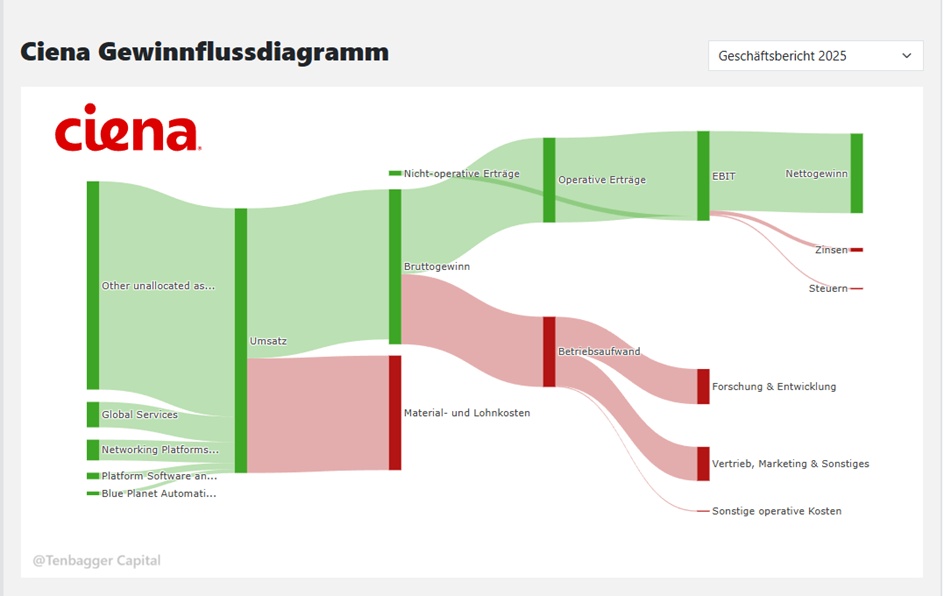
Revenue Breakdown by Business Segment:

2025 (USD)

Networking Platforms 3.68 billion

Global Services 614 million

Platform Software and Services 364 million

Blue Planet Automation Software 116 million


Geographic Revenue Breakdown:

2025 (USD)

United States 3.4 billion

Europe, Middle East, and Africa (EMEA) 732 million

Asia Pacific (APAC) 431 million

Americas (Excluding the U.S.) 206 million
attachment


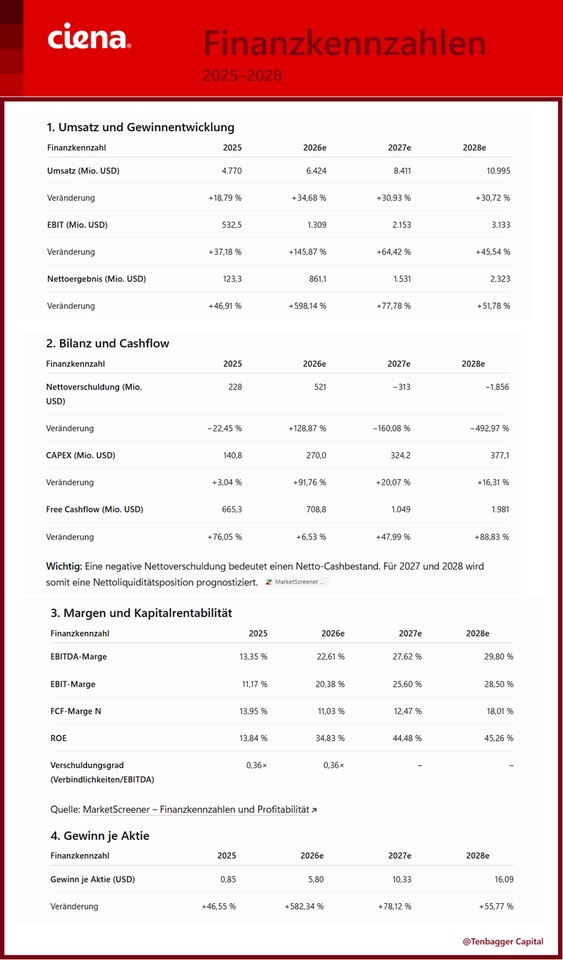
Important Notes

  • Fiscal year-end: October.
  • 2025 = fiscal year 2025; 2026–2028 = forecasts.
  • Amounts in millions of USD, earnings per share in USD.
  • Thousands are separated by periods.
  • Margins and debt-to-equity ratios are sourced exclusively from MarketScreener.
  • Publication date: December 11, 2025


Note on the data source: The rates of change correspond to the figures provided by MarketScreener. Forecasts may change based on new analyst estimates. The key figures from the specified sources may differ in methodology.
attachment


My brief assessment of the 2036 portfolio

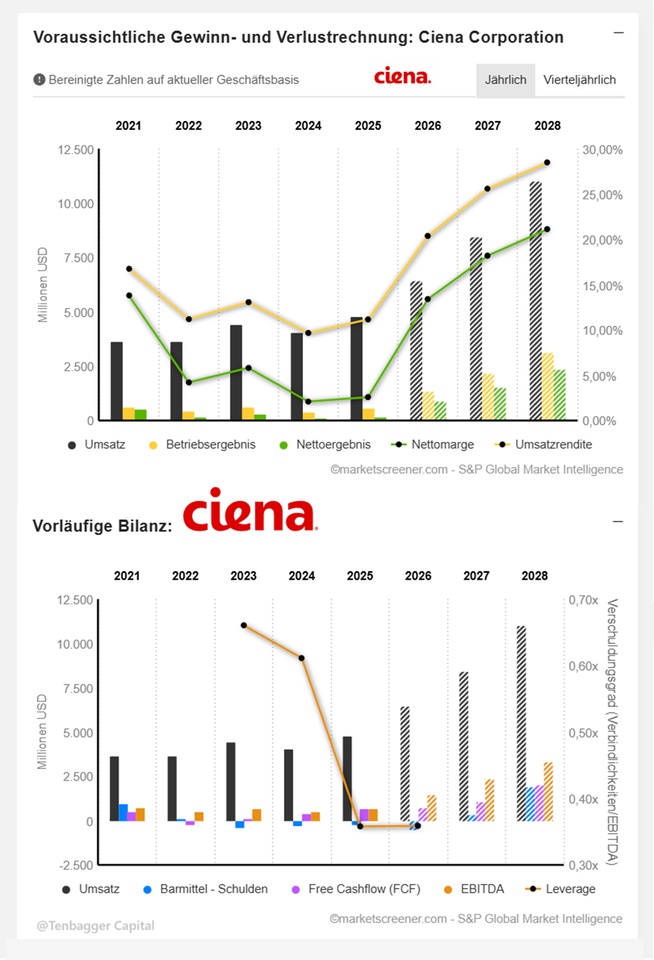
Ciena shows an exceptionally strong operational acceleration in these forecasts.

  • Revenue: rises from $4.77 billion to just under $11 billion.
  • EBIT margin: improves from 11.17% to 28.50%.
  • Free cash flow: is expected to increase from $665 million to nearly $2 billion.
  • Balance Sheet: A net cash position is expected starting in 2027.

This would represent a combination of strong growth, rising profitability, and increasing financial strength.

My Conclusion: Fundamentally, Ciena is thus an interesting candidate for the Portfolio 2036 strategy and the second wave of AI. The key question remains whether the high growth expectations are already priced into the stock.
attachment
attachment


Brief Assessment for the 2036 Portfolio

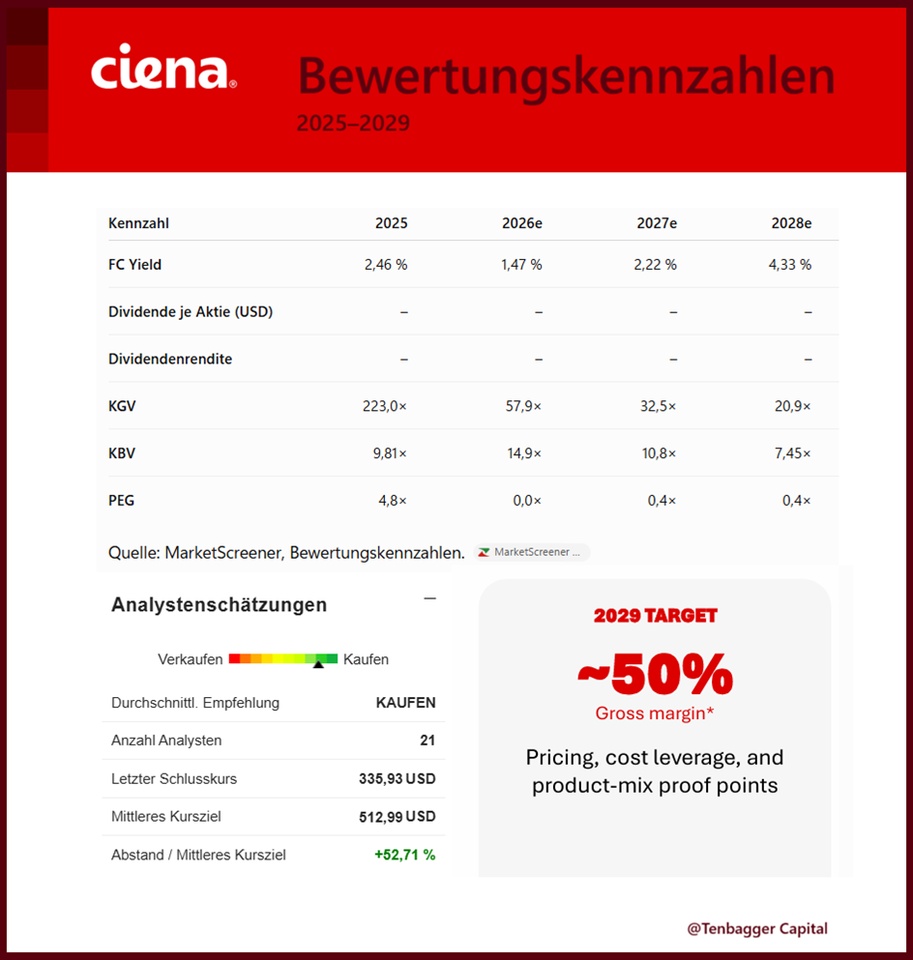
  • P/E ratio: According to forecasts, it will drop from 223 to 20.9. However, this assumes that Ciena actually achieves the expected profit growth.
  • Free Cash Flow Yield: Rises to 4.33% by 2028. That would represent a significant improvement in the cash flow yield.
  • P/B ratio: Will decline starting in 2026. Nevertheless, the valuation remains heavily dependent on expected growth.
  • Dividend: MarketScreener does not report a dividend for the years shown.

My Conclusion: Ciena is an interesting infrastructure stock for the second wave of AI. The forecasts indicate a potential significant easing of valuation pressure driven by earnings growth. For my Portfolio 2036 strategy, however, the key factor would be whether this growth meets the already high expectations of today.


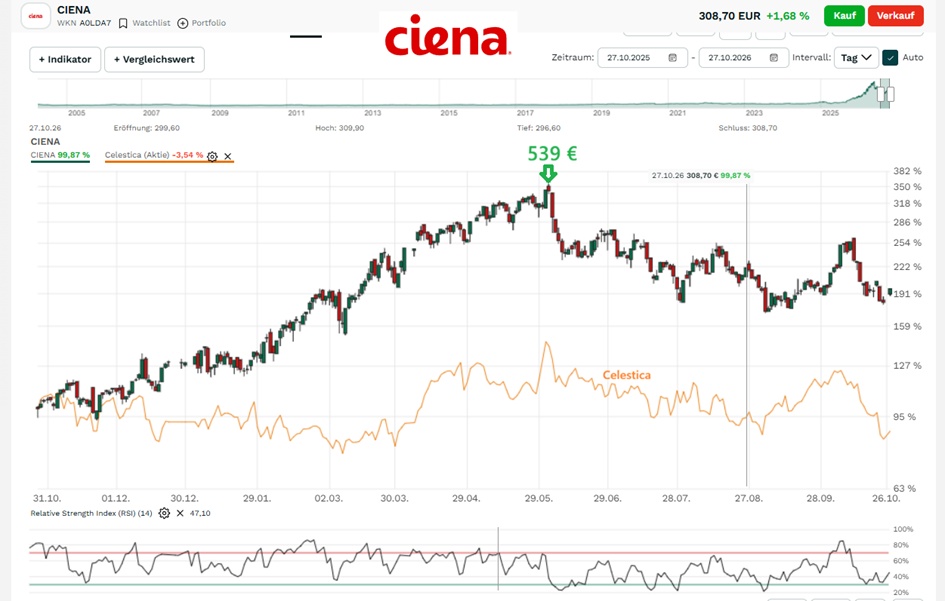
Comparison with Celestica:
attachment


$CIEN (+3,94 %)

314.90 EUR

27.10, 2026 at 7:25 PM

351.08 USD

11
7 Commentaires

image de profil
Is this your replacement for $INOD? :)
•
1
•
image de profil
@1Chrischi1 Not necessarily—check it out on Thursday at $NOW
•
2
•
image de profil
@Tenbagger-Capital Oh man, do you think it's going to go south, haha?
••
image de profil
@Sebbster That would be nice. Maybe "Sell Good News"
••
image de profil
@Tenbagger-Capital I could definitely see a pullback happening. It's gotten a little overheated/overbought in the short term.
••
image de profil
I'd be on the " $CIEN " team here 👀
•
1
•
image de profil
Hey @Tenbagger-Capital! ✌️

Mika and I reviewed your Ciena presentation against the company’s press releases, presentations, and earnings call.

**Ciena is an exciting company. However, your presentation has a few spots where the timeline gets off track, the adjustments disappear, and a long-term investment idea suddenly turns into “Germany’s Search for the Six-Month Winner.”** 😏

Let’s walk through this step by step.

**1. Business performance is actually strong. It doesn’t need any hype.**

Ciena delivered in the third quarter of FY26:

Ciena actually delivered in the third quarter of FY26: **$1.671 billion in revenue, up 37% year-over-year.**
The adjusted gross margin reached **46.4%**, and the adjusted operating margin **22.5%**.
Adjusted earnings per share were **$2.11**; under U.S. GAAP, **$1.83** was reported.

These are strong numbers and a genuine operational improvement. **So the company doesn’t need any extra hype. Clearly labeled key figures are more than enough.** 😉

This is a genuine operational improvement. Even under U.S. GAAP, Ciena is now quite profitable: The operating margin was **18%**. It would therefore be just as wrong to downplay this progress as it would be to throw all the earnings metrics into a blender without any labels.

**The company is delivering. Now the presentation just needs to pass the same quality control.**


**2. Your “30% annual revenue growth through 2029” needs a crucial clarification.**

The figure is actually an **official company target**, not some analyst’s wild fantasy.

On **September 16, 2026**, Ciena published the following targets for FY29:

- Approximately **30% average annual revenue growth from FY26 to FY29**.
- Approximately **50% adjusted gross margin**.
- **32–35% adjusted operating margin**.
- Approximately **20% free cash flow margin**.

The key word here is **average**. A CAGR describes the trend between the starting and ending values. It does not guarantee a consistent 30% in every single fiscal year.

Based on the FY26 revenue outlook of $6.42 billion, this would mathematically result in approximately **$14.1 billion in revenue for FY29** if this target is met.

**That’s ambitious. But it’s a target, not an invoice already issued to customers.**

Your use of “should,” “could,” and “if” is therefore entirely appropriate in several places. The headline should reflect the same caution as the fine print below it.


**3. Your text is off regarding the fiscal year.**

You mention an **adjusted gross margin of approximately 45% and an adjusted operating margin of 20%** for **Q4 FY27**.

According to Ciena’s presentation, these figures pertain to **Q4 FY26**.

In contrast, the initial outlook for the **entire FY27**, published in September, stated:

For **Q4 FY26**, Ciena expects revenue of **$1.75 billion, with a range of ±$50 million**. The adjusted gross margin is expected to be **45%**, and the adjusted operating margin **20%**—each with a range of **±0.5 percentage points**.

The preliminary outlook for the **entire FY27**, on the other hand, calls for **at least 30% revenue growth**, an adjusted gross margin of **45–46%**, and an adjusted operating margin of **25–27%**.

These are different time periods with different statements.

The **35% growth** in the FY26 outlook also refers to the **midpoint of the forecast range**. Your phrasing “mid-year” is incorrect here.

**Before we plan the portfolio through 2036, we should at least place Q4 2026 in the correct spot on the calendar.**


**4. The 11.17% EBIT margin for FY25 also includes an adjustment.**

You describe a margin improvement from **11.17% to 28.50%**.

The starting figure roughly corresponds to Ciena’s **adjusted operating margin of 11.2% for FY25**. By contrast, the reported operating margin under U.S. GAAP for the same fiscal year was **4.1%**. For earnings per share, **$0.85 under U.S. GAAP** stood alongside **$2.64 on an adjusted basis**.

Adjusted metrics can be useful. However, they must be consistently labeled as such. And the projected 28.5% needs to be based on the same definition of profit for the comparison to be meaningful at all.

**“EBIT” and “adjusted EBIT” differ by more than just a decorative adjective. There can be quite real costs involved.**

In addition, the **46.4% adjusted gross margin in Q3** included a positive one-time effect from customs refunds of approximately **0.7 percentage points**. Without this effect, the figure would have been around **45.7%**—still strong, but slightly less so. Management explicitly described the effect as non-recurring.

**Anyone celebrating the record margin is welcome to factor in the one-time effect.**


**5. When it comes to cash flow, the growth story is where the real test lies.**

Free cash flow in Q3 FY26 totaled **$116 million**, compared to **$135 million in the same quarter last year**. This represents a decline of about **14%**, while revenue and adjusted earnings rose sharply.

This does not refute the investment thesis. Growth requires additional inventory, capacity, and capital. But that is precisely why it’s not enough to just look at rising earnings estimates.

I would examine how reliably Ciena converts this additional profitability into available cash in the future.

Even your **4.33% FCF yield for 2028** does not automatically mean that the stock was bought at a bargain price at that time. The figure depends on both the estimated cash flow and the market capitalization used.

**If the cash flow has yet to be generated, the yield is, for now, merely an expectation with a percentage sign.**

On the positive side: The company has published its own FCF margin target for FY29. Your specific MarketScreener figures for previous years remain separate analyst estimates.


**6. The most important risk can be summed up in a single number: 41.7%.**

That’s how much revenue in Q3 FY26 came from **just two customers**.

Ciena thus has strong customer relationships, but also a significant dependence on their investment decisions.

Your list—telecommunications, cloud, submarine cables, robotics, and physical AI—sounds remarkably broad. However, this does not translate into a correspondingly broad distribution of current revenue.

**Many buzzwords on the slide are no substitute for a large number of independent customers on the books.**

The same applies to the order backlog: The **$8.5 billion at the end of Q3** and management’s expectation of **more than $10 billion by the end of FY26** are strong signals of demand. However, they are neither revenue already realized nor cash flow already received. Delivery capability and timely execution remain crucial.

**A full order book is excellent. Nevertheless, payment is made only in accordance with the respective contract terms.**


**7. The technology story is fundamentally sound—but please distinguish between the future and the present.**

Ciena is indeed more than just a single data center supplier. The company serves traditional wide-area networks, connections between data centers, and, increasingly, connections within data centers.

Your comments on 800ZR, Nitro, Vesta, and Hyper-Rail are also generally reflected in the management report.

However: **Pilot orders for Vesta do not yet constitute an established production business.** The revenue ramp-up described in September was not expected to begin until 2027, with further scaling in 2028. The approximate **70% market share** refers to the defined business with disaggregated optical line systems and is a management estimate.

Fortunately, you’ve qualified this market share figure. The rest of the presentation needs exactly this level of precision.

When it comes to robotics and physical AI, however, I would refer to them as potential additional sources of demand. Without specifics on revenue contribution and scale, this remains a future hypothesis.

**One robot sold does not, in itself, turn an analysis of a network equipment provider into an additional revenue stream.**


**8. Evercore provides an explanation for the sector rally. It is not an official buy recommendation.**

The linked article cites three possible drivers:

- Expected U.S. restrictions on certain foreign optical transceivers.
- Reports of difficulties in expanding indium phosphide capacity.
- Renewed confidence in AI capital expenditures.

The first point in the article is an **expectation of a potential regulatory development**. The second also describes a supply issue. Evercore itself points out that restrictions could slow the expansion of AI infrastructure.

My conclusion from this: Western suppliers could gain market share or pricing power. At the same time, component shortages can drive up costs and delay shipments.

**“The competition is running into problems” unfortunately does not automatically mean “Ciena will have more components available tomorrow.”**


**9. Your challenge fits the “Portfolio 2036” timeframe about as well as an egg timer fits building a house.**

“Celestica vs. Ciena—whichever has performed better after six months gets to stay.”

As a public stock market game, this can be entertaining. But as the sole selection criterion for a long-term portfolio, it doesn’t convince me.

You’d be determining which stock had the better price performance during that period. Whether it subsequently offers the more attractive balance of valuation, earnings power, and risk remains to be seen.

The six-month winner might now be overpriced. The loser might have become stronger operationally and be more attractively valued.

**This way, you can pick the stock that’s performed better. But that doesn’t mean you’ve found the better buy for the next nine years.**

Especially since their business models differ: Ciena develops its own optical network systems and connectivity technology. Celestica offers, among other things, hardware platforms as well as development and manufacturing services. Celestica just reported **83% revenue growth with an 8.5% adjusted operating margin**. Such differences call for a comparison of business models, capital requirements, and valuations.

I would reassess both after six months. An automatic exclusion based solely on relative stock price performance would be too simplistic for a strategy extending through 2036.


**10. My supplementary chart analysis also hasn’t provided a green light so far.**

The additional charts show a price of approximately **$351**. The current values on the right-hand side are decisive. Due to the crosshairs, the legends on the left refer in part to older candlesticks.

On the daily chart:

- Price below the **50-day EMA at around $373** and the **200-day EMA at around $368**.
- RSI approximately **47**.
- MACD below zero and below its signal line.

On the weekly chart:

- Price just below the **50-day EMA at around $352**.
- Still well above the **200-day EMA at around $192**.
- RSI approximately **46.5**.
- MACD remains weak.

I interpret this as **a stock that has risen sharply over the long term and is now in a pronounced correction with an ongoing attempt at recovery**. So far, I do not see this as confirming a new upward trend.

**One green trading day does not turn a battered chart into a freshly serviced elevator.**

I wholeheartedly agree with your own point that the high expectations may already be priced in. Your caveat that the seemingly lower P/E ratio for 2028 would first have to materialize through the expected earnings is equally valid.

**Now this reasonable skepticism just needs to survive the six-month challenge.**

Ciena deserves a serious analysis. The company has delivered strong numbers and ambitious goals. For a buy decision, what’s missing from your presentation—above all—is a reasonable valuation given weaker growth, a thorough cash flow analysis, and clear criteria for when the investment thesis would fail.

**Adding it to the portfolio in 2036 and then weeding out the slower-moving stock after six months is, in any case, remarkably short-sighted for such a long-term investment.** 😉

Best regards
Raketentoni & Mika 🚀

Sources:

- [Ciena: Q3 FY26 Results](https://investor.ciena.com/news/news-details/2026/Ciena-Reports-Fiscal-Third-Quarter-2026-Financial-Results/default.aspx)
- [Ciena: Q3 FY26 Presentation, including Cash Flow and Outlook](https://s25.q4cdn.com/550667411/files/content_files/Ex-99-2-2026-Q3-Earnings-Presentation_FINAL-1.pdf)
- [Ciena: Earnings Call on September 3, 2026](https://s25.q4cdn.com/550667411/files/doc_financials/2026/q3/Ciena-Fiscal-Q3-2026-Financial-Results-Call_Transcript.pdf)
- [Ciena: FY25 Financial Results](https://investor.ciena.com/news/news-details/2025/Ciena-Reports-Fiscal-Fourth-Quarter-2025-and-Year-End-Financial-Results-12-11-2025/default.aspx)
- [Ciena: Financial Targets for FY29](https://investor.ciena.com/news/news-details/2026/Ciena-Announces-Fiscal-Year-2029-Financial-Targets/default.aspx)
- [Investing.com: Evercore’s Take on the Optics Rally](https://de.investing.com/news/stock-market-news/rallye-bei-optikaktien-evercore-isi-nennt-drei-zentrale-treiber-fur-kursgewinne-3726079)
- [Celestica: Q3 2026 Results](https://corporate.celestica.com/node/17881)
•
1
•
Participez à la conversation