

Following PepsiCo $PEP (-1,69 %) versus McDonald’s $MCD (-0,54 %) , our comparison series continues today—this time with two fintech companies:
Nu Holdings $NU (+4,22 %) and SoFi Technologies $SOFI (+1,37 %) .
Since we’re also invested in U.S. stocks, we’ll take a closer look at these two U.S.-listed companies.
Nubank was founded in Brazil in 2013 with the goal of making banking simpler and more affordable. SoFi was founded in 2011 in the Stanford University community and started out offering student loans.
Today, both companies offer a much wider range of financial services.
We’ll compare which stock performs better in terms of quality, valuation, opportunities, and risks.
Do you have any requests for future comparisons?
Feel free to suggest two stocks in the comments.
The only requirement: They should be from the same sector and, ideally, be direct competitors.

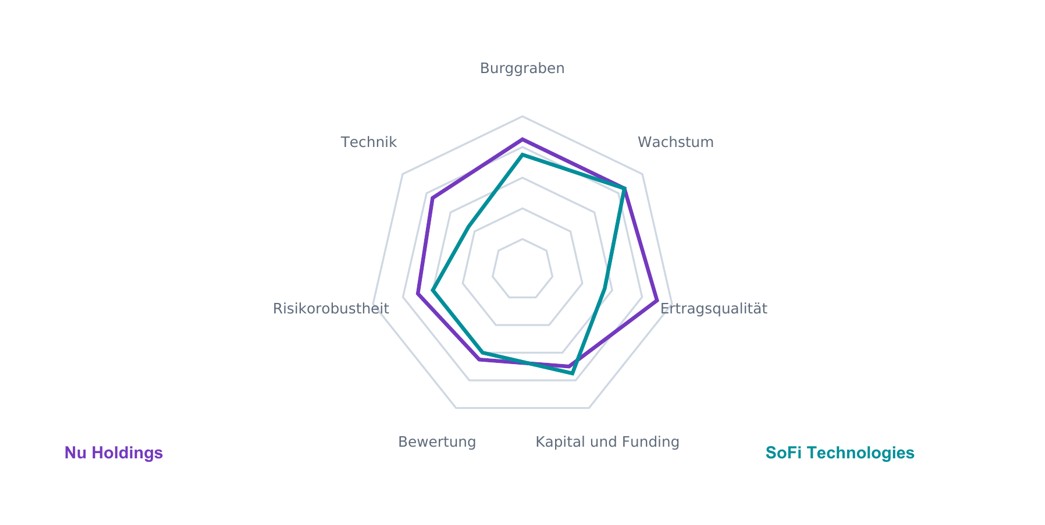
First things first: if I had to decide today, my choice would be Nu Holdings. Why?
Its established profitability, large active customer base, and
scale in Latin America are more compelling.
SoFi offers interesting U.S. banking, lending platform, and
payment options, but has earned significantly less on its capital so far. A nearly identical stock price does not imply comparable enterprise value.
Nu Holdings and the Quality of Its Earnings
How a large customer base becomes a profitable bank
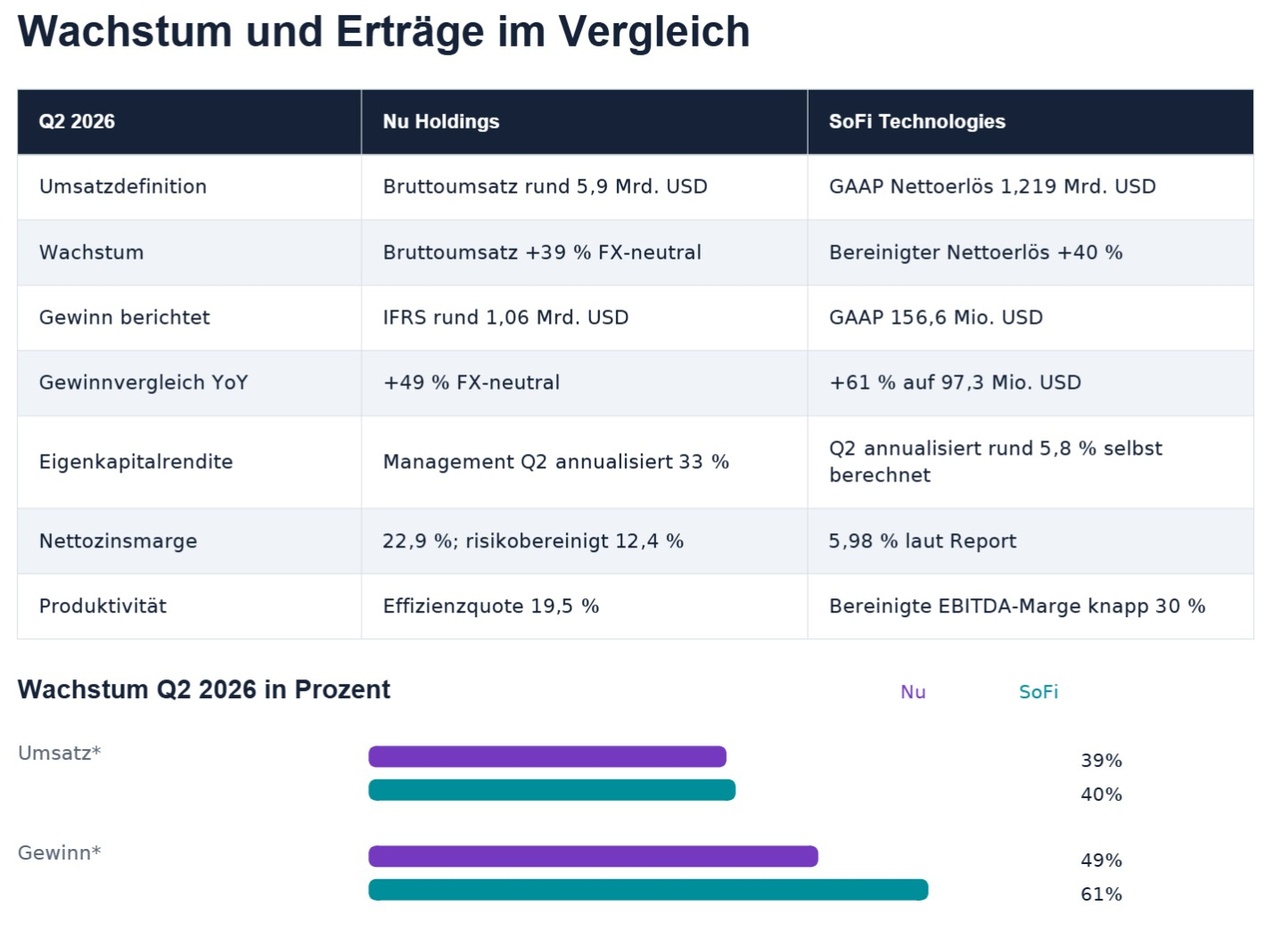
Nu posted a profit of approximately $1.06 billion in the second quarter. This figure is particularly impressive because it comes with a return on equity (ROE) of 33% and an efficiency ratio of 19.5% . ROE, or return on equity, measures profit relative to equity invested.
The efficiency ratio here describes expenses relative to the revenue base. Together, these metrics show how much revenue remains after operating expenses.
The company’s financial strength stems from low customer service costs and deeper customer relationships. A customer who consolidates their income, payment transactions, and multiple products with the same bank generates additional revenue and provides more information for credit decisions.
New offerings can then be sold within an existing relationship. Therefore, what matters is not just the number of customers, but whether activity, revenue per customer, and credit quality are all increasing together.
It is precisely this combination that makes Nu the top performer in this comparison.
The company does not need to base its appeal solely on future U.S. business. Its current core markets already provide a substantial profit base.
For valuation purposes, however, this also means that part of this advantage is already reflected in the high premium over book value. Strong financial results do not allow for an arbitrary entry price.
High returns also carry credit risk
The risk-adjusted net interest margin reached 12.4%. Put simply, it represents net interest income after accounting for credit costs. At the same time, the ratio of loans more than 90 days past due rose to 6.9%. Earlier stages of delinquency showed a more favorable trend. The figures therefore indicate neither a green light nor a confirmed credit default.
More unsecured loans can generate higher interest income and profits, but they also increase sensitivity to weaker income. At a growing bank, defaults on new loans often appear less serious at first because new loans do not reveal their losses until later.
That is why loan cohorts are important:
Loans from the same origination period are monitored over time, rather than simply comparing the average of the entire growing portfolio.
I would only consider the high margin sustainable if more mature loan cohorts also remain stable.
The counter-scenario to today’s quality assessment is a credit cycle in which higher losses erode part of the interest yield. Mexico and the U.S. offer additional opportunities, but should not mask this risk.
In our assessment, U.S. expansion is an option, not a necessary justification for the company’s overall value.
SoFi and the Path to Higher Returns on Capital
Strong growth alone is not yet enough for the quality premium
SoFi reported $156.6 million in GAAP net income and an adjusted EBITDA margin of just under 30%. Among other things, EBITDA excludes certain expenses from the operating picture; for a bank, it replaces neither shareholder returns nor return on equity. My Q2 ROE, calculated from quarterly net income and average shareholders’ equity, Q2 ROE, calculated based on quarterly profit and average equity, is approximately 5.8% on an annualized basis.
The long-term profitability target has thus not yet been achieved.
The Group is expanding several offerings simultaneously. In the long term, this can increase customer loyalty and revenue per member. In the short term, however, this incurs development, sales, and start-up costs.
The unchanged EBITDA forecast despite a higher revenue outlook shows that not every additional dollar of revenue immediately benefits shareholders. Furthermore, a higher absolute profit may grow at a slower rate due to a larger number of shares outstanding.
In my view, SoFi deserves a growth valuation, but not yet an unconditional quality premium.
A stronger case for buying will emerge if additional products actually deliver more recurring earnings per share. This comparison is therefore not a bet on whether SoFi can grow. The crucial question ishow profitable this growth will be for existing shareholders.
The lending platform and technology must each prove their worth separately
The Loan Platform business generated approximately $143 million in adjusted net revenue in Q2. It facilitates loans for partners and generates fees without having to permanently carry every brokered loan on its own balance sheet.
This is a sensible approach to achieving growth with less capital tied up.
The technology platform, on the other hand, generated only $84.5 million in revenue and shrank by 23% year-over-year.
Less balance-sheet exposure does not mean independence from the credit cycle. Partners must still be willing to purchase or finance loans. If loss assumptions worsen or yield requirements rise, their demand may decline.
Different metrics apply to the technology platform: customer retention, new contracts,
revenue growth, and margins. A new card partnership could improve this trend, but it alone does not prove a successful recovery for the entire segment.
The positive counterexample is: SoFi increases profitable multi-use, wins new B2B customers, and boosts its return on equity over several years.
Then today’s book value premium may prove to be a bargain.
If the yield remains low or the number of shares grows too quickly, the seemingly low book value multiple is of little help. That’s why I would place greater weight on the earnings confirmation more weight than a mere decline in the stock price.
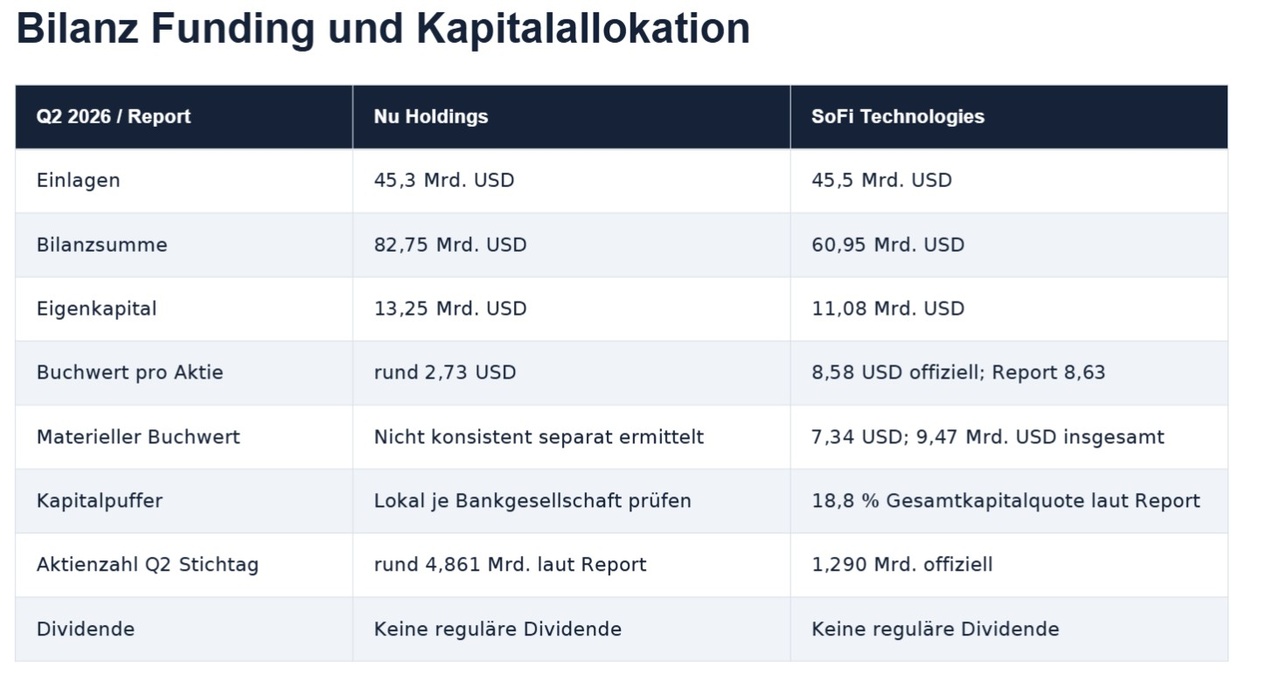
For banks, deposits are a source of funding and loans are operating assets. The generic negative FCF figures in the reports are therefore not suitable as direct indicators of insolvency or cash burn.
Even the “Net Debt / EBITDA” ratio would misinterpret the bank’s balance sheet in this context. The key factors are capital ratios, deposit stability, maturities, realized loan losses, and liquid assets.
The reported figure “Nu Loan-to-Deposit 35%” applies to Mexico, not to the group. 39.4 / 45.3 calculates to approximately 87% for the entire published loan portfolio. Due to differing portfolio and balance sheet definitions, this is also not automatically an identical regulatory ratio.
Why Nu Leads Operationally
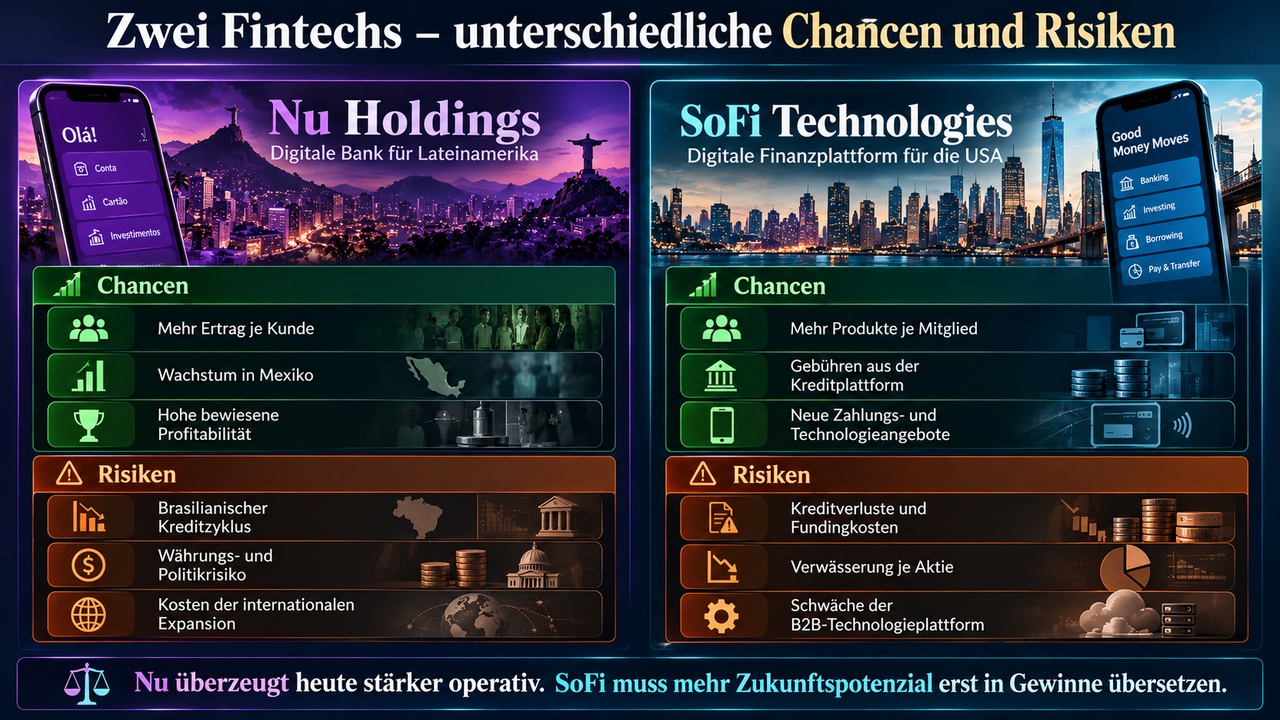
Nu operates a digital bank under the Nubank brand in Brazil, Mexico, and Colombia. The bank generates revenue from loans, cards, deposits, and fees. Its strengths lie in low operating costs and the ever-increasing proportion of customers who use Nu as their primary bank. This generates data and facilitates the marketing of additional products.
In the second quarter, the return on equity was 33 percent, according to the company. The efficiency ratio was 19.5 percent. This is a very strong foundation. Gross revenue rose 39 percent and profit 49 percent, both on a currency-adjusted basis. Mexico is expanding the growth potential, while the expansion into the U.S. still entails start-up costs and execution risks.
What Makes SoFi Interesting
SoFi combines U.S. banking, lending, investments, and financial technology. Its banking license enables deposit-based financing, while the loan platform business generates additional fees through loans to partners. Cross-selling is working: 51 percent of new products were opened by existing members.
Growth is strong: adjusted net revenue up 40 percent, members up 35 percent, products up 42 percent. GAAP profit totaled $156.6 million. However, the self-calculated annualized Q2 return on equity is only 5.8 percent. That is precisely where the difference lies compared to Nu. The B2B technology platform also shrank by 23 percent year-over-year and achieved a contribution margin of only 14 percent.
Opportunities, Risks, and Latest News
With Nu , I need to keep a close eye on credit quality. The proportion of loans more than 90 days past due rose to 6.9 percent in Q2. The company attributes part of this to seasonal factors and portfolio mix. However, this explanation does not replace ongoing monitoring of loan vintages. Added to this are Brazil’s economic policies and exchange rates, which affect U.S. dollar earnings.
SoFi stands to benefit more from a recovery in earnings but also faces greater uncertainty. The proportion of additional shares has grown significantly. It is not enough for revenue and absolute profit to rise; what matters is what remains per share. Both banks must comply with capital regulations and maintain stable deposit levels.
SoFi announced a stablecoin settlement with Mastercard as well as an Orbi card partnership in Mexico on October 8. This is strategically interesting. However, the reported annual settlement volume of more than $25 billion represents payment volume, not additional revenue. In my view, new payment offerings only make a significant contribution to valuation once they generate verifiable profits.
Nu’s price surge in early October was also part of a broad rally in Brazil following the first round of the presidential election. Ahead of the runoff election on October 25, I would not consider a political optimism premium a given.
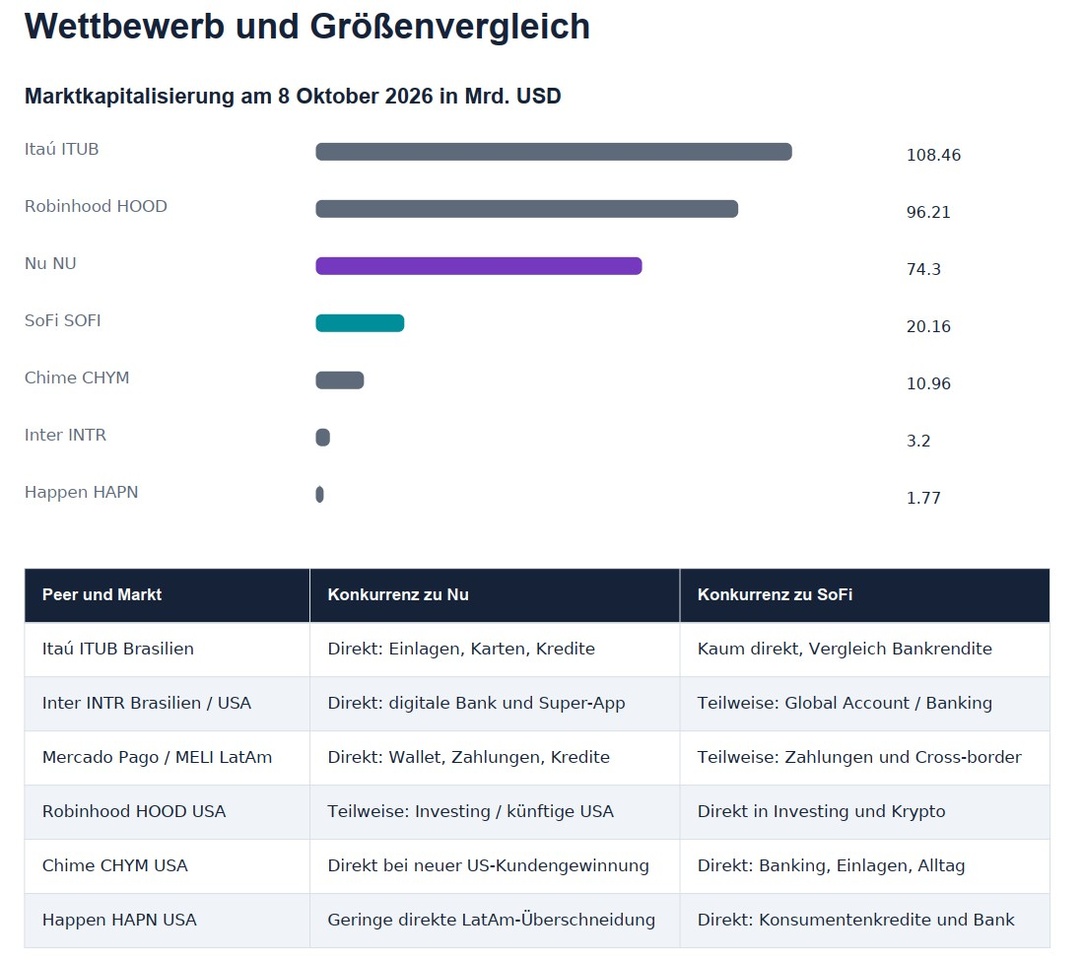
Valuation and Entry Point
Nu is cheaper relative to expected profits.
SoFi is cheaper relative to book value.
Both statements can be true at the same time:
Nu is already generating much higher returns on its capital, while SoFi must first significantly increase its returns. I do not automatically treat the negative standard free cash flow reported in financial statements as cash burn for banks. Loan growth and deposit movements significantly affect this metric.
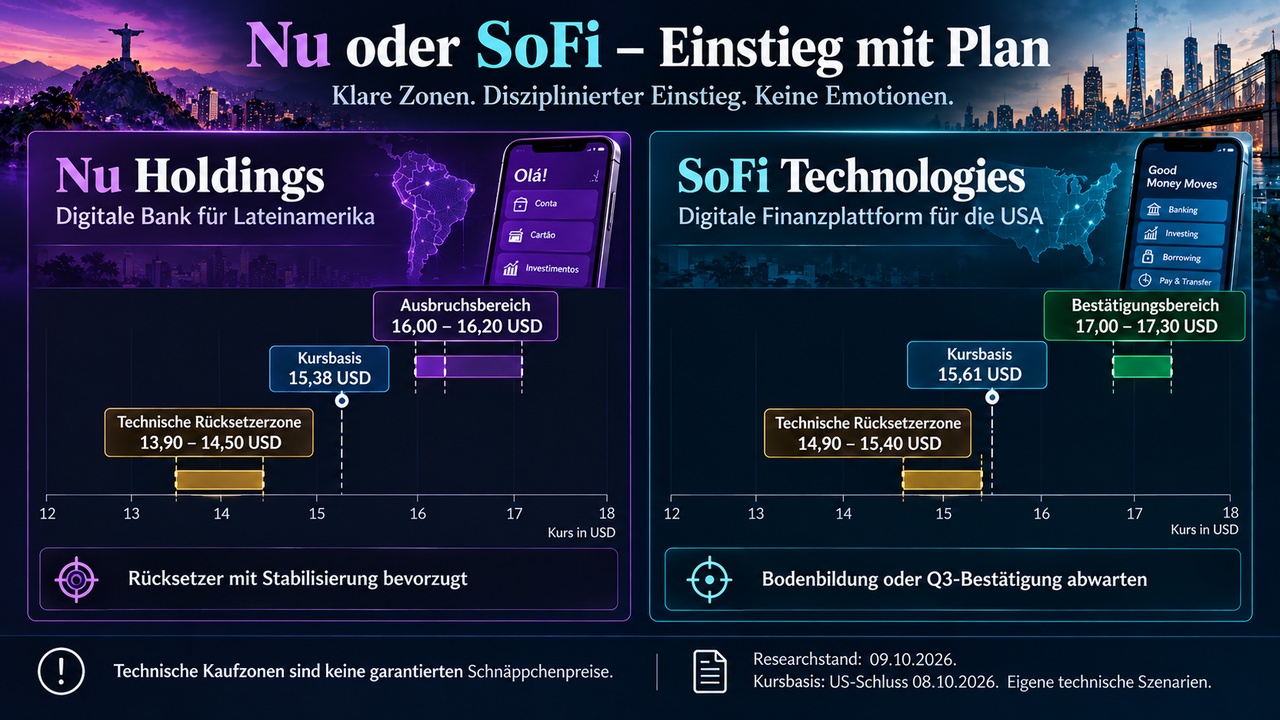
My bank earnings value model uses book values and discounted surplus earnings. In the conservative base case, this currently yields approximately $14.90 for Nu and $13.60 for SoFi. Both stock prices are thus trading above the conservative estimate. Technical buy zones do not guarantee bargain prices.
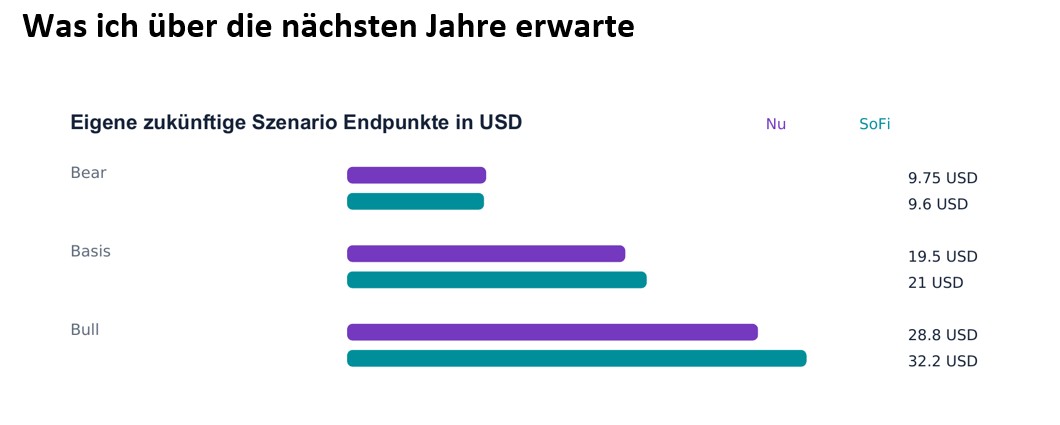
In a favorable scenario, SoFi could realize its higher upside potential. For that to happen, its return on equity, earnings per share, and Tech Solutions must show convincing improvement.
With Nu $NU (+4,22 %) , a significant portion of its operational strength is already evident. Nu therefore remains my long-term favorite. However, following the rapid rise, I would take a staggered approach and prefer to wait for a pullback.
SoFi $SOFI (+1,37 %) is an interesting stock to watch for me, but not an automatic buy solely because of the price drop. The Q3 earnings on October 27 are particularly important. According to calendars, Nu is expected to report on November 12; this date has not yet been officially confirmed in my research.
Sources:
Nu Q2 2026 Results
SoFi Q2 2026 SEC Earnings Report
Nu SEC Clarification on Monzo, September 30
Nu US Launch and Nu Global, September 10
SoFi Mastercard Settlement, September 22
SoFi Tech Solutions Orbi, October 8
SoFi Q3 Date Officially Confirmed
Nu Share Buyback of Up to $1 Billion
Nu Stock Prices and Key Figures
SoFi Stock Prices and Key Figures
Reuters Brazil Election Rally, October 5
and, of course, all the others :)


