1Lun·

The Defense Industry—Crisis-Proof?

attachment

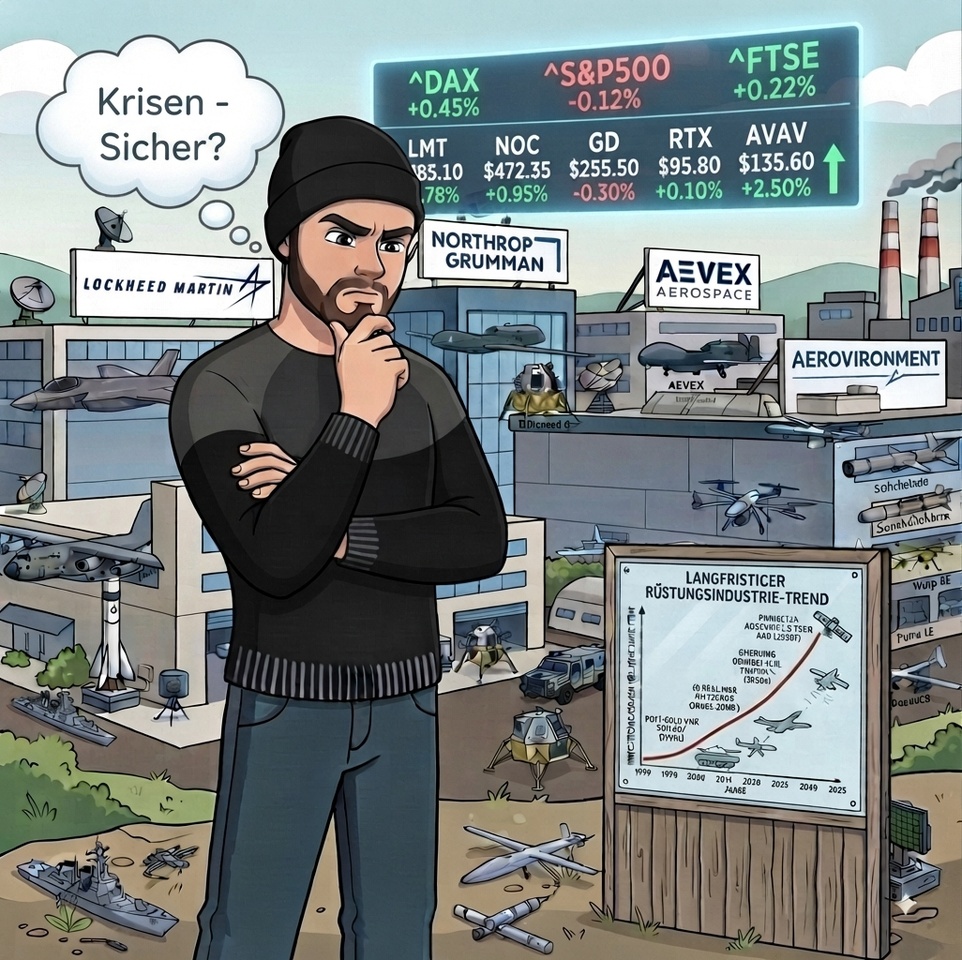
The aerospace and defense sector now accounts for about 8% of my investment capital. Although some companies in the industry are already in the $HMWO (-0,17 %) , $TDIV (-0,73 %) or the $VHYL (-0,38 %) portfolio, they were nevertheless added as individual stocks due to their long-term trends and future prospects.

These are $LMT (-1,5 %) , $NOC (-1,72 %) , $AVEX and $AVAV (-3,15 %)


The defense sector is booming for the first time since 1990 due to global conflicts and looming crises—order books are full, jobs are being created, and new plants are being built. Countries are arming themselves with drones, among other things, as well as other equipment and systems, ever since they’ve seen what these are now capable of. Defense capabilities against drones, cyberattacks, and hybrid warfare also play a massive role and require nations to arm themselves against these threats.
attachment

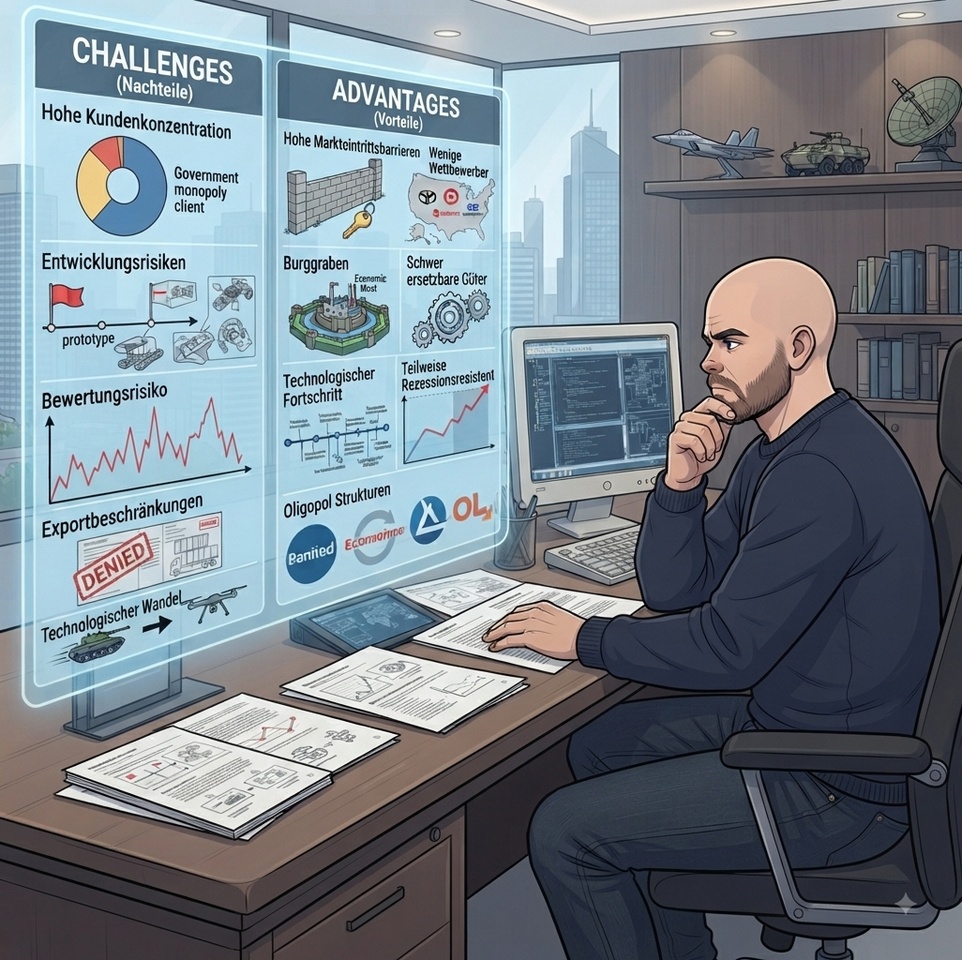
In addition to the current boom, however, this industry is also interesting for another reason: it is quite recession-proof due to its customer base. Furthermore, there are high barriers to market entry, few competitors, and the customers are almost exclusively governments—which also have maintenance and upgrade contracts in place for decades to come—and, last but not least, a certain level of trust among users in the systems’ performance.


Even though one might sometimes get the impression that NATO is falling apart, many systems and pieces of equipment are still compatible with one another—or are intended to become so in the future—which greatly expands the list of potential customers.

Disadvantages of the industry? A high concentration of customers, development risks, export restrictions, political interference—sometimes sensible, sometimes less so—and if a company falls behind technologically, it could very quickly lose ground.


While $LMT (-1,5 %) and $NOC (-1,72 %) have been established in the industry for years and are growing through scaling, diversification, and expertise, $AVEX and $AVAV (-3,15 %) represent, in my view, the future of military development and thus represent a growth bet on nations’ drive to deploy autonomous systems in crisis zones.
attachment

My conclusion is this: Anyone who actively chooses to include defense industry stocks in their portfolio accepts an ethical dilemma, but benefits from tremendous predictability, structural tailwinds, as well as technological change and the associated government spending.


Final Thoughts:

If world peace were to break out tomorrow—then, by the way, I would be more than happy and more than willing to pay the price for it in the form of losses!


*contains AI-generated images*

8
2 Comentarios

Imagen de perfil
Ein weiterer Nachteil der Branche wird im Beschaffungsprozess der ukrainischen Streitkräfte sichtbar:

In einem Krieg, der auf höchstem technologischen Level geführt wird, kommt es durchgehend darauf an, schnell und flexibel Material beschaffen zu können. Das bieten riesige Rüstungskonzerne schlichtweg nicht.

Ukrainische Einheits- und Verbandsführer bestellen Ausrüstung, UAV‘s, Waffen und Zubehör über eine staatliche Website, auf der viele kleine Unternehmen ihre Ware anbieten. Dieser dezentrale Beschaffungsprozess bietet den Streitkräften das, was sie brauchen. Unmittelbar verfügbares Gerät, welches ausprobiert, adaptiert, verworfen & ersetzt wird.

Die taktische Ebene einer Armee ist nicht an Langzeitverträgen, Wartungsfristen oder Ersatzteilproduktionslaufzeiten interessiert. All das, was Rüstungskonzerne einem Staat, der Kunde werden will, aufschwatzen, um langfristig und planbar Geld zu verdienen.

Wenn wir über große Rüstungsprojekte sprechen wie Kampfpanzer, Marschflugkörper, Fregatten, U-Boote & Kampfflugzeuge, bleiben die großen Rüstungskonzerne einsame Spitze. Allerdings muss man sich vor Augen führen, dass in der Ukraine auch folgendes zu sehen ist:

- ein 35 Mio € Panzer kann problemlos durch eine 1500€ Drohne vernichtet werden

- der Einsatzwert eines Kampfflugzeugs wird in einem Krieg zweier ebenbürtiger Parteien, aufgrund von fehlender Luftüberlegenheit, extrem reduziert

- Fregatten und U-Boote können in Häfen gefangen sein, da ein Auslaufen durch Untersee UAV‘s zu gefährlich ist

- Millionenschwere Marschflugkörper werden durch günstige Langstrecken-UAV‘s ersetzt, welche bessere Luftaufklärung und selektivere Zielbekämpfung ermöglichen

Die Rüstungskonzerne werden nicht aufhören Geld zu verdienen, gerade da Staaten wie Deutschland weiterhin viel auf konventionelle Kriegsführung setzen, aber man kann auch Gründe dafür finden, warum das, was Rüstungskonzerne bieten, für eine Armee nicht attraktiv sein kann.
•
8
•
Imagen de perfil
@hendrik_lmr Thank you for your in-depth analysis and explanation, which is absolutely spot on.
I think that many combat missions will also undergo fundamental changes in the future.

We’re already seeing the first steps in this direction with the CCAs program for the F-35. Something similar is also conceivable for tanks. To my knowledge, this is called MUM-T and is also based on the loyal wingman principle.

And even though drones now pose the greatest threat to infantry, we will always need “boots on the ground” and will continue to seek solutions there to minimize the danger as much as possible.
•
1
•
Únase a la conversación