

That's why I'm sticking with $MU (-6,95 %) Micron and $HY9H (-8,13 %) SK Hynix.
But these are also interesting:
My friends, here you should compare growth and valuation.
One of the largest SSD manufacturers is providing insight into its long-term contracts. Most of the storage capacity for the next two years has already been allocated.
SanDisk has published its latest annual report, and it doesn’t bode well for end customers. A slide on “New Business Models” (NBMs) summarizes the bleak outlook.
SanDisk refers to its long-term supply contracts with major customers for NAND flash memory and finished SSDs as NBMs. The manufacturer has signed eight such contracts with customers for data centers and edge devices. PC, laptop, and smartphone manufacturers are apparently not included. The contracts typically run for four to five years.
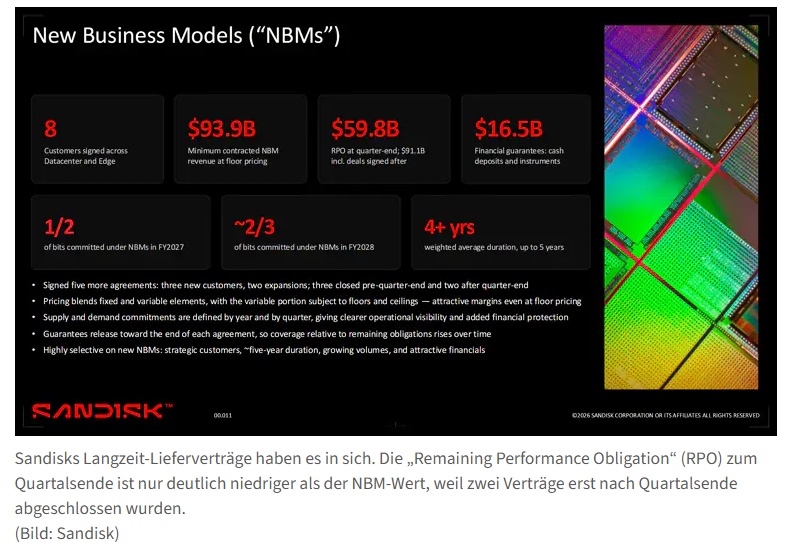
For the period from July 2026 to the end of June 2027, SanDisk has already allocated half of its memory production to the eight NBM customers. For the following twelve months, the figure is laut Bekanntmachung it’s even two-thirds. And that doesn’t even include the allocation for contracts outside the NBMs. Either way, it’s clear that less and less is left for PC manufacturers. Meanwhile, the eight contracts combined provide for guarantees totaling $16.5 billion in the event that customers purchase less storage than agreed upon.
In particular, the figures highlight the state of the NAND flash memory and SSD markets: SanDisk is the world’s second-largest manufacturer specializing exclusively in NAND flash and SSDs. Unlike Samsung, SK Hynix, and Micron, its figures are not mixed with DRAM for RAM.
Nearly $94 billion minimum value
The eight contracts have a combined value of at least $93.9 billion. SanDisk clarifies that this figure applies to the lowest agreed-upon NAND flash prices. The companies have negotiated price ranges depending on availability. CFO Luis Visoso said in an analyst conference call regarding the figures that actual revenue will likely be higher. However, even at the lowest prices, the margin is expected to be attractive.
All memory manufacturers are currently negotiating long-term supply contracts, mostly with price ranges. In doing so, they are effectively reducing volatility in the market: When all companies set high minimum prices, they no longer undercut each other significantly. The minimum prices typically correspond to current levels. A Rückkehr zu den Speicherpreisen aus dem Jahr 2025 ist damit unwahrscheinlich.
Revenue and Profit Rise Significantly
SanDisk generated $9 billion in revenue in the second calendar quarter. Compared to the first quarter of 2026 alone, this represents 51 percent growth. According to the manufacturer, one-third of the growth is attributable to additional sales and two-thirds to higher prices. The gross margin stands at a staggering 84.6 percent.
This leaves just over seven billion in operating profit and just under seven billion in net profit. A year earlier, SanDisk had posted a net loss of 23 million US dollars. Due to low SSD prices at the time, the company was operating on the verge of profitability.
Kioxia Is Growing Even Faster
Kioxia, the largest pure-play NAND flash manufacturer based in Japan, reported its neuesten Geschäftsbericht veröffentlicht. The company generated revenue equivalent to 11 billion U.S. dollars in the second quarter of 2026. However, due to higher operating expenses and, above all, taxes, the resulting profit is significantly lower than Sandisk’s: just under 5.3 billion U.S. dollars.
Kioxia is much more secretive about its long-term contracts than its competitors. They exist, but details are unknown.
Eine einzige Herstellerfolie zeigt, wie schlecht es um SSD-Preise steht | heise online
