

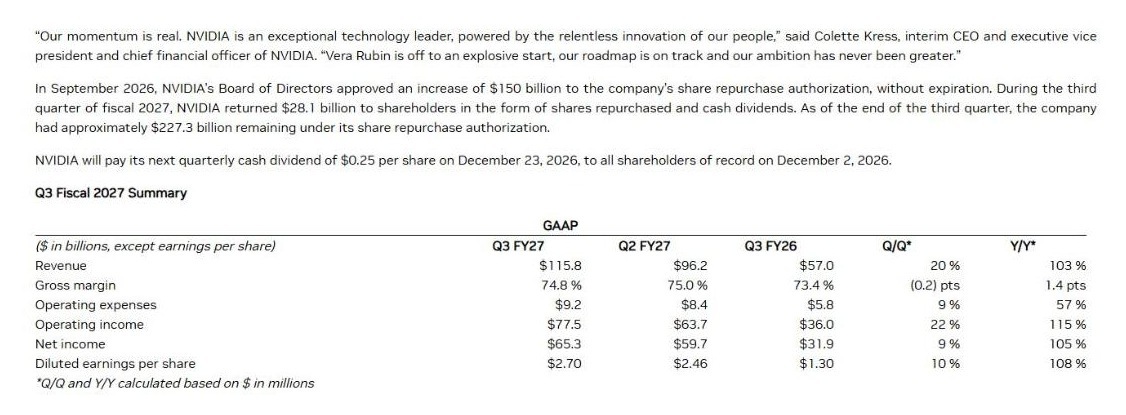
Nvidia is posting record numbers, but its stock is in the midst of its biggest crisis of confidence in years: In the third quarter of fiscal year 2027, revenue rose 103% to $115.8 billion, and adjusted earnings per share of $2.68 were well above the expected $2.47, and Nvidia is projecting $130 billion in revenue for the fourth quarter. During the conference call, interim CEO Colette Kress added: For fiscal year 2028, Nvidia now expects growth of around 75% instead of the previous estimate of around 70%, and the order backlog from cloud customers rose to $2.5 trillion. Nevertheless, the stock is trading at $155.46 (Nasdaq, Nov. 17, 2026), about 36% below its all-time high of $243.37, weighed down by Jensen Huang’s resignation on November 12. From a technical analysis perspective, the extremely high trading volume on the day of the Huang news has made the area around $150 a potential support zone. However, a sustained signal will only emerge above $170; only then is a recovery to $191.72—and potentially beyond toward the record high—possible. If the stock continues to fall, the next support level is around $131.
Key Points
- Q3 FY 2027: Revenue $115.8 billion (+103%), Data Centers $107.6 billion (+110%)
- Adjusted earnings per share: $2.68 (expected: approx. $2.47), free cash flow: $43.8 billion
- Q4 Outlook: $130 billion in revenue ±3%, gross margin 71% to 72%
- Conference call: FY 2028 growth of approximately +75%, order backlog of $2.5 trillion
- Leadership: Colette Kress is interim CEO; the board of directors will not bring Jensen Huang back
- Dividend: $0.25 per quarter; next payment on December 23, 2026
- Analysts: Average price target $265.23 (63 analysts, Nov. 18, 2026)
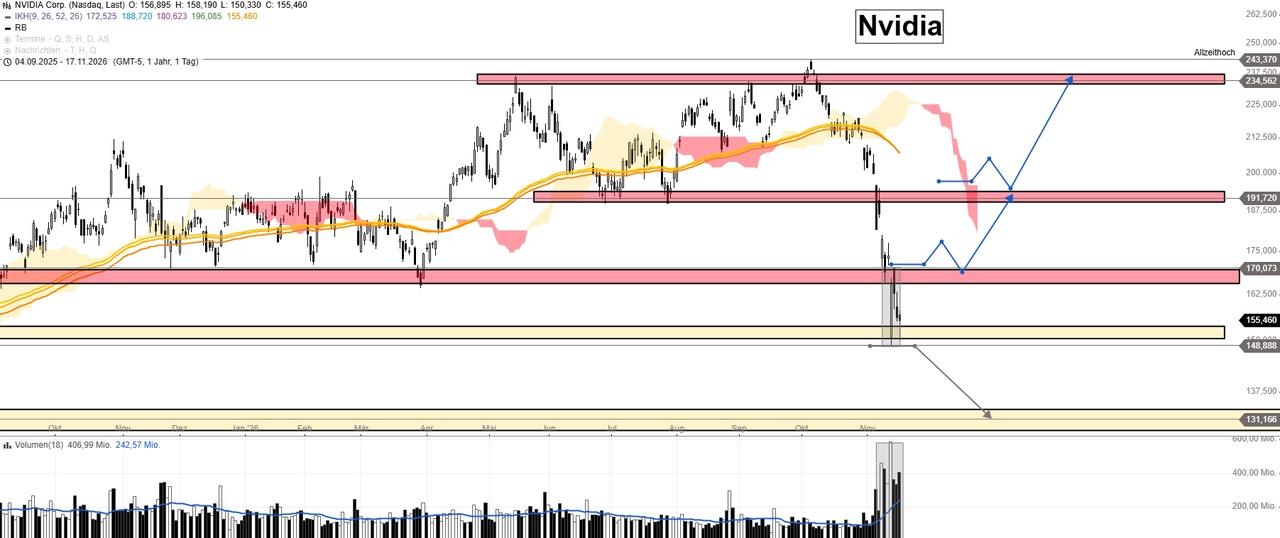
- Chart levels: Support zone around $150, signal above $170, targets at $191.72 and all-time high, downside risk to $131
What are Nvidia’s current key metrics?
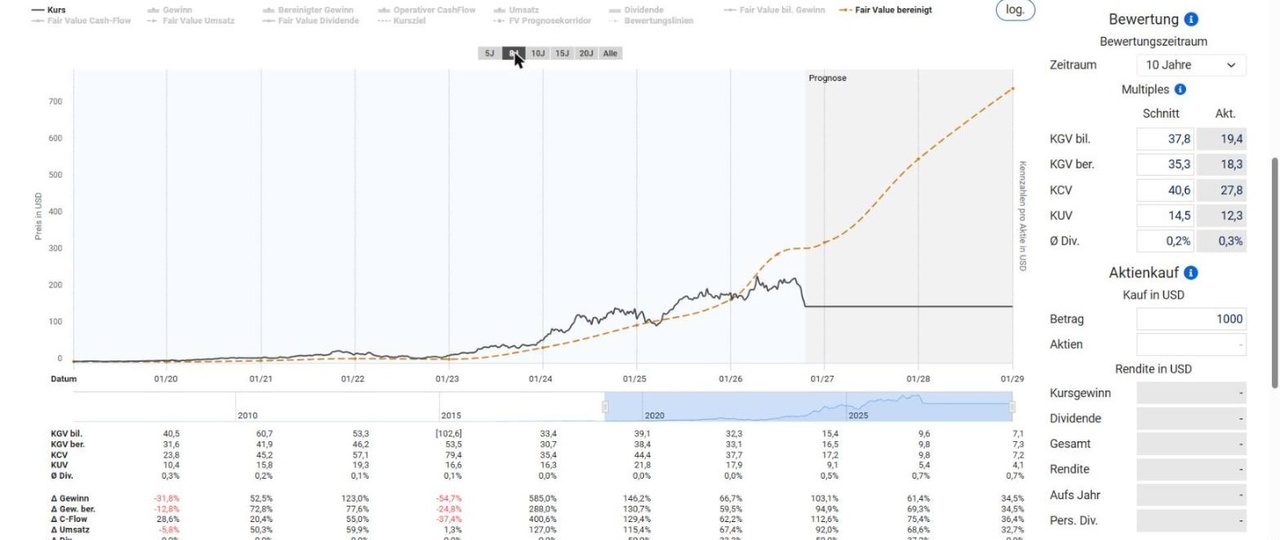
Following the crash, Nvidia stock is trading at its lowest valuation in years: According to Aktienfinder, the adjusted P/E ratio stands at 18.3; on average over the past ten years, investors have paid 36.8 times earnings.
Based on expected earnings for the next fiscal year, the P/E ratio drops below 10, according to Aktienfinder. The price-to-cash-flow ratio (27.8 instead of 42.7) and the price-to-revenue ratio (12.3 instead of 15.5) are also below their long-term averages.
- Price (Nasdaq: NVDA): $155.46 (Nov. 17, 2026)
- After-hours following the earnings report: $162.56 (+4.6%) (Nov. 17, 2026)
- All-time high = 52-week high: $243.37 (October 6, 2026)
- 52-week low: $148.80 (November 12, 2026)
- Distance from all-time high: approximately −36% (November 17, 2026)
- Year-to-date performance: approximately −17% (November 17, 2026)
- Market capitalization: approx. $3.8 trillion (November 17, 2026)
- Revenue for Q3 FY 2027: $115.8 billion (+103%) (Nov. 17, 2026)
- Data Centers Q3 FY 2027: $107.6 billion (+110%) (November 17, 2026)
- Edge computing Q3 FY 2027: $8.2 billion (+42%) (November 17, 2026)
- Q3 Gross Margin (Adjusted): 74.9% (November 17, 2026)
- Net Income Q3 (GAAP): $65.3 billion (+105%) (Nov. 17, 2026)
- Earnings per Share Q3 (adjusted): $2.68 (expected approx. $2.47) (Nov. 17, 2026)
- Q3 Free Cash Flow: $43.8 billion (November 17, 2026)
- Q4 FY 2027 Revenue Outlook: $130 billion ± 3% (November 17, 2026)
- Q4 Gross Margin Outlook: 71 to 72% (November 17, 2026)
- Adjusted P/E ratio (current / 10-year average): 18.3 / 36.8 (Aktienfinder, November 18, 2026)
- Current P/B ratio / 10-year average: 27.8 / 42.7 (Aktienfinder, Nov. 18, 2026)
- Current P/S ratio / 10-year average: 12.3 / 15.5 (Aktienfinder, November 18, 2026)
- Average Analyst Price Target: $265.23 (+71%) (63 analysts, November 18, 2026)
- Dividend: $0.25 per quarter (yield approx. 0.6%) (payment Dec. 23, 2026)
- Next Date: Q4 results for FY 2027 expected in late February 2027 (not yet confirmed)
- Index: Nasdaq 100, S&P 500, Dow Jones (—)
- WKN / ISIN / Ticker: 918422 / US67066G1040 / NVDA (—)
What news is currently driving Nvidia stock?
Nvidia stock is currently being driven by two opposing forces: record results with a significantly improved outlook on the one hand, and the leadership crisis following Jensen Huang’s resignation on the other.
On November 12, Huang stepped down as CEO following an internal investigation; CFO Colette Kress has been leading Nvidia on an interim basis ever since. The figures released on November 17 show that business has so far remained unaffected: Revenue significantly exceeded the company’s own forecast of $108 billion, and according to Nvidia, the new Vera Rubin platform got off to the fastest start in the company’s history. Full details on the quarter can be found in our Nvidia Aktie News zu den Quartalszahlen.
- Nov. 18, 2026 – Analyst reactions to the earnings report: Goldman Sachs reaffirms its “Buy” rating with a price target of $220, while JPMorgan raises its target from $215 to $230. Summit Insights, on the other hand, downgrades the stock to “Hold” (Neutral).
- November 17, 2026 – Q3: Revenue +103%, Outlook $130 billion: Revenue of $115.8 billion instead of the expected $109 billion; adjusted earnings per share of $2.68. Q4 outlook: $130 billion ± 3%. (Bullish)
- November 17, 2026 – Conference Call: +75% for FY 2028: Kress expects approximately 75% growth for fiscal year 2028; cloud customer order backlog at $2.5 trillion. Supervisory Board does not reinstate Huang. (Bullish)
- November 16, 2026 – Price target cuts ahead of earnings: Mizuho lowers the price target from $250 to $220 (Outperform) – Reason: Huang was considered the most important dealmaker in the AI industry. (Bearish)
- November 12, 2026 – Jensen Huang resigns: Following an internal investigation, Huang steps down as CEO. Colette Kress becomes interim CEO; the stock falls intraday to $148.80. (Bearish)
What did Nvidia management say about the outlook during the conference call?
Interim CEO Colette Kress significantly raised the outlook during the conference call on November 17: For fiscal year 2028 (February 2027 through January 2028), Nvidia now expects revenue growth of around 75% instead of the previous estimate of around 70%—and that’s on a higher base than previously anticipated.
“Our momentum is real,” said Kress, noting that demand continues to accelerate.
What went well: According to information from the conference call, the new Vera Rubin platform already generated nearly $20 billion in revenue in its first production quarter—the fastest ramp-up in the company’s history. The order backlog from cloud customers rose from $2 trillion to $2.5 trillion within three months. Business with enterprise customers is expected to more than double in fiscal year 2028. Racks are in operation at CoreWeave, Google Cloud, Microsoft Azure, Oracle, and Nebius, among others, and will soon be at SpaceXSI as well—my analysis of SpaceX Aktie.
The catch: The gross margin is expected to drop to 71–72% in the fourth quarter, down from 74.9% in the third quarter. Kress described this as a low point because Nvidia is fulfilling existing supply contracts under old terms. Added to this is the unresolved leadership issue: Supervisory Board Chairman Harvey Jones made it clear that Jensen Huang will not be returning; a permanent successor has yet to be named; and the Supervisory Board’s investigation is ongoing.
Outlook: For the fourth quarter, which includes an additional week, Nvidia is projecting $130 billion in revenue (±3%), excluding data center revenue from China. In addition, the board of directors has increased the share buyback program by $150 billion; approximately $227 billion remains available.
What does Nvidia do, and how does the company make money?
Nvidia is the world’s leading provider of AI chips and AI data centers—the Santa Clara-based company now generates over 90% of its revenue from systems on which cloud providers and AI companies train and run their models.
Nvidia was founded in 1993 by Jensen Huang, Chris Malachowsky, and Curtis Priem, originally as a manufacturer of graphics cards for video games.
Two segments: The Data Center segment ($107.6 billion in revenue in the third quarter of fiscal year 2027) includes AI accelerators such as Blackwell and Vera Rubin, the company’s own Vera CPUs, networking technology such as Spectrum-X, and complete rack systems. Edge Computing (USD 8.2 billion) includes graphics cards for gamers and PCs, chips for cars and robots, and local AI computers.
How Nvidia Makes Money: Nvidia doesn’t just sell chips; it sells entire AI ecosystems consisting of hardware, networking, and the CUDA software platform, to which developers have been tied for years. This results in gross margins of around 75%. New growth areas include software for AI agents, autonomous driving, robotics, and sovereign AI projects by governments—such as those in collaboration with Palantir, as my analysis Palantir Aktie .
Nvidia Stock (NVDA) Third-Quarter FY 2027 Earnings, Buybacks, and Dividend (as of Nov. 18, 2026) – Source: Nvidia Investor Relations / Christian Lill
Nvidia Stock Fundamental Analysis: What Is the Fair Value of Nvidia Stock?
According to Aktienfinder’s calculation, based on adjusted earnings and the average P/E ratio over the last ten years, the fair value of Nvidia stock is approximately $300 for the end of 2026 and approximately $540 for the end of 2027 —nearly double to three and a half times the current price.
However, this calculation assumes that investors will once again pay a P/E ratio in line with the average of the past ten years and that earnings estimates will be met.
Growth: Revenue grew by 103% in the third quarter of fiscal year 2027, reaching $293.7 billion in the first nine months. Nvidia is projecting $130 billion for the fourth quarter and approximately 75% growth for fiscal year 2028. According to the FMP consensus, analysts expect revenue of approximately $411 billion for fiscal year 2027 and approximately $692 billion for 2028.
Margins: With an adjusted gross margin of 74.9% and an operating margin of approximately 67%, Nvidia is one of the most profitable large companies in the world. In the fourth quarter, the gross margin temporarily drops to 71–72%.
Cash Flow and Balance Sheet: Free cash flow reached $43.8 billion in the third quarter and $113.7 billion over nine months. Of this, $22.1 billion went toward share buybacks and $6.0 billion toward dividends. One of the largest customers is Amazon with its cloud division AWS, which will invest approximately $220 billion in 2026 alone—more on this in my analysis of Amazon Aktie.
Valuation: According to Aktienfinder, the adjusted P/E ratio stands at 18.3 instead of the ten-year average of 36.8, and the price-to-cash-flow ratio at 27.8 instead of 42.7. Based on the earnings expected for the coming fiscal year, the P/E ratio is below 10. The market is thus pricing in a significant risk that growth will collapse after the AI boom or that the leadership crisis will cost the company customers.
Fair Value Assessment of Nvidia Stock (NVDA) for 2027 (as of November 18, 2026) – Source: Aktienfinder / Christian Lill
Nvidia Stock Price Targets and Forecast for 2027
Analysts see an average price target of $265.23 for Nvidia stock, representing about 71% upside potential—however, from a technical analysis perspective, a sustainable signal will only emerge above $170; at which point $191.72 and, above that, the record high of $243.37 become attainable.
Below $148.89, there is a risk of a pullback to $131. My analysis of Infineon Aktie.
Key price levels:
- 52-week high = all-time high: $243.37 (Oct. 6, 2026)
- Current price: $155.46 (Nasdaq, Nov. 17, 2026), after-hours $162.56
- Resistance levels: $170.07, $191.72, $234.56
- Buy signal: sustained rise above $170
- Price targets after the signal: $191.72, then toward the all-time high
- Support zone: around $150, lower boundary at $148.89
- Critical downside level: $148.89, with support at $131 below that
Analyst price targets:
- Average price target: $265.23, range $130 to $515 (63 analysts, S&P Global/Stock Analysis, Nov. 18, 2026)
- Average price target: $261.83 (36 analysts, Public.com, November 18, 2026)
- JPMorgan: $230, previously $215 (November 18, 2026)
- Goldman Sachs: Buy, $220 confirmed (November 17, 2026)
- Mizuho: Outperform, $220, previously $250 (November 16, 2026)
- Summit Insights: Downgraded to Hold (November 18, 2026)
Chart Analysis:
Nvidia Stock (NVDA) Chart Analysis and Price Targets for 2027 (as of Nov. 18, 2026) – Source: Stock3 / Christian Lill
On the daily chart, Nvidia stock showed a strong reversal candle following the announcement of Jensen Huang’s departure: On November 12, the price fell intraday to $148.80 and ended the day significantly higher. This reversal candle was accompanied by extremely high volume, the likes of which were not seen at all last year. High volume at a low generally indicates a bottom is forming, as large market participants have absorbed the panic selling. The area around $150 (yellow zone) could therefore be used to form a bottom, with $148.89 as the lower boundary.
The buy signal (blue arrow): However, a sustained signal confirming this bottom will only be triggered above $170. That is where the red resistance zone around $170.07 lies, a level at which the stock has recently failed to break through on multiple occasions. If the stock manages to break above this level, it could rally directly to $191.72, where the next red resistance zone and the price gap from early November are located. Furthermore, a rally toward the record high is even possible: The resistance zone at $234.56 lies just below the all-time high of $243.37.
The risk (gray arrow): If market participants do not begin to form a bottom and continue to sell the stock, the price will fall below $148.89. In that case, the next support level is already in the $131 range (yellow zone around $131.17).
My assessment: The trading volume suggests a bottom around $150, but this will only be confirmed above $170. Until then, the bottoming process is an opportunity, not a signal.
What is the forecast for Nvidia stock in 2030?
For the 2030 fiscal year (through January 2030), analysts expect revenue of approximately $1.08 trillion—the same figure cited by finanzen.net—and earnings per share of about $24.10, according to the FMP consensus. With a P/E ratio of 15 to 20, that would correspond to a share price of around $360 to $480.
This is a sample calculation, not a price forecast: It assumes that Nvidia will more than double its earnings per share compared to the current fiscal year (consensus around $9.30).
Factors supporting this: The $2.5 trillion order backlog from cloud customers, the projected growth of around 75% in fiscal year 2028, and the doubling of the company’s business. With Vera Rubin, its own CPUs, networking technology, and software for AI agents, Nvidia is further expanding its position.
Arguments against it: The estimates for 2030 are based on a small number of analysts (19 for earnings) and are therefore uncertain. If the major cloud providers cut back on their investments, growth could come to an abrupt halt. Added to this are export restrictions to China, dependence on contract manufacturer TSMC, and the unresolved succession of Jensen Huang. From a technical analysis perspective, a rise above $170 is first required.
How much is Nvidia’s dividend?
Nvidia pays a quarterly dividend of $0.25 per share; the next payment will be made on December 23, 2026, to all shareholders of record as of December 2, 2026.
On an annualized basis, this amounts to $1.00 per share; at a share price of $155.46, this corresponds to a dividend yield of approximately 0.6%.
For a long time, Nvidia’s dividend—at $0.01 per quarter—was almost symbolic, but in the current fiscal year 2027, Nvidia has raised it significantly. In the third quarter, $6.0 billion was paid out to shareholders as dividends. However, the majority of distributions continue to take the form of share buybacks: $22.1 billion in the third quarter, with approximately $227 billion still available under the buyback program. Nevertheless, Nvidia is not the right choice for investors primarily seeking regular income—the stock remains a growth stock.
Conclusion: Should you buy or sell Nvidia stock?
Nvidia is posting record operating results and raising its outlook, but following Jensen Huang’s resignation, the stock remains stuck about 36% below its all-time high—the extremely high trading volume suggests a bottom is forming around $150, but a sustainable signal will only emerge above $170.
Factors in Nvidia’s favor include a 103% increase in revenue, a growth outlook of around 75% for fiscal year 2028, a backlog of $2.5 trillion, and an adjusted P/E ratio of 18.3, well below the ten-year average. My analysis of how the company’s main competitor is handling the same AI demand is available at AMD Aktie.
Factors weighing against the stock include the unresolved leadership issue, the ongoing investigation by the supervisory board, the declining gross margin in the fourth quarter, and concerns about stricter AI regulations. From a technical perspective: Above $170, a rebound to $191.72—and potentially toward a record high—is possible. If the stock falls below $148.89, the next support level is at $131.
✅ Opportunities
- Revenue +103%, Q4 outlook: $130 billion
- Approximately 75% growth planned for fiscal year 2028
- Cloud customer order backlog: $2.5 trillion
- Adjusted P/E ratio of 18.3 vs. a 10-year average of 36.8
- Record trading volume at the low suggests a floor around $150
- A rebound from over $170 to $191.72 is possible
⚠️ Risks
- No permanent successor for Jensen Huang
- Supervisory Board investigation continues
- Gross margin drops to 71–72% in Q4
- Reliance on a few large cloud customers
- Export restrictions to China
- Below $148.89, a pullback to $131 is possible
Sources
- Nvidia Investor Relations: Third-Quarter Results for Fiscal Year 2027 (Nov. 17, 2026)
- SEC Form 8-K: Nvidia Q3 Fiscal 2027 Press Release (November 17, 2026)
- Nvidia Investor Relations: CFO Comments and Q3 FY 2027 Presentation
- Q3 FY 2027 Conference Call (November 17, 2026): Reports from Investing.com, TheStreet, PYMNTS, GuruFocus, and CoinDesk
- Analyst Reports: Investing.com (Goldman Sachs, November 17, 2026), CNBC (Mizuho, November 16, 2026), Stock Analysis (Summit Insights, November 18, 2026), Rallies.ai (JPMorgan, November 18, 2026)
- Average price target: Stock Analysis / S&P Global and Public.com, November 18, 2026
- Consensus estimates: Financial Modeling Prep (FMP) and finanzen.net, November 18, 2026
- Nasdaq prices: Alpha Vantage and Investing.com, as of November 17, 2026
- Stock3: NVIDIA Corp. (Nasdaq) daily chart, as of November 17, 2026
- Aktienfinder: Fair value calculation (adjusted earnings), valuation metrics for NVIDIA, as of November 18, 2026
This is not investment advice—all information is provided solely for financial education purposes.
What are your current thoughts on $NVDA (-3,25 %) ?
