
Dear Community,
Since some time has passed since my last analysis of the “electricity highways” and grid infrastructure, it’s time for a follow-up. In recent posts, we’ve systematically worked our way through the physical chain of the AI boom: From the resource (water) to generation (nuclear/SMR) via geothermal energy, all the way to distribution (HVDC cables).
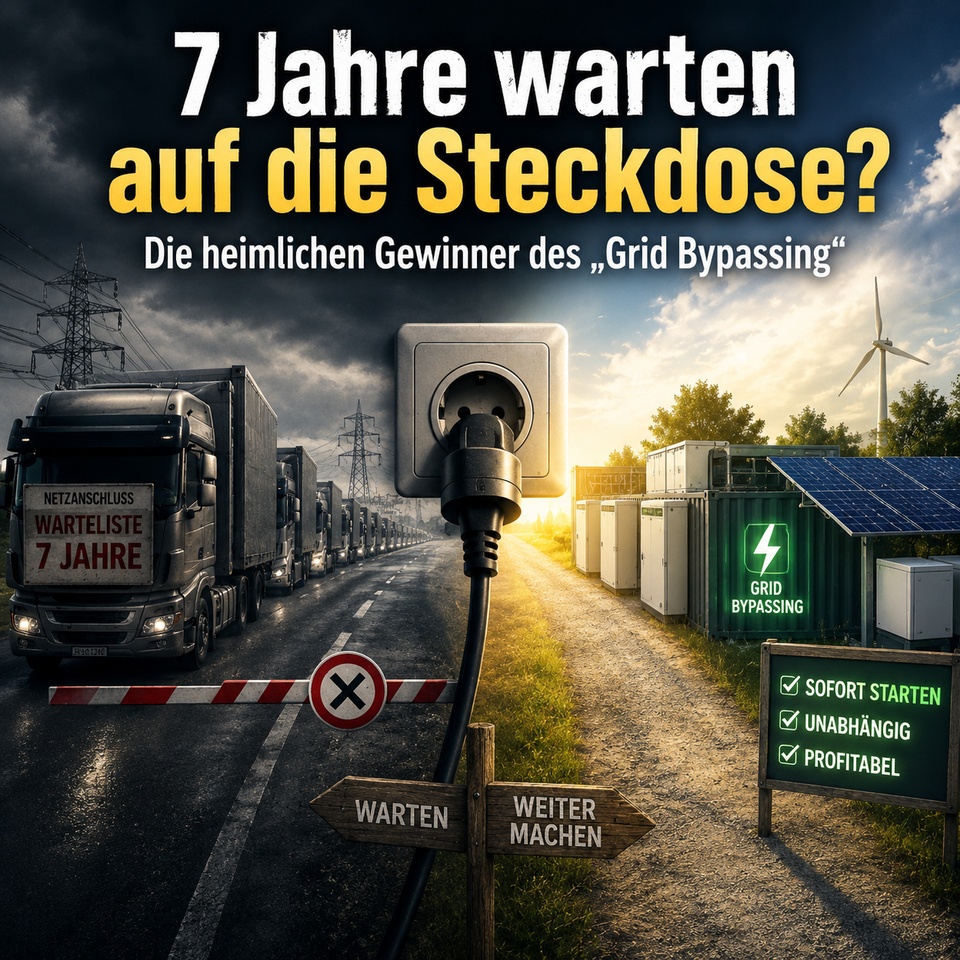
But reality continues to strike relentlessly in 2026. While the tech giants keep announcing new, gigantic AI models, we’re hitting a concrete wall in the real world. The problem is no longer just transporting electricity over long distances—the problem is that the public power grids are simply full. In many regions, wait times for a high-power grid connection now stretch to several years.
But a big-tech corporation isn’t going to wait seven years for an outlet. The consequence? A radical trend toward “grid bypassing” and self-sufficient microgrids. Data centers are increasingly becoming their own, grid-independent power plants right on site. And this is exactly where, away from the media spotlight, a completely new, explosive growth market is emerging.
The companies I’d like to introduce to you today are growing in the shadow of the AI hype and supply exactly the hardware without which the lights would literally go out in the data center or the chips would melt:
1. Powell Industries ($POWL (+1,56 %))
The nervous system for power distribution
While companies like Eaton build gigantic transformers, Powell Industries supplies the custom-made, highly complex switchgear, control systems, and modular “Power Houses” that are essential for safely distributing power in heavy industry and massive AI data centers.
- Business Model & Foundation: Powell designs, builds, and maintains custom-made systems for comprehensive energy management. These systems ensure that the massive, irregular energy flows in industrial and utility facilities are precisely monitored, controlled, and protected against power outages.
- Products & Services: The product range extends from medium- and low-voltage switchgear and integrated control systems to turnkey, modular power plant containers (Power Control Rooms and E-Houses). This is complemented by the high-margin after-sales segment, which includes installation, commissioning, and global field services.
- Markets & Sales: Historically deeply rooted in the traditional industrial sector (oil & gas, petrochemicals, mining, and heavy industry), Powell is now aggressively expanding its business through project engineering and direct sales in the renewable energy and high-tech infrastructure sectors.
- The Growth Driver: When tech companies build their own mini-power plants (microgrids) to become independent of the unstable power grid, each of these projects requires Powell’s customized infrastructure.
- The numbers speak for themselves: Powell is currently experiencing a historic boom. The order books (backlog) are full to bursting, and profits are rising because margins on custom AI infrastructure are extremely high.
- Opportunities & Market Potential: As a specialist in custom-built switching technology, Powell is at the intersection of three megatrends: the construction of self-sufficient data centers, global grid modernization, and the ongoing decarbonization of industry. Through strategic acquisitions in the areas of automation and SCADA systems (intelligent monitoring software), Powell is also transforming itself from a pure hardware supplier into a high-margin systems provider. The massive order backlog secures growth for years to come.
- Risks & Stumbling Blocks: The business model is heavily project-based—phases of investment freezes by tech giants can therefore lead to noticeable order cyclicality. Additionally, margins are sensitive to supply chain bottlenecks or volatile raw material prices (such as copper and steel). Intense competition in the tech infrastructure sector requires constant pressure to innovate. At the operational level, it is also important to keep an eye on weather-related production outages at the main sites as well as the ever-present threat of cyberattacks on control systems.
2. Bloom Energy ($BE (+2,83 %))
On-site power generation (behind-the-meter)
Bloom Energy manufactures so-called solid oxide fuel cells. What makes them special is that they generate highly efficient electricity through an electrochemical process—without any combustion. They can be powered by natural gas, biogas, or pure hydrogen.
- Product & Technology: Bloom’s technological flagship is stationary solid oxide fuel cell systems for decentralized power generation. These modules flexibly and highly efficiently convert various energy sources into electricity, are easily scalable in a modular fashion, and are uncompromisingly designed for continuous base-load operation (24/7).
- The Business Model: Revenue is generated through a clever mix: the direct sale of systems and modules combined with predictable, recurring income from Energy-as-a-Service contracts, long-term operations management, and maintenance. The entire project development, from installation to cloud-based energy management software, comes from a single source. Customers include global companies, utilities, and, increasingly, the world’s largest data center operators.
- Market Position & Strategy: In the current market environment, Bloom excels in three key areas: radical emissions reduction, absolute off-grid supply security, and extreme fuel flexibility (the systems currently run on natural gas but are fully compatible with biogas or pure green hydrogen). The foundation for long-term success is the strong synergy between high-margin hardware sales and decades-long service and supply agreements.
- The Growth Driver: Tech giants can no longer wait years for local utilities to lay new power lines to their data centers. Bloom Energy provides the solution for on-site autonomous power. Oracle has announced a massive AI data center in the U.S. state of New Mexico, which is to be powered by a massive 2.45-gigawatt fuel cell microgrid from Bloom Energy. The energy provider AEP has also signed contracts with Bloom for up to 1 gigawatt of capacity.
- Growth potential: After years of being viewed as an unprofitable clean-tech stock, the demand for AI power is now catapulting Bloom Energy into a significantly higher league of commercial growth.
- Opportunities & Market Potential: Bloom’s ace in the hole is its market-leading SOFC technology, which runs on both natural gas and hydrogen and achieves outstanding overall efficiency through combined heat and power (CHP) utilization. This is a magnet for the massive demand from data-intensive data centers and industry. Backed by the recently reported massive improvements in revenue and margins, alongside new electrolyzer initiatives and partnerships with global giants, the company possesses explosive growth potential.
- Risks & Stumbling Blocks: Historically high price volatility and recurring warnings from analysts indicate that market expectations and the stock’s valuation are extremely ambitious. Furthermore, the company’s narrative relies on the successful scaling of production and a steady flow of orders. A high dependence on political subsidies, volatile gas prices, and emerging competition in the decentralized energy solutions sector could at times weigh heavily on earnings and share price performance.
3. Modine Manufacturing ($MOD (+3,18 %))
The Underrated Cooling Specialist
Vertiv is often mentioned when it comes to data center cooling. But Modine Manufacturing is the classic turnaround and growth gem that is frequently overlooked. Originally known as an automotive supplier of heat exchangers, the company has undergone a radical transformation and, through its “Modine Data Center” division, now focuses entirely on the thermal management of server farms.
- Core Business & Technology: Modine is a global specialist in highly complex thermal management. The company develops, manufactures, and sells advanced heat exchangers, coolers, heating and air conditioning components, as well as customized cooling solutions for the electronics and process industries.
- The Business Model: Modine serves both original equipment manufacturers (OEMs) and the aftermarket with a mix of high-precision series products and modular system solutions. Its competitive edge lies in the combination of customer-specific development, in-depth engineering services, and global manufacturing and logistics support. Revenues are generated primarily from sales of highly efficient products, long-term service contracts, and joint development projects.
- Value Proposition & Strategy: The core promise in the age of decarbonization is: maximum energy efficiency while simultaneously reducing weight and emissions. Through close technical collaborations, Modine integrates its systems directly into customers’ infrastructure. Strategically, management is radically focused on high-margin growth markets such as modern building technology and thermal management for data centers.
- The Growth Driver: Modine builds highly efficient air and liquid cooling systems. Since the new AI chips (such as Nvidia’s Blackwell architecture) can no longer be managed with air cooling alone, the market for liquid cooling is a sure bet for growth.
- The niche: While Vertiv dominates the very large standard hyperscale contracts, Modine secures extremely high-margin contracts in the colocation market (data centers leased by third parties) and in custom industrial cooling systems.
- Opportunities & Market Potential: With an extremely broad product portfolio in data center cooling and innovative heat exchange solutions, Modine is bridging the gap to the absolute megatrend in tech infrastructure. Through targeted acquisitions and aggressive capacity expansions in the field of liquid cooling, the company is positioning itself as a key international player to tap into the exploding demand for energy-efficient cooling systems.
- Risks & Challenges: On the downside, there is a historically high concentration of customers and the classic cyclical nature of the automotive and industrial sectors. The rapid capacity expansions carry certain execution risks. In addition, volatile raw material costs, supply chain bottlenecks, and regulatory hurdles—such as the global technological shift toward new, more environmentally friendly refrigerants—could weigh on operating margins and cash flow in the short term.
4. Hammond Power Solutions ($HPS.A (+3,15 %))
The unsung hero of bottleneck solutions
When data centers are built, electricity is the absolute bottleneck. Hammond is a Canadian specialist in dry-type transformers and power quality systems. Without these devices, electricity from the grid or on-site generators cannot be made usable for sensitive AI servers.
- Business Model & Technology: Hammond focuses on the development and manufacture of heavy-duty dry-type transformers. Unlike oil-filled transformers, these are low-maintenance, fire-safe, and ideally suited for direct installation in or on critical building structures.
- The Data Center Factor: Data centers require customized, extremely reliable voltage conversion. Hammond reported a jump in its order backlog in Q1 of +94.6% compared to the previous year—driven almost exclusively by global data center projects.
- Financial Strength: In Q1, revenue jumped 31.5% to a new record high. Adjusted earnings per share (EPS) rose by just under 30% to CAD 2.08. The company is growing highly profitably and investing heavily in capacity expansions (including in Mexico) to keep up with demand.
- Opportunities & Market Potential: Thanks to the global boom in the construction of self-sufficient energy networks (microgrids) and the sheer volume of data center tenders, Hammond enjoys excellent pricing power. Since transformers have long lead times, the enormous order backlog secures capacity utilization and profitability well beyond the current year.
- Risks & Challenges: The company is heavily dependent on raw material prices for copper and electrical steel. Should the global expansion of data centers temporarily slow down due to macroeconomic shocks, this would dampen cyclical demand. Additionally, there is a logistical risk due to the high concentration of expanded manufacturing capacity in Mexico.
5. Sterling Infrastructure ($STRL (+1,96 %))
From Foundations to Turnkey Tech Infrastructure
Over the past two years, Sterling has successfully transformed itself from a traditional civil engineering and road construction firm into a sought-after specialist in infrastructure for tech giants. Its "E-Infrastructure Solutions" segment now accounts for over 60% of its business.
- Core Business & Foundation: Sterling operates as a diversified infrastructure and construction group. Its traditional foundation includes challenging civil engineering and transportation projects, bridge, airport, and road construction, as well as complex water and drainage systems. This is complemented by turnkey system solutions for commercial and residential construction.
- Growth Focus & Transformation: The company is radically steering its portfolio toward the future: The clear focus is on the E-Infrastructure segment (specifically optimized for mega data centers and industrial high-tech utilities) as well as specialized technical services. Through targeted, strategic acquisitions, Sterling is making a strategic push into high-margin and extremely high-growth markets.
- Business Model Logic: The financial strategy is cleverly designed: Sterling uses the stable, cash-generating revenues from traditional transportation and infrastructure contracts as an internal engine to finance expansion into rapidly growing tech segments. Through decentralized, highly efficient operational units, the Group combines rapid scaling and rising margins with a well-stocked, recurring project pipeline.
- The Data Center Factor: Sterling handles the entire development, the foundation (civil construction), and—through the key acquisition of the CEC Facilities Group—the highly complex electrical and mechanical equipment of modern hyperscale data centers.
- Financial strength: The E-Infrastructure segment recently reported a 123% year-over-year increase in revenue. With a signed backlog of approximately $3 billion and total project visibility of nearly $4.5 billion, Sterling has an exceptionally strong foundation for further growth. Particularly impressive are the segment’s operating margins, which remain stable at around 25%.
- Opportunities & Market Potential: The radical focus on the E-Infrastructure segment is proving to be a massive growth catalyst. Sterling is not only riding the data center wave here but is also benefiting directly from the global trend of industrial onshoring (the reshoring of production). The unstoppable growth in the order backlog and extremely targeted acquisitions are cementing an excellent market position. The sharply rising margins and rock-solid cash generation provide management with maximum financial flexibility for further organic growth and strategic acquisitions.
- Risks & Stumbling Blocks: Where there is a lot of construction, risks also lurk: Complex large-scale projects always entail unforeseeable execution and cost risks that can weigh on margins. Furthermore, due to its remaining traditional business segments, the company remains vulnerable to the cyclical nature of the construction and housing markets. Fierce competition in tenders, potential integration issues following acquisitions, and an inherent dependence on government subsidies and private investment programs require investors to remain vigilant.
6. Preformed Line Products ($PLPC (+0,95 %))
The physical connection to the rest of the world
An extremely solid, often overlooked industrial company that supplies the physical connectivity components for energy and communications networks. They manufacture cable clamps, splice enclosures, and protective fittings.
- Business Model & Infrastructure: PLP manufactures indispensable niche products: high-strength mounts, damping systems, and splice closures that protect cable networks from mechanical stress, storms, and wear and tear. They ensure that the physical connection of data and power lines remains stable.
- The Data Center Factor: Every data center requires massive amounts of external fiber-optic and power connections. PLP provides the critical infrastructure to connect these networks to data centers and new, decentralized energy sources in a storm-proof, secure, and high-performance manner.
- Financial Strength: In the recently reported Q1, revenue rose by 19% to $176.3 million. The U.S. business even grew by 26%—driven by the expansion of energy and communications networks. With earnings per share of $2.14, PLP impressively demonstrates how profitable the often-overlooked infrastructure suppliers can be as they benefit from the investment cycle surrounding electrification, grid expansion, and data centers.
- Opportunities & Market Potential: Since global grid expansion and the construction of private microgrids must be aggressively pursued, demand for PLP’s fasteners is significantly less sensitive to economic cycles than that of many traditional industrial companies. The company’s extremely strong market position among energy utilities and telecommunications giants ensures reliable and highly profitable cash flows in the long term.
- Risks & Challenges: PLP is also heavily dependent on material costs for aluminum, steel, and plastics. Furthermore, the company operates in a highly fragmented market, which means that local fluctuations in demand within the telecommunications sector (e.g., delays in fiber-optic expansion) can slow short-term growth in individual quarters.
My personal favorites
If I had to pick two stocks from this list today, they would definitely be Sterling Infrastructure and Powell Industries.
Sterling Infrastructure ($STRL (+1,96 %)) appeals to me because the company has already successfully completed its transformation from a traditional infrastructure service provider to a beneficiary of the hyperscaler and data center boom. The E-Infrastructuresegment is now the most important growth driver and combines solid growth rates with remarkably strong margins for this sector. I find it particularly attractive that Sterling isn’t reliant on the success of a single AI company—they earn their revenue from the physical infrastructure that is needed regardless of who emerges as the winner of the AI revolution.
Powell Industries ($POWL (+1,56 %)) is, in my view, an absolute key player in the entire AI infrastructure complex, one that often receives too little attention for its critical role amid the big headlines. While investors primarily discuss Nvidia, Broadcom, or power generators, Powell supplies the critical switchgear and medium-voltage infrastructure without which not a single new plant can be safely connected to the grid. The order books are full to bursting, and the increasing bottlenecks in the power grid point to sustained high demand in the long term. For me, Powell is therefore a classic “pick-and-shovel” stock: unspectacular at first glance, but indispensable for electrification.
Both companies are benefiting from the same megatrend—the explosive demand for power and data center infrastructure. While Sterling shines as a reliable partner in the large-scale project development of hyperscalers, Powell impresses with enormous pricing power in a critical niche market. It is precisely this combination that makes both stocks particularly exciting to me right now.
Brief strategic conclusion: The scaling of AI in 2026 will not fail due to a lack of will on the part of Big Tech, but rather due to the physical limits of our infrastructure (we discuss this throughout here). Whoever disconnects from the ailing public grid will win the race for computing power. The second- and third-tier gems are right at the source of capital here, as the hyperscalers are willing to pay any price for rapid availability.
I’m now interested in your assessment of this dynamic: Does the trend toward self-sufficient infrastructure currently make these classic industrial gems the actually “safer” growth bets than the extremely highly valued software and AI model providers, and where do you see the greatest cluster risk with these stocks? Is it more likely to be the volatile commodity prices for copper and steel that could put pressure on margins, or do you see the greater danger in Big Tech immediately freezing its multi-billion-dollar project pipelines in the event of an economic slowdown?
Best regards ✌🏼
Anderlé


