
Dividends for August 2026: 16 Consecutive Monthly Records
From now on, my investment income will have to suffice
Sometimes you just have to pause for a moment when looking at your own numbers.
August was another one of those months for me.
After what was already my best July ever in terms of dividends, my portfolio also set a new personal record in August. And that’s not all:
It was already my 16th consecutive monthly record.
Since May 2025, I’ve been able to surpass my previous record every single month.
At the same time, my 2026 dividend year continues to go significantly better than planned. My goal for this year is, for the first time, €50,000 in gross dividend income. After just the first six months, I’d already reached half of that. It’s now clear: unless something goes terribly wrong, this mark is well within reach.
And for me, it’s now about more than just achieving the highest possible annual total.
Because as of September 2026, my life as an employee will be a thing of the past. This means I’ll now have to cover certain ongoing expenses myself that were previously covered by my employment. This includes my health insurance.
My investment income means I have to pay the highest rate. All told, my monthly premium comes to about €1,250. And this is exactly where my project “Increase Monthly Background Income” comes into play.
I want to gradually increase the distributions from my monthly income-generating investments to the point where they alone cover my monthly health insurance premiums.
That’s why a monthly base income of 1,250 € isn’t just some arbitrary target for me. It’s taken on a very concrete meaning since I left the world of full-time employment for good.
So let’s take a look at the August figures, the trend in my dividend income, and where my portfolio stands now.
One more quick note on dividends
If you’re now really eager to learn more about dividends: From October 9–11, 2026 the Online Dividend Offensive will take place.
And now for what might be the most interesting part for you:
In 2026, for the first time ever, there will even be a free way to participate.
So if you want to brush up on your dividend knowledge, be sure to check out the free access optionbefore you buy a ticket.
€2,568.83 in Dividends in August
The dividends I received from securities in August totaled €2,568.83 gross.
This represents an increase of 2.17% .
But what’s even more important to me is the long-term trend: I set another personal monthly record in August.
It was my 16th consecutive monthly record.
And this streak is actually more impressive to me than the single August figure.
After all, a single record can happen from time to time. But when it continues for 16 months in a row a new record is set every month, it shows that there has been a lasting change in my portfolio’s earning power.
For the current year, I’m still aiming for the €50,000 gross from dividends .
After the first six months, I had already reached half of my annual goal. And things continued to improve afterward: My July and now my August were each the best months of their kind that I’ve experienced so far.
The picture becomes even more interesting when looking at the remaining months.
Even if my dividend income from September through December were merely on par with the corresponding months of the previous year, I would still reach a total by year-end that exceeds my annual target.
Of course, that doesn’t mean the €50,000 is a sure thing yet. Dividends can be cut, companies can suspend their payouts, and my portfolio is constantly changing.
But the starting point is pretty comfortable.
The €50,000 was an ambitious goal at the beginning of the year. Now it’s a realistic milestone.
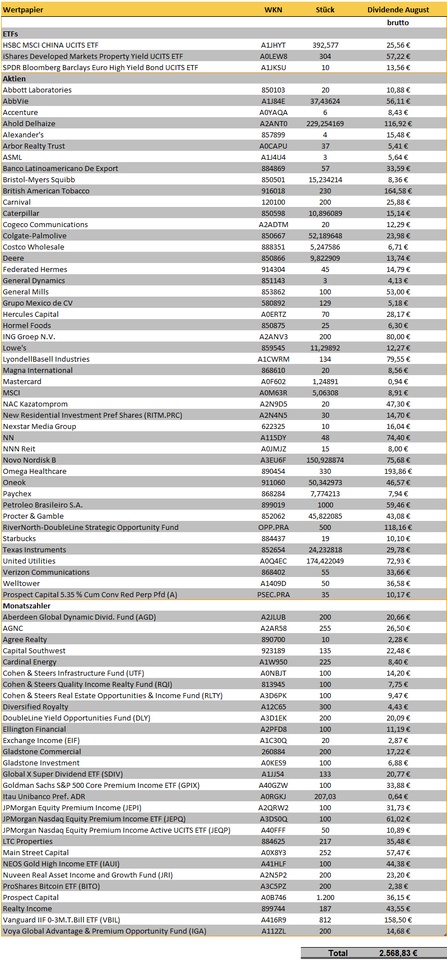
Dividend increases are part of the game
A key component of my long-term dividend growth is, of course, the companies themselves.
In August, 9 companies in my portfolio increased their dividends.
In contrast, there were 3 cuts.
In the case of Honeywell International, however, the cut should be viewed in the context of the spin-off of Honeywell Aerospace. This should be taken into account when assessing the situation and should not simply be equated with a traditional cut to the current dividend.
Below you’ll find a complete overview of the dividend increases and cuts in August.

This brings the total in my annual tally to 89 dividend increases and 13 cuts.
Of course, 13 cuts aren’t ideal.
But that’s exactly why I like the approach of a broadly diversified dividend portfolio: Not every company has to get everything right every year.
Some increase their payouts significantly, others only marginally. Some keep them constant, and for a few, things just go the other way once in a while.
What matters most to me is the total cash flow over many years.
And there, the trend continues to point upward.
My monthly “background noise” serves a specific purpose
Another goal of mine is to continue receiving more than €2,000 in dividends in 2026.
That has worked so far.
However, in a traditional dividend portfolio, payouts aren’t distributed evenly throughout the year. Many companies pay quarterly, which means some months bring in plenty of cash, while others are significantly leaner.
That’s exactly why I’ve been focusing on the “monthly background noise”.
This refers primarily to the payouts from my monthly payers.
My goal for this project is: €1,250 net per month from monthly payers alone.
Why €1,250, of all amounts?
Since September 2026, this has been a pretty concrete figure for me.
I’ve finally ended my career as an employee and now have to pay for my health insurance entirely on my own. Because of my investment income, I fall into the highest tax bracket. The monthly premium is approximately €1,250.
My reasoning behind this is therefore quite simple:
At some point, the monthly income streams should pay for my health insurance.
Not on paper. Not as a theoretical return calculation.
But actually, every month, through their dividends.
I’m still a long way from that right now. But that’s exactly why this project remains on my personal cash flow to-do list.
Because once my health insurance is already being financed each month by the dividends from my monthly income sources, yet another recurring expense in my life is simply covered by my cash flow.
And it’s precisely these small building blocks that make financial freedom tangible for me.
The Evolution of My Dividends Since 2015
The following chart shows how my dividend income has evolved over the years.
The year 2026 is shown in light green. The comparative figures for previous years are color-coded accordingly.
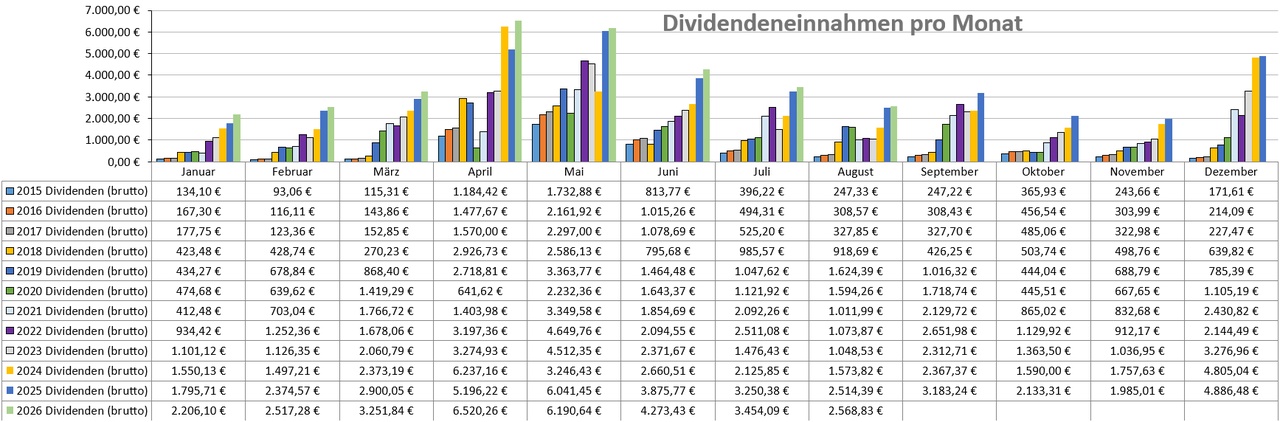
When looking at individual months, there are, of course, frequent fluctuations—some larger, some smaller.
This is primarily due to the different payment schedules of the companies. A quarterly payer simply can’t ensure a steady cash flow every month.
Nevertheless, I like the overall picture.
Because when you take a step back and don’t focus on individual months, the long-term trend becomes quite clear:
Cash flow is growing.
And that’s exactly what matters to me when building my dividend portfolio.
It’s not about collecting exactly the same amount every month.
It’s about ensuring that the dividends continue to grow over many years.
From 2015 to today
The trend becomes even clearer when we aggregate the monthly income into annual figures.
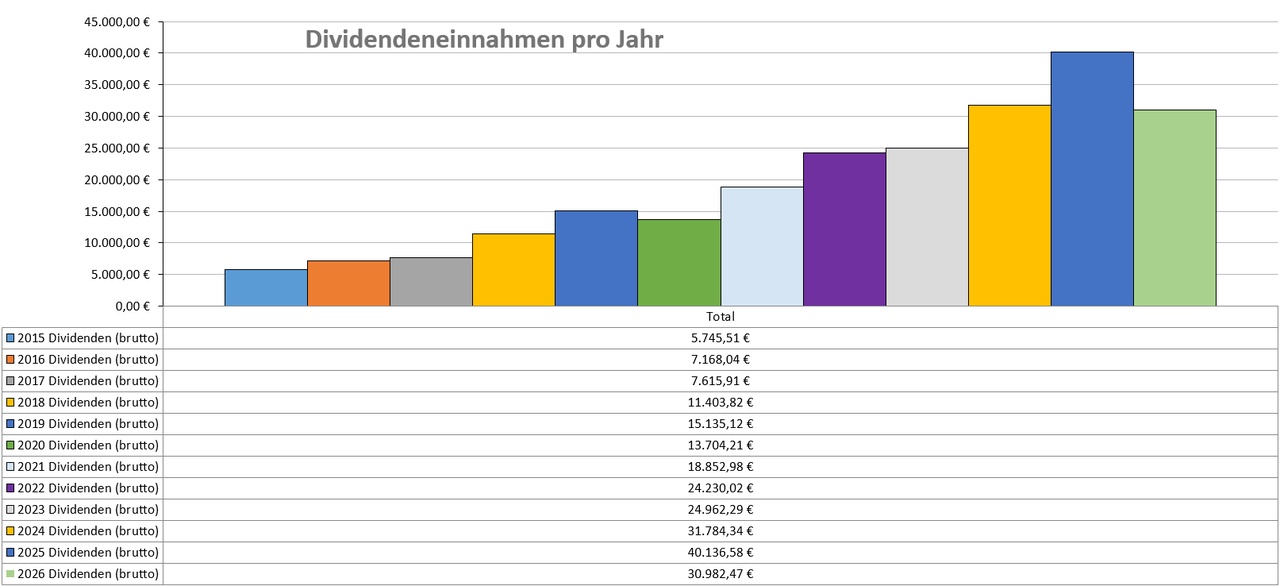
Here you can see quite impressively what can result from long-term wealth accumulation.
Over the years, many small and large dividends have turned into an ever-increasing stream of income.
And the light green bar on the far right?
It’s not finished yet.
After all, there are still four months left.
I’m curious to see where it will end up by the end of the year.
For me, the €50,000 for 2026 isn’t the end of the journey. It’s more like the next milestone.
Because once you’ve experienced how a growing cash flow develops, you quickly find yourself wanting more.
What kind of dividends could my portfolio pay out in the future?
This brings us to a question I find almost even more exciting than the dividends I’ve already received:
How much in dividends can my current portfolio generate in the future?
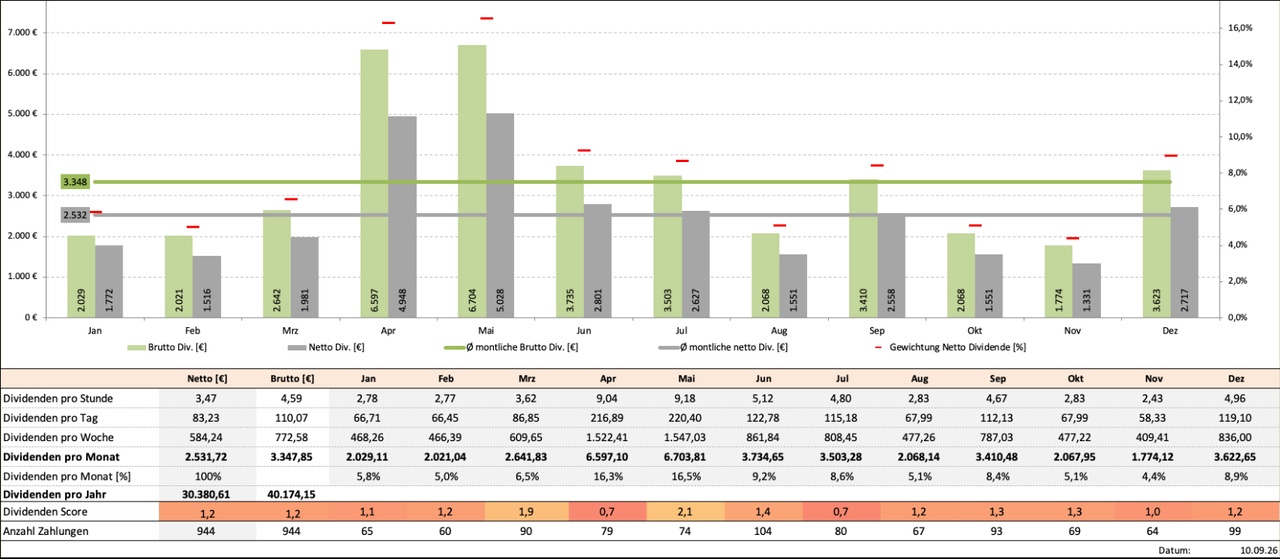
Of course, this calculation has its limitations.
Some CEFs and ETFs cannot be integrated into the tool. For example, my analysis does not include the Vanguard 0-3 Month Treasury Bill ETF (VBIL) and Global X 1-3 Month T-Bill ETF (CLIP).
The actual expected distribution for my entire portfolio is therefore slightly higher.
I also find it interesting to look at the monthly net dividend.
The tool currently shows €2,533.04 in net dividends per month .
And that’s where it gets interesting for me.
Wealth is good. Cash flow is better.
I didn’t build up my portfolio just to see the biggest possible number on the screen someday.
Of course, wealth is important.
But what has always particularly fascinated me about investing is that assets can continuously generate income.
Interest.
Dividends.
Option premiums.
Cash flow.
And it’s precisely this cash flow that creates part of the freedom I’ve built up over many years.
My time as an employee has finally come to an end as of September 2026. Now I can observe even more closely just how far my accumulated wealth and the resulting income will actually take me.
If the projected dividend income from my portfolio already exceeds what I need for my modest lifestyle, that’s a pretty comfortable starting point for me.
And the best part is:
The portfolio keeps generating returns.
Even though I no longer commute to work every morning, my investments continue to pay out.
Companies generate profits. Some of those profits come to me as dividends.
And if I reinvest those dividends, they can grow into even more income-generating assets.
For me, that’s the real appeal of long-term wealth building.
The €50,000 in dividends in 2026 are certainly a nice goal.
But they’re just another milestone.
And while the light green bar for 2026 is still growing, I already have my sights set on the next project:
The monthly background noise needs to get louder.
Because once my monthly income streams eventually pay out €1,250 every month, at least my health insurance will already be covered by a very specific portion of my cash flow.
And then the rest of my portfolio can continue to work for me.


