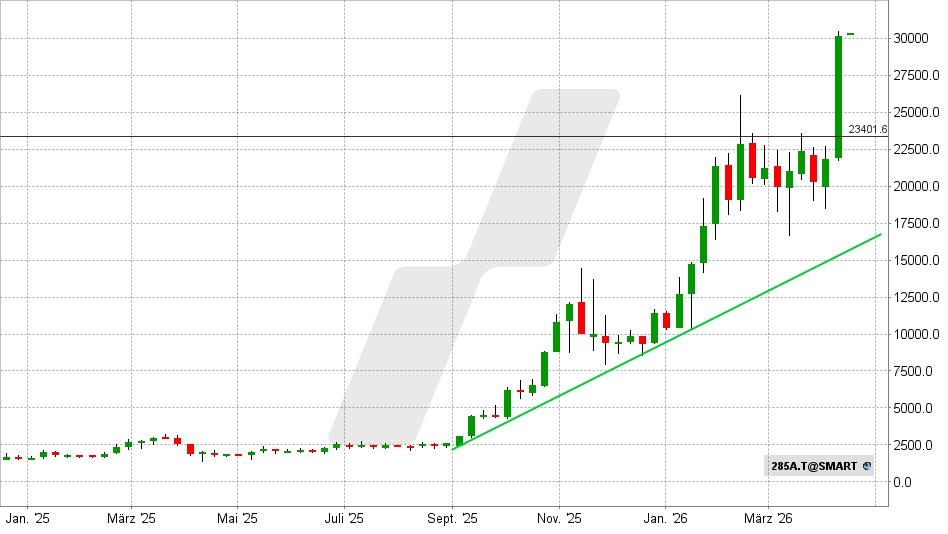
$285A (+4.03%)
$MU (-0.75%)
$WDC (-1.85%)
$005930
The amount of data is growing rapidly and so is the demand for NAND memory. Kioxia supplies it.
From Toshiba heir to global memory player
Kioxia is a highly specialized provider of memory technology. The company emerged from Toshiba's former memory division and is now one of the global key players in the NAND flash market.
NAND flash memory is indispensable today because it stores large amounts of data quickly, energy-efficiently, permanently and without mechanical parts in a space-saving manner. This is precisely what makes it the standard solution in smartphones, laptops, data centers and industrial applications.
The business model is clearly structured: Kioxia does not sell end devices, but rather versatile components.
The product portfolio can be divided into two main areas. Firstly, pure memory chips, such as SLC, MLC, TLC or QLC NAND. These differ in terms of how many bits are stored per memory cell, and therefore in terms of cost, speed and service life. SLC stands for high reliability and is used in industrial or automotive applications, for example, where data integrity is crucial.
Secondly, ready-made memory solutions such as SSDs or embedded memory (eMMC, UFS), which are integrated directly into end devices.
The company's own 3D flash architecture BiCS FLASH is particularly relevant in terms of technology. Here, memory cells are stacked vertically, which massively increases capacity and reduces costs at the same time.
This is particularly relevant for data centers.
Oligopoly with AI booster
Furthermore, the NAND flash market is a global oligopoly. The reason for this lies in the extreme barriers to entry. Setting up modern semiconductor production costs tens of billions. At the same time, the development of memory technology requires decades of experience, in-depth process expertise and close integration of research and production. New competitors have virtually no chance of overcoming these hurdles in the short term.
Added to this are economies of scale. Memory chips are a mass business with strong price competition. Those who do not produce in huge volumes have no chance in competition. This leads to a natural concentration on a few global players.
In this environment, Kioxia is part of a small leading group. Its biggest competitor is Samsung Electronics. Followed by SK Hynixwhich has gained significant weight through the acquisition of Intel's NAND business, and Micron Technology. Western Digital also plays an important role and is closely linked to Kioxia through joint production structures.
All of these companies are currently recording significant increases in profits, driven primarily by the enormous demand for AI hardware.
This has paid off
The Börsengang of Kioxia has therefore proved to be a stroke of luck and has paid off for shareholders. But this could be just the beginning of a success story.
Growth momentum has increased significantly in the first nine months of the current financial year (3/2026). Sales increased by 80% to 1,360 billion yen, which led to a 72% increase in profit to 252 million yen.
This corresponds to a turnover of 7.31 billion euros and a profit of 1.35 billion euros.
Kioxia is expected to present its figures for the final quarter on May 15. It is currently expected that profit will increase by 80% to 932 yen per share. Kioxia therefore has a KGV of 32.7.
At first glance, the share does not look like a bargain. However, as already mentioned, the industry is at a crucial point. Demand is outstripping supply, which has led to full capacity utilization in production and rising prices.
At the same time, a massive expansion of production is underway to keep up with demand.
As a result, Kioxia's profit is likely to roughly quadruple in the current financial year. According to consensus estimates, earnings will rise by 397% to JPY 4,600 per share.
Should this happen, the P/E ratio would fall to 6.6
Kioxia share: Chart from 10.04.2026, price: JPY 30,350 - symbol: 285A | source: TWS
The share is therefore currently unstoppable and from a fundamental perspective there is little to prevent the rally from continuing. The biggest Risiko are the typical price cycles in this sector. NAND flash is largely standardized. When supply and demand collapse, prices often fall dramatically.
Source: