
Today, our search for exciting, lesser-known companies takes us back to Denmark.
There, we came across Schouw & Co $SCHO (+1.01%) — an industrial holding company active in a wide range of sectors, from fish feed to electronics, hydraulics, and technical textiles.
What makes the stock particularly interesting: The group combines a long history with strong current financial results, a solid balance sheet, , and several independent growth stories.
Some companies make headlines every day. Others build value behind the scenes over decades. Schouw & Co clearly belongs to the latter group.
What began as a manufacturer of paper bags founded in 1878 has evolved into a diversified Danish industrial holding company that is now active in fish feed, electronics manufacturing, hydraulics, automotive replacement parts, technical textiles, and sportswear.
It is precisely this mix that makes the stock interesting:
Schouw is not a pure growth stock, not a classic dividend stock, and not a passive conglomerate. Management develops independent industrial companies, invests countercyclically, and seeks to translate operational improvements into sustainably higher cash flows.
Following strong results for the third quarter of 2026 and BioMar’s IPO, this Scandinavian stock—which has received little attention in Germany—deserves a closer look.
So let’s take a closer look at what’s behind this Scandinavian company and whether the stock is still attractive after its recent surge. 🇩🇰📈
As of November 9, 2026 | Reference price: 889 DKK or approximately 119.16 EUR
1 What Does Schouw Do, and How Did the Company Come to Be?
Schouw & Co was founded in Copenhagen in 1878 by Victor Schouw.
Its original business was paper bags. For more than a century, packaging remained the company’s core business. In 1930, a paper mill was added, followed in the 1950s and 1960s by the Pure-Pak business for beverage cartons.
The decisive turning point came in 1988:
Schouw sold 50 percent of its packaging business to Elopak $ELO (-0.37%) and used the proceeds to transform itself from a single packaging manufacturer into a diversified industrial group.
This was followed by investments in P. Grene, Schulstad, and Micon. Through Micon, Schouw also played a significant role in Danish wind power history for a time. Later, NEG, Micon, and Vestas merged to form a global wind power leader.
Since Jens Bjerg Sørensen became CEO in 2000, the group has pursued the strategy
“A bigger and stronger Schouw.”
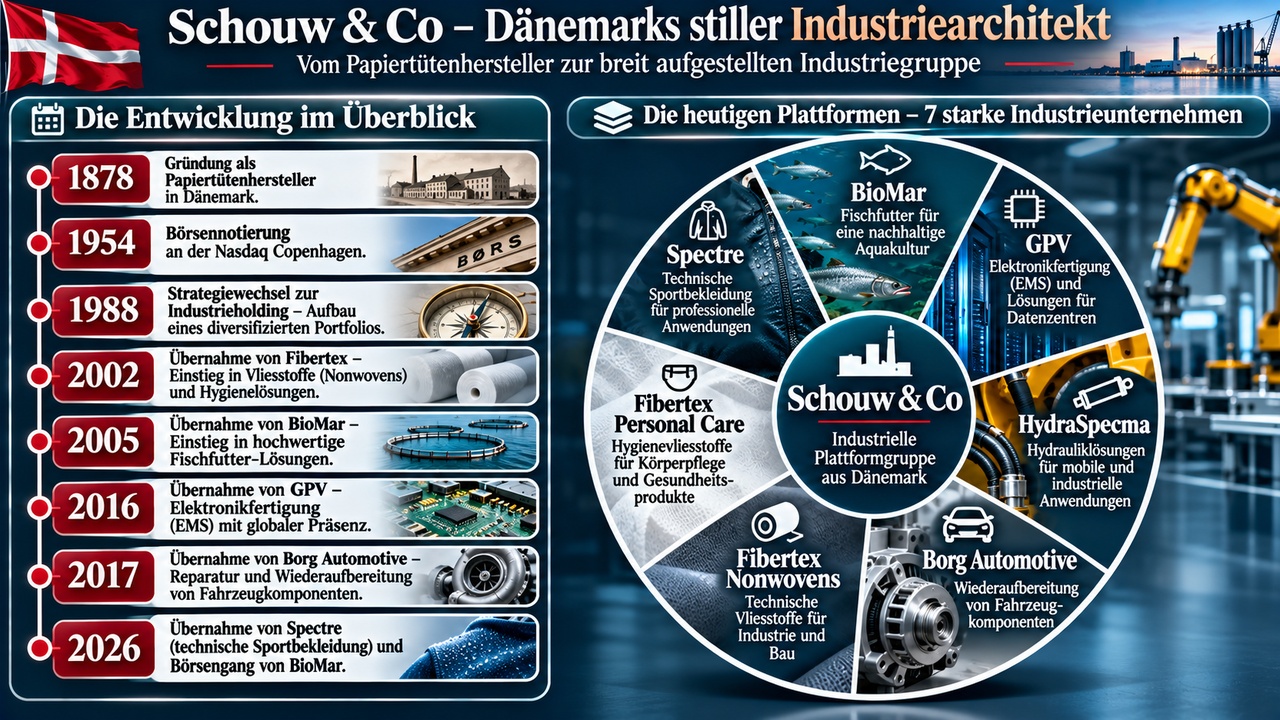
Fibertex was added in 2002, BioMar in 2005, GPV in 2016, Borg Automotive in 2017, and Spectre in 2026. Schouw has been listed on the Copenhagen Stock Exchange since 1954 and now employs more than 15,000 people.
Today, the group consists of seven industrial platforms:
2 Market Position, Moat, and Group Logic
Schouw’s moat does not lie in a single brand. It stems from seven specialized B2B platforms with long-standing customer relationships, technical manufacturing expertise, certifications, global production networks, and decentralized management. The subsidiaries operate independently, while Schouw provides capital, management discipline, and strategic development.
BioMar benefits from formulation expertise, global sourcing, research, and close relationships with aquaculture customers. GPV is rooted in complex electronics and mechatronics solutions where quality, delivery reliability, and certifications are more important than the lowest unit price. HydraSpecma and Fibertex also occupy technical niches where switching suppliers can be costly and risky.
However, the group structure also has disadvantages. A conglomerate is harder to analyze, and weaker segments can obscure the progress of the stronger subsidiaries. BioMar’s partial IPO creates more transparency here: Schouw retains control but gains a visible market value for his largest asset and additional financial flexibility.
3 Shareholder Structure, Free Float, and Tradability
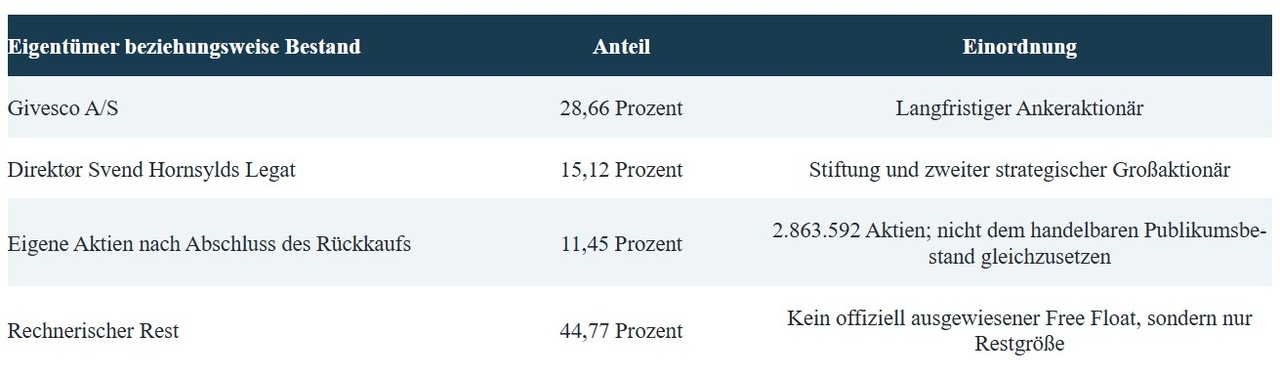
Important: Schouw does not publish a current free float figure defined according to index methodology on its ownership page. The calculated remainder of 44.77 percent should therefore not simply be referred to as the official free float. Similarly, a potential free float says nothing about the actual available liquidity.
The stock is traded on Nasdaq Copenhagen under the ticker symbol SCHO and ISIN DK0010253921. In the daily chart shown here, approximately 12,870 shares were traded. At 889 DKK, this corresponds roughly to 11.4 million DKK or 1.53 million EUR in daily trading volume. This is usually sufficient for retail investors, but significantly less than for a European large-cap stock. The observed bid-ask spread is not reliably documented in the available sources.
4 The Quality Formula
For an industrial conglomerate, a simple quality formula serves only as a rough filter. As a reasonable approximation, I use revenue growth plus operating margin.
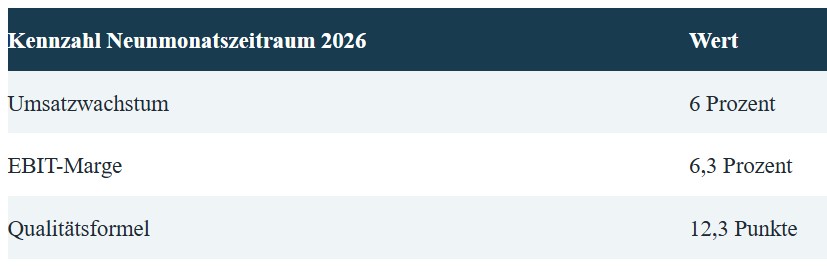
This is solid, but not typical of a software stock with an extremely high margin. The true quality is more evident in the performance: EBIT rose by 32 percent in the first nine months, growing significantly faster than revenue. Operational scalability is therefore much better than the formula alone would suggest.
5 The Cash Flow Quality Formula
As a measure of cash flow, I use operating cash conversion—that is, operating cash flow divided by EBITDA.

The third quarter was strong in terms of cash flow. However, the build-up of working capital weighed on the nine-month period. In addition, large sums were spent on acquisitions and investments, particularly in connection with Spectre. As a result, free cash flow after investments was negative in the first nine months.
6 Dividend Filter
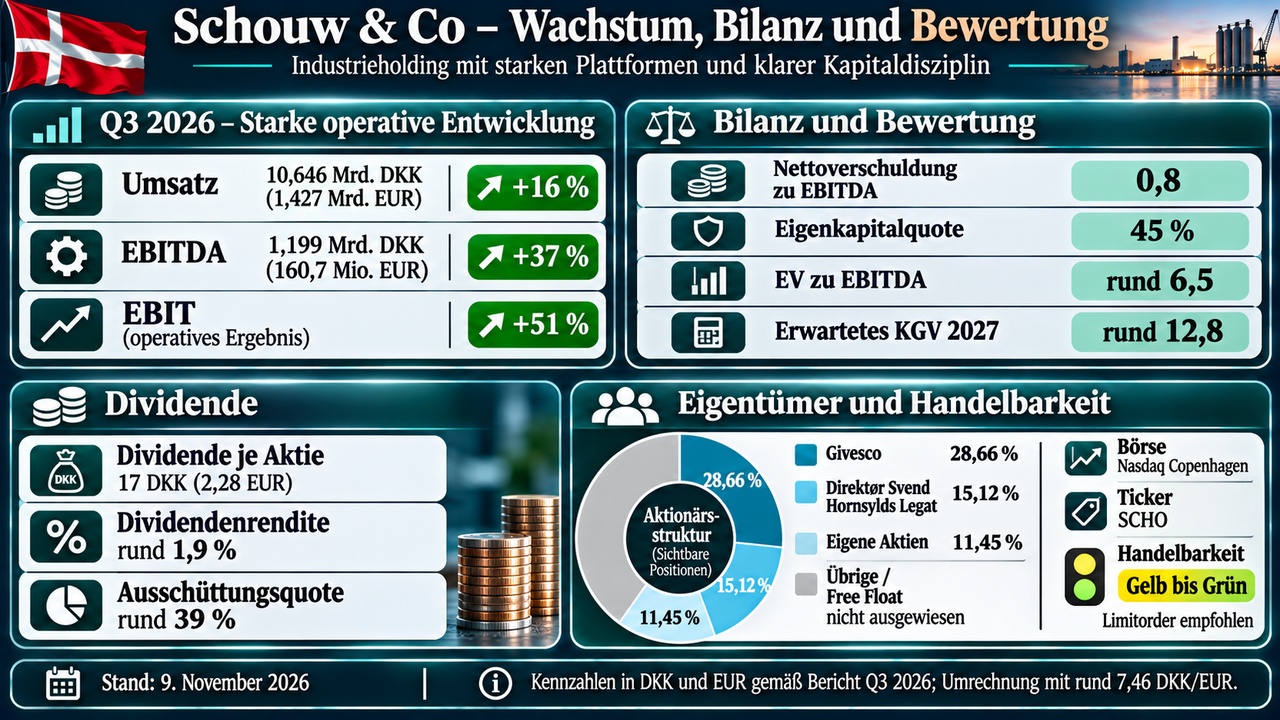
Schouw paid a dividend of 17 DKK per share for fiscal year 2025, equivalent to approximately 2.28 EUR. At a share price of 889 DKK, this results in a yield of about 1.9 percent. The reported payout ratio is approximately 39 percent.
Dividend Yield: Approximately 1.9 percent
Last annual dividend: 17 DKK / approximately 2.28 EUR
Payout ratio: About 39 percent
History: Paid for many years; mostly stable or increasing
Growth: Most recently increased from 16 to 17 DKK
Margin of Safety: Solid, as a large portion of profits remains within the company
7 P/E Ratio and Earnings Growth
The trailing P/E ratio shown by InvestingPro is approximately 20. Based on estimates from only two analysts, the following figures are projected for the coming years:
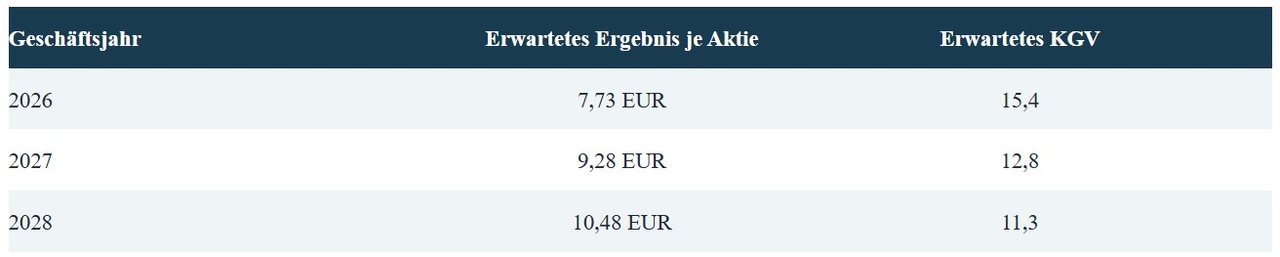
These estimates look attractive, but should not be interpreted as a reliable consensus due to the very small analyst base. On a positive note, earnings grew significantly faster than revenue in the third quarter. Earnings per share rose 52 percent to 23.53 DKK during the quarter.
8 KCV and Free Cash Flow Valuation
The screening shows a free cash flow yield of around 10.4 percent, which would theoretically correspond to a price-to-free-cash-flow ratio of about 9.6. This figure looks favorable but is currently of limited use.
The reason: The 2026 nine-month financial statements include significant investment and acquisition payments. As a result, free cash flow after investments was negative, even though the operating business generated cash. A mechanical P/CF or P/FCF ratio would make the group appear either too cheap or too expensive—depending on the time period selected.
9 P/S, P/B, EV/EBITDA, and Balance Sheet
Based on the current share price and the number of shares after deducting treasury shares, the market capitalization stands at approximately 19.7 billion DKK or 2.64 billion EUR.
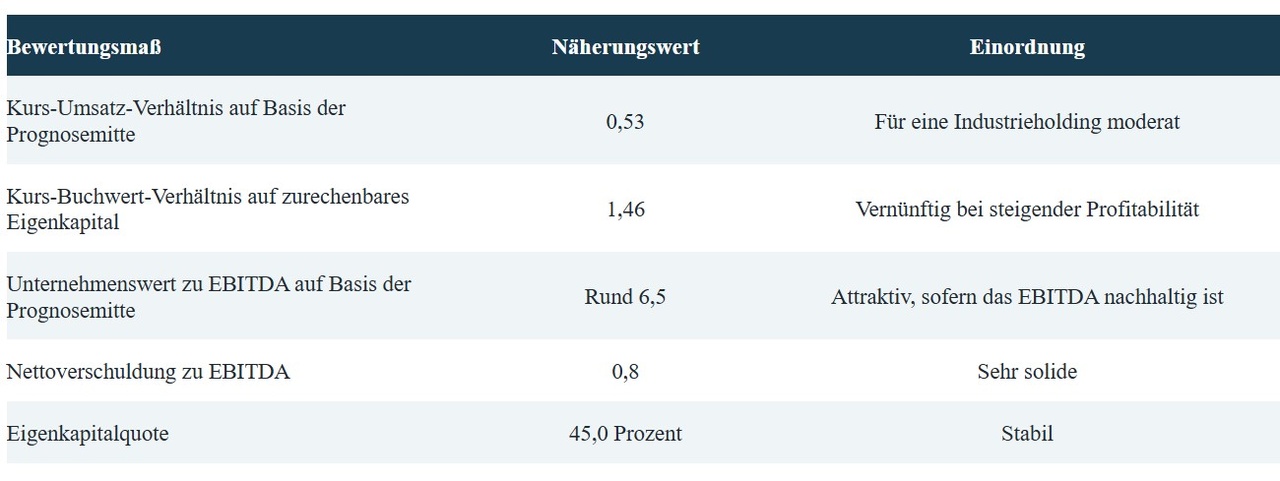
Net debt stood at 2.635 billion DKK, or approximately 353 million EUR, at the end of September. Attributable equity amounted to 13.515 billion DKK, or approximately 1.81 billion EUR. The balance sheet allows for further investments and smaller acquisitions without Schouw appearing to be aggressively leveraged.
10 Current Figures and Operational Drivers
Schouw reported a strong third quarter on November 6, 2026:
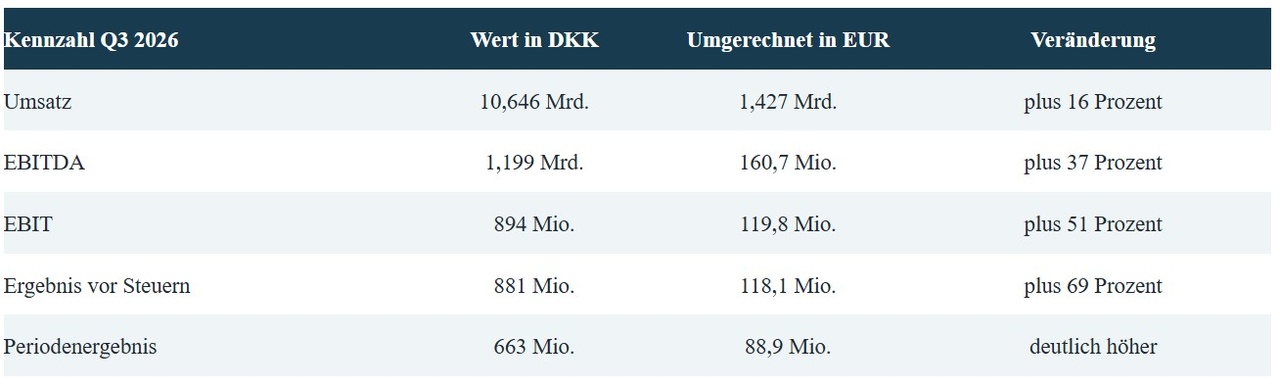
For the full year, Schouw now expects revenue of DKK 36.2 to 38.1 billion, corresponding to approximately EUR 4.85 to 5.11 billion. EBITDA is expected to reach 3.375 to 3.525 billion DKK, or approximately 452 to 473 million EUR.
The key drivers are BioMar, efficiency gains at GPV, growth at Fibertex Nonwovens, and the integration of Spectre.
The BioMar IPO netted Schouw approximately 2.6 to 2.7 billion DKK, while the group retained 74 percent. This reduces debt and makes the value of the group’s most important division more visible to investors.
11 Opportunities and Catalysts
BioMar as a value anchor: The separate stock price makes the value of the largest holding more transparent and could reduce the conglomerate discount.
GPV and data centers: More complex electronics, control systems, and mechatronics for growing infrastructure markets offer additional potential.
Operational Leverage: Even moderate revenue growth led to significantly stronger EBIT growth in 2026.
Fibertex Nonwovens: Specialty technical applications are growing more rapidly than traditional standard nonwovens.
Spectre: The acquisition expands the portfolio to include technical sports and outdoor apparel. If integration is successful, this could give rise to another platform.
Capital Allocation: The proceeds from the BioMar sale, low debt, and share buybacks provide management with several ways to create value per share.
Share Buybacks: The repurchase of treasury shares increases each remaining shareholder’s stake in the company.
12 Risks and What Could Go Wrong
Conglomerate discount: The market may consistently value the complex structure lower than individual pure plays.
Cyclical end markets: GPV, HydraSpecma, Borg, and parts of Fibertex are dependent on investment cycles and industry demand.
BioMar Dependency: Despite diversification, BioMar remains the most significant contributor to earnings. Raw materials, fish prices, animal health, and aquaculture cycles all have an impact.
Borg Automotive: Demand is weak. A prolonged slump or structural changes in the vehicle fleet could weigh on the business.
Integration of Spectre: New platforms take time. In the first month of consolidation, the EBITDA contribution—including acquisition-related effects—was negative.
Working Capital: Growth ties up capital. The weaker cash conversion over the nine-month period must be monitored.
Currency and Raw Materials: The Group manufactures and sells its products worldwide. Exchange rates and prices for plastics, metals, energy, and agricultural commodities affect margins.
Valuation and timing risk: Following the rapid rise in the stock price, a great deal of optimism is already priced in for the short term.
Liquidity: The stock is tradable but is not a highly liquid large-cap stock. During periods of market stress, spreads and slippage may increase.
13 Chart Analysis
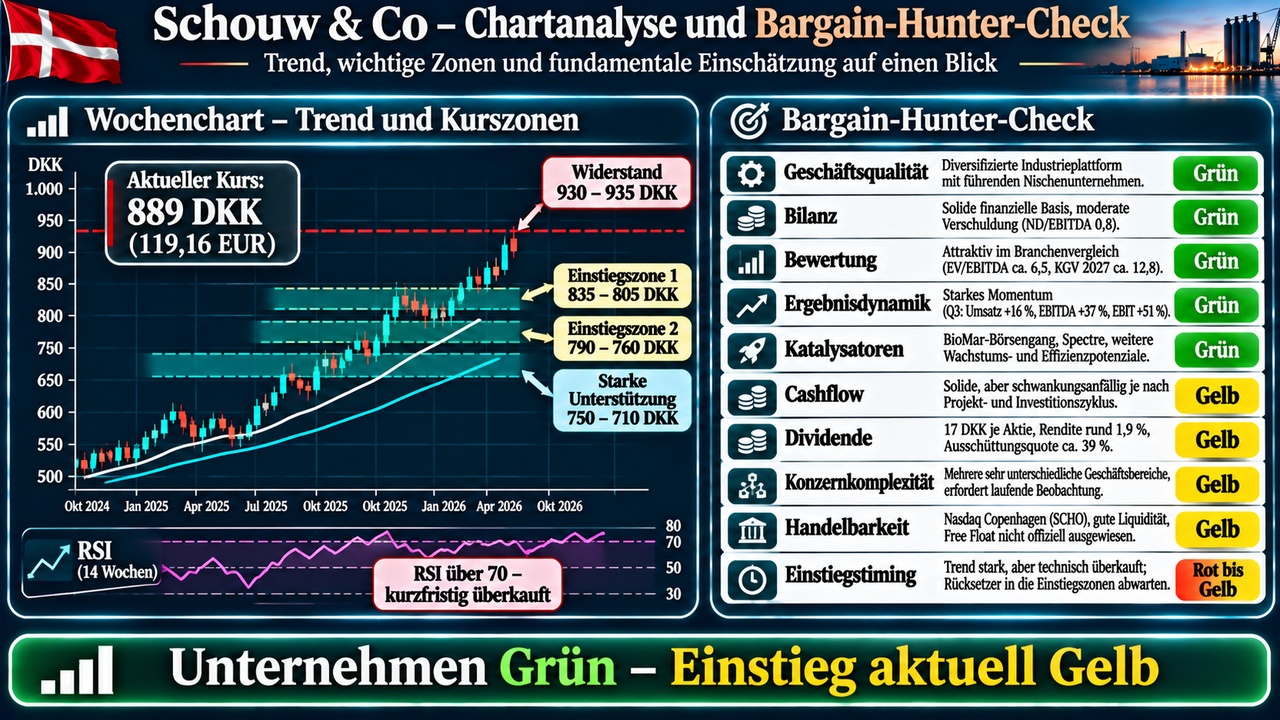
The weekly chart shows an intact long-term uptrend. The price is clearly above the 50- and 200-week moving averages. The recent breakout to 889 DKK was accompanied by a positive MACD. At the same time, the RSI stands at around 79 on the daily chart and is also well above 70 on the weekly chart. The stock is therefore technically overbought.
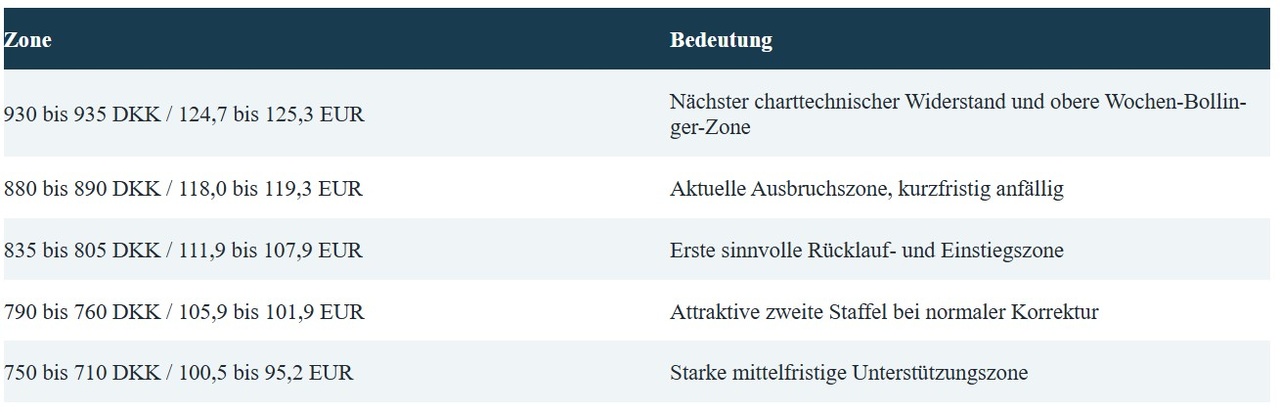
Chart Assessment: The trend is clearly positive, but the risk-reward ratio for an immediate full buy is only moderate. A confirmed breakout above 935 DKK would be a new sign of strength. For long-term investors, a staggered entry on pullbacks seems more reasonable.
14 Bargain Hunters List
Bargain Hunter Result: The company appears undervalued on an enterprise value basis, but after the recent rally, the stock is not a classic short-term bargain. Company quality: about 8 out of 10; current entry timing: about 5 out of 10.
15 My Conclusion and Clear Assessment
Schouw & Co $SCHO (+1.01%) is, in my view, one of the more interesting, yet under-the-radar industrial holding companies in Northern Europe. The group combines solid balance sheet quality, transparent capital allocation, and several specialized market leaders. The Q3 results show that earnings growth is not reliant on a single segment. The BioMar IPO increases transparency and gives Schouw additional financial flexibility.
The chart, in particular, argues against making a large initial investment right away.
At 889 DKK, the stock is overbought following its strong breakout.
Fundamental strength does not protect against a normal correction of ten or fifteen percent.
My clear take:
In the long term, Schouw is a quality candidate worth buying.
Currently, however, I would not buy the full desired position. It makes more sense to either take a small initial position with sufficient liquidity reserves or wait for the 835 to 805 DKK range.
A second tranche would be interesting in the 790 to 760 DKK range. Those who are already invested have no fundamental reason to sell just because of the high RSI following the Q3 results—but should expect short-term pullbacks.
Sources and Data
Schouw & Co Q3 Report dated November 6, 2026: https://ml-eu.globenewswire.com/Resource/Download/d94dc8ac-4ac0-4d6a-acbf-23c999c37576
Schouw & Co Ownership Structure: https://www.schouw.com/investors/ownership
Schouw & Co Company History: https://www.schouw.com/about-us/our-history
Schouw & Co Capital Markets Day and BioMar: https://www.schouw.com/news/capital-markets-day-2026-a-stronger-platform-for-the-next-phase
Stock Buyback on November 9, 2026: https://www.globenewswire.com/news-release/2026/11/09/3398608/0/en/schouw-co-to-initiate-share-buy-back-programme-of-up-to-dkk-75-million.html
User-provided Q2 earnings call: https://de.investing.com/news/transcripts/earnings-call-schouw--co-hebt-nach-breiten-zuwachsen-im-zweiten-quartal-die-prognose-fur-2026-an-93CH-3621398
Investing.com and InvestingPro screenshots provided by the user, as of November 9, 2026
Currency conversion: 1 EUR equals 7.46038 DKK. Rounding differences may occur.
Note: This presentation is a general company analysis and not individual investment advice. Forecasts, analyst estimates, and fair-value models are subject to uncertainty. Prices and financial metrics are subject to change.
and, of course, everyone else :)
