

Verizon stock is one of Wall Street’s biggest dividend payers—and, from a technical analysis perspective, has been trading within a broad sideways range between approximately $41 and $51.6 for months. On November 13, 2026, the stock was trading at $46.38 (Nov. 13, 2026, 7:40 p.m. CET, NYSE), which is about 14% higher than at the start of the year but about 10% lower than the 52-week high of about $51.70 reached in March and September. Verizon pays a quarterly dividend of $0.7075, which amounts to $2.83 annually and represents a yield of approximately 6.1%. At the end of January 2026, the company increased its dividend for the 20th consecutive time. Under new CEO Dan Schulman, operations are performing better than expected: In the third quarter of 2026, Verizon gained 406,000 new contract mobile subscribers, free cash flow rose by 12.1% to $7.8 billion, and the 2026 forecast was raised for the third consecutive time. However, October 9, 2026, weighed on the stock: After SpaceX announced the purchase of mobile spectrum for Starlink Mobile, the stock plummeted by about 10%. Analysts have an average price target of $50.65. From a technical analysis perspective, the stock remains slightly bullish above just under $45; a buy signal with a new monthly high opens up potential up to $51.61.
Key Points
- Dividend: $0.7075 per quarter, $2.83 per year, yield around 6.1% (as of Nov. 13, 2026)
- 20th consecutive dividend increase at the end of January 2026 (+2.5%)
- Q3 2026: 406,000 new contract customers in mobile communications, revenue of $34.3 billion (+1.5%), adjusted earnings per share of $1.31 (+8.3%)
- 2026 forecast raised for the third time: adjusted earnings per share of $5.04 to $5.06
- 2026e P/E ratio around 9, free cash flow after nine months: $18.0 billion
- SpaceX risk: Share price drop of approximately 10% on October 9, 2026
- Analysts: Average price target $50.65 (range $44 to $62)
- Chart levels: Slightly bullish above just under $45, target $51.61; below $44.50, sell signal above $40.92 and $38.46 to $35.45
What are Verizon’s current key metrics?
With a price-to-earnings ratio of around 9 based on 2026 earnings estimates, Verizon stock is attractively valued and offers one of the highest dividend yields among major U.S. corporations at approximately 6.1%.
The market capitalization stands at approximately $192 billion (as of November 13, 2026). However, this is offset by debt of $166.2 billion, which limits the scope for further dividend increases.
- Share price (NYSE: VZ): $46.38 (November 13, 2026, 7:40 p.m. CET)
- 52-week high: approximately $51.7 (March 13 and September 15, 2026)
- 52-week low: approximately $38.7 (January 20, 2026)
- Year-to-date performance: approximately +14% (November 13, 2026)
- Market capitalization: approximately $192 billion (Nov. 13, 2026)
- Revenue for Q3 2026: $34.3 billion (+1.5%) (Oct. 26, 2026)
- Earnings per share for Q3 2026: $1.25 (GAAP) / $1.31 (adjusted, +8.3%) (October 26, 2026)
- New mobile contract customers in Q3 2026: 406,000 (October 26, 2026)
- Free cash flow for Q3 2026 / 9 months: $7.8 billion (+12.1%) / $18.0 billion (October 26, 2026)
- 2026 Forecast Adjusted Earnings Per Share: $5.04 to $5.06 (+7% to 7.5%) (Oct. 26, 2026)
- P/E ratio 2026e / 2027e: approx. 9.2 / approx. 8.8 (analyst consensus)
- Quarterly / annual dividend: $0.7075 / $2.83 (since Q1 2026)
- Dividend yield: approximately 6.1% (November 13, 2026)
- Total debt / net debt-to-EBITDA ratio: $166.2 billion / 2.3x adjusted EBITDA (September 30, 2026)
- Fair value at end of 2026 / end of 2027: approximately $53.20 / approximately $55.70 (Aktienfinder, Nov. 13, 2026)
- Average analyst price target: $50.65 (range: $44 to $62) (November 13, 2026)
- Next Date: Q4 2026 earnings expected in late January 2027 (not yet confirmed)
- WKN / ISIN / Ticker: 868402 / US92343V1044 / VZ (—)
What news is currently driving Verizon stock?
Two main factors are currently driving Verizon stock: strong subscriber growth under new CEO Dan Schulman and concerns about SpaceX as a new mobile communications competitor.
On October 9, 2026, SpaceX announced the purchase of a nationwide spectrum package in the 800-MHz band for its Starlink Mobile service—Verizon stock subsequently plummeted by about 10% to $41.65, marking the weakest trading day since 2002, according to TIKR. Approval from the U.S. Federal Communications Commission (FCC) is still pending. Since then, the stock has recovered well: The third-quarter results released on October 26 showed the best third quarter for contract customers in five years, even though revenue fell slightly short of expectations. To learn how Elon Musk’s space company plans to expand Starlink into a mobile communications powerhouse, read my analysis of SpaceX Aktie.
- November 10, 2026 – Recovery Continues: Verizon stock has gained about 11% since the SpaceX shock on October 9, 2026, and closed at $46.31. The next dividend announcement is expected in early December. (Bullish)
- November 2, 2026 – Dividend paid: Verizon is paying $0.7075 per share to all shareholders of record as of October 9, 2026. The amount has remained unchanged since the first quarter of 2026. (Neutral)
- October 27, 2026 – Analysts slightly lower price targets: Citigroup ($53, Buy), TD Cowen ($55, Buy), Morgan Stanley ($50, Equal Weight), Goldman Sachs ($47, Buy), and Barclays ($44, Equal Weight) adjust their targets following the earnings report. (Neutral)
- October 26, 2026 – Q3 results and third forecast upgrade: 406,000 new contract customers in mobile communications, adjusted earnings per share of $1.31 (+8.3%), free cash flow of $7.8 billion (+12.1%). Revenue of $34.3 billion was slightly below expectations; the stock fell 3.5%. (Bullish)
- October 9, 2026 – SpaceX shock: SpaceX purchases mobile spectrum in the 800 MHz band for Starlink Mobile. Verizon stock plunges by about 10% to $41.65; Scotiabank lowers its price target from $51.50 to $50. (Bearish)
- September 9, 2026 – Dividend Confirmed: Verizon confirms the quarterly dividend of $0.7075, payable on November 2, 2026. (Neutral)
What does Verizon’s management say about the quarterly results?
Verizon CEO Dan Schulman speaks of another record quarter and raised the 2026 forecast for the third consecutive time on October 26.
His key message: Verizon is just one year into a multi-year growth story. Instead of relying on high cell phone subsidies, the company is attracting customers with simpler plans and an expanded loyalty program.
What went well: With 406,000 new contract customers in mobile, Verizon posted its best third quarter in five years. The churn rate fell to 0.94% per month. In broadband, 314,000 new connections were added, including 159,000 via fixed wireless access and 155,000 via fiber optics. Adjusted EBITDA rose 8.0% to $13.8 billion, with the margin reaching a record 40.2%. Free cash flow climbed 14.3% to $18.0 billion after nine months.
The catch: Revenue grew by only 1.5% to $34.3 billion, falling slightly short of analysts’ estimates. Total debt has risen to $166.2 billion as a result of the acquisition of Frontier Communications, which was completed on January 20, 2026. The net debt-to-EBITDA ratio stands at 2.3 times adjusted EBITDA. Added to this is new competition from SpaceX, the effects of which will not become apparent for several years.
Outlook: For 2026, Verizon now expects 1.1 to 1.2 million new mobile contract customers, adjusted earnings per share of $5.04 to $5.06 (+7 to 7.5%), and free cash flow growth of nearly 12%. Capital expenditures are expected to remain unchanged at $16.0 to $16.5 billion. Verizon plans to allocate up to $4.5 billion for share buybacks in 2026, of which $4.0 billion has already been executed.
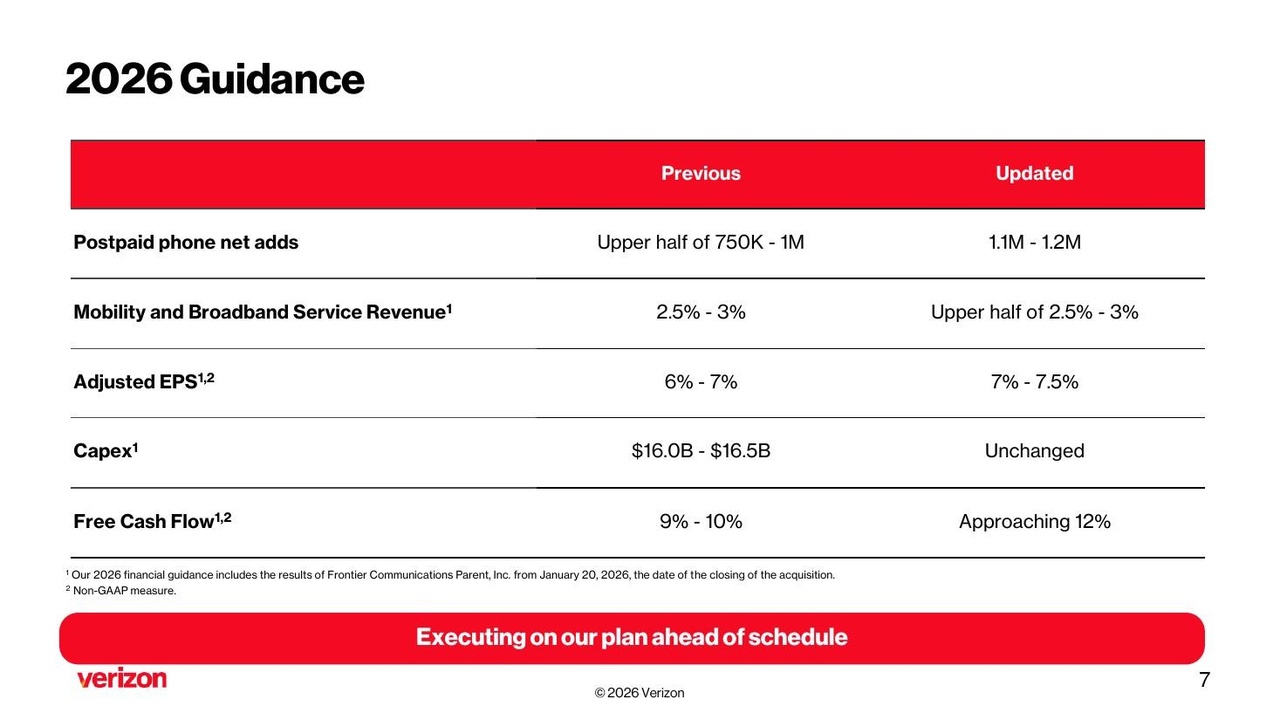
Revised 2026 Forecast for Verizon Stock (VZ) Following the Third Quarter (as of Nov. 13, 2026) – Source: Verizon Investor Relations / Christian Lill
What is Verizon?
Verizon (officially Verizon Communications Inc.) is one of the largest mobile and telecommunications companies in the U.S., headquartered in New York, and generated revenue of $138.2 billion in 2025.
The company was formed on June 30, 2000, through the merger of Bell Atlantic and GTE. The name is a combination of the Latin words “Veritas” (truth, reliability) and “Horizon” (horizon, foresight). Dan Schulman, the former CEO of PayPal, has led the company since October 2025. Verizon stock is listed on the New York Stock Exchange under the ticker symbol VZ.
Consumer (Residential Customers): In 2025, approximately 77% of revenue—totaling $106.8 billion—came from the consumer business. This includes mobile phone plans with a fixed monthly price, prepaid plans, smartphones and accessories, as well as internet via fiber optics (Fios) and via the 5G network (Fixed Wireless Access). Since January 20, 2026, the fiber-optic provider Frontier Communications has also been part of Verizon.
Business (Business Customers): The business customer segment generated approximately $29.1 billion in revenue in 2025. Verizon provides businesses and government agencies with mobile services, networks, cloud and security solutions, and applications for the Internet of Things.
How Verizon Makes Money: The business model relies on recurring monthly fees. Every contract customer pays month after month, and that is precisely what makes the cash flow so stable and the high dividend possible in the first place. The most important metrics are therefore new contract customers and the churn rate. Deutsche Telekom, which—through its subsidiary T-Mobile US—is Verizon’s fiercest competitor in the U.S., follows a similar model—more on this in my analysis of Deutsche Telekom Aktie.
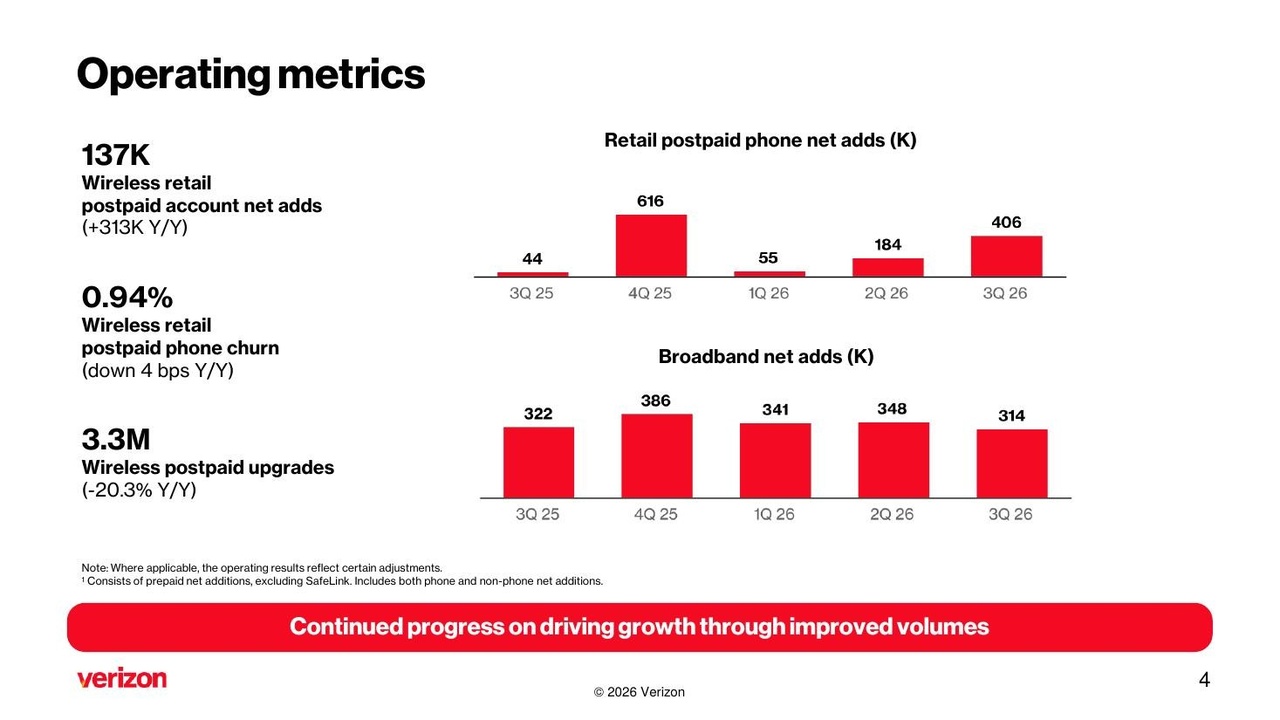
Customer growth for Verizon stock (VZ) in the third quarter of 2026 (as of November 13, 2026) – Source: Verizon Investor Relations / Christian Lill
How much does Verizon pay in dividends?
Verizon currently pays a dividend of $0.7075 per share per quarter, or $2.83 per year—at a share price of $46.38 on November 13, 2026, this corresponds to a dividend yield of approximately 6.1%.
The dividend is paid four times a year, in early February, May, August, and November.
20 Consecutive Increases: In late January 2026, Verizon raised its quarterly dividend by 2.5% from $0.69 to $0.7075—its 20th consecutive increase. The increases are traditionally small, but they are reliable. Verizon is not yet a dividend aristocrat; that requires 25 consecutive years. CEO Dan Schulman describes the company’s commitment to the dividend as “unwavering.”
Is the dividend secure? In the first nine months of 2026, Verizon paid $8.8 billion in dividends on free cash flow of $18.0 billion. The dividend thus consumes only about 49% of free cash flow; the remainder goes toward share buybacks and debt reduction. In terms of earnings, the payout ratio stands at approximately 56% of adjusted earnings per share of $5.05 (midpoint of the 2026 forecast).
Upcoming Dates: Verizon typically announces the next dividend in early December. Last year, the record date was January 12 and the payment date was February 2. The next payment is therefore expected in early February 2027. Whether Verizon will raise the dividend again at that time remains to be seen—the most recent increases came in September 2025 and late January 2026. If you’d like to compare dividend stocks with a completely different profile, check out my analysis of McDonald's Aktie a “dividend king” that has been increasing its payout year after year for decades.
- Q1 2026: $0.7075 | Record date: April 10, 2026 | Early May 2026
- Q2 2026: $0.7075 | Record date: July 10, 2026 | August 3, 2026
- Q3 2026: 0.7075 USD | Record date: October 9, 2026 | November 2, 2026
- Q4 2026: 0.7075 USD (expected) | Record date: expected mid-January 2027 | expected early February 2027
- Quarterly dividend following the increase at the end of January 2026: 0.7075 USD (+2.5%) | Record date: — | 2.83 USD per year, yield approximately 6.1%
- Quarterly dividend starting in September 2025: $0.69 (+1.8%) | Record date: — | $2.76 per year
- Quarterly dividend starting in September 2024: $0.6775 (+1.9%) | Record date: — | $2.71 per year
- Quarterly dividend starting in September 2023: $0.665 (+1.9%) | Record date: — | $2.66 per year
Verizon Stock Fundamental Analysis: Is Verizon Stock Undervalued?
With a P/E ratio of about 9.2 based on 2026 earnings and about 8.8 based on estimates for 2027, Verizon stock is trading at a lower valuation than its own ten-year average of about 10.5 — the discount primarily reflects the high debt and low revenue growth.
For a dividend stock, this is a solid starting point.
Growth: Verizon is not a growth stock. Revenue rose by only 2.5% to $138.2 billion in 2025 and by 1.5% in the third quarter of 2026. Analysts expect revenue of approximately $140.2 billion for 2026 and approximately $142.8 billion for 2027. More important is earnings: Adjusted earnings per share are expected to rise by 7 to 7.5% to $5.04 to $5.06 in 2026, and analysts expect around $5.29 for 2027.
Margins and Cash Flow: The adjusted EBITDA margin reached a record high of 40.2% in the third quarter. Operating cash flow stood at $29.9 billion after nine months; after capital expenditures of $11.9 billion, free cash flow totaled $18.0 billion. That is more than enough to cover dividends and share buybacks.
Balance Sheet: Debt remains the weak point. Total debt rose to $166.2 billion due to the Frontier acquisition; unsecured net debt stood at $123.7 billion at the end of September, representing 2.3 times adjusted EBITDA. My analysis of Vonovia Aktie.
Fair Value: Based on adjusted earnings and historical valuation, the Stock Finder calculates a fair value of approximately $53.20 at the end of 2026 and approximately $55.70 at the end of 2027. Compared to the current price of $46.38, this represents a discount of approximately 13 to 17%.
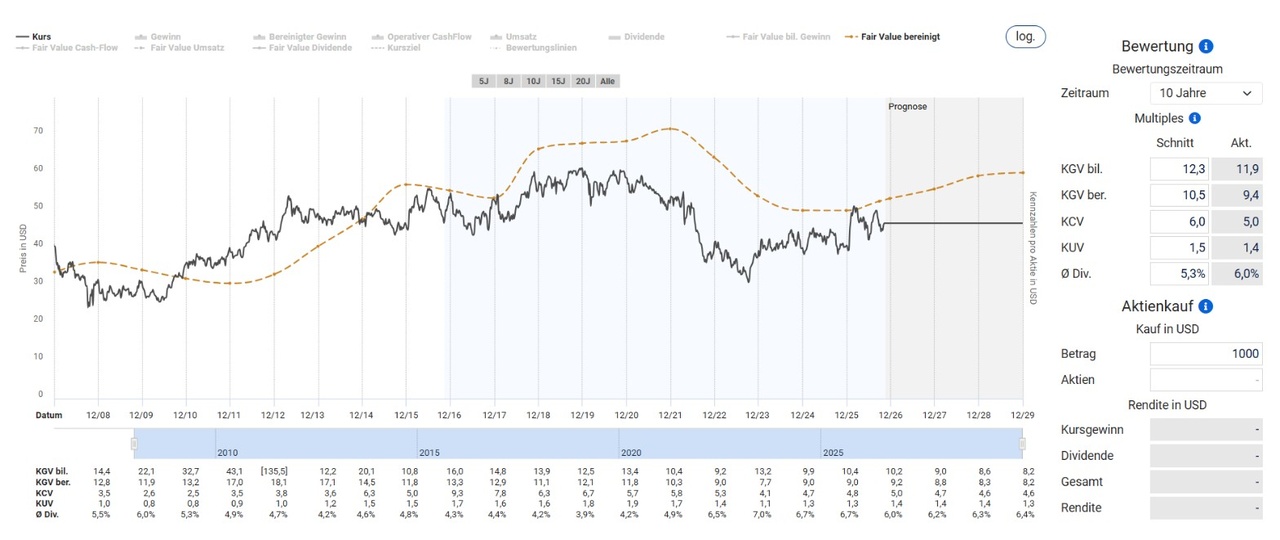
Fair Value of Verizon Stock (VZ) in 2027 (as of Nov. 13, 2026) – Source: Stock Finder / Christian Lill
Verizon Stock Price Targets and Forecast for 2027
Analysts see an average price target of $50.65 for Verizon stock, representing about 9% upside potential – From a technical analysis perspective, a new monthly high could lead to a rise to the upper end of the range at $51.61; however, a drop below $44.50 would trigger a sell signal, with support levels at $40.92, $38.46, and $35.45.
Above just under $45, I rate the stock as slightly bullish.
Key price levels:
- 52-week high: around $51.70 (March 13 and September 15, 2026)
- Current price: $46.38 (Nov. 13, 2026, 7:40 p.m. CET, NYSE)
- Resistance and price target upon a buy signal: upper range boundary at $51.61
- Slightly bullish above: just under $45 (support zone around $45.32)
- Critical support level: $44.50 (below this, a sell signal: initially $40.92, then $38.46, target $35.45)
Analyst price targets:
- Average price target: $50.65 (range $44 to $62, as of Nov. 13, 2026)
- TD Cowen: Buy, $55 (October 27, 2026)
- Citigroup: Buy, $53 (October 27, 2026)
- Morgan Stanley: Equal Weight, $50 (October 27, 2026)
- Goldman Sachs: Buy, $47 (October 27, 2026)
- Barclays: Equal Weight, $44 (October 27, 2026)
Chart Analysis:
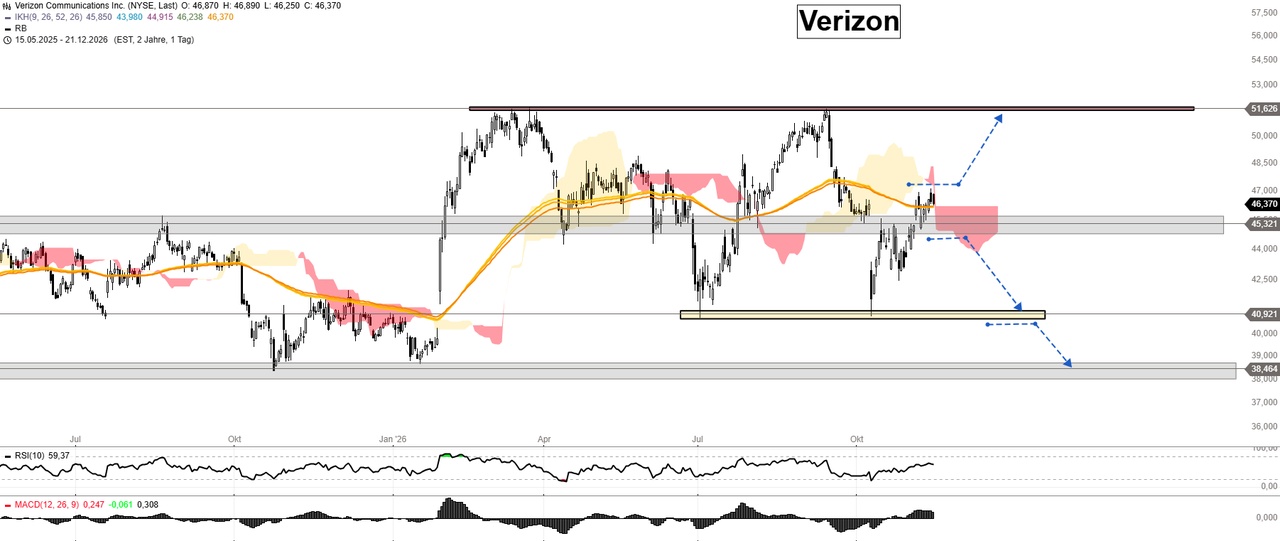
Verizon Stock (VZ) Chart Analysis and Price Targets for 2027 (as of Nov. 13, 2026) – Source: Stock3 / Christian Lill
Verizon stock has been trading sideways on the daily chart for months. Since the breakout in early February 2026, the price has been moving within a wide range between the support level at $40.92 and the upper range boundary at $51.61, where the stock turned downward in both March and September 2026. The stock is not currently showing a clear trend.
The slightly bullish zone: As long as Verizon stock trades above just under $45, I consider it slightly bullish. There is an important gray support zone around $45.32, which the price reclaimed in early November. The RSI stands at around 59, placing it in the neutral to slightly positive range, while the MACD is hovering just above the zero line.
The buy signal (blue arrow): A buy signal becomes possible as soon as the stock reaches a new monthly high. From there, a rise to the upper range boundary of $51.61 is possible—representing a potential gain of just over 11% from current levels.
The sell signal (blue, dotted downward arrow): Should the price sustainably fall below the $44.50 mark, it will initially head toward the yellow support zone at $40.92. The stock rebounded from that level in July and October 2026.
The downside target: If support at $40.92 also fails to hold, the next target is the gray zone around $38.46—where the lows from fall 2025 and January 2026 were recorded. The likely target for the sell signal is $35.45.
Conclusion: Should you buy or sell Verizon stock?
With a dividend yield of about 6.1%, a P/E ratio of around 9, and three consecutive earnings forecast upgrades, Verizon stock is a solid dividend play—but from a technical analysis perspective, there is no clear trend, a buy signal will only emerge with a new monthly high and a target of $51.61.
Factors in Verizon’s favor include its strongly rising free cash flow, 20 consecutive dividend increases, the best customer numbers in years, and a discount to fair value. Anyone looking for a dividend stock from a completely different industry should also take a look at my analysis of Münchener Rück Aktie .
Factors working against the stock include high debt of $166.2 billion, weak revenue growth of 1.5%, and new competition from SpaceX, which caused a price drop of about 10% on October 9, 2026. From a technical analysis perspective, the stock remains slightly bullish above just under $45. If the $44.50 level is sustainably breached, a sell signal will emerge: The stock will initially head toward support at $40.92, and below that, the zone around $38.46; the likely target is $35.45.
✅ Opportunities
- Dividend yield of around 6.1%, 20 consecutive increases
- Dividends account for only about 49% of free cash flow
- Q3 2026: 406,000 new contract customers, best third quarter in five years
- 2026 forecast raised three times in a row; earnings per share +7% to 7.5%
- 2026e P/E ratio around 9; fair value according to Aktienfinder around $53 to $56
- Buy signal with a new monthly high; target price: $51.61
⚠️ Risks
- Total debt of $166.2 billion following the Frontier acquisition
- Revenue growth of only 1.5% in the third quarter of 2026
- SpaceX plans to launch its own mobile service, Starlink Mobile
- Fierce price competition with T-Mobile US and AT&T
- Small dividend increases, most recently 2.5% per year
- Below $44.50: Sell signal with a target of $35.45
Sources
- Verizon News Center: Third-Quarter 2026 Results (October 26, 2026)
- Verizon Investor Relations: Earnings Presentation and Financial Reports for Q3 2026 (October 26, 2026)
- Verizon News Center: Dividend Announcement dated September 9, 2026
- Verizon News Center: Dividend Announcement dated June 4, 2026
- Verizon Corporate History (Company History, Origin of Name)
- Analyst price targets as of October 27, 2026, according to MarketScreener and Beinsure (October 29, 2026); Consensus price target according to MarketScreener and TIKR (November 10, 2026); Ratings according to Financial Modeling Prep
- SpaceX spectrum acquisition and stock price reaction as of October 9, 2026, according to Financial Modeling Prep and TIKR (November 10, 2026); January 2026 dividend increase according to TIKR and Rallies.ai
- NYSE prices: Financial Modeling Prep and Google Finance (November 13, 2026, 7:40 p.m. CET); Analyst estimates for 2026 through 2030: Financial Modeling Prep
- Stock3: Verizon daily chart (NYSE, USD), as of November 13, 2026
- Stock Finder: Fair value calculation (adjusted earnings), valuation metrics, and segment revenue for Verizon, as of November 13, 2026
This is not investment advice—all information is provided solely for financial education purposes.
What are your current thoughts on $VZ (+0.55%)?